Euro Stablecoins Have Entered DeFi—What Are Other Local Currencies Waiting For?
TechFlow Selected TechFlow Selected
Euro Stablecoins Have Entered DeFi—What Are Other Local Currencies Waiting For?
90% of non-USD transaction volume is contributed by euro-pegged stablecoins, while other local currencies are currently used almost exclusively for payment settlements.
 Navigating Web3 tides with focused insights
Author: Prathik Desai / The Token Dispatch
Translated by TechFlow
TechFlow Intro: This article uses data to clarify a commonly misunderstood issue: non-USD stablecoins are not a monolithic category—euro-pegged stablecoins and other local-currency stablecoins follow entirely divergent paths.
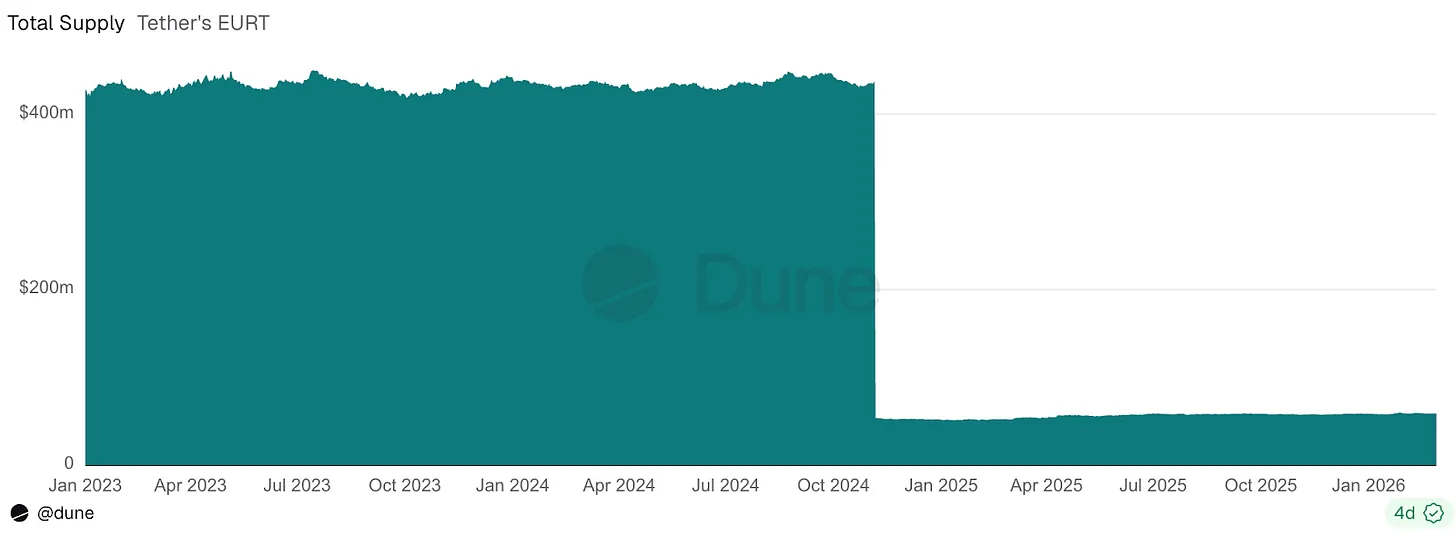
EURT was effectively killed off by the EU’s Markets in Crypto-Assets (MiCA) regulation—but this, paradoxically, spurred market-wide rebuilding: its supply has nearly tripled since 2023.
More critically, the analysis reveals that euro-pegged stablecoins account for 90% of all non-USD transaction volume, while other local-currency stablecoins are currently used almost exclusively for payments and settlements. DeFi integration is the next phase—not the present reality.
Full Text Below:
Money only becomes truly useful once it reaches its destination. Wages earned overseas must pass through banks, foreign exchange desks, payment partners, and local compliance checks before they can be used back home to pay rent, tuition, utilities, and groceries. Until then, it is merely value in motion—not yet a medium of exchange.
The same problem now exists on-chain. Stablecoins move funds globally via code, but their practical utility depends on where they can plug in, who is permitted to use them, and what rules govern their reserves and redemptions.
This concept struck me forcefully while reviewing Dune’s report, “Beyond De-Dollarization: The Rise of Local-Currency Stablecoins.”
In today’s quantitative analysis, I’ll explain the factors driving growth in non-USD, local-currency-pegged stablecoins.
Regulation’s Bite
The clearest example of regulatory impact occurred with Tether’s euro-pegged stablecoin. In 2024, the European Union’s Markets in Crypto-Assets (MiCA) regulation officially entered into force—and almost immediately sealed the fate of EURT.
EURT had been one of the earliest and largest non-USD stablecoins; its circulating supply plummeted from over $400 million to roughly $50 million. As a result, the total supply of local-currency stablecoins dropped from $1 billion to $350 million.
Crypto enthusiasts often assume code alone is sufficient. They launch a token, inject liquidity, and expect the market to do the rest. But non-USD stablecoins are not abstract internet money. They aim to be better digital versions of euros, yen, baht, and other local currencies—capable of flowing on public rails without being constrained by banking hours. Yet they operate within domestic financial systems, subject to reserve requirements, licensing regimes, payment networks, and redemption expectations.
EURT’s shutdown reminds us that first-mover advantage and scale alone are insufficient. A single change in the domestic rulebook can erase all of a pioneer’s advantages.
Yet regulation is not universally harmful to stablecoins. If it were, non-USD stablecoins would likely have stalled after EURT’s exit.
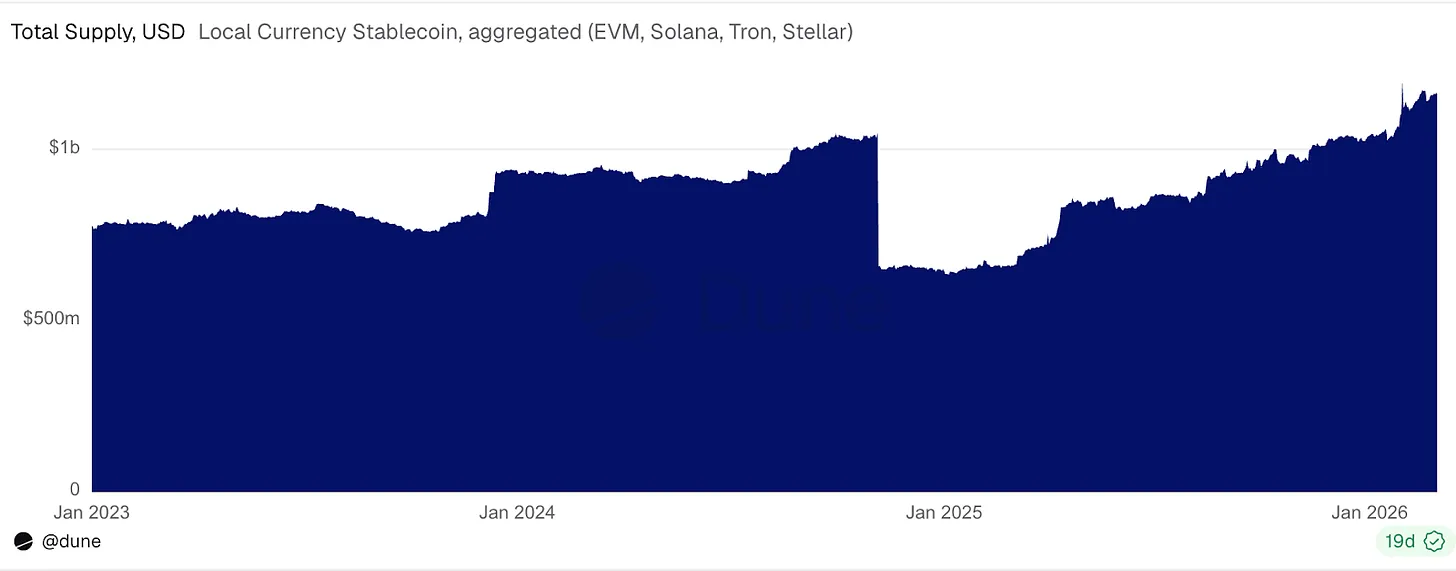
Excluding EURT, the total supply of non-USD stablecoins grew from approximately $350 million in January 2023 to $1.1 billion by February 2026—nearly tripling.
The Market Is Expanding
Alongside this supply growth, the number of addresses holding such stablecoin balances rose from roughly 42,000 to over 1.2 million during the same period.
Monthly transaction volume increased from $600 million to $10 billion—a 16-fold rise. The number of monthly sending addresses surged 22-fold, from ~6,000 to 135,000.
Both holder and sender growth outpaced supply growth—indicating market expansion driven by rising participation.
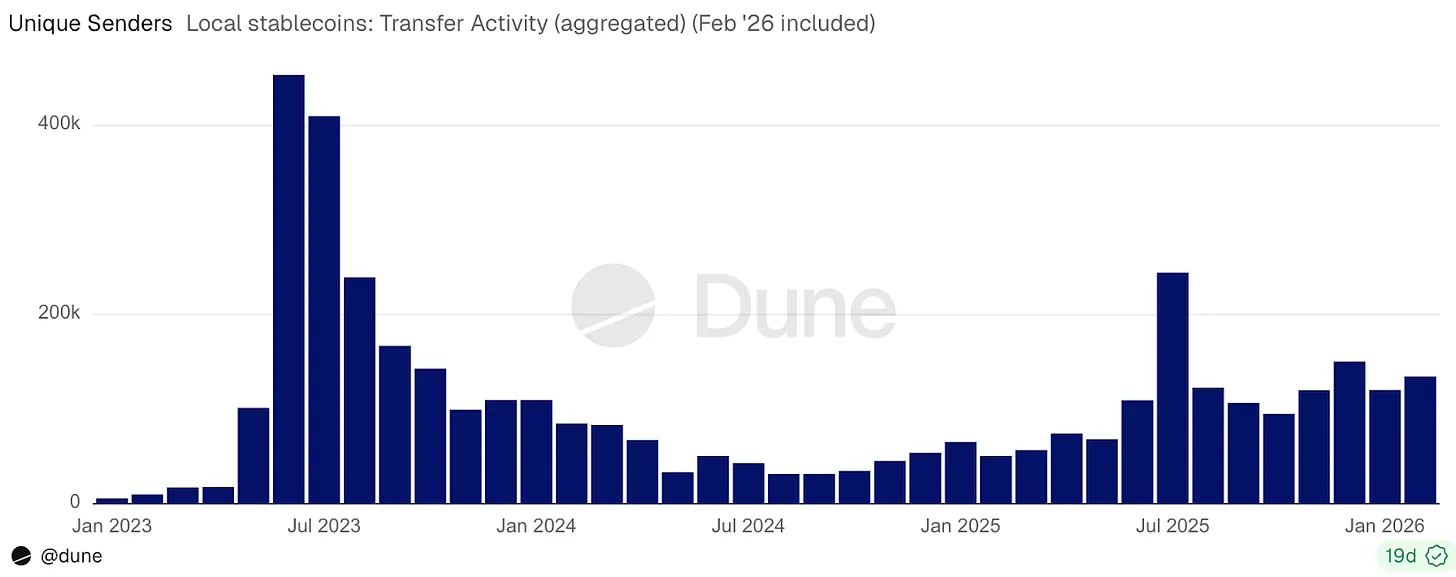
Thus, regulation does not always harm markets—as it did with EURT—in this case, it attracted more stablecoin issuers and users.
Where Non-USD Funds Are Flowing
By early 2026, “unidentified” transfers accounted for 38% of total local-currency stablecoin transaction activity. This likely reflects payments and settlement flows—including peer-to-peer transfers and movements from self-custodied wallets to payment service providers.
Next came lending (29%), DEX activity (17%), and centralized exchange-related flows (14%).
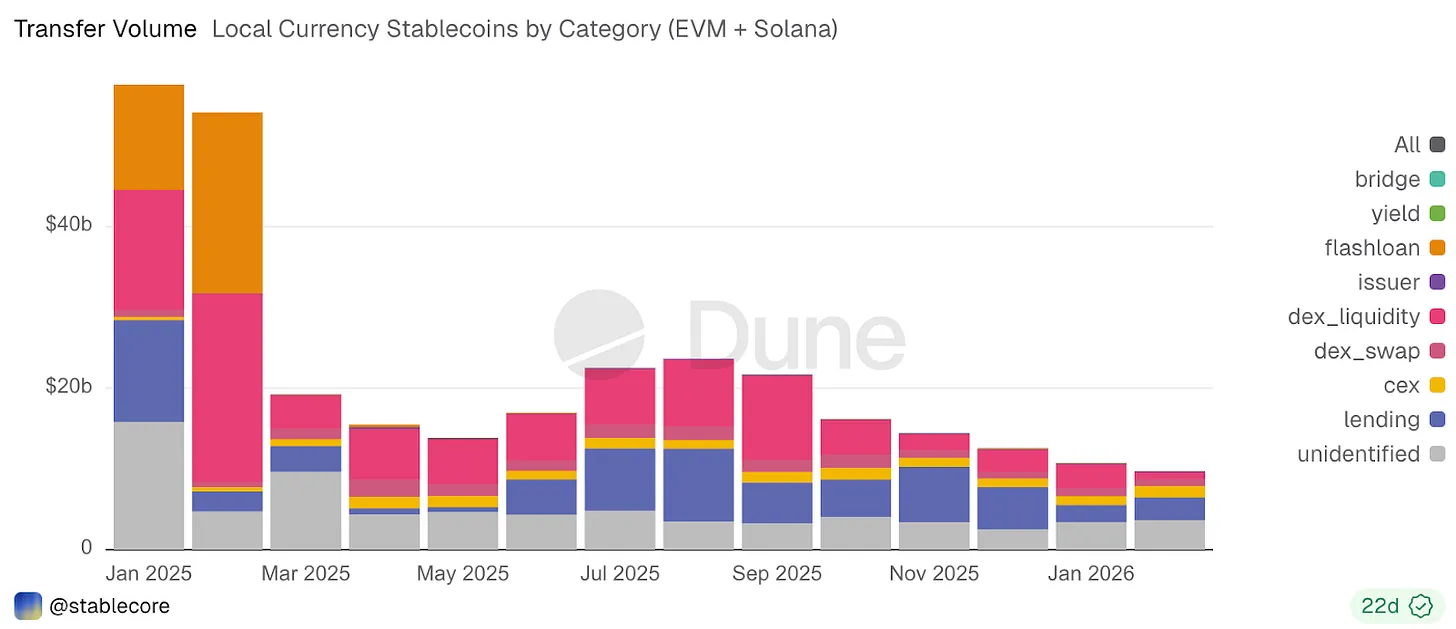
This breakdown shows that non-USD stablecoins are used on-chain in two primary ways: (1) as payment instruments or as liquid funds moving between individuals or businesses; and (2) for core DeFi operations—such as lending and trading.
But there’s an important caveat in the data. If we exclude euro-pegged stablecoins, the market tells a dramatically different story.
Euro-pegged stablecoins account for over 90% of total transaction volume—and are increasingly treated as financial assets in their own right. Users deposit them into lending markets, trade them on DEXs, and treat them more like yield-bearing, collateralizable, DeFi-circulating on-chain cash. This makes local-currency stablecoins appear significantly more mature.
EURC, alongside EURS, EURm, and EUROe, has already been integrated into DeFi yield venues including Aave, Morpho, and Fluid.
By contrast, once euro-pegged stablecoins are removed, the remaining non-USD stablecoins are used primarily for settlement infrastructure.
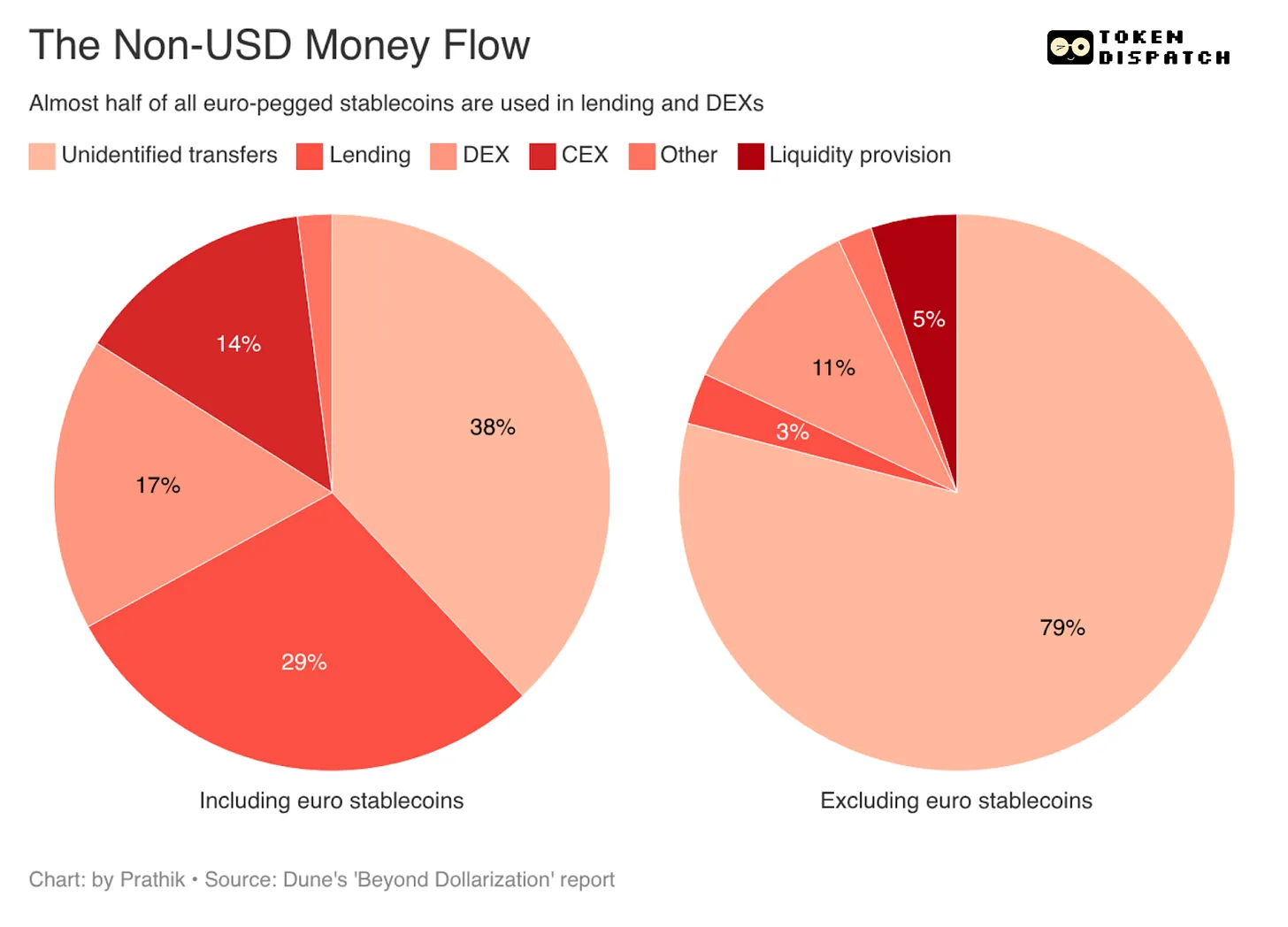
Nearly 80% of non-USD, non-euro stablecoin transactions fall into the “unidentified” category—likely covering wallet-to-wallet fund transfers, corporate debt settlement, remittance-style transfers, and payment flows routed through service providers.
The dominance of euro-pegged stablecoins within the non-USD stablecoin ecosystem suggests that the next wave of growth will likely center on core DeFi operations. Outside the eurozone, non-USD stablecoins will first expand as infrastructure enabling domestic funds to flow on digital rails—and only later become suitable for core DeFi operations.
This growth is critical because it originates from stablecoins used in payroll disbursement, treasury management, merchant settlement, remittances, and foreign exchange (FX).
These domains face far stricter regulatory scrutiny than core DeFi operations—since operational capital tolerates ambiguity far less than speculative assets. If a token is expected to function within domestic payment systems, treasury workflows, and highly regulated environments, it requires predictable reserves, transparent redemption processes, and legal clarity. Regulation will therefore play a pivotal role in non-USD stablecoin adoption.
This also explains why growth is concentrated in regions with mature financial systems. The report notes that activity in Brazilian real (BRL) and Japanese yen (JPY) stablecoins accelerated sharply following improvements in local regulatory frameworks—while markets lacking dedicated regulatory regimes, such as Indonesia, lagged behind.
I’ve also identified the economic rationale for non-USD stablecoins.
Cross-border payments still incur high currency-conversion costs, and remittances lose significant value to FX spreads and intermediaries. More local-currency stablecoins can reduce the amount of value that must detour through USD before reaching its destination—lowering FX costs, eliminating settlement friction, and allowing businesses and individuals to hold value in the currencies they earn, spend, and save.
Their potential extends far beyond DeFi itself. Euro-pegged stablecoins have already set a powerful precedent for integrating local digital currencies into financial systems. Yet the broader win lies in reducing the cost and speed of cross-border fund flows globally—and diminishing reliance on the US dollar.
Issuers that make local currencies easier to send, settle, and embed into existing payment infrastructure will capture the vast potential of non-USD stablecoins. And if they create favorable conditions for broader adoption, DeFi integration will naturally follow.
Join TechFlow official community to stay tuned
Telegram:https://t.me/TechFlowDaily
X (Twitter):https://x.com/TechFlowPost
X (Twitter) EN:https://x.com/BlockFlow_News