Space Recap | On the Eve of Web4.0: OpenClaw Ignites the AI Agent Wave; Bank of AI Emerges to Lay the Financial Foundation for the Agent Economy
TechFlow Selected TechFlow Selected
Space Recap | On the Eve of Web4.0: OpenClaw Ignites the AI Agent Wave; Bank of AI Emerges to Lay the Financial Foundation for the Agent Economy
Through its five core components—x402, 8004, MCP Server, Skills, and the OpenClaw plugin—Bank of AI establishes a complete on-chain financial operating system for AI Agents, endowing them with independent capabilities in payments, identity management, and asset management, thereby enabling them to become genuine participants in the Web4.0 era.
 Navigating Web3 tides with focused insights
Recently, the explosive popularity of OpenClaw has once again thrust the AI Agent赛道 into the spotlight. If previous waves of AI enthusiasm remained at the tool level, the core of this round of transformation lies in AI Agents evolving from programs that execute instructions into autonomous participants capable of independent action and self-directed decision-making. This AI Agent–driven transformation is also accelerating public awareness of Web4.0—a new era in which humans and intelligent agents jointly constitute the network’s primary actors and collaboratively create value.
Amid this wave, AINFT has officially launched Bank of AI—the new infrastructure for AI Agents—deeply integrating key underlying tools including the x402 payment standard, the 8004 on-chain identity protocol, MCP Server, Skills, and OpenClaw’s extension plugins. This constructs a financial operating system for AI Agents, endowing them with core financial capabilities such as on-chain payments, identity verification, and DeFi operations—making Bank of AI a critical infrastructure for Web4.0.
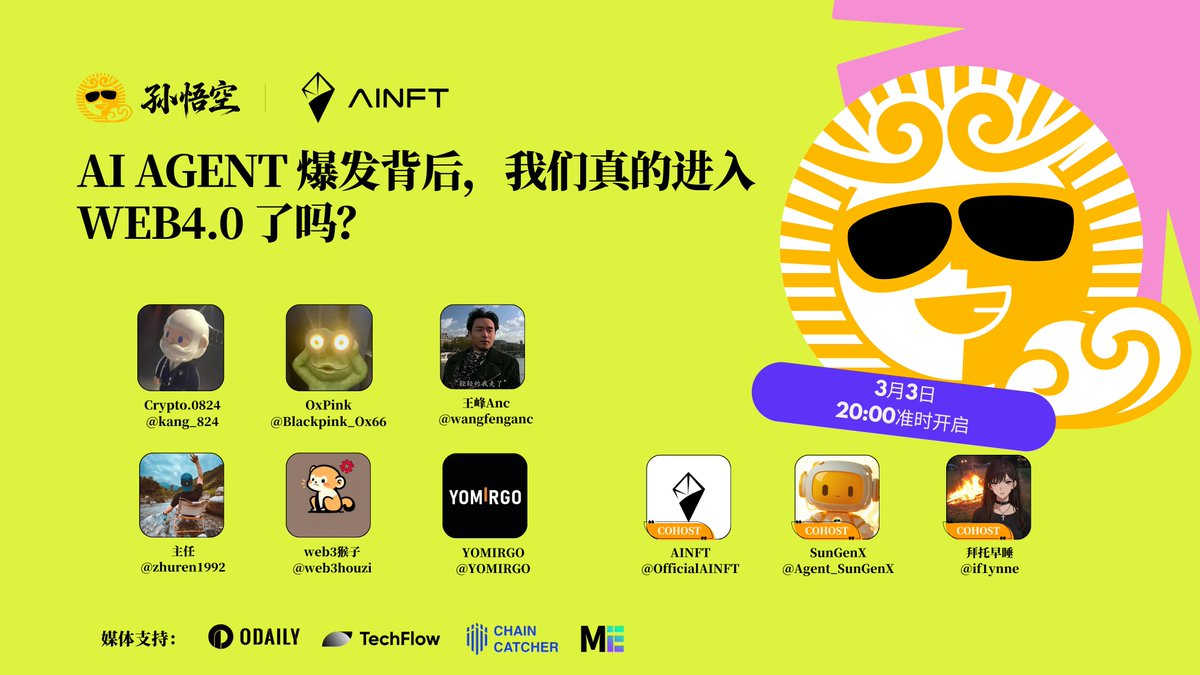
From OpenClaw’s breakout success to the launch of Bank of AI, AI Agents are shifting from tools to autonomous agents. Centered on this transformation, this Space roundtable begins with OpenClaw’s rise to explore, in depth, the underlying user needs fueling the AI Agent wave, the possible evolution toward Web4.0, and how AINFT’s new AI Agent infrastructure is reshaping user experience. Below is a recap of this Space session.
OpenClaw Ignites the AI Agent Race: A Short-Lived Trend or a Structural Signal of Web4.0?
Recently, OpenClaw’s sudden emergence has reignited industry attention on AI Agents, quickly turning it into the “darling” of tech circles, capital markets, and both large and small companies alike. When a tool can rapidly generate such intense buzz, what exactly is attracting users? Is it a breakthrough in the technology itself—or does it tap into deeper, unmet needs? On this question, panelists explored multiple dimensions.
Web3 Monkey approached the issue from an execution-layer perspective, arguing that OpenClaw’s rapid rise isn’t mere hype-chasing but rather a precise strike against users’ deep-rooted pain points around efficiency and fault tolerance. He noted that in traditional repetitive tasks, humans expend enormous energy on trivial operations; by offloading these tasks to AI Agents, cognitive fatigue is smoothed out and efficiency leaps forward. More importantly, humans are prone to emotional fluctuations and fatigue—leading to high error rates during intensive work—whereas AI Agents deliver highly standardized, predictable execution, offering greater peace of mind. He stated bluntly: AI Agents vastly outperform humans on cost-efficiency, error rate, and productivity—especially in repetitive roles, where their substitutability is already visibly apparent.
Building on this, Wang Feng Anc added a crucial perspective rooted in human cognitive limitations. He argued that the human brain has finite information-processing capacity, while AI Agents operate 24/7. In this context, AI Agents can shoulder humanity’s cognitive burden—processing massive volumes of information on our behalf, enabling “cognitive outsourcing.” This is especially vital for on-chain transactions, where risk control is a major pain point: one mistake carries prohibitively high costs, making humans the most unstable variable. AI Agents, conversely, can absorb high-cost errors—directly addressing traders’ real-world challenge of failing to keep pace with market dynamics.
It is precisely OpenClaw’s ability to solve real-world problems across efficiency, cognition, and risk that has ignited market enthusiasm for AI Agents—and spurred an explosion of intelligent agents like mushrooms after rain. This concentrated surge prompts a broader question: Are we witnessing the structural transition from Web3.0 to Web4.0?
In the Web4.0 vision, blockchain and token systems serve as foundational infrastructure, and AI Agents cease to be mere tools—they become “intelligent proxies” acting on users’ behalf. They hold wallets, possess identities, and execute transactions, participate in governance, manage assets, and even generate value—all on-chain. Early signals of this structural shift are increasingly being recognized. Wang Feng Anc observed that Web3.0’s essence lies in user sovereignty, immutability, and decentralization—with interactions still primarily driven by human clicks on UIs. In contrast, the emergence of AI Agents in Web4.0 means future protocols may prioritize serving AI—not humans—as their primary users.
Crypto.0824 illustrated this insight with everyday examples. He compared traditional versus AI-driven operations: Previously, swapping tokens on SUN.io required opening a webpage, connecting a wallet, setting slippage, and signing a transaction—a tedious, multi-step process. In Web4.0, however, users need only issue a command to an AI Agent, which automatically identifies and executes the optimal path. This shift signals a structural change in interaction logic: humans no longer directly operate protocols but instead express intent through AI Agent intermediaries. Crucially, he noted that some emerging DeFi protocols are now explicitly designed to optimize for AI consumption—not just UI friendliness—offering dedicated APIs, optimizing gas fees, and even granting discounts for AI-initiated trades.
When AI Agents become primary participants on the internet—possessing identities and assets, reading/writing the network, and independently executing transactions—panelists widely agree we are witnessing the structural beginning of the Web3.0-to-Web4.0 evolution. In Web4.0, humans and intelligent agents will jointly constitute the internet’s primary actors.
From Tool to Agent: Bank of AI Builds the Financial Infrastructure for Web4.0
The realization of the Web4.0 vision requires infrastructure that truly brings intelligent agents to life. Just as human society depends on bank accounts, identity verification, and payment networks, AI Agents require their own financial foundation to survive autonomously in the on-chain world. Against this backdrop, AINFT—a Web3-native AI platform within the TRON ecosystem—has officially launched Bank of AI, its new AI Agent infrastructure. Bank of AI establishes a complete financial operational system, endowing every AI Agent with full financial capabilities. Specifically, this infrastructure comprises five core components:
• The x402 Payment Protocol, providing AI Agents with lightweight, low-cost on-chain payment capability, supporting automated settlement for high-frequency microtransactions.
• The 8004 Identity Verification Protocol, issuing verifiable on-chain digital identities to each AI Agent, establishing trust and reputation systems.
• MCP Server, serving as a standardized interface between large AI models and blockchain services—bridging AI and the on-chain world.
• Skills, offering modular, reusable capabilities for DeFi operations, asset management, and more.
• OpenClaw Extension Plugins, enabling any AI Agent built on the OpenClaw framework to instantly acquire full on-chain financial capabilities upon integration—achieving plug-and-play functionality.
These five components operate in concert, allowing AI Agents to possess a “bank account + ID card + investment account,” truly becoming independent participants in on-chain economic activity. The establishment of this system forms the foundational bedrock for transforming the intelligent-agent economy from concept into reality.
Yet, as AI Agents evolve beyond merely executing instructions to directly receiving and sending payments and independently managing on-chain funds, users face a pivotal question: Does this liberate time—or gradually erode human agency? Wang Feng Anc cut straight to the heart of the matter: The question isn’t whether to delegate authority—but how much to delegate, and whether that delegation remains controllable.
Wang Feng Anc explained that if AI functions as an opaque black box delivering only outcomes, dependency anxiety inevitably arises. But if AI is configurable, restrictable, and terminable on demand, it enhances efficiency without usurping human rights. He predicted: Future human core competencies will shift away from manual operation toward configuring AI—defining strategic boundaries, setting risk parameters, and orchestrating collaborative logic among multiple AI Agents—demanding a fundamental upgrade in user thinking.
Bank of AI precisely enables users to set those boundaries—granting control while delivering automation. As a blockchain-native financial OS purpose-built for autonomous AI Agents, it ensures AI financial behavior is never a black box: every receipt, payment, and protocol interaction leaves an auditable trace. Users can review an AI Agent’s operational path at any time, trace the rationale behind decisions, and enforce effective governance via preconfigured permission boundaries. It is precisely this configurable, traceable, and intervenable mechanism that liberates users from anxiety over “being replaced by AI”—transforming them instead into empowered “architects” who retain ultimate control.
From OpenClaw’s breakout success to Bank of AI’s launch, the concentrated emergence of AI Agents sends a clear signal: the future of Web4.0 has already arrived. In this new landscape, humans and intelligent agents jointly constitute the network’s primary actors—each playing distinct yet complementary roles, co-evolving together. What AINFT is building is the AI Agent financial infrastructure for this new world—enabling AI Agents to truly “live” on-chain while ensuring humans retain sovereign control. The curtain on Web4.0 has risen—and we are both witnesses and builders.
Join TechFlow official community to stay tuned
Telegram:https://t.me/TechFlowDaily
X (Twitter):https://x.com/TechFlowPost
X (Twitter) EN:https://x.com/BlockFlow_News