HTX Research’s Latest Report Analyzes OpenClaw: Competition for Execution Entry Points and HTX’s AI Strategic Path
TechFlow Selected TechFlow Selected
HTX Research’s Latest Report Analyzes OpenClaw: Competition for Execution Entry Points and HTX’s AI Strategic Path
The report’s central theme is: as AI evolves from merely “answering questions” to actively “executing tasks,” who will control the next-generation gateway to work?
 Navigating Web3 tides with focused insights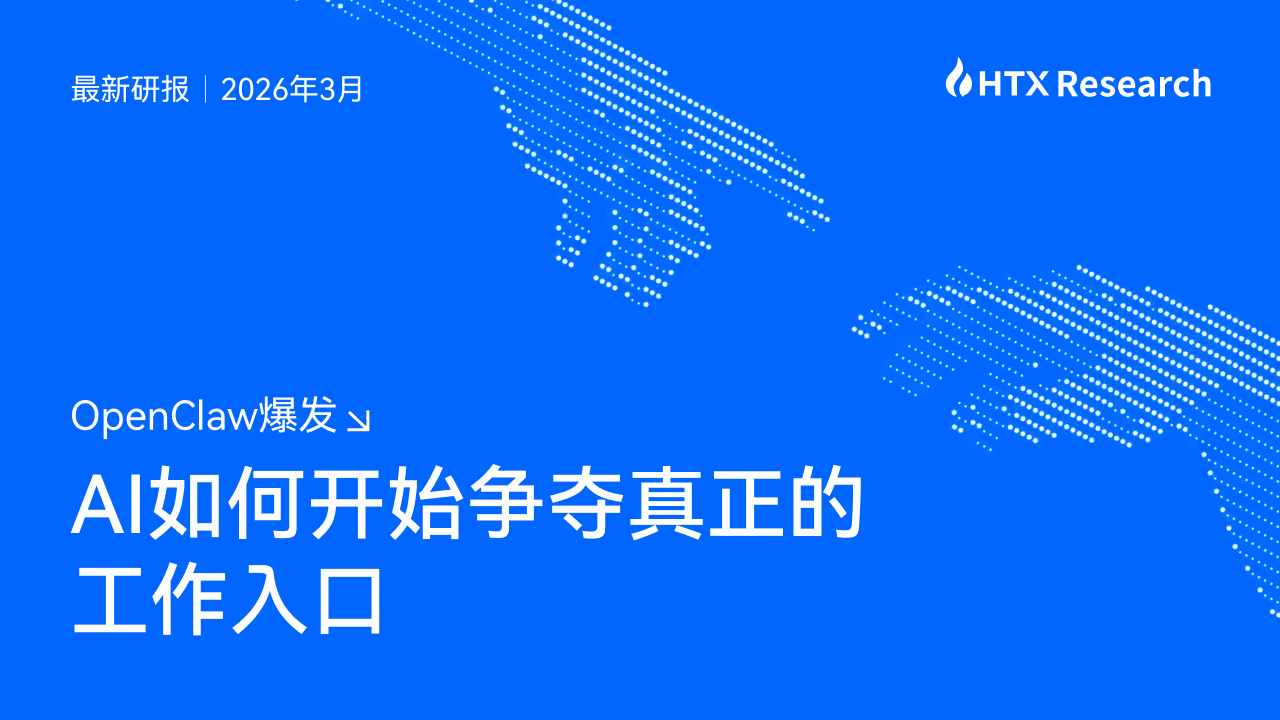
Recently, HTX Research—the dedicated research arm of HTX—released its latest report titled “From OpenClaw’s Surge: How AI Begins Competing for the Real Entry Point to Work—a Case Study of OpenClaw 2”. Centered on the rapidly rising open-source project OpenClaw, the report systematically analyzes the industry trend of AI evolving from question-answering tools to a hostable execution layer—and delves deeply into HTX’s AI product strategy and differentiated competitive positioning.
The core question driving the report is: As AI shifts from “answering questions” to “executing tasks,” who will control the next-generation entry point to work? To address this, the report analyzes five dimensions: product form, market drivers, evolution of human-AI task division, China-specific opportunities, and risk and barrier thresholds.
The Emergence of the AI Execution Layer: From “Chatting Better” to “Actually Getting Things Done”
OpenClaw has drawn widespread market attention not because it improves answer quality—but because it delivers real execution capability. Defined as a personal AI assistant running natively on users’ own devices, OpenClaw receives tasks via multiple messaging interfaces—including WhatsApp, Telegram, Slack, Feishu, and Microsoft Teams—and orchestrates actions across files, browsers, calendars, email, and terminals. As the report notes, OpenClaw isn’t competing for a new chat interface; it’s vying for the execution entry point in the AI era—where humans gradually retreat to defining goals and making critical judgments, while digital agents begin handling parts of the execution chain.
This shift rests on five concurrent trends reaching maturity: (1) model capabilities have entered a “good-enough” stage, sufficient to support moderately complex, multi-step tasks; (2) the high-frequency nature of messaging interfaces allows AI to embed seamlessly into existing workflows—without requiring users to migrate; (3) open-source distribution enables rapid adoption beyond developer circles; (4) self-hosted deployment addresses growing concerns around data sovereignty; and (5) small teams’ practical need to “do more with fewer people” provides immediate traction.
China’s Unique Adaptability
The report highlights that OpenClaw’s momentum in the Chinese market is significant and cannot be overlooked. Much of the day-to-day work for China’s vast number of SMEs occurs across messaging-driven interfaces—such as WeCom, Feishu, and customer service backends—making them naturally receptive to execution-layer tools like OpenClaw. Cities including Shenzhen and Wuxi have already launched subsidies, co-working spaces, and startup incubation programs centered on the OpenClaw ecosystem—linking it directly to the “one-person company” narrative. High-message-volume use cases—including content teams, agency operations, investment research monitoring, and customer service triage—are identified as the earliest viable application areas.
Security and Governance: Three Thresholds from Hot Project to Infrastructure
Yet OpenClaw still faces three key thresholds before it can mature into foundational infrastructure. First is the security threshold—recent incidents include malicious installers distributed via spoofed GitHub repositories and search-engine ads. Second is the governance threshold: enterprises require clear permission auditing, action replay, and human approval mechanisms. Third is the template threshold: generic platforms lacking industry-specific integration templates will struggle to cross the chasm from “early experimentation” to “long-term adoption.”
HTX’s AI Strategy: From Model Aggregation to Platform-Level Service Entry Points
As a global cryptocurrency exchange with deep expertise in AI, HTX’s AI trajectory complements—not competes with—the trend embodied by OpenClaw. While OpenClaw represents “AI as an execution layer,” HTX is actively realizing “AI as a platform-level service entry point and ecosystem connector.”
HTX’s in-house AINFT product aggregates mainstream large language models—including those from OpenAI, Anthropic, and Google—allowing users to access diverse models through a single interface, eliminating the need to switch between platforms. At login, AINFT uses TronLink wallet signatures—requiring neither phone numbers nor credit cards—to align with crypto-native user habits. For payments, it adopts a “pay-as-you-go” model—enabling on-demand top-ups—breaking away from traditional AI subscription plans and better matching on-chain users’ needs for high-frequency, low-value, elastic usage.
This product design reflects HTX’s upgraded understanding of AI—not merely as an efficiency tool, but as an extension of platform capabilities. In the future, users may enter the platform not solely to trade, but also to leverage AI and intelligent services—which in turn drives engagement and activity back to trading and broader platform usage.
From a competitive strategy perspective, amid widespread rollouts of AI Skills across major exchanges, HTX pursues a more focused, differentiated approach: HTX AI Skills launched with full coverage of spot and futures trading execution; upcoming expansions include market analysis, market intelligence, and an in-app AI assistant—establishing a closed loop across four critical dimensions: “trade execution, risk assessment, market intelligence, and user entry.” The report emphasizes that competitive advantage lies not in stacking Skill counts, but in being the first to integrate execution, risk, intelligence, and entry into a seamless end-to-end experience.
The Sector Remains Early—But the Direction Is Clear
The evolution of AI from the tool layer to the execution layer remains in its infancy—security, governance, and ecosystem maturity are all far from complete. Yet OpenClaw’s breakout has made one thing unmistakably clear: the next phase of AI competition may no longer revolve solely around parameters or answer quality, but will extend to entry-point control, permission governance, skill ecosystems, and organizational trust. HTX’s early strategic positioning in this space offers a compelling industry case study—demonstrating how crypto platforms can transform AI from an external capability into an internally operable, scalable, long-term asset.
About HTX Research
HTX Research is the dedicated research division of HTX, conducting in-depth analyses across broad domains—including cryptocurrencies, blockchain technologies, and emerging market trends—and publishing comprehensive reports and expert assessments. Committed to delivering data-driven insights and strategic foresight, HTX Research plays a pivotal role in shaping industry perspectives and supporting informed decision-making in the digital asset space. With rigorous methodologies and cutting-edge data analytics, HTX Research consistently operates at the frontier of innovation—leading thought leadership and fostering deeper understanding of dynamic market developments. Visit us.
For inquiries, please contact [email protected]
Join TechFlow official community to stay tuned
Telegram:https://t.me/TechFlowDaily
X (Twitter):https://x.com/TechFlowPost
X (Twitter) EN:https://x.com/BlockFlow_News
 HTX Research