








Which Crypto Sectors Has the AI Agent “Eaten”?
TechFlow Selected TechFlow Selected
Which Crypto Sectors Has the AI Agent “Eaten”?
Robots drive trading, while humans control the payment and trust layers.
 Navigating Web3 tides with focused insights
By: blocmates.
Translated by: AididiaoJP, Foresight News
If, like us, you’ve been deeply immersed in this industry over the past few years, you’ll notice a clear shift in the atmosphere.
Things no longer feel as exhilarating. The only topics capturing attention seem to be those prefixed with two words—AI and Agent.
The prevailing consensus holds that the industry is being heavily optimized for AI Agent services, pushing products still reliant on direct human interaction—or the “human layer”—to the margins.
Thus, from a human perspective, the industry may appear somewhat rigid. Yet on-chain activity remains vibrant and dynamic at a new layer—the Agentic layer—where humans cannot directly intervene technologically.

Efficiency is driving more users toward AI-driven interactions. Platforms originally designed for human clicks and operations are now being optimized for “non-human” services.
Major players like Uniswap Labs launched seven open-source “Skills” for AI Agents in February. These tools enable autonomous AI coding Agents (e.g., Claude, Cursor, or other Agent frameworks) to interact directly and reliably with the Uniswap protocol on-chain.
However, contrary to the ubiquitous narrative on social timelines that “AI Agents will eat everything,” closer inspection reveals a slightly different story—Agent activity growth is more sector-specific than industry-wide.
We decided to dig deeper—to identify which sectors have already been “eaten,” and which remain untouched.
Our goal: to understand whether the human layer in crypto is truly disappearing, and to explore solutions built atop crypto’s new layer that ensure control remains intact.
Sectors Already Dominated by AI Agents

In specific sectors, we observe highly active AI Agent–driven behavior while direct human interaction declines. Examples include:
Derivatives Trading (Perpetuals)
The perpetuals market represents crypto’s most clearly bot-dominated liquid market. Speed, pattern recognition, and 24/7 execution are tasks machines perform better than humans. No one would argue that humans should manually front-run trades.
The top 10 perpetual protocols generated ~$592 billion in trading volume over the past 30 days, with Hyperliquid alone accounting for $248.8 billion, followed by Aster ($61.6 billion).

Aster’s “Human vs. AI” live trading competition—run over two weeks under high volatility—offers a clear illustration: 43% of human participants were liquidated, while all 30 AI Agents completed the competition without a single liquidation—100% survival rate.
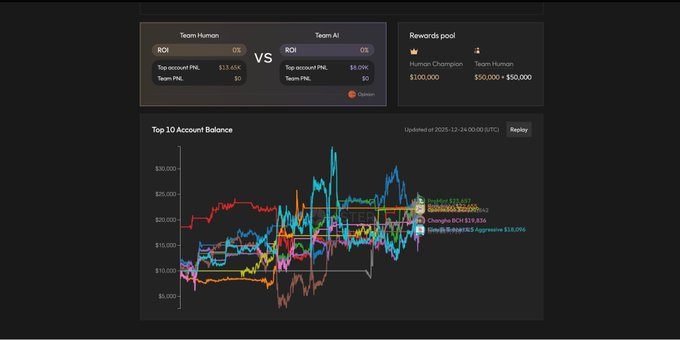
Overall ROI for human trading teams was -32.22%, whereas AI Agents limited total losses to ~$13,000, achieving an overall ROI of -4.48%.
Arbitrage Trading (MEV)
This is crypto’s most unequivocally bot-dominated domain—there simply exist no scalable, profitable human MEV operators.
Cross-chain MEV ecosystems have evolved into fiercely competitive automated trading industries, where specialized bots and infrastructure tools scan blockchain mempools.
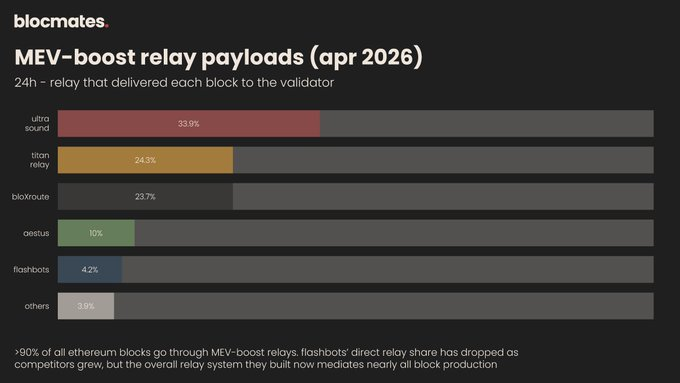
In 2025, sandwich attacks accounted for 51.56% of total MEV transaction value ($289.76 million). On Solana, sandwich bots captured 1.7%–5.4% (average 2.9%) of daily trading volume, executing $3.85 billion in sandwich trades across over 3.9 million bundles.
A single bot accounted for 42% of all sandwich trade volume, executing over $1.6 billion in trades over the past 30 days.
This extends to DeFi protocols: the entire liquidation lifecycle—monitoring, triggering, and execution—is handled by permissionless bots.
While this predates the AI Agent boom, the entire process is now significantly automated by Agents as the DeFAI category continues to grow.
Yield Optimization
This category is inherently Agent-first. Data shows that 68% of new DeFi protocols launched in Q1 2026 incorporate at least one autonomous AI Agent for trading, liquidity management, and risk monitoring.
Compared to data from 12 months ago, AI Agent adoption in yield has increased by 15%.
AI Agents consistently outperform on platforms like Giza and ZyFAI—the latter delivering +73.42% excess returns versus static strategies.
Giza recorded over 800,000 autonomous trades, with peak AUM reaching $40 million.
Beyond Giza and ZyFAI, numerous other projects operate in this space—we’ve covered some already, and others we’re happy to explore further upon request and deeper review—including:
Arrakis, Reflect, AFI, Lulo, Sail, Almanak, Surf, Infinit, AXAL, Superform, DeFi Saver, Kamino, Mamo, HeyAnon, and more.
Updates from top-tier projects like Pendle—including deploying MCP connectors and building Skills to seamlessly integrate with both crypto-native and non-native AI Agents—further confirm that the yield sector is rapidly shifting toward Agent-first interaction.
Spot Trading & Portfolio Optimization
Automated trading bots currently account for an estimated 65% of global crypto trading volume. At the start of 2026, daily active on-chain AI Agents reached 250,000—a >400% increase from 2025.
Especially on Solana, AI Agents generated $31 billion in DEX trading volume in 2025—roughly 2% of total DEX volume ($1.5 trillion).
We observe growing Agent-driven spot trading—including cross-chain meme coin trading.
Users increasingly rely on Agent-first infrastructure for token launches, trading, and portfolio management—fueling the popularity of platforms like Virtuals, Bankr, Glider, Surf, and Symphony.
Battlefield Sectors (Coexistence of Agent + Human Activity)
Prediction Markets
Polymarket serves as crypto’s most granular testing ground for AI vs. humans—and the data is hard to refute. We’ve all seen posts boasting millions earned using Agents on prediction markets.
Yet among 10,582 active traders, 880 bots (8.3% of accounts) averaged $119,156 in profit, versus $12,671 for humans—a per-capita gap of 9.4x.
Agents achieved a 66.4% win rate, compared to 45.3% for humans. Arbitrage windows shrank from 12.3 seconds in 2024 to 2.7 seconds in 2026; sub-100ms-executing bots captured 73% of all arbitrage profits.
AI-driven Agents now account for ~18% of total prediction market volume, and over 30% of Polymarket wallets are already using AI Agents.
Yet nuance matters: For markets lasting weeks or months, the gap narrows substantially—in certain categories, humans actually outperform.
Bots struggle with change, becoming confused when fundamental dynamics shift. Humans adapt instead.
Thus, short-term arbitrage games are now dominated by Agents, while long-term judgment games remain firmly human territory.
This implies that Agent activity and human interaction on prediction markets will likely remain balanced in the foreseeable future—until models emerge with sufficient perceptual capability to make the nuanced decisions still dominated by humans.
DeFi Lending
Lending exemplifies another clear case of layered automation. As noted in Agent-dominated sectors, liquidation bots are deeply entrenched—yet the vast majority of deposit and borrowing decisions remain human-driven.
Aave leads with $12.4 billion TVL, followed by Morpho ($6.9 billion).
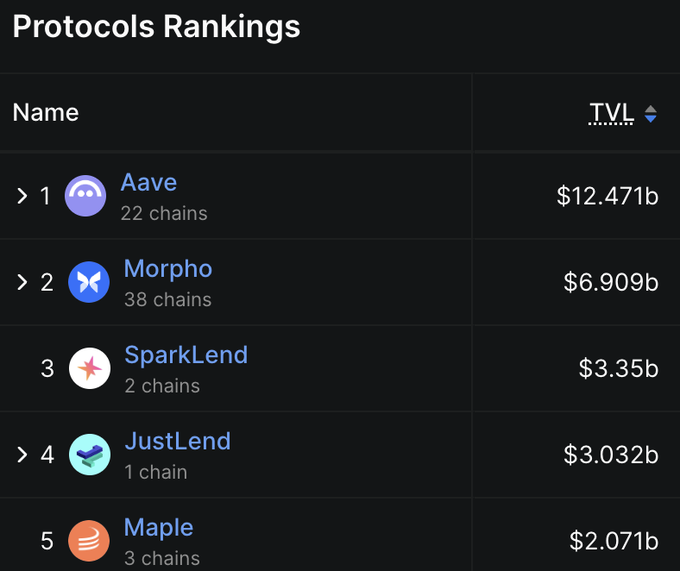
DeFAI Agents have redeployed over $2 billion TVL across lending and yield protocols—an impressive absolute figure, yet representing <2% of total DeFi TVL ($130–140 billion).
This clearly indicates that deposit decisions, collateral selection, and risk appetite remain predominantly human-driven. While AI Agents handle edge-case pipelines, the core remains firmly under human control.
Human-Dominated Sectors
Stablecoins & Card Payments
As of March 2026, stablecoin market cap stood at ~$312 billion. Adjusted trading volume—filtered for bot activity, MEV, and wash trading—reached $28 trillion in real-world economic activity in 2025, growing at a 133% CAGR since 2023.
Stablecoin transfers under $250 hit a record 5.84 billion in August 2025. We interpret these as users sending money to family, paying freelancers, or splitting bills. Over 80% of USD-backed stablecoin transactions occur outside the U.S.—where Agent adoption leads.
Real people in emerging markets use stablecoins for dollar access and economic hedging—making them critical to stablecoin market share. In February 2026 alone, trading volume reached $1.78 trillion.
Additionally, card-based payments are flourishing amid clearer regulation. Products let users spend crypto assets anywhere traditional cards are accepted, with funds remaining self-custodied until purchase moment.
Only ~5% of this sector is Agent-driven. The rest involves people moving money. Unlike bot-dominated sectors, users here typically don’t know—or care—that they’re using crypto. That’s precisely the point.
Wallets
Wallets represent the final human layer between users and the blockchain—and a layer that cannot be fully abstracted away.
Though abstraction attempts exist, approval processes urgently require human oversight. Someone must sign. Someone must decide whether to trust what’s in front of them.
Phantom boasts over 15 million monthly active users. The broader wallet space is investing in human-centric improvements—such as human-readable transaction previews, biometric security, and card-based spending.
The best wallets of 2026 have evolved from “mnemonic + string” storage containers into full financial dashboards.
Enterprise-grade Agent wallets in 2026 include budget limits, whitelists, audit logs, and emergency stops—treating Agents as operators with restricted permissions, not omnipotent signers.
Human & Agent Verification Layer: More Agents = Greater Need for This
As more Agents flood on-chain activity, proving you’re human—or that an Agent acts on your behalf—gains increasing value.
Several projects are advancing along this axis to ensure we don’t lose ourselves in the machine world’s matrix.
World & AgentKit
First mention: World (formerly Worldcoin – WLD)—these folks have verified over 17 million users via Orb hardware iris scans.
World positions itself as a response to an AI-saturated world—building digital infrastructure where being human truly matters.
It then launched AgentKit: a toolkit enabling AI Agents to carry cryptographic proofs verifying they’re backed by unique humans authenticated via World ID, integrated with Coinbase and Cloudflare’s x402 protocol for stablecoin micropayments.
t54
Another project we’re tracking is t54, building trust and security infrastructure (“the trust layer”) for the Agentic economy—the world where autonomous AI Agents handle real tasks like managing funds, making payments, and transacting on behalf of individuals or enterprises.
Currently, AI Agents moving real funds is risky (no verification, no accountability, easy to scam or violate compliance rules).
t54 addresses this via x402-secure—a dedicated trust layer enhancing the x402 protocol for secure AI Agent micropayments. x402-secure provides real-time risk scoring via its Trustline Engine and helps detect scams—including prompt injection—to ensure accountability.
t54 delivers these guardrails so institutions and users can genuinely trust Agents handling finances.
Self Protocol
These builders are constructing a decentralized zk-proven human–Agent binding layer atop ERC-8004 (on-chain Agent identity).
Self Protocol uses zk technology to anchor each AI Agent to a verified human owner (human proof), without doxxing or data leakage.
It prevents Sybil attacks, supports self-custodial wallets, autonomous action, and commercial agreements—all while preserving human accountability.
Selfclaw has integrated with ecosystems including Celo and Google Cloud, with fee recycling supporting verified Agents.
Kite AI
Kite is a foundational L1 purpose-built for the Agentic internet (EVM-compatible, using Proof-of-AI consensus).
It offers Agent Passport (verifiable identity, delegation, programmable spending rules or guardrails), autonomous stablecoin payments, governance, and verification—enabling Agents to authenticate, transact, and collaborate without intermediaries.
Conclusion
Seriously—we’re not anti-Agent. The data in trading, MEV, and yield is unambiguous: bots have won those rooms—and won’t cede them back.
A head-to-head contest where 43% of humans got liquidated versus zero robots tells you everything about who owns the speed game.
Yet network-wide data still shows humans doing most of the work in areas that truly touch real life—payments, identity, and verification.
These are the layers that truly create value and generate real revenue. They share a common trait: they require judgment, trust, physical presence, or cultural context—none of which can yet be reduced to optimization functions.
We believe teams shouldn’t abandon building for direct human interaction in these domains and sectors.
Agents currently need humans more than humans need Agents. We believe teams grasping this—and those building Agent and human attestation systems—are worth watching.
Join TechFlow official community to stay tuned
Telegram:https://t.me/TechFlowDaily
X (Twitter):https://x.com/TechFlowPost
X (Twitter) EN:https://x.com/BlockFlow_News
 blocmates.


