His net worth increased fivefold, and he ate Coinbase's "lunch"
TechFlow Selected TechFlow Selected
His net worth increased fivefold, and he ate Coinbase's "lunch"
"I don't want to be just a bystander; I hope to participate personally."
 Navigating Web3 tides with focused insights
Text: Nina Bambysheva
Translation: Lei&Rach
Vladimir Tenev first disrupted the fee model of the financial brokerage industry, and now has quintupled his net worth to $6 billion by aggressively embracing cryptocurrency. He reshaped global financial services through stock tokenization and AI-driven investing, and is now setting his sights on the $124 trillion in wealth poised to be passed down from the baby boomer generation.
Perched atop the hills of the Bay of Cannes lies a 25-acre estate—Château de la Croix des Gardes. This mansion from the "Belle Époque" era gained fame as a filming location for Alfred Hitchcock’s movie To Catch a Thief, and hardly seems like a place frequented by cryptocurrency financiers.
Yet on a sunny afternoon in June, Robinhood took over this historic estate to host a crypto event themed “To Catch a Token.” The event was led by Johann Kerbrat, Robinhood’s head of crypto and a long-time resident of the French Riviera.

The event opened with a cinematic flourish: in a video, Robinhood co-founder and CEO Vladimir Tenev drove a midnight blue 1962 Jaguar E-Type convertible along coastal mountain roads, paying homage to Cary Grant’s iconic entrance in To Catch a Thief. As the scene faded, Tenev appeared in person wearing a white Tom Ford pinstripe suit with a black-and-white patterned necktie, carrying a green briefcase, greeting over 300 invited guests. Vitalik Buterin, founder of Ethereum, along with executives from financial giants such as JPMorgan, Mastercard, and Stripe, were among the attendees.
This level of spectacle is not unwarranted. Robinhood’s stock has soared to an all-time high of $111 per share, up 384% from last year, pushing the brokerage’s market capitalization to nearly $98 billion, placing it among the top 250 most valuable companies globally. In 2024, Robinhood generated nearly $3 billion in revenue and $1.4 billion in profit, with $255 billion in assets under custody and a net deposit growth rate of 44% over the past year. With 26 million active or funded accounts, Robinhood is rapidly approaching Charles Schwab’s 37 million, while tripling E-Trade’s size and surpassing Merrill Lynch by sixfold. Meanwhile, Tenev’s personal fortune surged fivefold within a year to $6.1 billion.
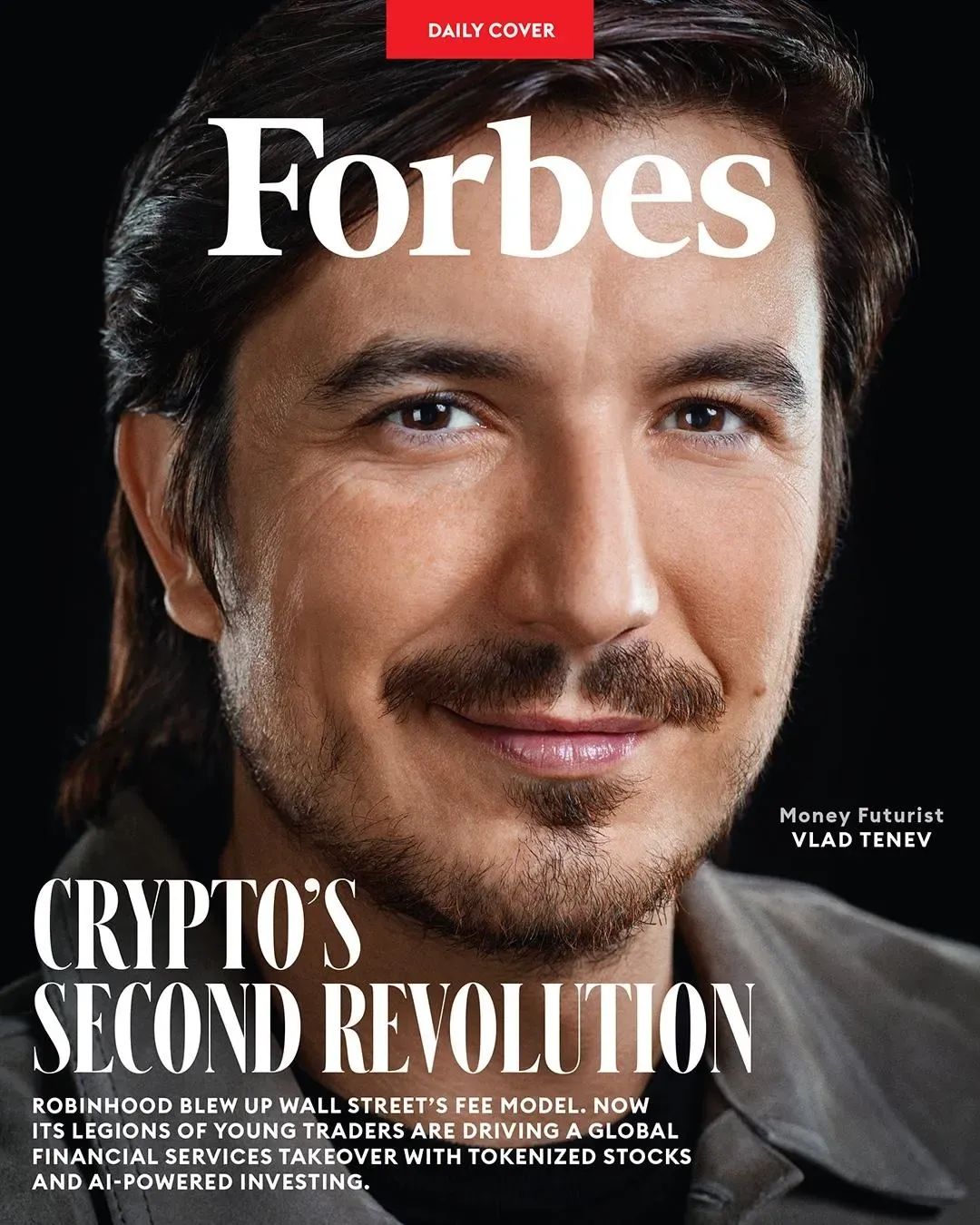
Photo Credit: GUERIN BLASK FOR FORBES
01
The 38-year-old CEO maintains a tightly packed schedule.
In late May, Tenev traveled to Las Vegas to explain to 35,000 Bitcoin supporters how cryptocurrency will further disrupt global finance through tokenization—the process of converting assets like stocks, bonds, and real estate into digital tokens tradable around the clock on blockchain networks. He then rushed to Tampa to attend the Registered Investment Adviser Conference, followed weeks later by delivering his annual shareholder meeting speech at Robinhood’s luxurious Manhattan office. “This week I’m in New York, next France, then the UK,” he recited effortlessly, listing Robinhood’s dozen offices across Europe, North America, and Asia. “I visit each at least once a year, and we keep adding more.”
Tenev, with neatly cropped hair and a goatee, bears a resemblance to Errol Flynn’s portrayal of the legendary outlaw in the 1938 film The Adventures of Robin Hood. Though youthful in appearance, the young leader speaks with the seasoned composure of someone steering a financial juggernaut. Born from the aftermath of the global financial crisis and the Occupy Wall Street movement, Robinhood has matured. Today, it targets digitally native users who favor digital trading, aiming to become their one-stop financial platform. According to Cerulli Associates, this demographic will inherit approximately $124 trillion in assets over the next two decades, largely from their baby boomer parents.

Photo Credit: MANDARIN ORIENTAL; ROBINHOOD
A week before his appearance at the French chateau, Tenev outlined the thinking behind the event. “We move fast, and this was a great opportunity to show the world what we’ve built. We need to deeply consider the story behind every product—it also greatly motivates our team.”
The castle event marked Robinhood’s first global launch focused entirely on cryptocurrency, unveiling several major announcements.
Starting in July, European users will be able to trade blockchain-based “stock tokens” on Robinhood—financial derivatives without voting rights that track the prices of hundreds of U.S. stocks and ETFs, including pre-IPO tech giants like SpaceX and OpenAI. These trades will be commission-free and available 24 hours a day, five days a week. Meanwhile, staking services for U.S. users—locking digital assets on blockchains like Ethereum and Solana to earn yield—will finally receive regulatory approval. After acquiring Luxembourg-based crypto exchange Bitstamp for $200 million in June, Robinhood will also enable continental European users to trade perpetual contracts for Bitcoin and Ethereum. To support this ecosystem, Robinhood is building its own blockchain.
“Our entire industry is at a pivotal moment,” Tenev told guests fanning themselves in the southern French heatwave. “Now is the perfect time to prove cryptocurrency is more than just a speculative asset—it has the potential to become the foundation of the global financial system. Our mission is to make that potential inevitable.”
02
To understand the transformation Tenev aims to lead, one must revisit Robinhood’s turbulent history.
In 2013, Tenev and co-founder Baiju Bhatt, both Stanford graduates in physics and mathematics, sensed the timing was right to disrupt traditional finance. After graduation, they developed software for elite hedge funds on Wall Street that dominated markets through high-frequency trading.
This experience gave them firsthand insight: these funds had an insatiable appetite for trading volume—and were willing to pay for it. Meanwhile, the vast retail investor base, accustomed to paying $10 or $25 per trade on platforms like Charles Schwab, Fidelity, and Merrill Lynch, represented a rich source of volume. So Tenev and Bhatt built a mobile app designed for novice investors—simple, engaging, with no minimum balance and zero commissions—knowing hedge funds would pay to execute these retail trades. They then launched their zero-commission platform with the slogan “Democratize Investing,” promoting it with the energy of a blockbuster video game release.
Even before launching, nearly a million users had pre-registered on Apple’s App Store. By September 2019, legacy brokers like Charles Schwab, E-Trade, Fidelity, and TD Ameritrade (later acquired by Schwab in 2020) had all eliminated trading commissions, cementing Robinhood’s zero-fee model as the new industry standard.
But the good times didn’t last. In early 2021, pandemic lockdowns and millions in government stimulus checks fueled a surge in Robinhood’s trading volume, thrusting it into regulatory spotlight during the GameStop “meme stock” frenzy.
Fueled by Reddit’s WallStreetBets community, GameStop’s stock price skyrocketed, ignoring its dismal fundamentals. This unprecedented volatility forced clearinghouses to demand massive margin calls from Robinhood, compelling Tenev to halt buying of GameStop shares on the platform. This sparked user outrage, media backlash, congressional scrutiny, and even questions following the suicide of a young Robinhood options trader.
Yet the crisis did not deter Tenev. Instead, it clarified his belief in how outdated, closed, and inefficient the U.S. stock trading system truly was, reinforcing a long-held conviction. “Honestly, can we put stocks on the blockchain? I truly believe the real value lies in enabling 24/7 trading,” he said.
Initially, Robinhood tried extending trading hours via Blue Ocean, an alternative trading platform in West Palm Beach, but ultimately failed. “I didn’t realize how hard it would be to change core infrastructure—so much depends on it. I underestimated the complexity,” Tenev admitted.
Meanwhile, Kerbrat, Robinhood’s head of crypto, explored other paths to fulfill Tenev’s vision. Under the Biden administration, U.S. regulators remained cautious toward digital assets, so Kerbrat’s team turned to Europe, where regulations were clearer. “Sometimes, it’s easier to build new infrastructure from scratch. We believe this technology can scale across any jurisdiction, and eventually expand worldwide,” Tenev said. He knew that as millions of global investors begin trading U.S. stocks as easily as meme coins, Robinhood’s volume—and profits—would grow exponentially.
03
While Kerbrat researched asset tokenization in Europe, Robinhood quietly transformed itself elsewhere.
In March 2024, co-founder Bhatt, whose net worth had reached $6.7 billion, left the company (having stepped down as co-CEO in 2020) to pursue a new venture in space-based solar power. Despite unresolved lawsuits from the GameStop episode, Tenev pushed forward with a wave of new products: individual retirement accounts (IRAs), high-yield savings accounts, a 3% cashback credit card (with 3 million users on the waitlist), on-demand cash delivery private banking, and complex options tools previously reserved for institutional investors. As Cantor Fitzgerald managing director Brett Knoblauch put it, Robinhood is evolving into “a universal machine capturing every financial opportunity.”
This rapid-fire product rollout mirrors Tenev’s own pace of life.
After a brief pause, the Bulgaria-born founder spread his hands with a hint of resignation: “My daily routine is wake up, work, eat, exercise, sleep. My wife doesn’t like me saying this, but I genuinely enjoy blending work into life—merging the two.”
Tenev admits he didn’t fully anticipate how deeply the “no-barrier” trading approach would resonate with entrepreneurial spirit during Robinhood’s explosive growth.
Last year, at a private event in Miami, top users included not only self-taught day traders but also small business owners and startup founders—individuals who approached the market with the same DIY mindset they brought to entrepreneurship. He believes this strong sense of autonomy is Robinhood’s true moat: “Entrepreneurs don’t like relying on others. They prefer doing things themselves.” Robinhood’s products are tailored for those who want full control over their wealth.
Tenev plans to capture the next generation of investors in three phases.
The first phase focuses on winning the active trading market—a segment with immediate returns, evidenced by Robinhood’s current performance. The medium term (within five years) involves expanding into the full spectrum of personal finance, covering credit cards, crypto, mortgages, and IRAs. The third phase centers on building a world-class financial ecosystem powered by Robinhood’s own blockchain. “The third phase will dwarf the first two,” Tenev said while preparing for the next day’s shareholder meeting. “Progress starts slowly when opportunities emerge, but effects compound over time.”
Tokenization may be Robinhood’s moonshot, but its core crypto business is already surging.
In 2024, Robinhood’s crypto division generated $626 million in revenue, up sharply from $135 million the previous year, accounting for over a third of total trading income. In Q1 2025, crypto revenue hit $252 million. Rob Hadick, general partner at crypto venture firm Dragonfly, noted, “They’re eating Coinbase’s lunch in the U.S. market.” Knoblauch pointed out that in May 2025, Robinhood’s crypto trading volume rose 36% month-over-month while Coinbase’s declined. While acknowledging Coinbase still dominates institutional clients (“with broader services and custodial capabilities”), he added that Robinhood’s acquisition of Bitstamp in June brought 5,000 institutional accounts and additional licenses in Europe and Asia.
Tenev and Kerbrat insist Robinhood’s operating model differs fundamentally from crypto exchanges like Coinbase. “In this industry, people endlessly debate which blockchain layer is superior, completely ignoring end users,” Kerbrat said. “We don’t build technology to show off—we build things people use daily, letting them feel the tangible advantages over traditional finance.”
Micky Malka, founder of Ribbit Capital and early investor in Robinhood, Coinbase, and Revolut, argues that focusing too much on the Coinbase-Robinhood rivalry is short-sighted. “To me, the key question over the next decade isn’t their competition—it’s how much market share they’ll take from traditional financial institutions.”
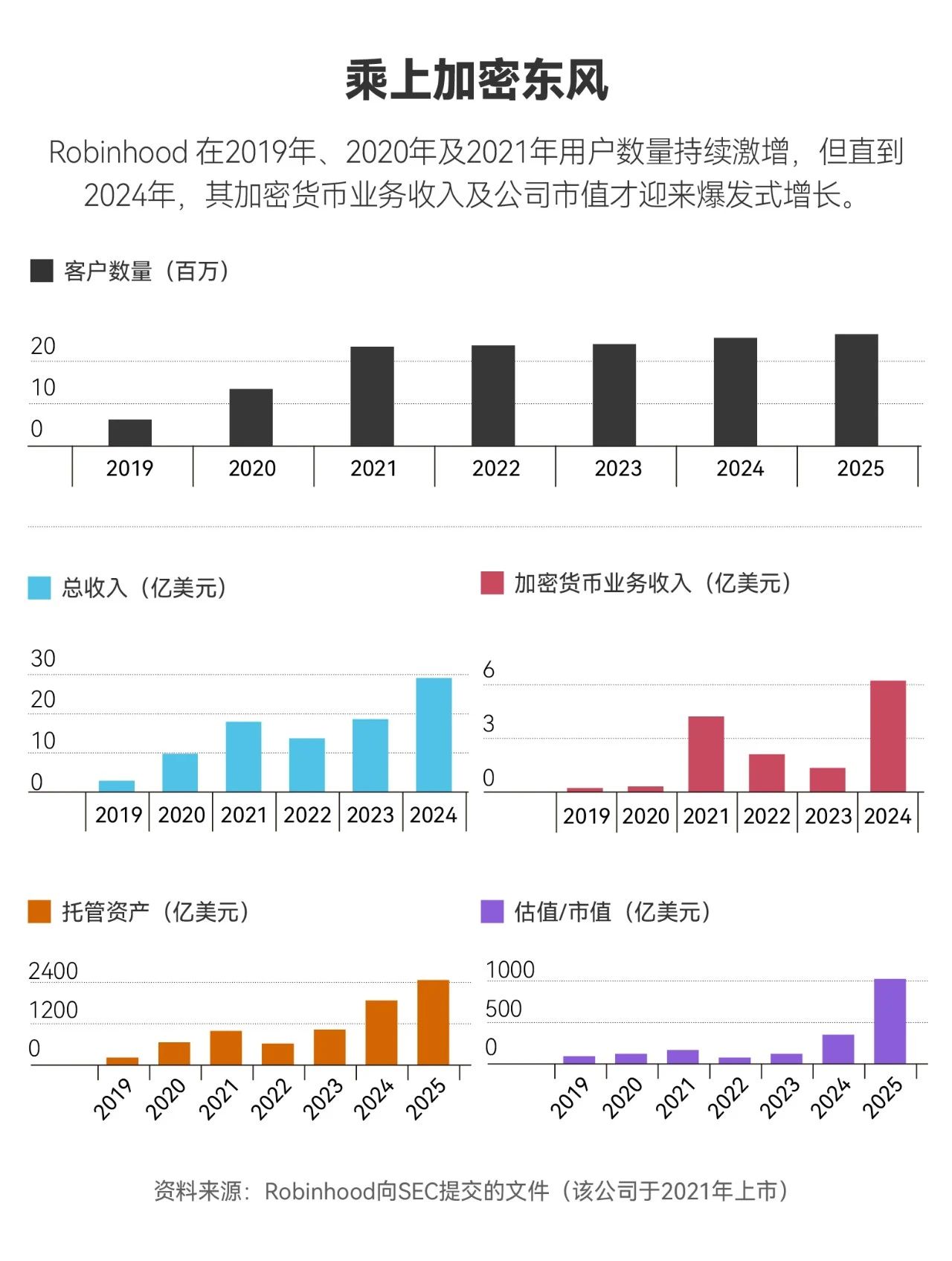
Knoblauch estimates Robinhood’s current $255 billion in assets under custody could match Interactive Brokers’ $665 billion within seven years. The next target is Charles Schwab; according to the analyst, Robinhood has captured market share from the legacy broker for 14 consecutive months.
04
Tenev is equally committed to diversifying the business.
The old Robinhood faced criticism for its heavy reliance on payment for order flow (PFOF), a model dependent on high-frequency trading and Wall Street’s most aggressive hedge funds. While trading still accounts for 56% of revenue (down from 77% in 2021), John Todaro, managing director at Needham & Company, notes Robinhood now operates ten business lines, each expected to generate over $100 million in revenue within two years.
Take Robinhood Gold: initially a $5 monthly or $50 annual subscription offering margin trading, premium research, and modest yield on cash balances, it has evolved into the cornerstone of Tenev’s powerful subscription model. Current benefits include 4% yield on brokerage account cash, up to $1,000 in interest-free margin loans, and a 3% contribution match for IRAs. The newly launched Robinhood Gold credit card offers 3% cashback on all purchases and has already been issued to 200,000 customers. “If Gold reaches 15 million users, annual subscription revenue could near $1 billion,” Knoblauch said. “This shifts the business from cyclical to stable recurring revenue, diversifying overall income streams.”
In addition, Robinhood launched “Robinhood Strategies”—a human-AI collaborative robo-advisory service spearheaded by Tenev, targeting the $60 trillion U.S. wealth management market dominated by giants like Morgan Stanley and Merrill Lynch. With an annual management fee of just 0.25%, capped at $250 per year for Gold members, users receive algorithmically managed yet human-supervised customized portfolios of stocks and ETFs. Since launching in March, this disruptive platform has attracted $350 million in assets.
Tenev compares the company’s product development to scientific experimentation—empowering small internal teams to test hypotheses and gathering real-time user feedback directly through social media channels.
“Many companies just follow external trends and copy competitors,” Tenev said. “We launch new products or features because we enjoy exploring and solving problems ourselves.” Robinhood’s recent mortgage lending service—offering 30-year fixed rates at 6.1% with a $500 closing cost subsidy—is an example, having grown from a secret online pilot launched in June. “Once news leaked, it exploded on social media. Then I tweeted confirming we were testing it—that might have been my most viral tweet this year.”
Tenev’s tokenization strategy carries a “moonshot” quality.
While many crypto regulations remain under discussion in the U.S. Congress, they are already implemented in Europe, making it Robinhood’s testing ground. “Our experiment in Europe is: what would Robinhood look like if rebuilt entirely on crypto infrastructure? We’ll assess the results and bring the best elements from the EU version back to the U.S. and other global markets,” he explained.
Currently, stock tokenization remains small. xStocks, an emerging platform under Switzerland’s Backed Finance, leads the niche, having tokenized over 60 well-known public stocks like Apple and Amazon, listed on major crypto exchanges like Kraken and Bybit. Yet its daily trading volume remains under $10 million. The model faces structural risks: these tokens are derivatives backed by off-chain assets, meaning corporate actions like dividends or stock splits—or events during weekend market closures—could cause collateral calculation errors or even involuntary liquidations.
Dragonfly’s Hadick warns: “Market makers must absorb these risks, but how do they hedge when markets are closed? If they bear the risk, they’ll widen spreads significantly and charge high fees. Off-chain infrastructure isn’t ready, nor are on-chain products… I worry these early offerings will end up being useless.”
Still, others are joining.
In June, Gemini, led by crypto investors the Winklevoss brothers, launched tokenized trading of MicroStrategy stock for EU customers. Coinbase is reportedly seeking SEC approval for tokenized stock offerings, and even Larry Fink, CEO of BlackRock (with $12.5 trillion in assets under management), has urged the SEC to approve tokenization of stocks and bonds. Robinhood goes further—extending beyond public companies to tokenize private ones, recently announcing tokenized shares of OpenAI and SpaceX, both valued above $300 billion. OpenAI swiftly issued a statement distancing itself, emphasizing it never authorized or endorsed such tokens. Hadick cautioned, “No founder wants their equity circulating on-chain in the hands of complete strangers.”
05
Tenev is no stranger to criticism.
He admits, “There’s still a lot of cruft in the system,” using a derogatory programmer’s term for bloated, unnecessary, or outdated code. “Brokerages won’t easily let us pull their stock assets. But what if self-custody becomes possible? Once you can tokenize stocks and hold them yourself, you break free from the brokerage system—just like loading a crypto wallet on MetaMask, Robinhood, or Coinbase. In the future, you’ll seamlessly hold and trade stocks through any interface, in almost any context.”
This is why Tenev is so determined to make Robinhood the “one tool” young users rely on for all financial needs. In retail financial services, the power of user inertia rivals only the effect of compound interest. Customers are sticky, but Tenev knows traditional giants like Fidelity, Schwab, and Merrill Lynch are increasingly on the defensive as trillions in assets shift from baby boomers to digitally native heirs. In fact, he sees his biggest competitors not as Coinbase or Fidelity, but tech firms like Anthropic and OpenAI: “These companies move fastest and do the most interesting things. But it’s too early to say ChatGPT will disrupt finance.”
Malka, an early investor in Robinhood whom Tenev regards as a mentor, is estimated by Forbes to have earned over $5 billion through his stake. The investor has no qualms praising Tenev: “Robinhood has a leader under 40 who naturally thinks in AI, deeply understands AI trends, masters tokenization, and integrates both strategies flawlessly—few possess such abilities. We’re just laying the groundwork for the ‘internet moment’ in money, when anyone, anywhere, can use the same financial tools to save. As credit assessment becomes more precise and efficient, borrowing costs will fall. All of this will come true.”
Tenev firmly believes Robinhood will eventually replicate and enhance family office services for high-net-worth families through AI agents, achieving the vision of a “family office in your pocket.”
AI sits at the heart of Tenev’s vision. The former math PhD candidate recently co-founded an AI startup, Harmonic, serving as chairman. He leads the company alongside computer scientist Tudor Achim, formerly of autonomous driving startup Helm.ai.
Reflecting, Tenev said, “If a mobile app could solve the Riemann Hypothesis or other Millennium Prize Problems—mathematics’ deepest unsolved puzzles—that would be extraordinary. I don’t want to be just an observer. I want to participate.”
Jamie Dimon, Larry Fink, and Ken Griffin—Wall Street’s titans—beware.
Join TechFlow official community to stay tuned
Telegram:https://t.me/TechFlowDaily
X (Twitter):https://x.com/TechFlowPost
X (Twitter) EN:https://x.com/BlockFlow_News
 Forbes