Robinhood and xStocks are so popular, why don't you consider building your own?
TechFlow Selected TechFlow Selected
Robinhood and xStocks are so popular, why don't you consider building your own?
How to build a tokenized stock platform that retail investors can participate in while keeping regulatory compliance manageable?
 Navigating Web3 tides with focused insights
Author: Shao Jiaodan, Huang Wenjing
Introduction
RWA (real-world asset tokenization) is rapidly becoming a mainstream narrative in the Web3 world, and one particularly "down-to-earth" direction—tokenized stocks—is currently among the most feasible paths.
The reasons are simple:
-
The underlying assets are mature enough that there's no need to spend effort proving their value;
-
The technical barrier is relatively manageable, with established tools already available for on-chain issuance and mapping;
-
Regulatory pathways are gradually clarifying, especially in Europe and certain offshore jurisdictions, where real projects have already launched.
However, when many people hear the word "stock," they instinctively wonder: Is this a security? Can it be sold to retail investors? Do we need a license?
In reality, some projects have already found ways to balance both compliance and market reach. They reduce regulatory pressure while still accessing retail markets. Representative examples include:
-
Robinhood: The most popular retail securities platform in the U.S.;
-
xStocks: Offers tokenized stock trading in non-EU, non-U.S. regions, tradable on-chain.
As a lawyer specializing in Web3 compliance, I’ve also started receiving similar inquiries frequently:
-
How exactly does a tokenized stock platform operate?
-
Do small or mid-sized teams like ours stand a chance?
-
If we want to launch one, where should we start, and how should we structure it legally?
This article avoids buzzwords and abstract concepts. It focuses on answering one question:
How do you build a tokenized stock platform that retail users can participate in, with manageable compliance risk?
Robinhood Model: Productizing Retail Securities Trading to the Extreme
Robinhood isn’t an on-chain platform in the traditional sense, but its operational model offers valuable inspiration for Web3 product design.
1. Core Features:
-
Extremely simplified interface, avoiding complex terminology used by traditional brokers;
-
Zero commissions and no minimum deposits, directly serving retail investors;
-
All securities clearing and custody handled by partner institutions;
2. Jurisdiction and Compliance Structure:
-
Robinhood Markets Inc. was founded in Menlo Park, California, USA;
-
Subsidiaries Robinhood Financial LLC and Robinhood Securities LLC hold U.S. securities licenses and are regulated by both the SEC and FINRA;
-
Besides securities, Robinhood also operates subsidiaries in places like the UK offering crypto asset services, but its stock trading service explicitly excludes non-U.S. users.
3. Reasons for Geographic Restrictions:
Robinhood serves only the U.S. market for two main reasons:
-
Offering securities trading to overseas users would require navigating complex licensing and registration obligations in regions such as the EU, Canada, and Japan;
-
Securities regulations in these regions are increasingly localized and stringent, making international expansion costly and legally uncertain.
xStocks Model: Token-Mapped Real Stocks + Non-Security Disclaimer + Retail Access
xStocks is one of the few platforms that maps stock prices into tokens and enables trading—allowing retail participation while deliberately avoiding classification as securities.
1. Core Structure:
-
Each xStock token maps 1:1 to an actual stock, which is physically held by a broker or custodian;
-
Tokens do not confer voting rights, dividend rights, or governance rights, and the platform does not market them as "securities";
-
The platform handles dividends through "automatic reinvestment" in token form—i.e., if the underlying stock pays a dividend, users do not receive cash but instead get additional tokens of equivalent value;
-
Users must complete basic KYC; tokens can be traded on-chain, but access is blocked for users in high-regulation jurisdictions.
2. Entity Structure and Jurisdiction:
-
The token issuer is Backed Assets (JE) Limited, registered in Jersey—not part of the EU and not directly subject to MiCA or the Prospectus Regulation;
-
The service provider is Payward Digital Solutions Ltd., registered in Bermuda—a jurisdiction with lenient financial regulation;
-
xStocks products are issued by non-U.S. entities, deliberately avoiding U.S. legal applicability.
3. Restricted Regions and Rationale:
xStocks explicitly states it does not serve the following countries or regions:
United States (including all U.S. Persons), EU member states, United Kingdom, Canada, Japan, Australia.
The reasons are:
1. These regions have extremely strict regulations on securities issuance; xStocks would likely be classified as conducting illegal securities offerings if operating locally;
2. The platform lacks required licenses or regulatory exemptions in these areas, so it actively avoids oversight via IP blocking and KYC restrictions;
3. Registering issuing entities in Jersey and Bermuda is a common strategy to reduce compliance risk.
Fundamental Differences and Shared Insights from These Two Models
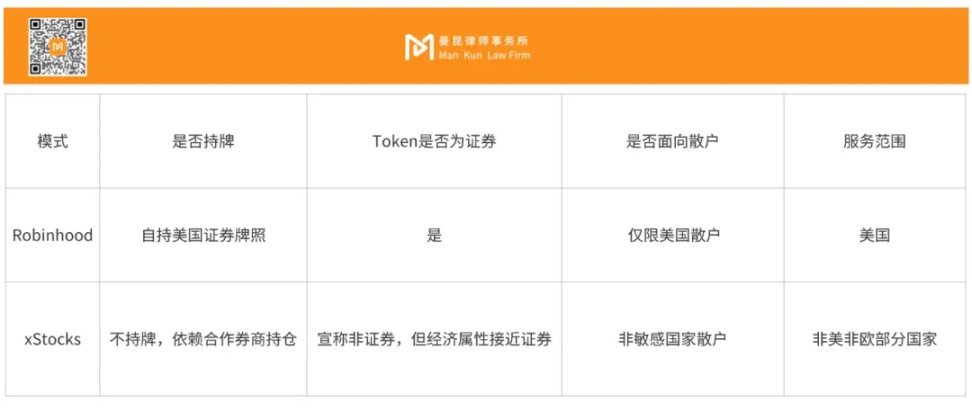
These two approaches represent fundamentally different logics:
-
Robinhood: “Operating within the regulatory framework as a security”
-
xStocks: “Structuring to avoid securities regulation”
Founders don't have to choose sides. Instead, they should learn how these models use legal structures, technical paths, and compliance isolation to create platforms that “can launch, grow, and avoid landmines.”
If You Really Want to Build One, How Should You Structure It?
Tokenizing stocks isn’t just about copying a smart contract—you need to define clear roles:
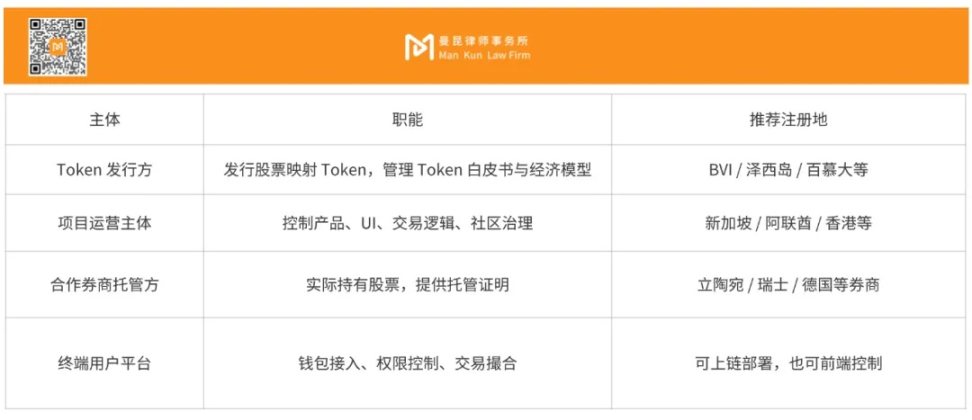
The key is:
-
The platform handles “price mapping + token issuance + user interaction”;
-
Partners handle “position holding + reporting + risk isolation”;
-
The two parties coordinate via agreements and data synchronization, but regulatory responsibilities remain clearly separated.
Which Institutions Do You Need, and What Agreements Should You Sign?
Tokenized stocks aren’t isolated systems—they rely on coordination across multiple resources:
1. Partners:
-
Licensed brokers (for physical stock custody or trade execution);
-
Blockchain issuance platform and technical team (smart contract deployment + permission modules + oracles);
-
Legal counsel (token classification analysis, structural design, user agreements);
-
KYC/AML service providers;
-
Smart contract auditors.
2. Required Agreements:
-
Token issuance whitepaper + legal disclosure document (Offering Terms);
-
Asset custody agreement / custodial proof (Custodial Agreement);
-
Platform user agreement + risk disclosure statement (T&C);
-
Compliance integration agreements (KYC, IP blocking, etc.);
-
Documentation explaining token-platform integration contracts.
Several Critical Points You Might Overlook But Must Consider
Hitting any of these could trigger not just community FUD, but actual regulatory action:
-
Tokens must not grant any “yield promises,” “governance rights,” or “claim rights”;
-
Do not open access to users in high-risk jurisdictions such as the EU, U.S., or Japan;
-
Avoid using terms like “stock,” “shareholder rights,” or “dividend-eligible”;
-
Enforce geographic and identity controls through both technology and contractual terms;
-
Prepare legal opinion letters, risk disclosures, and KYC audit trails for inspection.
Your Ability to Launch Doesn’t Depend on Licenses—It Depends on Structure
Stock tokenization is a viable yet meticulously designed venture. It’s neither as unregulated as NFTs nor as rigidly rule-bound as traditional securities. Your goal shouldn’t be to break through aggressively, but rather to:
-
Find the right entry point
-
Design a clear structure
-
Clearly define what your token represents
-
Avoid crossing red lines related to users, markets, and laws
This market isn’t saturated. Instead, it's in a gap phase—where institutions are watching closely but acting cautiously, and entrepreneurs are interested but hesitant to enter. Stop waiting to see what others do. This赛道 isn’t crowded yet. Once giants take the spots, you’ll only be left as a user.
Join TechFlow official community to stay tuned
Telegram:https://t.me/TechFlowDaily
X (Twitter):https://x.com/TechFlowPost
X (Twitter) EN:https://x.com/BlockFlow_News