








From Grassroots to a $60 Billion Market Cap, Robinhood Turns Trading into Entertainment
TechFlow Selected TechFlow Selected
From Grassroots to a $60 Billion Market Cap, Robinhood Turns Trading into Entertainment
Started with zero commissions, thrived on the crypto boom.
 Navigating Web3 tides with focused insights
By: Yanz, Liam
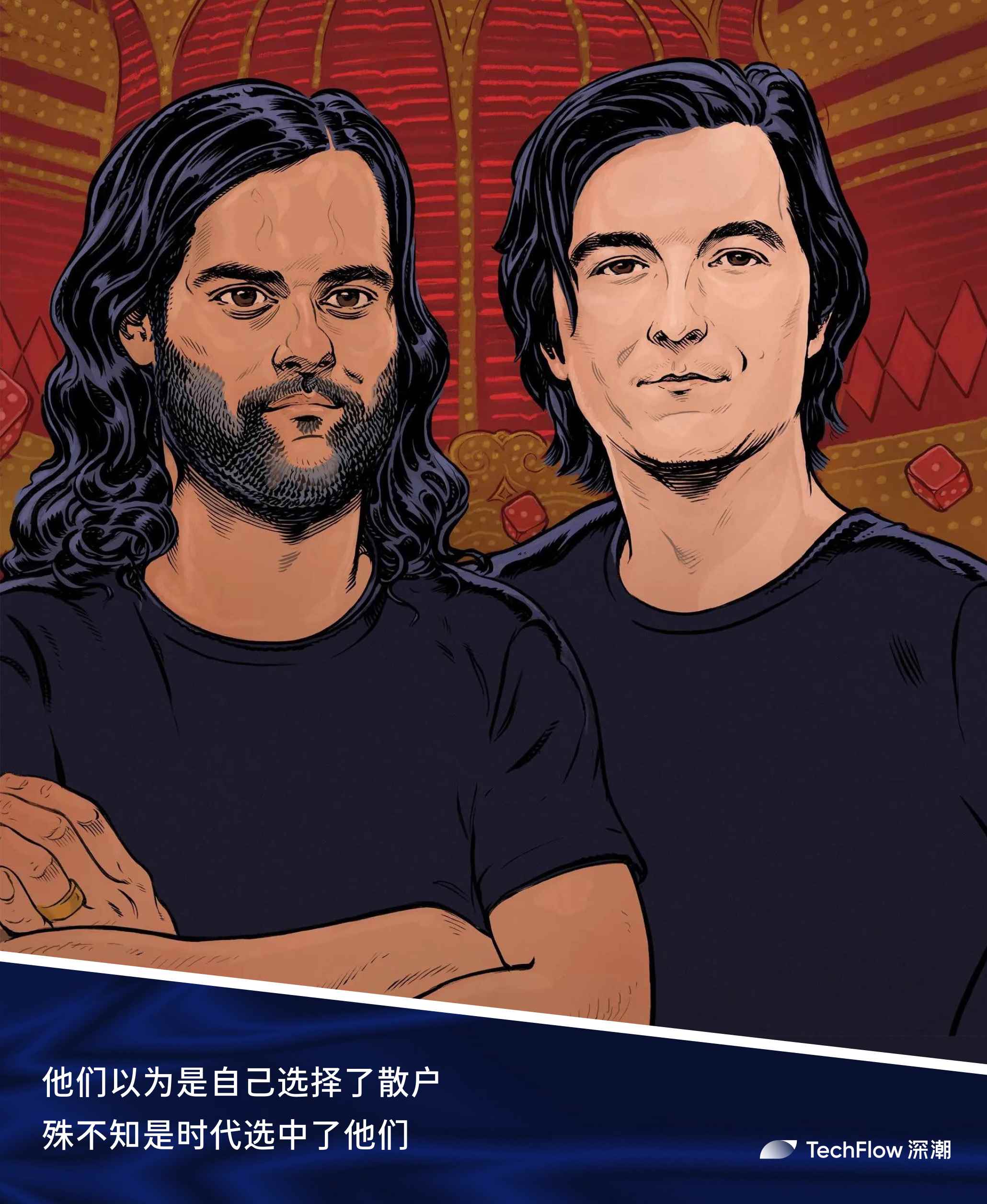
"A good financier—the Robin Hood of finance," a friend once described Vladimir Tenev.
Later, that nickname would become the name of a company that transformed the financial industry. But even that wasn't the beginning of the whole story.
Vladimir Tenev and Baiju Bhatt, two founders with academic backgrounds in mathematics and physics from Stanford University, first met during a summer research project as undergraduates at Stanford.
Neither could have predicted they would one day become deeply intertwined with a generation of retail investors. They thought they had chosen retail investors—yet in truth, it was the era that chose them.

During his time at Stanford, Tenev began questioning the future of mathematical research. He grew weary of an academic life that might require years spent on a single problem with no guarantee of results, and he couldn't understand why his PhD peers were willing to endure meager incomes for such work. This skepticism toward traditional career paths quietly planted the seeds of entrepreneurship.
In the fall of 2011, amid the peak of the "Occupy Wall Street" movement, public resentment toward the financial sector reached its zenith. Protesters’ tents dotted Zuccotti Park in New York, and even from their office windows in San Francisco, Tenev and Bhatt could sense the ripple effects.
That same year, they founded Chronos Research in New York, developing high-frequency trading software for financial institutions.
Yet soon they realized traditional brokerages used high commissions and complex trading rules to keep ordinary investors out of financial markets. This led them to ask: Could the technology built for institutions also serve retail investors?
At the time, emerging mobile internet companies like Uber, Instagram, and Foursquare were reshaping consumer behavior. Products designed specifically for mobile devices were setting new trends. In contrast, even low-cost brokers like E-Trade struggled with mobile compatibility.
Tenev and Bhatt decided to ride this technological and consumer wave, transforming Chronos into a free stock trading platform targeting millennials, and applied for a brokerage license.
Millennials, mobile internet, zero-commission trading—Robinhood assembled the three most disruptive elements of the era.
They had no idea then that this decision would launch Robinhood’s extraordinary decade.
Hunting the Millennials
Robinhood set its sights on a blue ocean largely ignored by traditional brokerages—the millennial generation.
A 2018 survey by Charles Schwab found that 31% of investors compared trading fees when choosing a brokerage. Millennials were especially sensitive to "zero fees," with over half saying they’d switch platforms based on cost alone.
Zero-commission trading emerged precisely under these conditions. While traditional brokers typically charged $8–$10 per trade, Robinhood eliminated this fee entirely and removed minimum deposit requirements. Allowing trades starting at just $1 quickly attracted novice investors. Combined with a clean, intuitive, and almost "gamified" interface, Robinhood boosted user engagement—and cultivated a cohort of young users addicted to trading.
This shift in pricing models eventually forced the entire industry to adapt. In October 2019, Fidelity, Charles Schwab, and E-Trade successively announced they would eliminate per-trade commissions. Robinhood became the pioneer—the first to raise the zero-fee banner.
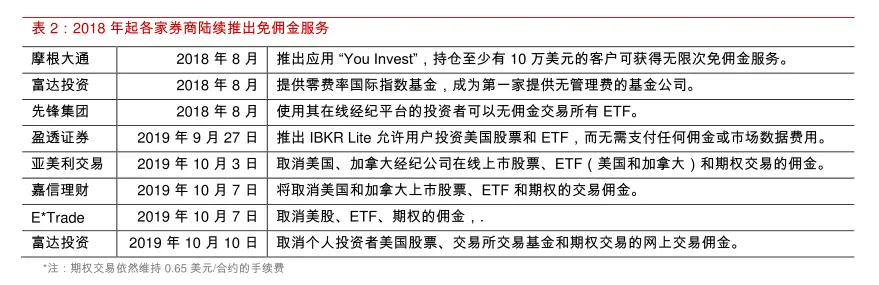
Source: Orient Securities
Using Google's Material Design style introduced in 2014, Robinhood’s gamified interface even won an Apple Design Award—making it the first fintech company ever to receive the honor.
This was part of its success—but not the most crucial part.
In an interview, Tenev paraphrased a line from Gordon Gekko in the movie *Wall Street* to describe the company’s philosophy: "The most important commodity that I have is information."
This quote reveals the core of Robinhood’s business model—Payment for Order Flow (PFOF).
Like many internet platforms, Robinhood’s apparent "free" service comes at a hidden cost.
It profits by selling users' order flow to market makers, though users may not get the best available market prices, mistakenly believing they’ve gained from commission-free trading.
To put it simply, when users place orders on Robinhood, those trades aren’t sent directly to public exchanges like Nasdaq or NYSE. Instead, they’re first routed to market makers partnered with Robinhood (such as Citadel Securities). These firms execute trades at tiny price spreads—often just fractions of a cent—and profit from the spread. In return, they pay Robinhood referral fees—known as payment for order flow.
In other words, Robinhood’s free trading earns money “behind the scenes,” invisible to users.
Although founder Tenev repeatedly claimed PFOF wasn’t a source of profit, reality told a different story: in 2020, 75% of Robinhood’s revenue came from transaction-related activities; by Q1 2021, that figure rose to 80.5%. Even as the share has declined slightly in recent years, PFOF remains a critical pillar of Robinhood’s income.
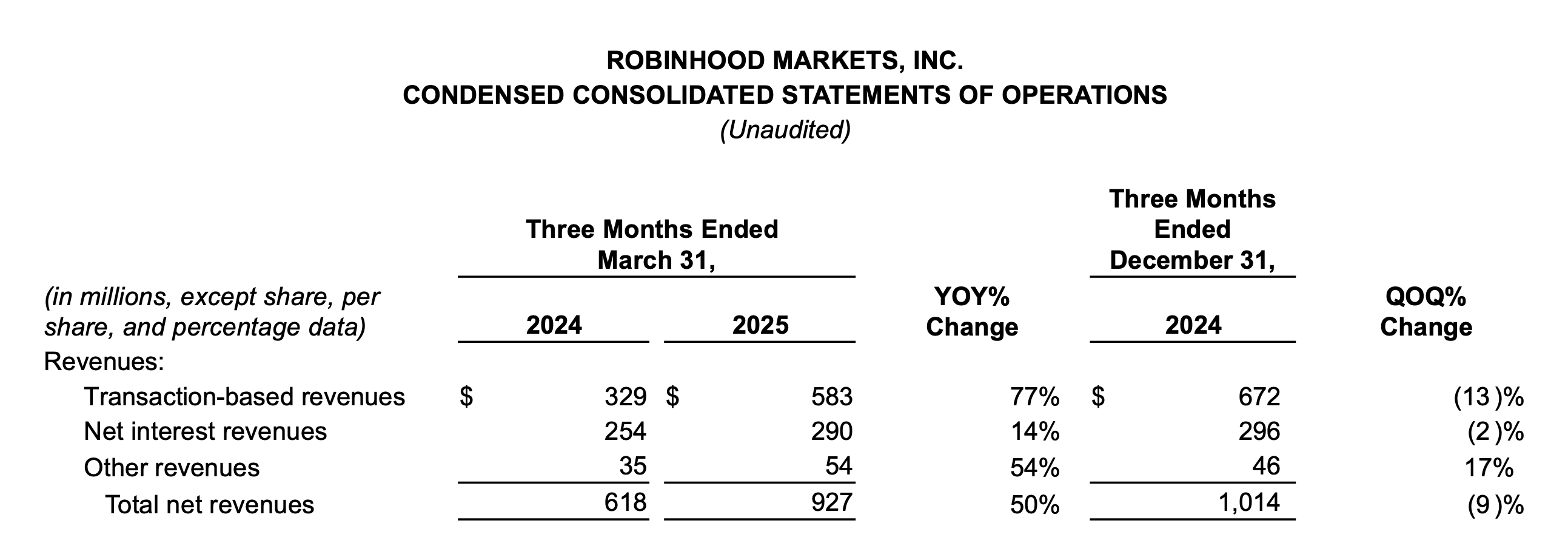
Adam Alter, a marketing professor at New York University, said bluntly in an interview: "For a company like Robinhood, merely having users isn’t enough. You need them constantly clicking 'buy' or 'sell,' removing every possible barrier to financial decisions."
Sometimes, this extreme ease of access brings not just convenience—but also risk.
In March 2020, a 20-year-old American college student named Kahn lost $730,000 on options trades through Robinhood—far exceeding his $16,000 principal. The young man took his own life. In a note left for his family, he wrote: "If you're reading this, I'm gone. Why can a 20-year-old with no income control nearly $1 million in leverage?"
Robinhood had perfectly tapped into the psychology of young retail investors—low barriers, gamification, social features—and reaped the rewards of that design. As of March 2025, the average age of Robinhood users remained around 35.
But everything the universe gives comes with a price tag. Robinhood was no exception.
Robin Hood—Robbing the Poor to Serve the Rich?
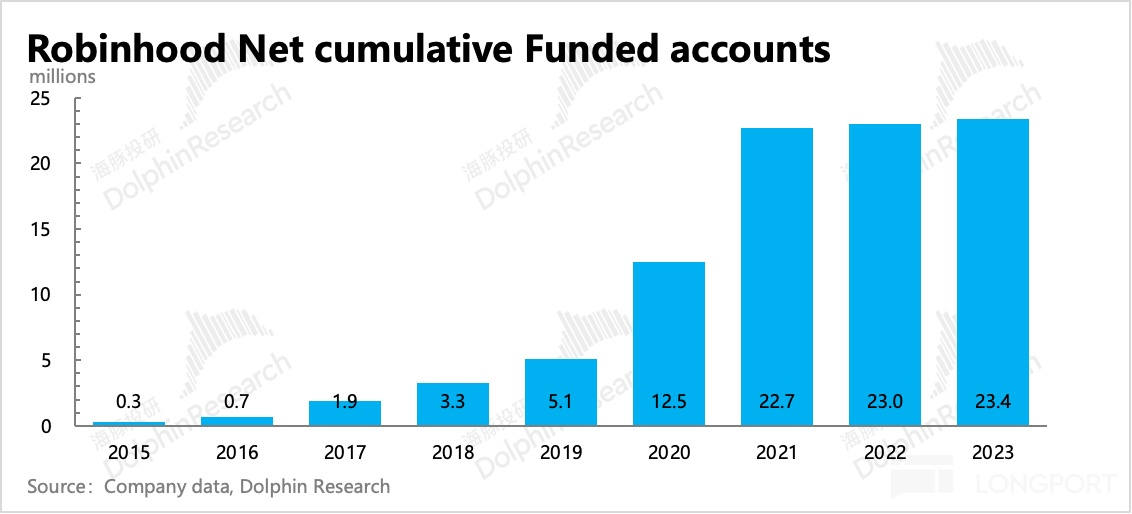
From 2015 to 2021, Robinhood’s registered user base grew by 75%.
Especially in 2020, fueled by the pandemic, U.S. stimulus policies, and a surge in public investing interest, both user numbers and trading volume skyrocketed, with assets under custody briefly surpassing $135 billion.
With rapid growth came conflict.
By late 2020, Massachusetts securities regulators accused Robinhood of using "gamification" to attract inexperienced investors while failing to provide adequate risk controls during market volatility. Shortly after, the U.S. Securities and Exchange Commission (SEC) launched an investigation, alleging Robinhood failed to secure optimal execution prices for users.
Ultimately, Robinhood agreed to pay $65 million to settle with the SEC. The SEC explicitly stated that despite the benefit of zero commissions, users still lost $34.1 million overall due to inferior pricing. Robinhood denied wrongdoing, but this controversy was only the beginning.
The event that truly thrust Robinhood into public scrutiny was the GameStop saga in early 2021.
GameStop, a video game retailer beloved by generations of Americans, had fallen into crisis due to the pandemic and became a prime target for short-selling by institutional investors. But thousands of retail investors refused to let capital crush the company. Rallying on Reddit’s WallStreetBets forum, they used platforms like Robinhood to buy shares en masse, triggering a historic "short squeeze."
GameStop’s stock surged from $19.95 on January 12 to $483 on January 28—a gain of over 2,300%. A grassroots revolt against Wall Street shook the traditional financial system.
Yet what seemed like a victory for retail investors quickly turned into Robinhood’s darkest hour.
The financial infrastructure at the time couldn’t handle the sudden trading frenzy. Under existing settlement rules, stock trades required T+2 days to clear, and brokers had to pre-fund risk margins for client trades. With trading volume exploding, Robinhood’s required margin payments to clearinghouses soared.
On the morning of January 28, Tenev was woken by his wife, informed that Robinhood had received a notice from the National Securities Clearing Corporation (NSCC) demanding **$3.7 billion** in risk collateral—pushing the company’s liquidity to the brink.
He scrambled overnight to contact venture capitalists and raise emergency funds to prevent systemic collapse. Meanwhile, Robinhood took drastic action: restricting purchases of "meme stocks" like GameStop and AMC, allowing users only to sell.
This decision instantly ignited public fury.
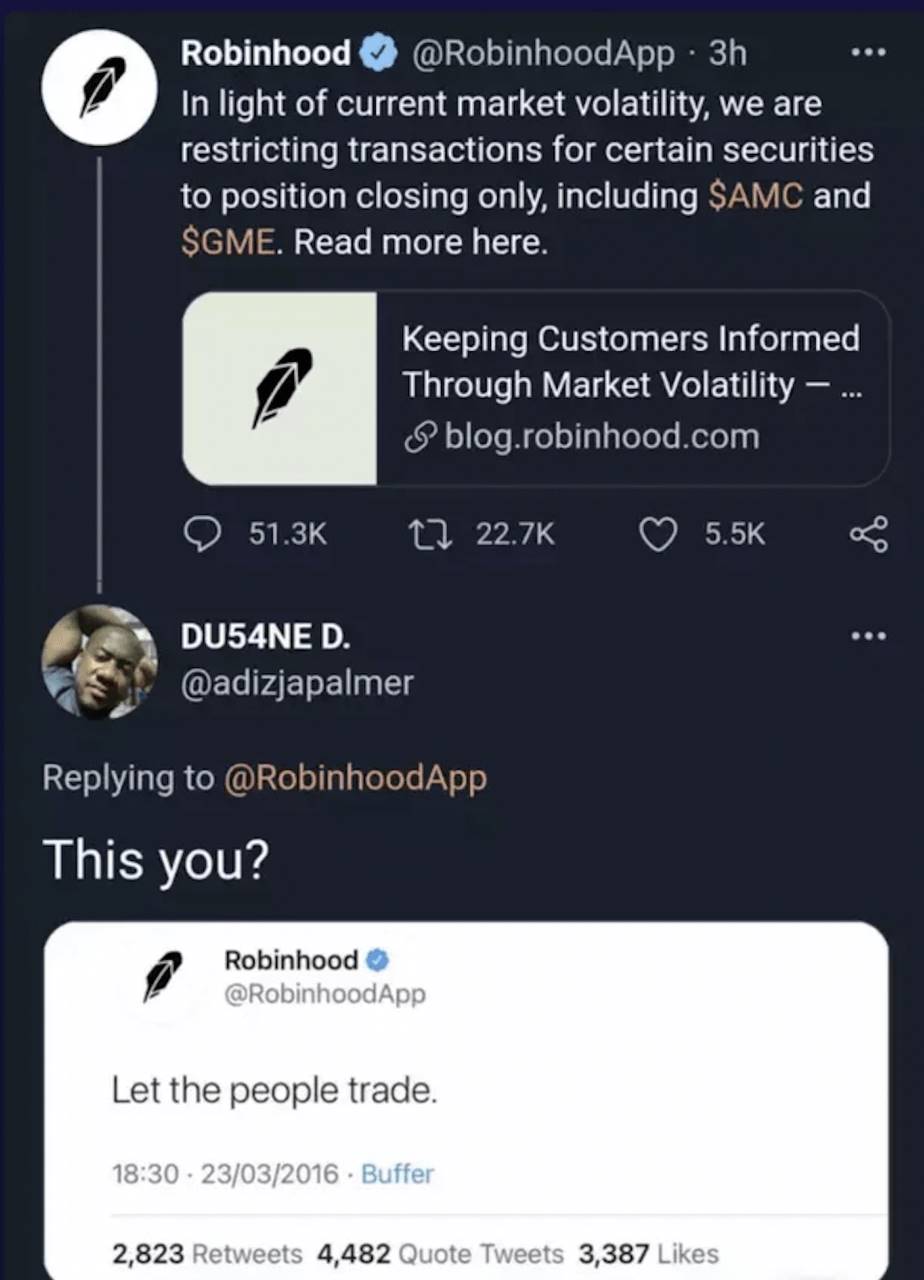
Millions of retail investors felt Robinhood had betrayed its promise of "financial democratization." Critics accused it of caving to Wall Street. Conspiracy theories emerged, alleging collusion between Robinhood and Citadel Securities—its largest order-flow partner—to manipulate markets and protect hedge fund interests.
Online harassment, death threats, and waves of negative reviews poured in. Robinhood suddenly went from "champion of retail investors" to public enemy number one. Tenev and his family were forced into hiding and hired private security.
On January 29, Robinhood announced it had raised $1 billion in emergency funding. Over subsequent rounds, it ultimately secured $3.4 billion. Still, lawmakers, celebrities, and public opinion relentlessly pursued the company.
On February 18, Tenev was summoned to testify before the U.S. Congress. Facing intense questioning from representatives, he insisted Robinhood’s actions were driven solely by settlement pressures—not market manipulation.
Still, doubts persisted. The Financial Industry Regulatory Authority (FINRA) launched a full investigation and imposed the largest fine in its history—**$70 million**, including $57 million in penalties and $13 million in customer compensation.
The GameStop incident became a turning point in Robinhood’s history.
The financial storm severely damaged Robinhood’s image as a "protector of retail investors." Brand reputation and user trust suffered major blows. Overnight, Robinhood became a company caught between angry retail traders and watchful regulators.
Yet the event also prompted U.S. regulators to reform settlement systems, accelerating the move from T+2 to T+1 settlement cycles—a lasting impact on the entire financial industry.
After the crisis, Robinhood pushed forward with its long-planned IPO.
On July 29, 2021, Robinhood went public on Nasdaq under the ticker "HOOD" at $38 per share, valuing the company at approximately $32 billion.
But the IPO didn’t deliver the anticipated windfall. On its first trading day, the stock opened lower and closed at $34.82—down 8% from its offering price. Though it saw brief rebounds later due to retail enthusiasm and institutional buying (e.g., ARK Invest), its overall trajectory remained under pressure.
The divide between Wall Street and the market was clear: Was Robinhood the gateway to a new era of retail finance, or a controversial business model vulnerable to regulatory risks?
Robinhood stood at a crossroads of trust and suspicion, officially entering the harsh realities of public markets.
Yet few noticed a subtle signal buried within the S-1 filing: in Robinhood’s prospectus, the word “Crypto” appeared 318 times.
This seemingly minor detail was, in fact, a declaration of strategic reinvention.
Crypto was the new narrative Robinhood quietly unveiled.
Crashing Into Crypto
As early as 2018, Robinhood had quietly entered the cryptocurrency space, launching Bitcoin and Ethereum trading. At the time, this move was seen more as a product expansion than a core strategy.
But market enthusiasm changed everything.
In 2021, *The New Yorker* described Robinhood as: "a zero-commission platform offering both stocks and crypto, striving to be a more enlightened version of Wall Street, on a mission to 'democratize finance for all.'"
Data confirmed the potential of this path:
-
About 1.7 million users traded crypto on Robinhood in Q4 2020. By Q1 2021, that number surged to 9.5 million—a more than fivefold increase in a single quarter.
-
In Q1 2020, crypto trading accounted for about 4% of total transaction revenue. By Q1 2021, this jumped to 17%, and by Q2, exploded to 41%.
-
Starting in 2019 with just $4.15 million in crypto assets under custody, the figure grew to $35.27 million by end-2020—an increase of over 750%. By Q1 2021, assets under custody hit $1.16 billion, up more than 2,300% year-on-year.

Now, cryptocurrency had evolved from a niche offering into one of Robinhood’s key revenue drivers, explicitly positioned as a growth engine. As they stated in filings: "We believe crypto trading opens new avenues for our long-term growth."
But what exactly caused Robinhood’s crypto business to explode within just one or two quarters?
The answer was also in the S-1 filing. Remember the Dogecoin craze of 2021? Robinhood was one of its biggest accelerators.
The S-1 document clearly stated: "For the three months ended June 30, 2021, 62% of crypto revenue came from Dogecoin, up from 34% in the previous quarter."
To meet user demand, Robinhood announced in August 2021 plans to introduce crypto deposit and withdrawal features, allowing users to freely transfer Bitcoin, Ethereum, Dogecoin, and other assets in and out of wallets.
Six months later, at the LA Blockchain Summit, Robinhood officially launched the beta version of its multi-chain Robinhood Wallet, opening it to iOS users in September 2022 and fully rolling it out in 2023.
This marked the beginning of Robinhood’s transformation from a "centralized broker" to a "digital asset platform."
Yet just as Robinhood was accelerating its shift amid the crypto boom, a then-legendary figure set his sights on the company—Sam Bankman-Fried (SBF).
The then-high-flying CEO and founder of FTX, known for aggressive expansion and ambitions to disrupt traditional finance.
In May 2022, SBF quietly acquired approximately 7.6% of Robinhood’s shares through his holding company Emergent Fidelity Technologies, worth about $648 million.
When news broke, Robinhood’s stock surged over 30% in after-hours trading.
In a 13D filing with the SEC, SBF said he viewed the stake as an "attractive investment" and pledged not to seek control or interfere with management—for now. But the filing left room for future changes in intent, preserving strategic flexibility.

In reality, SBF’s move couldn’t be dismissed as mere financial investment.
At the time, FTX was aggressively expanding into regulated U.S. markets, trying to shed its identity as a "pure crypto exchange" and break into traditional finance and securities. Robinhood—with its massive retail user base and regulatory credentials—was the ideal bridge.
Rumors swirled that SBF wanted deeper collaboration with Robinhood, even a potential acquisition. Though SBF publicly denied this, he never ruled out future possibilities.
But SBF’s grand plan never reached its intended "win-win" outcome.
By late 2022, FTX collapsed spectacularly. SBF faced charges of fraud, money laundering, and financial crimes. In January 2023, the U.S. Department of Justice seized approximately 56 million Robinhood shares held via SBF’s holding company, then valued at around $465 million.
A stake once symbolizing a "crypto-financial alliance" had become legal hot potato.
Not until September 1, 2023, did Robinhood finally resolve the ownership risk by repurchasing the shares from the U.S. Marshals Service (USMS) for $605.7 million.
Ironically, if calculated against Robinhood’s current $86 billion market cap, SBF’s original 7.6% stake would now be worth about $6.5 billion—more than ten times his initial investment.
Indeed, the "attractive investment" SBF identified proved highly attractive—just not for him.
Takeoff: The Stock Soars
If the GameStop episode was Robinhood’s trial by fire, then 2025 marked its true moment in the spotlight.
The signs were there all along.
In Q4 2024, Robinhood shattered records across key metrics:
-
Assets under custody, net deposits, Gold subscription users, revenue, net profit, adjusted EBITDA, and earnings per share—all exceeded expectations;
-
Quarterly revenue surpassed $1.01 billion, net profit hit $916 million, Gold subscribers exceeded 2.6 million, and adjusted EBITDA reached $613 million;
-
Crypto trading volume surged to $71 billion, crypto revenue grew 700% year-over-year, generating $358 million in a single quarter.
Notably, in the Q4 earnings call, founder Tenev said: "We see enormous opportunity ahead, as we work to enable anyone, anywhere, to buy, sell, hold any financial asset and conduct any financial transaction through Robinhood."
Perhaps a small foreshadowing.
On February 14, 2025—two days after the earnings release—Robinhood’s stock hit its first 2025 peak at $65.28.
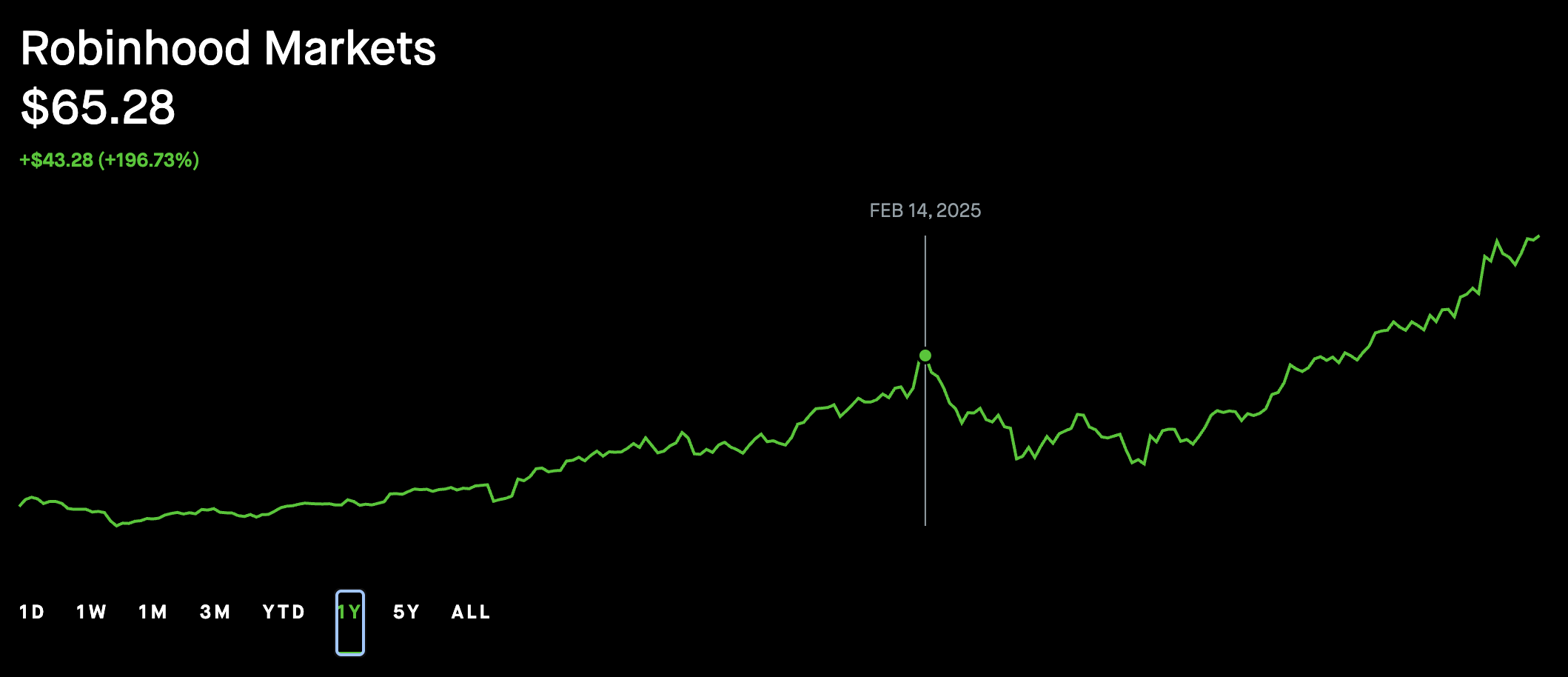
But what truly ignited the stock’s meteoric rise was the convergence of global financial and crypto markets.
With Trump’s election and U.S. policy shifting toward "crypto-friendly" stances, regulatory risks for Robinhood began to ease.
On February 21, 2025, the SEC Enforcement Division formally notified Robinhood Crypto that it was closing a year-long investigation into its crypto operations, custody practices, and payment for order flow, and would take no enforcement action. This letter cleared a major hurdle for Robinhood’s crypto expansion and served as a powerful catalyst for the stock’s breakout rally.
Then, Robinhood delivered a knockout punch.
On June 2, 2025, Robinhood officially announced the acquisition of Bitstamp, one of the world’s oldest crypto exchanges, for $65 million.
Renamed “Bitstamp by Robinhood,” the exchange was fully integrated into Robinhood Legend and Smart Exchange Routing systems. This strategic move granted Robinhood access to regulated assets and global markets, elevating it from a retail broker to a player competing with Coinbase and Binance on the global stage.
The next day, the stock crossed $70.
If the Bitstamp acquisition marked Robinhood’s international leap, what followed signaled its bold entry into Web3 capital markets.
Remember Tenev’s earlier hint? "Anyone, anytime, any financial asset, any transaction—take it further."
On June 30, 2025, Robinhood announced its official entry into blockchain-based securities, enabling European users to trade over 200 U.S. stocks and ETFs—including Nvidia, Apple, and Microsoft—as blockchain tokens on the Arbitrum network.
Beyond that, Robinhood revealed plans to develop its own Layer-2 blockchain—"Robinhood Chain."
The market responded strongly. Robinhood’s stock surged intraday, gaining 46% in the month, and on July 2, briefly breached $100—setting a new all-time high.
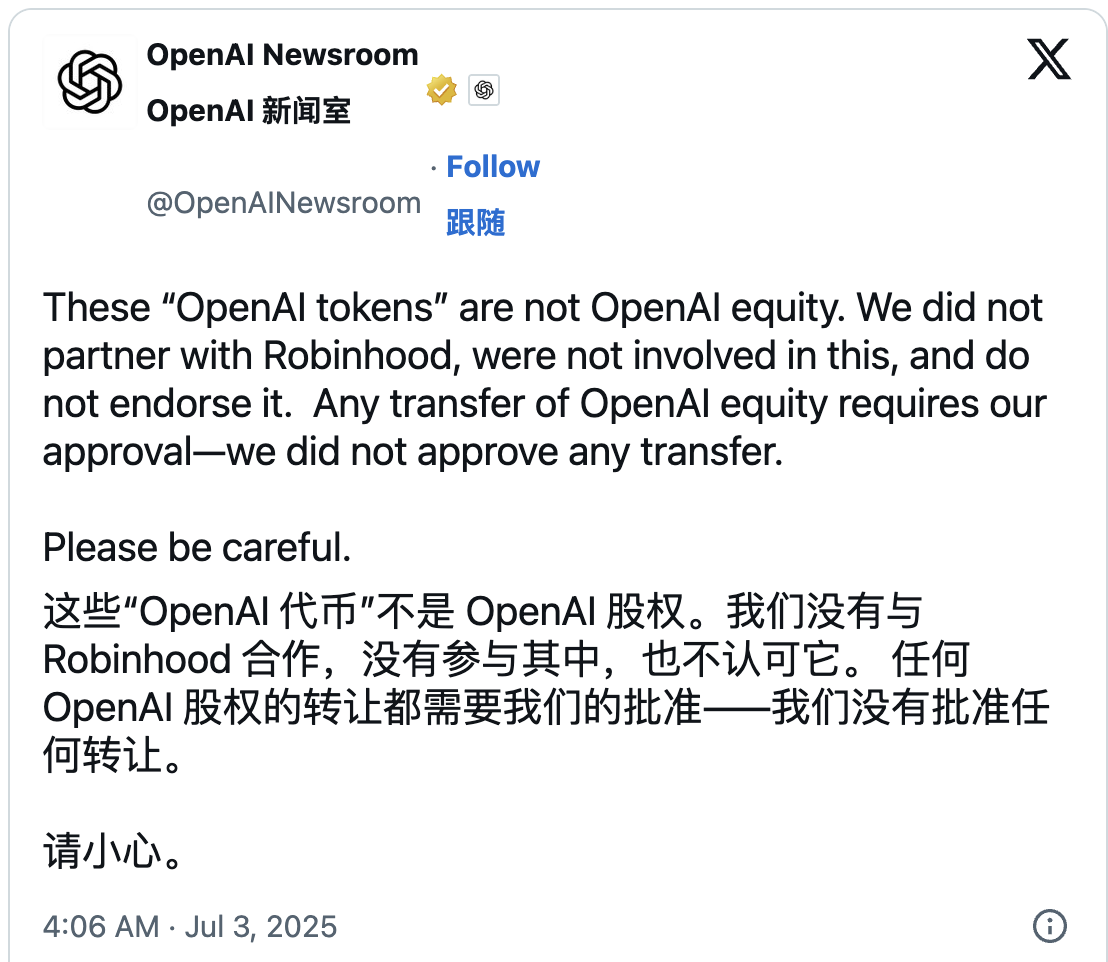
Though the stock pulled back temporarily after rumors of OpenAI equity tokenization were debunked, analysts widely agree: Robinhood has completed a stunning transformation from "retail broker" to "fintech platform," with blockchain securities poised to become its next long-term growth engine.
Today, Robinhood’s stock holds steady around $100, up nearly 150% year-to-date, with a market cap exceeding $88 billion (approximately 630 billion RMB)—far beyond what anyone imagined at IPO.
From its grassroots origins, the $86.7 billion Robinhood is unrecognizable from its past. From being the "public enemy" during the 2021 GameStop storm to becoming a frontrunner in the 2025 fusion of finance and crypto, Robinhood has not only endured the ultimate test of capital markets but also rebuilt itself at speed over five years.
If history once chose Robinhood, today, Robinhood has finally become the one shaping history.
Now, perhaps Tenev can tell his younger self—the one who once worried about math as a career: "You also spent years exploring a specific problem. Turns out, it wasn’t all for nothing."
Join TechFlow official community to stay tuned
Telegram:https://t.me/TechFlowDaily
X (Twitter):https://x.com/TechFlowPost
X (Twitter) EN:https://x.com/BlockFlow_News
 深潮TechFlow


