The Big Short Burry's New Post: First Time Shorting Caterpillar $CAT, Further Shorting AI and Semiconductors
TechFlow Selected TechFlow Selected
The Big Short Burry's New Post: First Time Shorting Caterpillar $CAT, Further Shorting AI and Semiconductors
He shorted all the hottest AI infrastructure stocks in one go.
 Navigating Web3 tides with focused insights
Author: Claude, TechFlow
TechFlow Editor's Note: Michael Burry, the prototype for "The Big Short," disclosed his latest short portfolio, shorting Caterpillar $CAT for the first time (up 86% in the first half of the year), the best performer in the S&P 500 this year, at an entry price of $1060.98. On the same day, he also established new short positions in Nvidia, Applied Materials, Tesla, and the Philadelphia Semiconductor ETF (SOXX). Almost all of these targets are core beneficiaries of the AI infrastructure rally. Burry's judgment is: valuations have reached extremes he hasn't seen in 30 years, "it's only a matter of time."
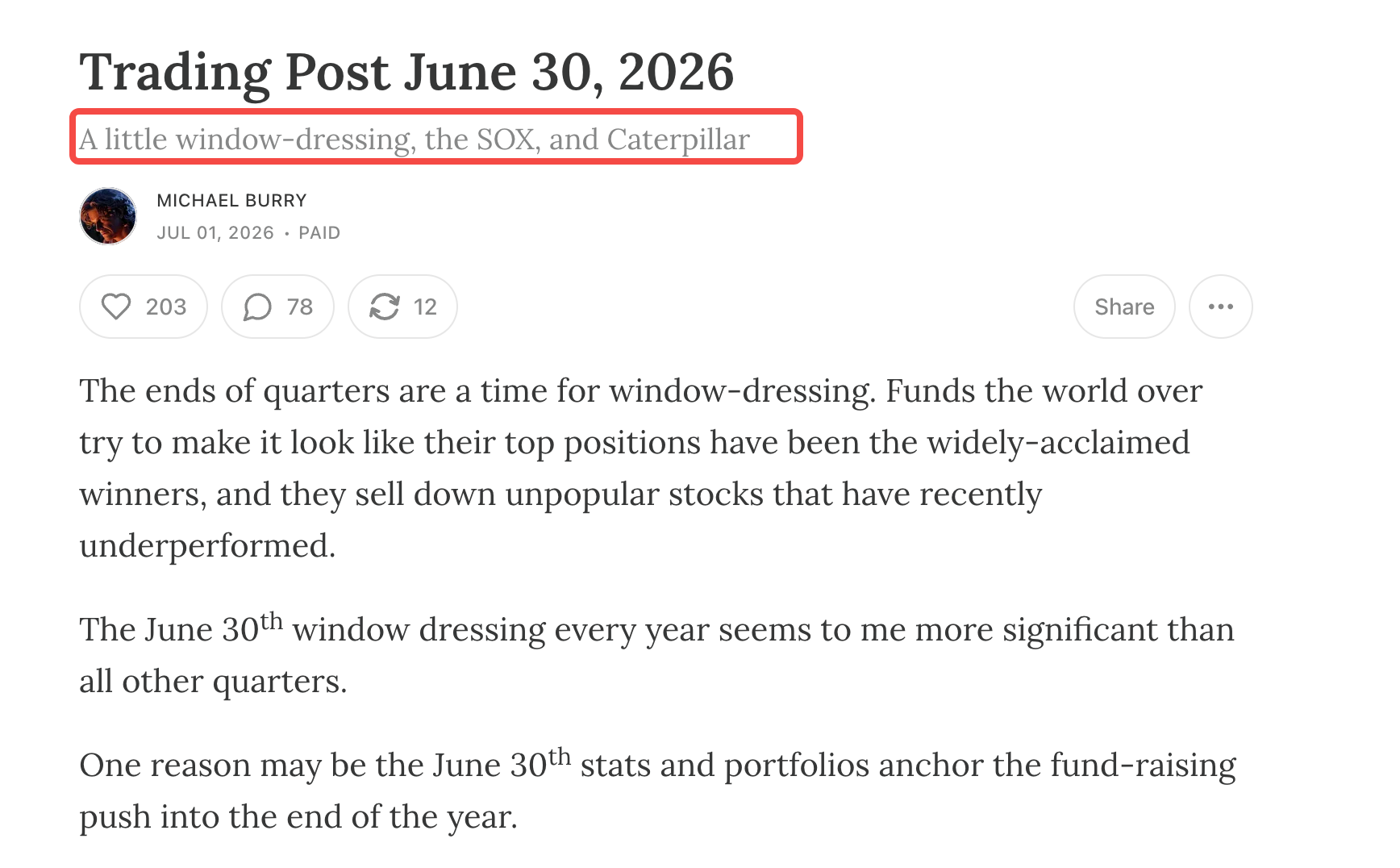
Hedge fund manager Michael Burry, known for accurately betting on the 2008 subprime crisis, published an article on June 30 on his paid Substack column "Cassandra Unchained," disclosing a batch of new short positions targeting the AI and semiconductor sectors at once. The article is titled "Trading Post June 30, 2026," and the core logic is just one sentence: this round of AI rally has risen to a dangerous position.
According to CNBC, Burry wrote: "This is the first time I've shorted Caterpillar. In the past, going long on this stock has always made me money well." This statement highlights the most unusual position in this holdings: Caterpillar is not an AI company; it builds engineering machinery, mining, and energy equipment.
First Time Shorting Caterpillar, Entry Price $1060.98, Because It Became an "AI Infrastructure Proxy"
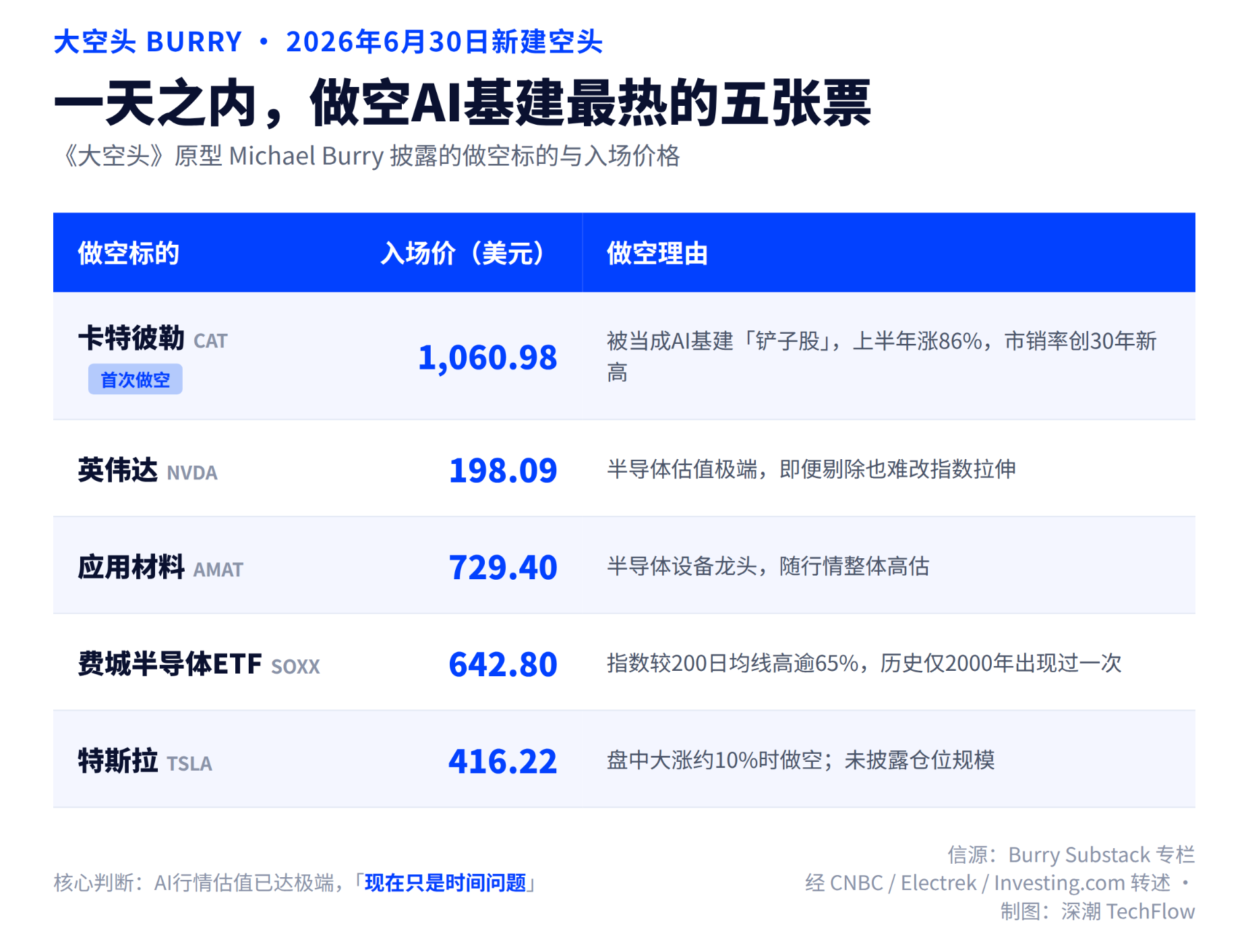
Burry shorted Caterpillar at the price of $1060.98. What alerted him was the valuation: as the stock price hit a new all-time high, Caterpillar's price-to-sales ratio (P/S, ratio of stock price to revenue per share) has risen to the highest level in at least the past 30 years. According to GuruFocus data, its price-to-earnings ratio is about 53 times.
Caterpillar itself has nothing to do with AI, but the market treats it as a "pick-and-shovel stock" for global AI infrastructure investment. Data center construction requires power generation, power transmission, and civil engineering, and more and more capital is flowing into this heavy equipment leader. As a result, Caterpillar cumulatively rose 86% in the first half of 2026, becoming one of the best-performing components in the S&P 500 this year.
Burry gave his own interpretation of the direct trigger for the day's rise. According to TipRanks, he wrote: "The direct trigger for today's rise is the large-scale spending plan announced by South Korea. In my view, this is precisely the beginning of the end for the rally. It's only a matter of time now."
Added Shorts on Nvidia, Applied Materials, SOXX Within One Day, All Entry Prices Marked
Caterpillar is not an isolated case. According to Electrek and Investing.com, the short entry prices Burry disclosed on the same day (June 30) were: Nvidia $198.09, Philadelphia Semiconductor ETF (SOXX) $642.80, Applied Materials $729.40.
What truly occupies the main body of this column is not Caterpillar, but semiconductors. Burry's argument is extreme valuations: the Philadelphia Semiconductor Index (SOX) is currently more than 65% above its 200-day moving average; this magnitude of stretch has historically occurred only once, which was when the internet bubble peaked in 2000. He also pointed out that the index's price-to-sales ratio has exceeded 16 times, and even excluding Nvidia, it is "almost unaffected."
In terms of specific operations, he rolled over the SOXX put options from January 2027 to March 2027, moving the strike price up to just over $400, while continuing to hold January put options for the Nasdaq ETF (QQQ). Regarding the pullback in semiconductors, he wrote: "It's only a matter of time now."
Shorting Tesla at $416.22, But This Position Did Not Disclose Size
Burry's handling of Tesla was different from the previous few positions. According to Yahoo Finance, he wrote: "Finally, I shorted Tesla at $416.22. Glad it rose back to this position again." Tesla closed at $379.71 on the previous trading day, and surged about 10% during Tuesday's trading, meaning Burry was shorting during the rise, rather than chasing the decline.
It is worth noting that he did not disclose any size information for the Tesla short—no number of shares, no amount, and no explanation of whether options were used. This point needs extra caution when interpreting. Burry's past Tesla shorts have been exaggerated by the media multiple times: Scion's 13F filing in Q1 2021 showed it held put options corresponding to 800,100 shares of Tesla, which was widely reported by media as a "$534 million" short, but that was only the notional value of the options (market value of shares calculated at the closing price at the time), not the capital he actually invested (i.e., option premiums, much smaller in size). He closed out that position in November 2021.
Tesla still fits Burry's overall bearish logic. Last December, he attacked Tesla's "absurd" share dilution and "absurdly overvalued" valuation, linking it to the Musk trillion-dollar compensation plan approved by shareholders. In April this year, after analyzing audit reports of several technology companies over the past decade, he called Tesla the "King of the Tranche of Tragedy"—referring to a class of companies where equity incentives exceed both GAAP-based incentive expenses and cumulative net profits.
This Is a Quarter-End "Liquidation-Style Short," But Without 13F Endorsement
According to Investing.com, this batch of positions reads more like a concentrated sweep of "over-risen" targets at the end of the quarter, rather than a separate judgment on a single stock. Burry has previously turned completely bearish: in Q3 2025, Scion held put options corresponding to 5 million shares of Palantir (notional value about $912 million) and put options corresponding to 1 million shares of Nvidia (about $187 million); these two exposures alone totaled about $1.1 billion. He has repeatedly named Oracle, Google, and Microsoft's aggressive data center expansion, warning that the market ignores the financial risks of heavy capital consumption under AI optimism, and repeatedly compares the current market to the internet bubble of 1999-2000.
Readers need to be reminded: as of press time, there is no confirmed 13F filing disclosure for the Caterpillar short. All current information comes from Burry's own column and social media, rather than regulatory filings. The exact size and structure of the positions will require hard data from Scion's next 13F.
Join TechFlow official community to stay tuned
Telegram:https://t.me/TechFlowDaily
X (Twitter):https://x.com/TechFlowPost
X (Twitter) EN:https://x.com/BlockFlow_News
 深潮TechFlow