LayerZero: A Revolution in Trustless Cross-Chain Interoperability or Just an Ideal?
TechFlow Selected TechFlow Selected
LayerZero: A Revolution in Trustless Cross-Chain Interoperability or Just an Ideal?
LayerZero Labs' mission is to solve interoperability issues between blockchains, providing dApp developers with the ability to pass messages across multiple blockchains without intermediaries.
 Navigating Web3 tides with focused insights
Author: Chain Teahouse
LayerZero is an interoperability protocol that uses new technology to instantly verify cross-chain transactions and connect different blockchains, overcoming the challenge of liquidity fragmentation. It aims to create pathways and platforms for communication between independent blockchain networks, enabling them to share assets, states, liquidity, and more.
Founded in 2021, LayerZero was established by a team of engineers led by Bryan Pellegrino (co-founder and CEO), along with co-founders Caleb Banister and Ryan Zarick (co-founder and CTO).
At the time, due to numerous isolated blockchains, users were forced to fragment their resources and liquidity, limiting their ability to transfer liquidity and state across closed ecosystems.
Thus, the mission of LayerZero Labs is to solve interoperability issues between blockchains, providing decentralized application (dApp) developers with the capability to pass messages across multiple blockchains without intermediaries. LayerZero employs an innovative architecture including ultra-light nodes, independent oracles, and relayers to securely and efficiently transmit messages between chains.
How It Works
LayerZero uses a set of smart contracts called LayerZero endpoints on each supported chain. In addition to connecting all chains supported by LayerZero, they can also be deployed on new chains to integrate them into the network. Cross-chain lending is one example, where transaction details are sent from one blockchain (e.g., Ethereum) to a LayerZero endpoint on another chain (e.g., Avalanche), facilitated by independent off-chain entities: Oracle and Relayer.
Specifically, the main components powering the LayerZero protocol include:
-
Relayer: Responsible for sending transaction proofs and data from Chain A to Chain B, while matching the block header hashes of Chain A and Chain B.
-
Oracle: Collaborates with decentralized oracle providers like Chainlink to deliver reliable data transmission for the LayerZero network.
-
Endpoints: A set of smart contracts divided into communicator, verifier, network, and library modules. The library module contains code for each blockchain network; when adding a new network, only the library module needs updating. These are facilities that directly interact with users or applications—or can be viewed as a series of smart contracts handling logic. Endpoints handle message transmission, verification, and reception, ensuring effective delivery when users send messages via the protocol.
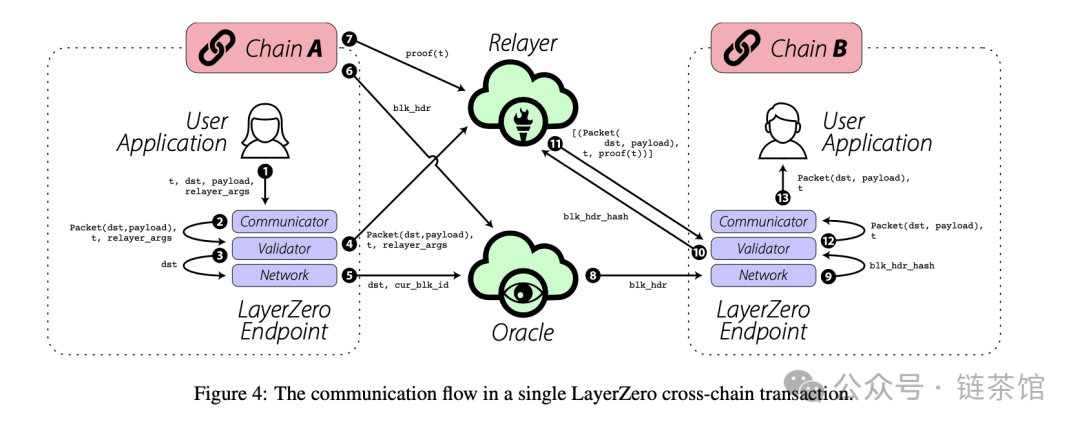
LayerZero’s message-passing process relies on two key entities: the Oracle and the Relayer. When a user agent (UA) sends a message from Chain A to Chain B, the message first passes through the endpoint on Chain A. The endpoint then notifies the designated Oracle and Relayer about the message and its destination chain. The Oracle delivers the block header to the endpoint on Chain B, while the Relayer submits the transaction proof. Once the proof is verified on the receiving chain, the message is forwarded to the final target address.
LayerZero's security is based on the principle that if two independent entities can confirm a transaction on one chain, the other chain can trust and execute it. After receiving transaction details, the Oracle creates a block header, while the Relayer independently generates a proof. If both agree, the transaction is considered valid and completed on the second chain.
Features and Ecosystem Use Cases
Bridging
Bridges are currently the most popular interoperability solution. Cross-chain bridges allow asset holders to transfer assets between different Layer 1 and Layer 2 platforms. There are many reasons investors bridge assets to another network, such as leveraging the fee structure of the target chain or benefiting from applications on that chain. Thanks to cheaper Proof-of-Stake (PoS) chains like Polygon, Fantom, and BNB Smart Chain (BSC), bridging has become more important than ever. However, apart from the previously discussed poor security, current bridge platforms still have shortcomings.
The capital intensity of operating bridges lies in the need to develop new infrastructure for each bridging direction. For example, a bridge platform supporting five networks would require writing five different codes and running five intermediate chains or light nodes.
LayerZero claims to solve this problem—first, ultra-light nodes have low requirements, and universal data exchange means the same infrastructure and code can be used to build bridges across multiple networks. Such bridges are more efficient and economical, eliminating the need for different code sets to bridge different chains.
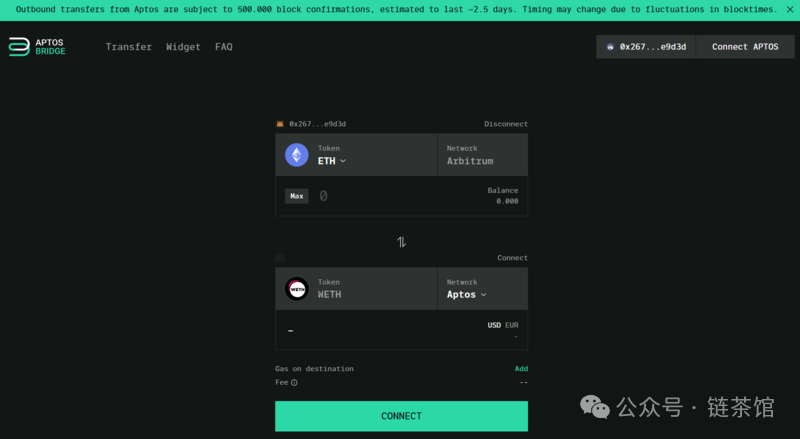
Aptos Bridge
Aptos launched in October 2022 with Aptos Token (APT) as the network's native currency. Aptos gained fame primarily due to its unique technology and its connection to Facebook's failed Diem project, since Aptos' modified Move language was originally developed for the Diem blockchain.
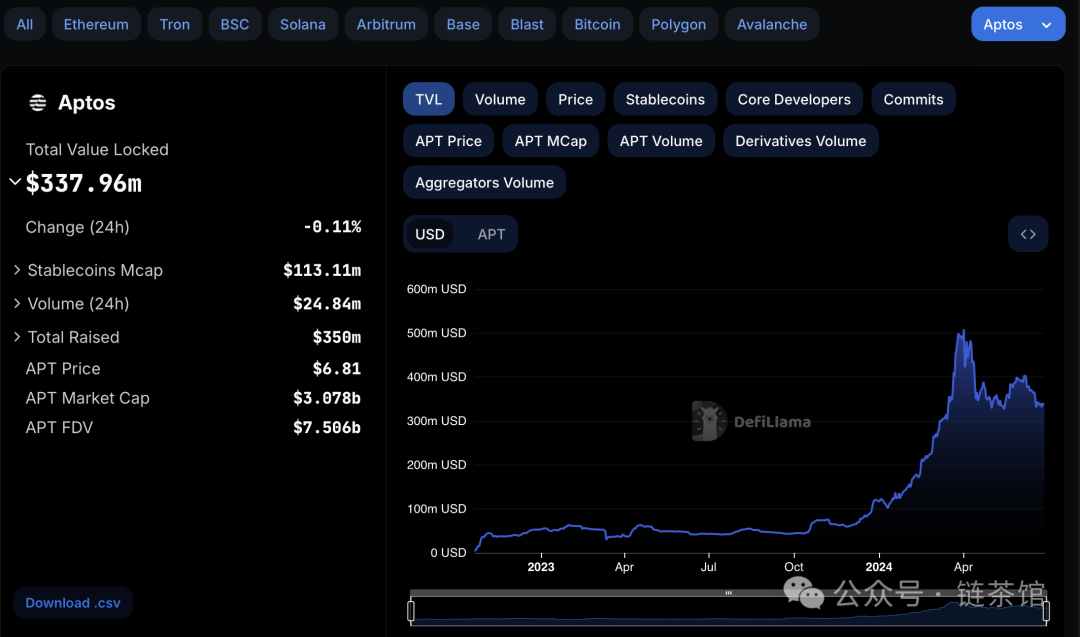
To date, Aptos has a market cap exceeding $3 billion, and DefiLlama reports $330 million in TVL on the network, making its ecosystem significant. However, Aptos is not EVM-compatible, which is where LayerZero comes in. The LayerZero Aptos bridge launched shortly after Aptos mined its genesis block, connecting Aptos with other EVM-compatible networks and even Ethereum itself.
Through the Aptos bridge, users can transfer assets supported by Aptos to other networks such as BNB Smart Chain (BSC), Avalanche, Polygon, Ethereum, and Ethereum Layer 2 networks like Optimism and Arbitrum. According to platform information, the bridging process is expected to take 2–5 days.
Stargate Finance (STG)
Stargate is a bridge platform built using LayerZero's interoperability technology. Stargate enables blockchain enthusiasts to transfer assets across chains in their native form, ensuring finality.
This is achieved through Stargate’s unified pool system, which handles transfer requests across supported chains. Liquidity providers stake their assets in a single asset pool within Stargate and receive staking rewards in stablecoins, funded by fees paid by users when bridging assets on the platform.
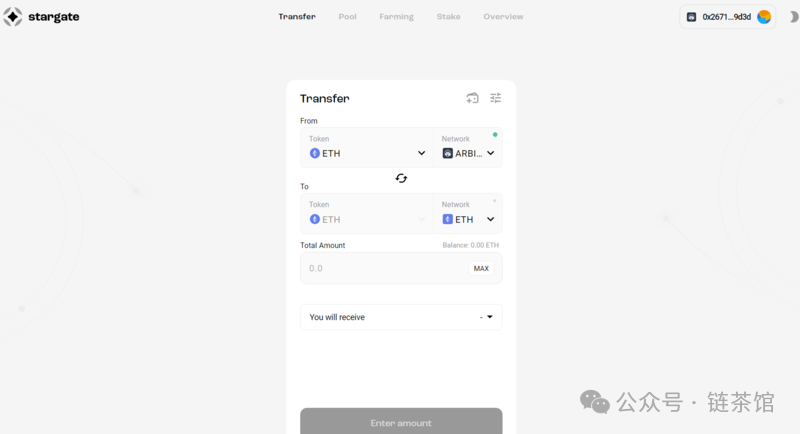
The bridge currently supports around eight networks, including Layer 2 scaling solutions like Arbitrum and Optimism. Omnichain technology provides a layer for supported tokens to operate seamlessly and move across other chains. Stargate Finance also offers cross-chain swaps, allowing users to send an asset from the source network and receive a different asset on the destination chain.
Data from the project page shows over $200 million worth of assets locked on the platform, reflecting the liquidity of pools servicing bridge requests. The Stargate token (STG) is the native token of the Stargate ecosystem, used for rewards and governance. Liquidity providers can stake their LP tokens and earn additional rewards in STG.
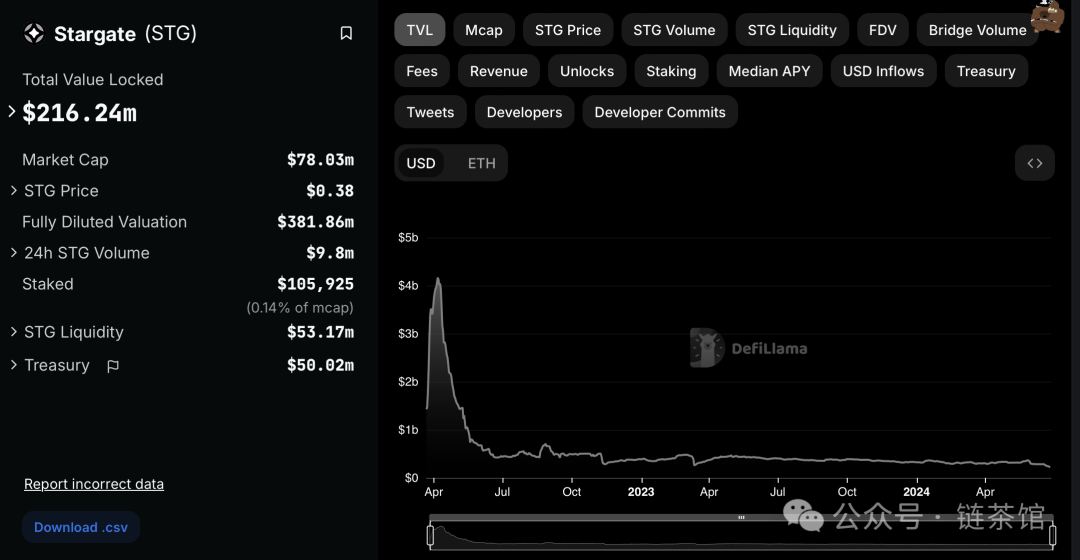
To contribute to project governance, STG holders must stake their tokens on the governance portal to obtain VeSTG, which is used to vote on improvement proposals. STG trades actively on both centralized and decentralized exchanges. You can click here to view active trading pairs for the STG token.
Cross-Chain Swaps and Unified Liquidity
Investors wishing to purchase crypto assets on different networks typically need to first bridge a unified asset to the target chain, then use a decentralized exchange on the target chain to make purchases. LayerZero's testnet bridge can directly exchange Ethereum on the mainnet and Layer 2 solutions like Arbitrum and Optimism into Goerli ETH. Similar systems could be developed at scale to support cross-chain swaps, eliminating the need to bridge and connect to exchanges on the target platform.
Current bridges use separate liquidity pools—for example, different pools serve bridging requests from Ethereum to Polygon PoS chain versus from Fantom’s Opera chain to Polygon. This may lead to inefficiencies. Liquidity on the Ethereum-to-Polygon bridge might be sufficient to handle all requests, while assets on the Fantom-to-Polygon bridge may be insufficient to complete requests immediately.
Ryan Zarick, co-founder of LayerZero, mentioned that LayerZero can leverage a unified liquidity pool to fulfill bridge requests from multiple destination chains.
LayerZero achieves the ultimate goal of bridging: unified liquidity across all chains with guaranteed finality on the source chain. This means when users transfer assets from Chain A to Chain B, users are guaranteed receipt of the asset on Chain B, and LP providers earn fees from all incoming transactions to Chain B regardless of the source chain.
Base
Base is Coinbase’s Ethereum Layer 2 solution, built using Optimism’s OP Stack software. Base offers decentralized applications a simple integration path, ensuring security, stability, and scalability for dApps, while providing convenient access to users and assets from Ethereum L1, Coinbase, and other interoperable chains.
The LayerZero protocol has gone live on Coinbase’s Base mainnet, facilitating cross-chain communication—including token swaps and transfers—through omnichain interoperability solutions, enhancing overall efficiency and accessibility in the decentralized ecosystem.
There are many practical applications resulting from the collaboration between LayerZero and Base. For example, the Parallel project has already leveraged the LayerZero protocol to smoothly move tokens between Base and Ethereum, demonstrating the protocol’s practicality and efficiency.
SushiSwap
SushiSwap is a multi-chain decentralized exchange powered by AMM. It claims to support over 400 crypto assets for instant decentralized swaps. Its liquidity pools hold over $200 million worth of crypto assets. These statistics come from the project’s official website and are accurate as of this writing. Its governance and reward system is powered by the SUSHI token.
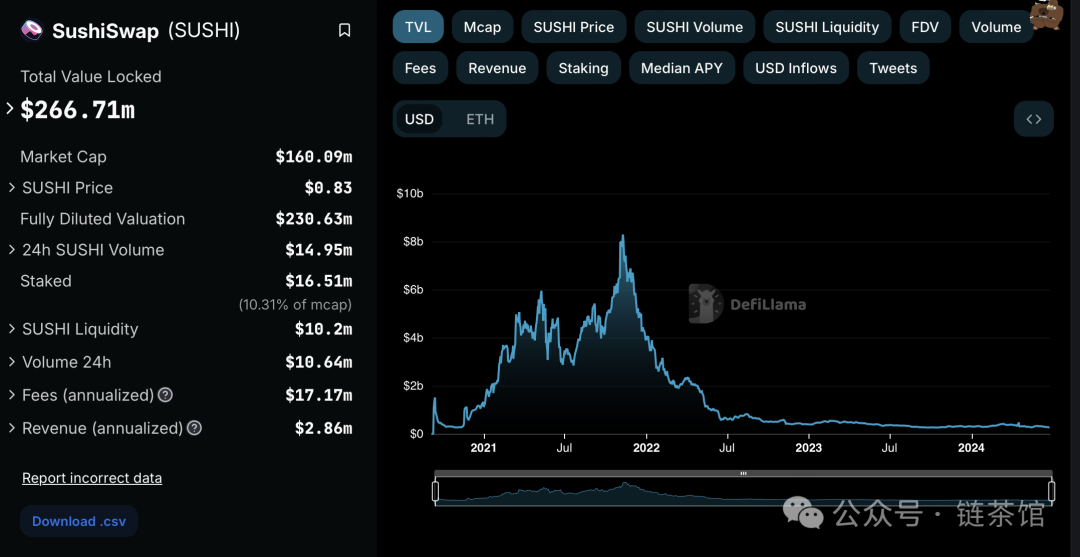
In July 2022, SushiSwap announced the launch of SushiXSwap. The new platform was developed using LayerZero’s interoperability technology to address pain points in multi-chain DeFi application usage. In the announcement, SushiSwap reflected on major issues affecting cross-chain interaction tools and how LayerZero’s technology could resolve them. At launch, SushiXSwap supported asset bridging across Ethereum, Fantom, and approximately five other networks.
LayerZero’s technology enables SushiSwap to develop a unified liquidity system that aggregates resources across supported networks to fulfill asset transfers and ensure these transactions complete in the shortest possible time. As an existing liquidity pool project, SushiSwap leverages its own pools to power bridges between chains hosting its projects, solving the issue of fragmented liquidity.
SushiSwap also addresses the cost structure of asset bridges by offering users the cheapest cross-chain transfer routes. This economically efficient solution uses Stargate Finance’s bridge infrastructure to find the cheapest route to transfer assets from the source chain to the destination chain. SushiXSwap will also use Stargate’s facilities to expand its bridge offerings and gradually extend to other networks over time. Cross-chain swaps are also available on SushiXSwap.
Omnichain Tokens and NFTs
By design, LayerZero’s technology creates a true zero layer—a truly interoperable ecosystem capable of interacting with any other network, sharing resources, and operating freely without platform limitations. LayerZero can pioneer "non-native" crypto assets. Non-native means they can be used on every chain without needing to port them to the destination chain and back via bridges that alter their original form. Omnichain tokens and NFTs will be unique and enjoy faster adoption, as investors can easily buy and store them on their preferred blockchain.
TofuNFT
TofuNFT is a multi-chain NFT marketplace deployed across more than 20 blockchain networks. NFT enthusiasts can list their NFTs on supported networks and sell them on TofuNFT’s marketplace, as well as collect works from other NFT creators. TofuNFT has been selected into the LayerZero ecosystem to develop an omnichain NFT marketplace.
Omnichain NFTs, like Omnichain Fungible Tokens (OFTs), are non-native NFTs that can be easily transferred across different networks in their original form. TofuNFT’s omnichain marketplace has already received a small number of omnichain NFT listings, such as the LayerZero Punk with a floor price of 0.015 ETH at the time of writing.
Oasys
Oasys is a blockchain optimized for gaming, using Ethereum’s Layer 2 scaling solution to provide a highly scalable Layer 1 hub and dedicated Layer 2s. The ecosystem offers game developers secure and scalable blockchain infrastructure to create more efficient, secure, and interoperable games.
Oasys validators include leaders from the gaming and Web3 space, such as SEGA, Ubisoft, and Yield Guild Games, who serve as initial validators on our Proof-of-Stake (PoS) blockchain. Oasys’ professional blockchain team combined with renowned figures from the gaming industry is revolutionizing the gaming sector.
Oasys is committed to creating an ecosystem for gamers and developers to distribute and develop games, addressing challenges faced by developers when building blockchain-based games. The company’s trio approach includes a fast network supported by gaming communities, a scalable network backed by AAA game developers, and a blockchain delivering optimal user experience through fast transactions and zero gas fees. This approach prepares participants to enter Oasys and start playing.
After integrating with LayerZero, Oasys will leverage LayerZero’s interoperability technology to enhance cross-chain operations for games and NFTs, offering richer and more inclusive gaming experiences. LayerZero also enables fungible token mobility through the Omnichain Fungible Token (OFT) standard. Bryan Pellegrino, co-founder and CEO of LayerZero Labs, added: “LayerZero adding endpoints to Oasys is a significant leap forward in in-game asset interoperability. LayerZero is committed to connecting communities and empowering players by making beloved games more accessible and enjoyable across different networks.”
Overall, LayerZero is primarily used by decentralized application developers who need to communicate across multiple blockchain networks. The LayerZero ecosystem also includes numerous projects across various categories, covering NFTs, payments, wallets, bridges, infrastructure, DeFi, DEXs, GameFi, and more, forming a vibrant and robust ecosystem.
$ZRO Token
$ZRO is the primary token within the LayerZero ecosystem, used to facilitate various activities and incentive mechanisms within the ecosystem.
$ZRO plays multiple roles in the LayerZero ecosystem, including:
-
Incentives and Rewards: Used to reward participants and contributors within the ecosystem.
-
Governance: $ZRO holders can participate in protocol governance decisions.
-
Payments and Transactions: Used to pay for cross-chain operations and other transaction fees within the ecosystem.
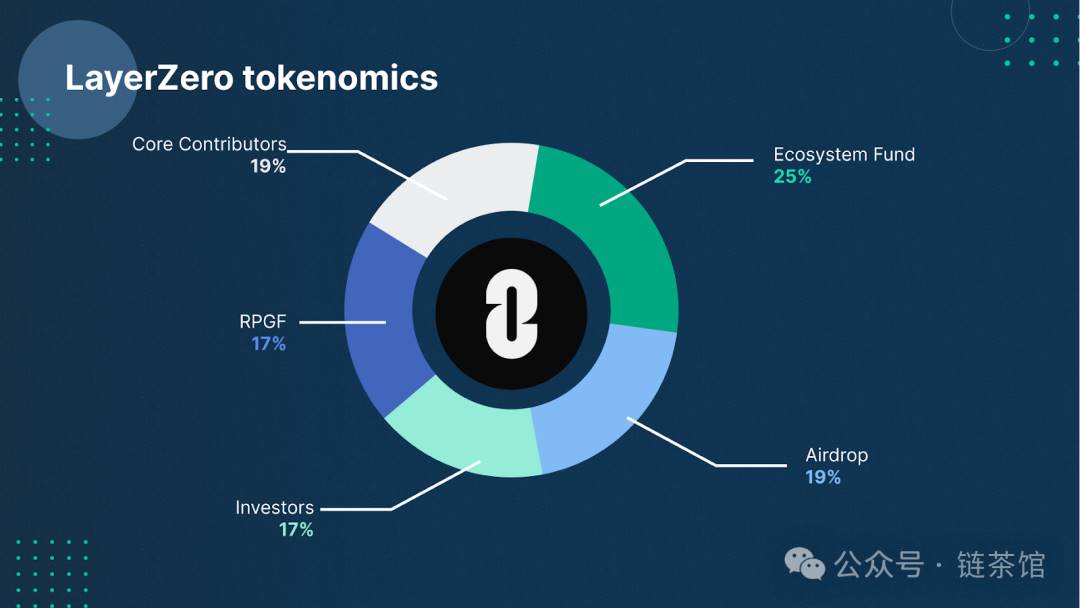
The initial distribution of the $ZRO token is as follows:
-
Ecosystem Fund: 25% (250 million)
-
Airdrop: 19% (190 million), of which 5% is allocated to IDO
-
Core Contributors: 19% (190 million)
-
Investors: 17% (170 million)
-
RPGF (Retroactive Public Goods Funding): 20% (200 million)
The circulating supply of $ZRO is 110,000,000 ZRO, with a total supply of 1,000,000,000 ZRO and a maximum supply of 1,000,000,000 ZRO.
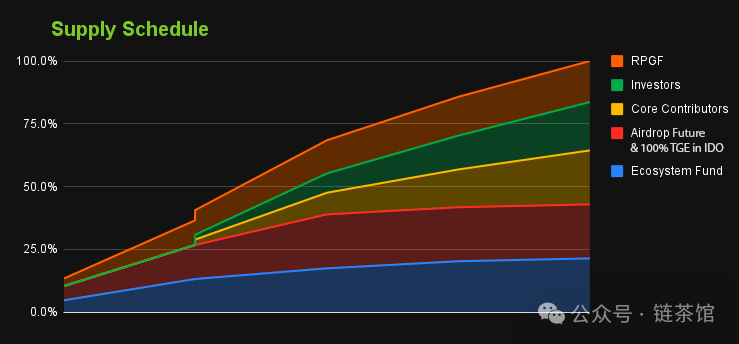
The $ZRO token release schedule is shown in the figure below:
Team / Funding Status
Bryan Pellegrino, co-founder and CEO of LayerZero Labs, graduated from the University of New Hampshire with a degree in Computer Science. He has served as an entrepreneur-in-residence, chief engineer for machine learning architecture, and co-founder of OpenToken.
Co-founder Caleb Banister specializes in writing and auditing smart contracts for blockchain-related projects. Caleb is a professional Solidity developer with a Bachelor’s degree in Computer Science from the University of New Hampshire. He is a skilled Java and Linux programmer building the future of multichain metaverse.
Another co-founder, Ryan Zarick, serves as Chief Technology Officer at LayerZero Labs. He is an experienced software developer and entrepreneur with over 10 years of experience in the tech industry. He co-founded Minimal AI, Coder Den, and 80Trill, and served as CTO at Buzzdraft. He holds a Master’s degree in Computer Science from the University of New Hampshire.
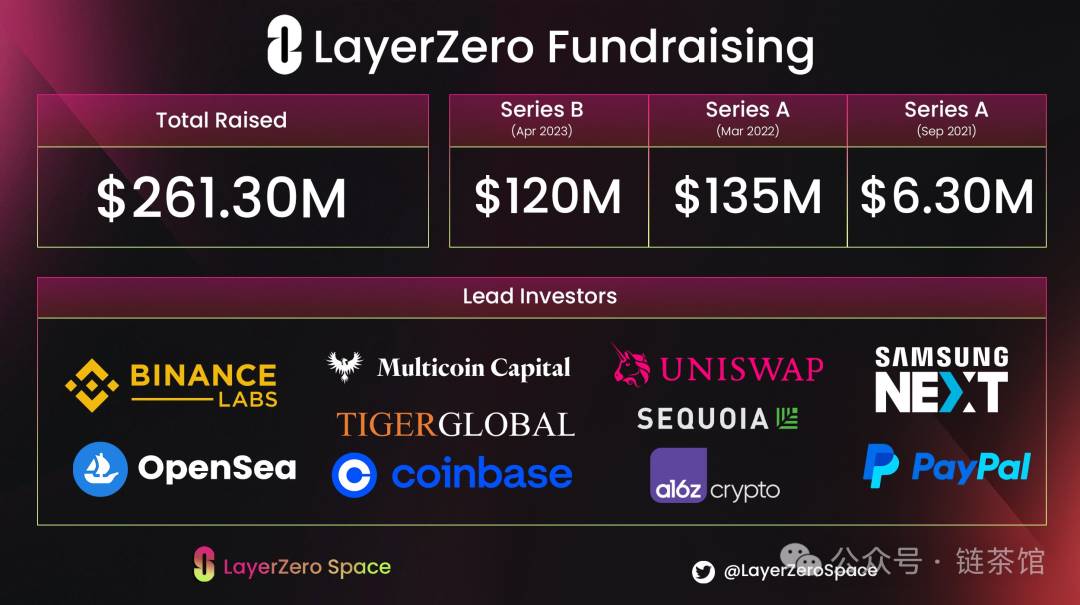
Since its inception, LayerZero has successfully completed multiple funding rounds, raising a total of $263 million, with a market valuation reaching $3 billion.
In its most recent Series B round, LayerZero raised $120 million on April 4, 2023, bringing its valuation to $3 billion. This round attracted participation from prominent investors including Andreessen Horowitz (a16z), Sequoia Capital, and Circle.
Previously, LayerZero completed a Series A1 round on March 30, 2022, raising $135 million at a $1 billion valuation. Key investors in this round included Andreessen Horowitz (a16z) and Sequoia Capital, reflecting strong market confidence in LayerZero’s technology and development.
Earlier, on September 16, 2021, LayerZero conducted a Series A round, successfully raising $6 million at a $50 million valuation. This early financial backing laid the foundation for LayerZero in the blockchain interoperability space and propelled the project’s initial growth.
Project Evaluation
LayerZero belongs to the cross-chain interoperability track within blockchain technology. The goal of this field is to solve communication and asset transfer problems between different blockchain networks, enhancing connectivity across the blockchain ecosystem.
Similar cross-chain interoperability projects to LayerZero include Wormhole.
Created by Jump Crypto, Wormhole is a decentralized cross-chain protocol designed to enable data and token transfers between different blockchains through a universal messaging protocol. Supported blockchains include Ethereum, Solana, Sui, Injective, and others.
Wormhole consists of 17 highly vetted Guardian nodes, which must confirm every transaction to ensure system security. It also supports cross-chain token and NFT transfers, has processed over 1 billion cross-chain messages, and is interoperable with Cosmos and Polkadot messaging systems. Additionally, Wormhole supports transferring NFT assets across multiple blockchain networks.
Wormhole could be considered the most mature protocol in the space and is the only one unconditionally approved for use by Uniswap. It claims to have handled over 1 billion cross-chain messages and interoperates with Cosmos and Polkadot messaging systems. Although Wormhole’s valuation may lag behind LayerZero, it has the highest adoption rate, and this momentum does not appear to be changing soon.
However, there are differences between LayerZero and Wormhole. Wormhole primarily relies on a fixed network of Guardian nodes, offering less flexibility, whereas LayerZero allows free selection of oracles and relayers, increasing system flexibility and modularity. Wormhole adopts a trust-dependent technical approach (wrapped assets held on bridge chains controlled by multisig accounts), while LayerZero uses light nodes running on destination chains that can package and send all transactions at once, directly transferring native assets between chains and avoiding complexity and risks during inter-chain transfers.
Therefore, Wormhole was exploited by hackers in 2022, resulting in a loss of 120,000 ETH (approximately $325 million), though its security has significantly improved since then. In contrast, LayerZero’s cross-chain system has never been successfully attacked by hackers to date.
Beyond security, LayerZero offers several additional advantages:
-
Scalability: Designed with scalability in mind, LayerZero can handle high transaction volumes without impacting performance, making it suitable for large-scale applications and enterprise integration.
-
Developer-Friendly: Offers a powerful suite of tools and APIs, making it easy for developers to build and deploy cross-chain applications.
-
Cost-Efficiency: Through LayerZero’s architecture, users can achieve cross-chain functionality without incurring high costs.
-
Ecosystem Support: LayerZero enjoys broad support from the blockchain community and industry stakeholders, forming a vibrant ecosystem of developers, users, and partners.
Although LayerZero’s design emphasizes scalability, it may sacrifice performance when handling extremely high transaction volumes or complex cross-chain operations. Ensuring optimal performance under all conditions remains a challenge the protocol must continuously address. Moreover, LayerZero’s security model depends on external validators such as oracles and relayers. While this enhances decentralization and security, compromised validators could introduce potential points of failure. Ensuring the reliability and trustworthiness of these external entities is critical to the protocol’s long-term viability.
However, given that LayerZero is still in its early stages and has only recently launched its token, it holds promising future potential. As long as its solutions continue to perform as claimed, and with more projects adopting robust interoperability solutions, the LayerZero ecosystem is bound to grow larger.
Join TechFlow official community to stay tuned
Telegram:https://t.me/TechFlowDaily
X (Twitter):https://x.com/TechFlowPost
X (Twitter) EN:https://x.com/BlockFlow_News