Deep Dive into Deso: Hybrid PoW Consensus, Social Graph, DID, and the Infinite State Applications Landscape
TechFlow Selected TechFlow Selected
Deep Dive into Deso: Hybrid PoW Consensus, Social Graph, DID, and the Infinite State Applications Landscape
Social media has changed the way we communicate, but not everyone believes these changes are always positive.
 Navigating Web3 tides with focused insights
Written by: Kadeem Clarke
Compiled by: TechFlow
Social media has transformed the way we communicate, but not everyone believes these changes are always positive. Many social media platforms have been criticized for failing to adequately moderate content, leading to the spread of misinformation.
Users are frustrated with how social media handles censorship, privacy, user control, data theft, and sharing. For example, Facebook and Instagram have faced legal action due to damaging user trust.
-
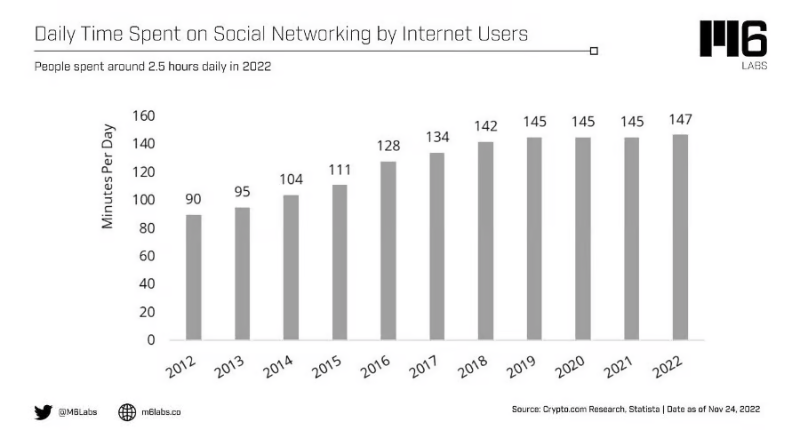
Over 4 billion people—more than half the world’s population—use social media. On average, internet users spend 2.5 hours per day on social platforms.
-
Data breaches are a common issue on social media. Your personal information could quickly appear on an illegal website. The 2021 Facebook breach is just one example—over 533 million users’ data was exposed. LinkedIn has also faced similar issues.
-
While big tech policies continue to evolve, decentralized social media may offer solutions.
DeSo – Decentralized Social
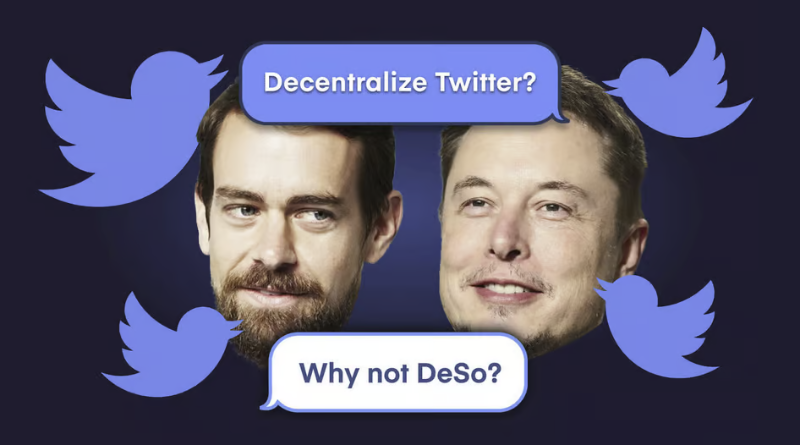
DeSo is a decentralized social network that not only gives users access to features found on most Web 2.0 platforms but improves upon them by allowing users greater control over their content and monetization options.
The native cryptocurrency of the Decentralized Social blockchain is $DESO. This unique Layer-1 blockchain is open-source and designed to support and scale social media applications requiring large amounts of data.
The Beginnings of DeSo
Nader Al-Naji, a former Google software engineer, founded Decentralized Social. His commitment to decentralized social media earned him the nickname “the killer of Facebook.”
In May 2019, BitClout began working on the Decentralized Social blockchain. Additionally, BitClout established the DeSo Foundation to support decentralization in social media and blockchain development.
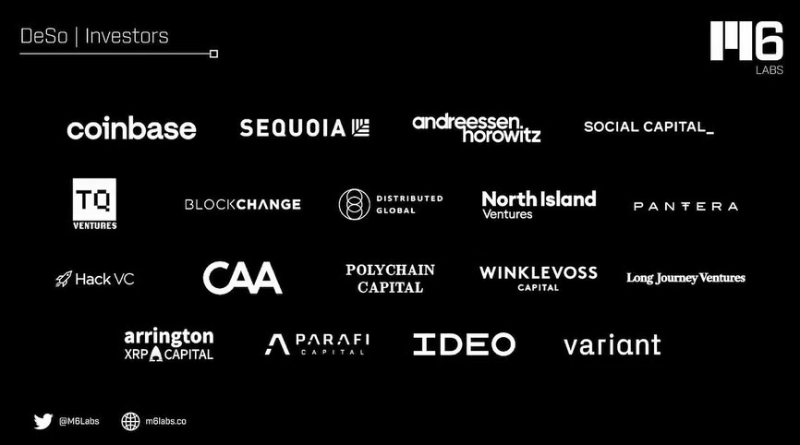
Several early investors supported the vision behind BitClout. A16z, Coinbase Ventures, Hack VC, Pantera Capital, Sequoia, and others contributed $200 million toward the development of the DeSo platform.
In December 2021, just months after launching the DESO platform, DESO was listed on Coinbase. Meeting its standards and requirements, DeSo became one of the fastest Layer-1 blockchains to be listed on an exchange.
Salil Shah joined the DeSo team in November 2022 to help grow the company. His current focus is on further developing the creator economy and enhancing Web3 functionalities on decentralized social media platforms.
DeSo's Mission
Like-minded individuals will come together through the DeSo platform, giving users more control over their social interactions. Thanks to its blockchain foundation, users will maintain a sense of privacy and an added layer of security when engaging with others.
DeSo provides users with a decentralized environment where they can manage every element of their social network. You’ll be able to access all your social media content on a single platform and thus truly own your data.
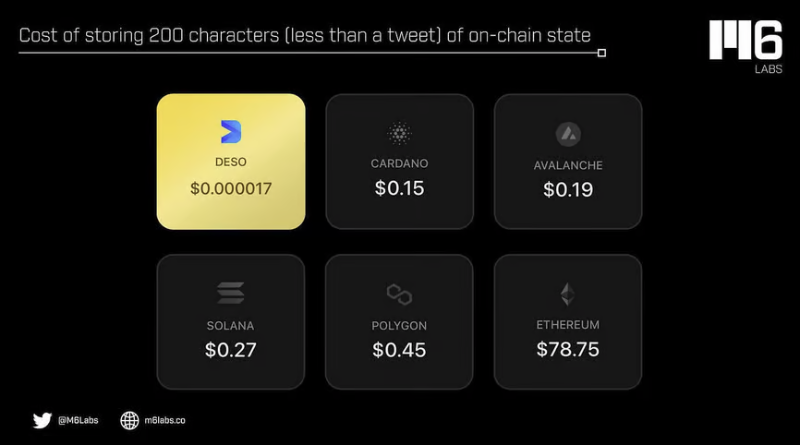
DeSo also simplifies the scaling of social media applications. To accommodate billions of users, Web 2.0 platforms require massive digital storage. In contrast, uploading "likes," images, and status updates onto blockchains like Ethereum would cost millions of dollars. According to their website, storing 200 characters on-chain costs just $0.000017 on DeSo, compared to $78.75 on Ethereum. No other solution, including Cardano or Avalanche, can match DeSo’s low storage costs.
According to information from their website, the best part is that anyone running a node to manage their feed also contributes data back to the public pool—profiles, posts, follows, etc.—stored on the public blockchain.
-
A post or like from a node on ESPN could appear on Politico’s feed. A post from China could show up on a feed running on a U.S.-based node, and vice versa. With each node operated, more content is contributed back to the global data pool stored on the blockchain, making every other node on the network stronger and more attractive to users.
-
In this way, DeSo can solve the collective action problem among independent publishers: publishers can now contribute to a public data pool that no one owns and will never be intermediated, rather than being forced to contribute to private data pools controlled by large corporations whose interests may not align with theirs.
-
Thus, we can transition from a world where data is a closely guarded private resource to one where it becomes a global utility accessible to anyone.
How Creators Can Earn on DeSo – Social Tokens, Social NFTs, and Social Tipping
Three product categories pioneered by DeSo have already revolutionized how creators monetize online content—and this is just the beginning.
-
Social Tokens
-
Social NFTs
-
Social Tipping
Anyone in the world can experiment with new ways for creators to earn money by building apps on DeSo, thanks to its open-source and monetizable nature.
For example, imagine a well-known creator wanting to start offering premium content in exchange for monthly subscriptions.
-
As soon as someone on the internet builds this feature, the entire ecosystem of DeSo apps gains immediate access to it.
-
The same applies to other features such as inboxes, where creators could be compensated for forwarding content or replying to fan messages.
-
The world’s top machine learning researchers could develop solutions with unrestricted access to full data streams, solving other challenges like identifying offensive content or eliminating spam, regardless of location.
At its core, the DeSo blockchain is an open protocol to which anyone in the world can contribute—ultimately enabling more ways to unlock creators’ true potential and restoring competition and innovation to social media.
Six Key Features of DeSo
Social media has several characteristics distinct from typical DeFi applications, especially regarding interaction and storage.
Hybrid PoW Consensus
Currently, the DeSo platform operates on a hybrid consensus mechanism. By leveraging the PoW model, the blockchain maintains high security while consuming significantly less energy than other major blockchains. The model is continuously being improved, and the development team plans to transition to a PoS protocol in the future.
Social Graph
Every post you like, every friend request you accept, and every status update forms your social graph.
Connections between users, groups, and organizations within a social network are all displayed in the social graph. All user data on decentralized social media is accessible. Therefore, social platforms and third parties cannot exploit your connections against you. Users can directly store all their posts and social graphs on-chain.
Hypersync x DeSo
Most blockchains are built to store only small amounts of data for efficiency. Social apps require unlimited data, whereas DeFi protocols typically need only a few bytes. Hypersync solves this problem and enables greater scalability.
Block downloading is the standard method for syncing blockchain activity—transactions are downloaded one by one. While fast, each transaction requires significant data. Hypersync helps users consume less data by providing a snapshot of block activity. Records are compressed, making them more compact and practical.
Infinite State Applications
Even using bridges to storage-focused blockchains like Arweave or Filecoin, most Web 2.0 applications cannot be implemented on today’s general-purpose blockchains due to high on-chain storage costs. Simply posting a link pointing to Arweave or Filecoin on any chain shown above would currently cost anywhere from $0.10 to over $1.00—unaffordable for many.
Most blockchains were developed to support finite-state applications with fixed storage needs; as these chains grow in popularity, costs may rise further. In contrast, social media applications are infinite-state programs capable of expanding indefinitely. The DeSo platform uses sophisticated, specially designed indexing systems to enhance scalability.
DeSo Identity Services
DeSo Identity Services development tools allow users to quickly store key pairs or credentials within DeSo-based applications. Developers don’t need to create complex forms or input validation to verify user identities. Instead, this is seamlessly integrated into the app.
Decentralized Social Apps
Hundreds of decentralized social apps are already live on the DeSo platform. With various development tools emerging, new apps frequently appear.
Among the most popular are:
-
Diamond: A decentralized version of Twitter that encourages engagement while offering new monetization methods for content creators.
-
Stori: A TikTok-like decentralized app focused on video content.
-
NFTz: A decentralized NFT marketplace similar to OpenSea, but with enhanced social and community elements.
-
DeSocialWorld: Connect with users worldwide in multiple languages.
-
DAODAO: Take your social fundraising to the next level through this unique Web3 platform.
-
Vibehut: Meet new friends based on shared interests or video chat with existing ones.
What Are Its Advantages?
Decentralized social may seem complex, but the DeSo platform is simple and intuitive, requiring little instruction.
Moreover, there are several unique advantages to using the DeSo platform that you won't find on other Web 2.0 social platforms.
Own Your Content
Although the most widely used platforms allow you to retain intellectual property rights, you may not control who sees your content. On the DeSo platform, your content remains under your authority at all times.
Get Paid for Your Content
As previously mentioned, the DeSo platform makes monetization straightforward. Content creators have multiple ways to earn extra income. Whether you want to convince people to buy your creator coin or receive social tips, all you need to do is start creating exciting content and communities to begin earning on DeSo.
As more people interact with your content, your potential earnings increase.
Building Apps Is Simple
The DeSo platform makes building new applications simple, with many resources available. The DeSo Developer Center is an excellent starting point for research related to your project.
Additionally, you can use any programming language you're already familiar with, such as Python or JavaScript. Since the DeSo platform is open-source, there are countless opportunities to leverage the Web3 social layer and build new applications.
Enhanced Privacy
Using blockchain technology makes it easier to maintain privacy on social media. Your data is securely stored on the DeSo platform rather than held by private companies.
Just like financial applications on blockchain, your data cannot be accessed without your permission.
Reduced Spam and Fake News
While content on the network isn’t centrally regulated, it does employ a reputation system. The accuracy of content you see can be rated through this decentralized system. Users are less likely to encounter individuals operating multiple accounts since they must pay for all activities.
With no algorithm controlling feeds, users can more precisely customize what content they see.
DeSo Roadmap
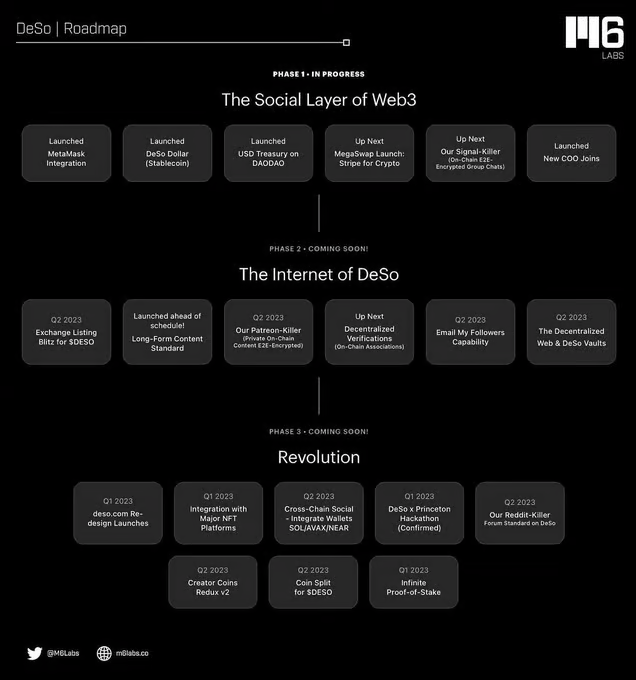
Phase 1 is still ongoing—the social layer of Web3—while Phase 2—DeSo’s internet—is approaching. The most exciting Phase 3, or so-called revolution, is also on the horizon:
Tokenomics
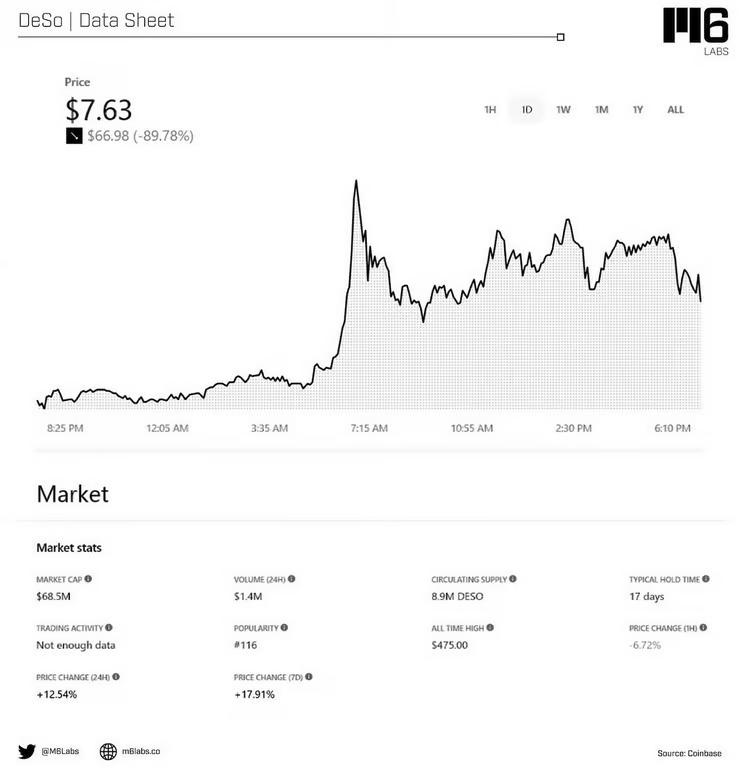
Since its initial release in June 2021, DESO’s price has experienced significant volatility. At launch, the token was valued at over $178.
After listing on Coinbase in December 2021, the token’s price briefly surged, reaching a peak of $438.10—an impressive 151% increase.
The blockchain is open-source, but a substantial reserve fund has been set aside for further development. The blockchain may experience price fluctuations in the future and attract more individual users through additional investments.
Conclusion
Over time, integration with other blockchain technologies could lead to broader adoption. For example, MetaMask integration allows users to engage in cross-chain interactions with various social applications.
Decentralized Social appears to effectively combine the benefits of blockchain with social media using cutting-edge Web3 technology. Investors may still need to assess what lies ahead. Nevertheless, the Decentralized Social platform offers several advantages, including low storage costs, enhanced privacy, and a wide range of decentralized social applications. It will be fascinating to observe how this evolving technology shapes the future of social media.
Join TechFlow official community to stay tuned
Telegram:https://t.me/TechFlowDaily
X (Twitter):https://x.com/TechFlowPost
X (Twitter) EN:https://x.com/BlockFlow_News
 M6 Labs