Ending the Domain Name Wars: Registry3's Vision and Practice of Unifying the Industry
TechFlow Selected TechFlow Selected
Ending the Domain Name Wars: Registry3's Vision and Practice of Unifying the Industry
In the martial arts world, everyone hopes for a renowned name. In the Web3 realm, a domain name is that identity.
 Navigating Web3 tides with focused insights
By Professor Zhou
Wherever people gather, there lies a martial world.
In navigating this martial world, everyone hopes for a renowned identity. In the Web3 realm, a domain name is precisely that identity.
To some extent, a domain is also a more intuitive form of identity than an address.
Yet currently, each chain and ecosystem appears to have its own domain service, forming isolated islands with little interconnection or synergistic effect. The allocation, management, and technical integration of different domains lack a unified framework and standard.
From a broader perspective, these issues directly impact whether the entire domain sector can achieve sustainable development.
Let us step into the martial world of Web3 domains, observe the chaos behind these problems, and witness the establishment of new rules for this江湖.
The Chaos in Web3 Domains
As we walk through the Web3 world, everyone has an on-chain address, but most struggle to remember their own or others’ complex string of letters and numbers. Similarly, in the Web2 world, we likely don’t know the IP address of Baidu’s homepage either.
We can access Baidu by typing baidu.com because DNS (Domain Name System) operates behind the scenes—translating human-readable URLs into IP addresses for seamless access.
ENS Paves the Way
Likewise, ENS pioneered the Web3 space by offering a DNS-like service: encapsulating complex on-chain addresses into readable, memorable names like 123.eth, which are then resolved back to their corresponding addresses during use.
Here, ENS itself is fundamentally a smart contract on-chain; each domain is minted as an NFT, allowing users full freedom to register, trade, transfer, and manage it.
The design logic of ENS isn't complicated—the registration and resolution functions largely mirror those of traditional internet domain services.
However, its emergence makes overcoming the inconvenience of raw on-chain addresses possible, reducing transaction errors. Registering an ENS domain allows users to express individuality and enables aggregation akin to a personal homepage: one can link social media profiles and assets under a single ENS domain page.
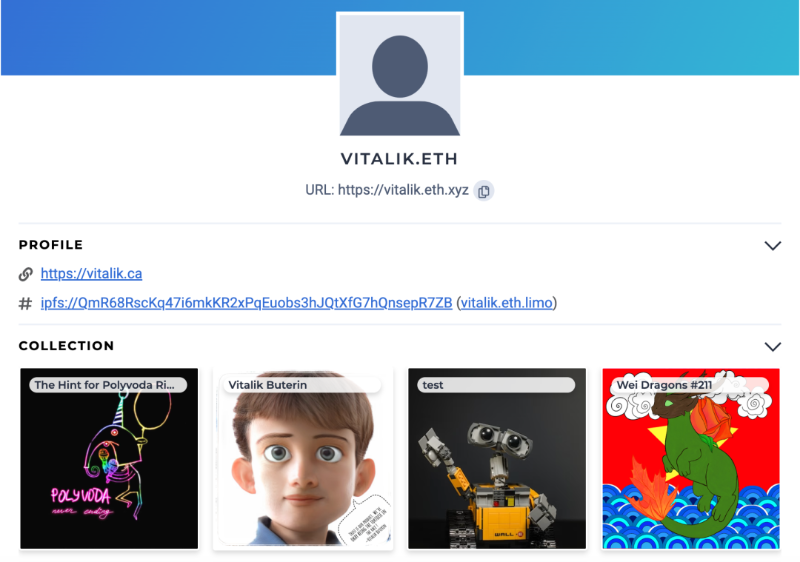
Thus, while preserving user data sovereignty, ENS achieves unification of uniqueness, readability, and aggregation in on-chain addressing. From the user's perspective, Web3 now has familiar “custom nicknames,” and obscure “0x” addresses gain personalized packaging.
The Rise of Fragmented Factions
With ENS making the first move, .eth gained growing fame in the realm.
But the broader Web3 landscape hosts numerous factions. As new blockchains compete fiercely, they naturally aim to establish their own domain systems within their ecosystems.
Meanwhile, exchanges, DApps, NFT projects, and domain providers all seek recognition in this space, inevitably claiming their share. Non-blockchain-specific domain suffixes have also emerged.
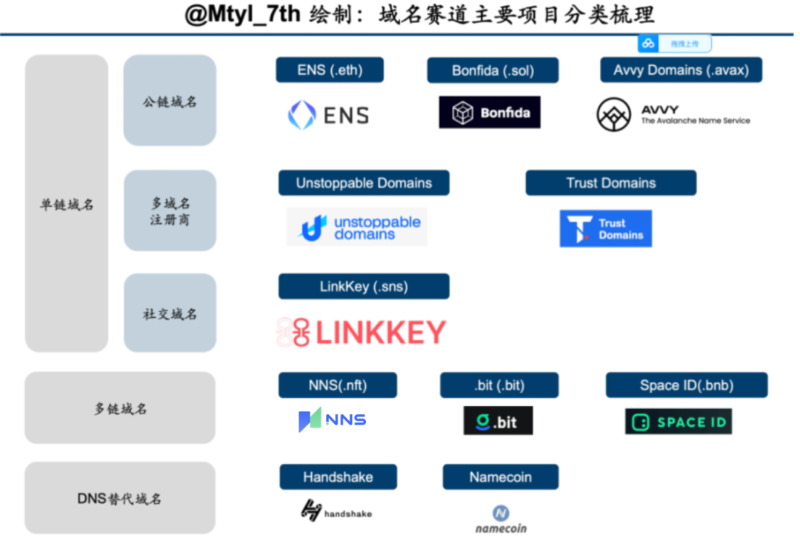
Image source: Chuan Lin - A&T Capital, "Comprehensive Insights into Web3 Domains: Use Cases, Market Landscape, and Future Challenges"
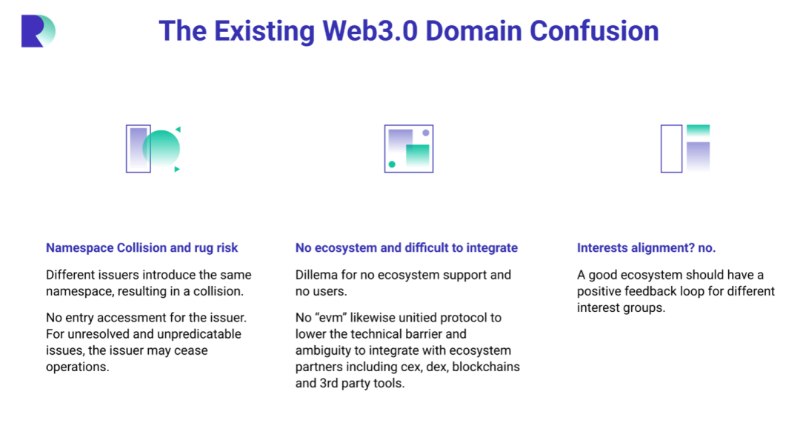
Competition thus became inevitable. Yet the resulting chaos generates negative externalities—pain points shared across the industry:
First, domain conflicts and fraud risks.
Since top-level domain allocation lacks clear rules, if Project A launches .abc domains first, Project B may no longer offer the same suffix. Or if both launch .abc, a naming conflict ensues, leading to disputes.
Additionally, ENS’s “zero-width character” issue reveals potential for domain spoofing—one seemingly identical domain might hide invisible characters, easily tricking users into wrong transfers. The market lacks a universally accepted way to distinguish genuine from fake domains. Also, should domains with different suffixes but the same prefix (e.g., 123.abc vs. 123.cba) point to the same person? Users face confusion and may resort to checking across multiple explorers.
Second, complexity in cross-ecosystem integration.
There are single-chain domains, multi-chain domains, and spaces enabling cross-chain domain display—each with distinct integration rules, technologies, and presentation methods.
For Web3 projects, registering, using, updating, maintaining, or transferring domains with different suffixes means complying with various issuers’ rules—an exhausting process of adaptation. Can you imagine if resolving Baidu used one rule set, while Google used another?
Finally, players lack shared incentives.
Different chains, exchanges, and projects each pursue their own goals, aiming to dominate in competition. With functionally similar domains, fragmented efforts are inevitable, resulting in isolated domain silos.
Under self-interest and localism, the success of Player A bears little relevance to Player B. The industry lacks a driving force capable of taking a holistic view to coordinate resource allocation, alignment, and ecosystem building for the domain sector.
When the entire domain sector faces common challenges, a collective solution becomes necessary.
Registry3: Establishing New Rules for the Realm
In this chaotic battle over domains, the influence of various factions seems unable to sustain continuous growth.
While ENS and similar services secure ownership on the demand side—ensuring domains and their resolved content belong fully to users—the supply-side issues grow increasingly apparent:
Who should get which domain? Which domain is legitimate? How do domains interoperate across chains? How can integration costs be reduced?
The key to solving these issues lies in establishing a widely recognized, inclusive, and clear set of rules (protocols and standards). Only when all players follow the same rules can friction decrease and efficiency improve.
Such rules already exist as successful precedents in Web2.
ICANN—the Internet Corporation for Assigned Names and Numbers—established domain allocation and management rules in the traditional internet world. It centrally manages IP address space, generic top-level domains (like .com), and country-code top-level domains (like .US).
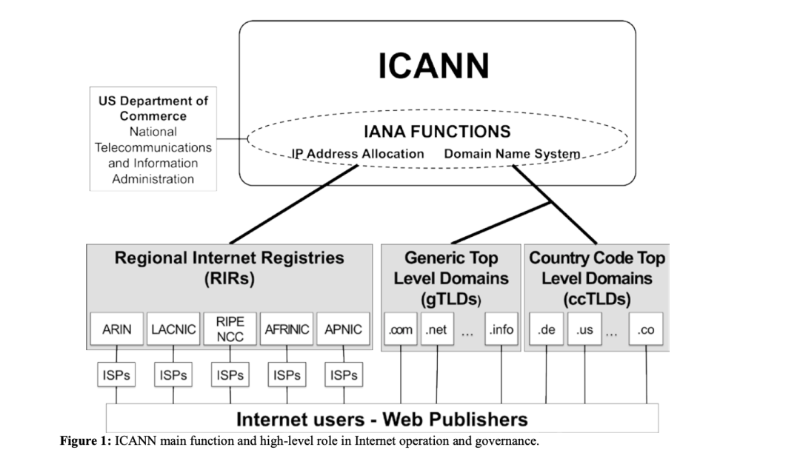
Image source: MIT academic paper: "Understanding ICANN’s Complexity in a Growing and Changing Internet"
You can think of ICANN as having created a globally unified standard to answer who gets which domain, how to register, and how to integrate. Precisely because of this shared rule set, global internet domains operate healthily, enabling applications and ecosystems to build upon them.
A Decentralized ICANN: Registry3’s New Rules
This old-world model offers valuable lessons for Web3.
In the Web3 domain space, we need a similar organization to establish new rules governing domain allocation and stakeholder coordination.
The recently launched project Registry3 aims to build exactly such a system: creating a framework to promote fair and open Web3 domain allocation, accelerating mass adoption through a comprehensive internal toolkit.
Delving deeper into its functionality, Registry3 resembles a "decentralized ICANN", striving to establish an industry standard for Web3 domains. Its product design spans domain allocation, technical integration, and management:
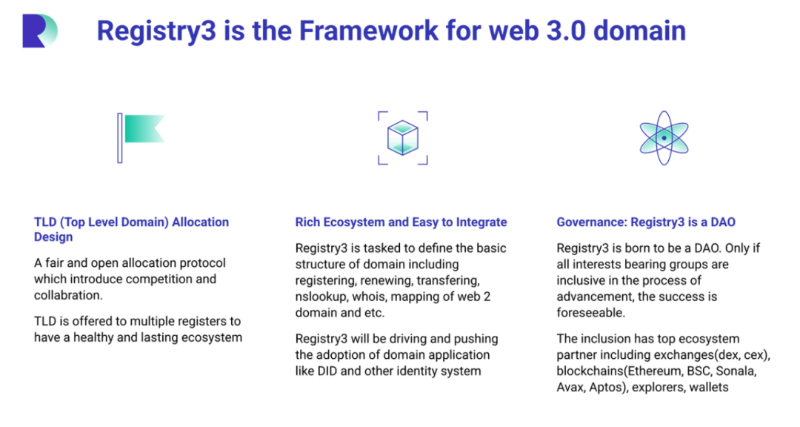
First: Design of Web3 Top-Level Domain Allocation Rules and CA Functions.
As mentioned earlier, suffix conflicts arise when two registrars offer the same suffix (e.g., ".abc"). This leads to disputes over priority and legitimacy. ICANN avoids this by centrally managing top-level domains (like .US and .UK) and allocating resources to different countries.
Similarly, Registry3 will design fair, open protocols incorporating mechanisms for competition and cooperation, conditionally issuing various Web3 top-level suffixes to multiple registrars to resolve such conflicts. While still in early stages, specific designs aren't fully public yet—but we anticipate token-based staking, bidding, and transfer mechanisms for top-level domains.
Additionally, Registry3 considers integrating CA (Certificate Authority) functionality. Due to issues like zero-width characters, visually identical domains may not be properly authenticated. Currently, only platforms like MetaMask and OpenSea provide inconsistent labeling. Registry3 plans to issue certificates verifying registered domains’ authenticity, mitigating spoofing risks.
Second: Unified and Simplified Domain Service Integration.
In today’s fragmented environment, integrating ".eth" requires ENS’s SDK, while ".bnb" needs SpaceID’s—there’s no unified process.
Registry3 defines a standardized technical integration specification. With multiple suffixes, developers won’t need separate SDKs—registrars only need to adopt Registry3’s unified SDK.
Like ICANN, processes such as domain resolution, renewal, transfer, auction, and WHOIS queries follow uniform standards, enabling smoother cross-chain and cross-ecosystem transitions.
Thanks to this standardization, once exchanges, wallets, and apps integrate via Registry3 (e.g., supporting .nft), they won’t need to re-evaluate security for every new .nft project—greatly simplifying identification and integration.
Finally: DAO-Based Governance for Domain Management.
ICANN is a centralized body shaped by Web2’s historical and international context. In Web3, however, DAOs better suit domain governance.
Exchanges, wallets, DApps, and even Web2 domain entities are stakeholders—they will inevitably engage in domain integration, verification, and redirection. Hence, involving them as DAO members in Registry3 is a natural progression. When new projects apply for domains, DAO members participate in security assessments, approving issuance only upon meeting criteria.
Moreover, DAO members form an alliance collectively responsible for the Web3 domain ecosystem, sharing benefits such as reduced integration costs, improved fraud detection, and enhanced cross-ecosystem interoperability.
Implementing the Rules: Chain, Nodes, and Ecosystem
Join TechFlow official community to stay tuned
Telegram:https://t.me/TechFlowDaily
X (Twitter):https://x.com/TechFlowPost
X (Twitter) EN:https://x.com/BlockFlow_News
Related Articles
A 15,000-person Caribbean island generates half its government budget by selling .ai domain names.
More than 2,000 new domains enter the registration system daily, with each domain representing revenue flowing into Anguilla’s treasury.

.io domain's fate uncertain? 16% of Web3 companies use .io
16% of Web3 companies use .io. Historically, ccTLDs (country code top-level domains) have been removed five times.

When .io Domains Face Crisis: A Domain's Rise and Fall Altered by Geopolitics
Be careful when choosing a top-level domain.

Deep Dive into Deso: Hybrid PoW Consensus, Social Graph, DID, and the Infinite State Applications Landscape
Social media has changed the way we communicate, but not everyone believes these changes are always positive.

KEY3.id launches Bored Ape domain .bayc, the first digital identity soulbound to a blue-chip NFT
DID application KEY3.id launched its first blue-chip NFT-backed .bayc digital identity (DID) today at 8:00 PM, now open for minting to all Bored Ape Yacht Club (BAYC) NFT holders.

DID: The Quest for Credit and Permissionlessness
The credit system is the cornerstone of a frictionless society, offering everyone the possibility of equal dignity and happiness.

End-to-End: The Decentralized Link Built by DID and On-Chain Data
When we push open the door to Web 3.0, all we see is desolation.

Learning from History: A Review and Outlook on the Evolution of Blockchain Sectors
When innovation in token business models, product maturity, and application narrative innovation converge, we will迎来 the next major cycle opportunity.

MM3 NFT: Splitting and Composability, Innovative Thoughts on DID
What kind of form and demand can drive more sustainable user and traffic growth?

After the Run on Banks: Predictions and Reflections—Privacy, Credit, DID
Demand in the following sectors—privacy, credit, decentralized identity, and reputation systems—may grow as flaws exposed by bank runs become apparent.