Web3 will not be built on existing smart contract public blockchains
TechFlow Selected TechFlow Selected
Web3 will not be built on existing smart contract public blockchains
General-purpose blockchains excel in DeFi, but expanding beyond DeFi will require new architectures.
 Navigating Web3 tides with focused insights
By: Deso
Note: This is an article published by the social blockchain DeSo, arguing that future Web3.0 applications such as social networking should not be built on existing general-purpose smart contract blockchains, but rather require customized blockchains to fully realize the potential of Web3.
Many people believe that general-purpose blockchains like ETH, ADA, Avalanche, and Solana will power everything on the internet—including financial applications, social apps, and even marketplaces like Amazon.
But a serious issue has been widely overlooked: on-chain storage.
While today’s general-purpose blockchains work well for light-storage applications like DeFi, they cannot scale to handle heavy-storage applications such as social platforms and marketplaces. Imagine a world where every "like" or follow in a decentralized app costs over $1 in storage fees. Unfortunately, all current general-purpose blockchains have inherent storage limitations.
The numbers don’t lie. The table below illustrates how the cost of storing just 1GB of on-chain state varies across different blockchains. Crucially, as general-purpose blockchains grow more popular, storage becomes scarcer and these costs are expected to rise only further. We’ll discuss DeSo as a special case later.
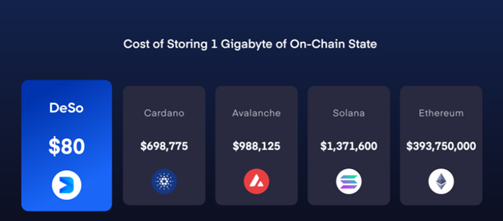
Even with storage-focused blockchain bridges like Arweave or Filecoin, the high cost of on-chain storage prevents most Web 2.0 applications from operating on today's general-purpose blockchains. At current prices, storing even a single link pointing to Arweave or Filecoin on a general chain costs $0.1–$1—prohibitively expensive. As these networks grow more popular, costs may rise further because they weren't designed for scalable storage.
Moreover, while many blockchains claim to support tens of thousands of transactions per second (TPS), this metric fails to account for the storage footprint of real-world applications. Fifty thousand DeFi transactions might generate zero bytes of new state data, whereas fifty thousand social transactions could produce dozens of megabytes requiring storage, indexing, and querying. Today, even the most advanced blockchains cannot handle the latter type of workload, severely limiting the development of compelling Web3 applications.
For years, we've researched ways to overcome this challenge. We believe all storage-intensive Web3 applications—such as social platforms and marketplaces—require new types of blockchains. This is because, as we'll explain, these applications are infinite-state applications, not finite-state ones.
From Finite State to Infinite State
All general-purpose blockchains available today are built to support what we call finite-state applications. In these apps, the amount of data—or state—you must retain per user is limited. For example, to build a financial application, you only need to track each user’s account balance. Users can transfer funds millions of times, yet you ultimately store just a few numbers representing final balances. In other words, your required state scales with the number of users, not the number of transactions.
Surprisingly, nearly all decentralized finance (DeFi) consists of finite-state applications. As long as you can store small account balances, you can build arbitrarily complex tools for trading, lending, etc.—you never need to store anything beyond final end-of-period balances.
This works because transactions in DeFi apps are state-neutral—they modify existing balances without appending new data to the state. The problem arises when blockchains attempt to disrupt domains beyond finance, where they must handle a completely different class of applications: infinite-state applications.
Now consider areas beyond finance. Infinite-state applications are those whose required storage grows indefinitely with the number of actions each user performs. Take a typical social app: users create profiles, add statuses, post content, follow others, give likes—all generating new data. Unlike DeFi, where transactions are state-neutral, every action in a social app enhances the state.
With social apps, you must store unlimited amounts of data—not just account balances. Worse, this state must be frequently queried by other users, demanding high availability. Unfortunately, many of today’s most popular applications—including most social platforms and marketplaces—are infinite-state. Moreover, as we’ll discuss, no existing general-purpose blockchain on the market today can handle such applications.
Inevitable Congestion on General-Purpose Chains
All general-purpose blockchains today—including ETH, ADA, Avalanche, Solana, and others—lack the capacity to handle infinite-state applications like social platforms or marketplaces. Scaling infinite-state apps—even for a small number of users—requires solutions tailored to their specific storage and indexing demands. Remember: 50,000 state-neutral transactions per second are fundamentally different from 50,000 state-augmenting transactions per second.
For instance, most modern general-purpose blockchains maintain high TPS by storing all account states in memory. This works fine—and is optimal—for finite-state apps like DeFi. But once someone tries to build an infinite-state app on your chain, you’re forced to store potentially megabytes or more per user, quickly exceeding memory limits. Furthermore, a general-purpose chain cannot intelligently decide which account states belong in memory and which don’t. It also cannot index data for real-time querying.
As a result, all general-purpose blockchains today impose strict storage limits to remain viable. This causes storage costs to skyrocket, making it nearly impossible to build infinite-state apps on them—and the situation worsens as these chains gain popularity.
No one attempts to build infinite-state applications on general-purpose blockchains because it’s impossible to do so at low enough cost. Yet there are many compelling use cases in the infinite-state domain. In fact, the vast majority of Web 2 applications—from Facebook and Instagram to Amazon—are infinite-state. So if you can’t even build most Web 2 apps on today’s finite-state chains, how can Web3 succeed? Worse, just one person building an infinite-state app on a general blockchain can congest storage for everyone. Think of sharing a dorm room—if one roommate makes a mess, the whole space becomes cluttered. Similarly, launching a full-scale social app or marketplace—even on a newer general blockchain—quickly hits inherent storage limits, rendering all infinite-state apps nearly unusable within a short time. This tragedy of the commons is already playing out on Ethereum and beginning to unfold on Solana.
Scaling Infinite-State Applications with DeSo
To meet the storage and indexing demands of infinite-state applications, we believe blockchains must be customized for the specific application at hand. Without assumptions about the type of data being stored (the schema), the cost of storing, indexing, and querying data rises sharply, making on-chain applications non-competitive.
Take a concrete example: the decentralized social blockchain, known as DeSo. DeSo is custom-built end-to-end to support social applications, meaning all its stored and indexed data follows a predefined schema.
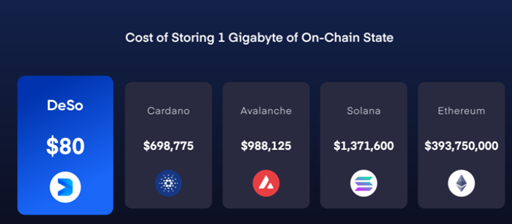
Files are stored and indexed differently than posts, which differ from follows, and so on. This level of customization makes storage on DeSo up to 10,000x cheaper than on Avalanche or Solana, while also enabling all DeSo nodes to deliver instant queries for relevant data. Queries like “who liked this post” or “who follows this user” are effectively instantaneous—something prohibitively expensive if data were unstructured. This also makes it easier for developers to build on DeSo, explaining why over 100 apps—including Diamond, PolyGram, Cloutfeed, Pulse, Supernovas, and more—are already live on the platform.
The simple table below shows how the cost of storing 1GB of on-chain state varies across blockchains. Notably, as storage becomes scarcer, rent on general-purpose chains is expected to increase over time. In contrast, DeSo’s costs are expected to remain fixed—or even decrease—because it is purpose-built for infinite-state use cases:
Interestingly, although DeSo was designed specifically for social applications, it can support any infinite-state application—as long as the data schema is well-defined. The key is that each new application type receives native-level support, with storage and indexing optimized accordingly. Over time, as network effects grow around the DeSo blockchain, it could expand to support marketplace data structures and beyond, potentially disrupting not just social media giants but much of Web 2.0.
On Storage-Focused Blockchains
It’s worth noting that some blockchains specialize in storage, such as Filecoin or Arweave. A common suggestion is to combine these with general-purpose blockchains to alleviate storage constraints. However, in practice, the cost remains too high—even storing a simple link to Filecoin or Arweave costs $0.1–$1 per item at current prices. Building most infinite-state apps using such bridges is financially unfeasible, and costs will only rise as these chains become more popular. Additionally, data stored on Filecoin or Arweave isn’t properly indexed, necessitating a separate indexing layer for each application at scale—an added complexity with its own rising operational and incentive costs.
As mentioned earlier, Arweave can store unindexed data (so-called blob storage). If users choose, the DeSo blockchain allows images and videos to be stored on Arweave, while DeSo itself stores only a reference link—avoiding both on-chain bloat and centralized services. Critically, because storing such a link on DeSo costs virtually nothing (~$0.0000184), DeSo can integrate these systems in ways general-purpose blockchains cannot today.
Conclusion
We believe most of the crypto space underestimates the difficulty of storing and indexing data at scale. For too long, the field has been confined to finite-state applications, overlooking the broad category of infinite-state applications—like social platforms and marketplaces—that make up the majority of Web 2.0. Given the inherent storage and indexing limitations of existing general-purpose chains, we believe customized blockchains are needed to unlock new use cases and allow Web3 to reach its full potential.
Join TechFlow official community to stay tuned
Telegram:https://t.me/TechFlowDaily
X (Twitter):https://x.com/TechFlowPost
X (Twitter) EN:https://x.com/BlockFlow_News