SynFutures: Taking Decentralized Derivatives Finance to the End
TechFlow Selected TechFlow Selected
SynFutures: Taking Decentralized Derivatives Finance to the End
SynFutures is a platform focused on building a fully decentralized and high-performance perpetual contract exchange.
 Navigating Web3 tides with focused insights
Author: Zhaomou
Preface: The author first became aware of SynFutures in 2023 through an interview conducted by its founder Matthew Liu with renowned trader Jez, during which Jez publicly revealed his true identity for the first time. Later learning that the project was backed by a top-tier lineup of blockchain venture capital firms, the author began closely following SynFutures. Both founders previously led the initial blockchain platform initiatives at traditional financial institutions, where they developed a strong interest in blockchain technology. Given their professional backgrounds in derivatives at Deutsche Bank, the idea for a decentralized derivatives exchange—SynFutures—naturally emerged.
SynFutures is focused on building a fully decentralized and high-performance perpetual contracts exchange. Anyone can list and trade futures and perpetuals on any asset within the platform. After three iterations, SynFutures has pioneered a unique oAMM mechanism for perpetual contracts.
1. Funding Overview:
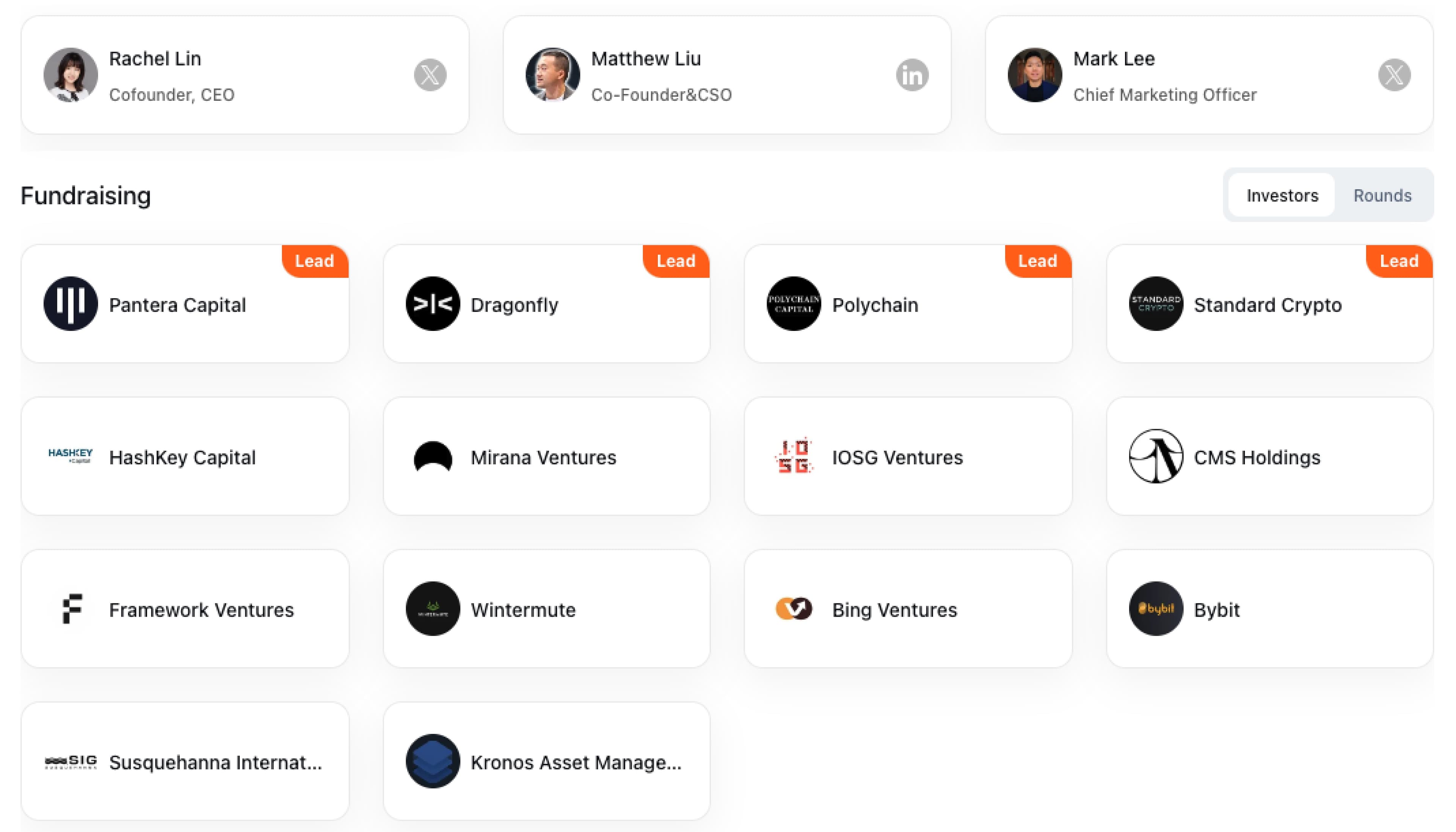
Led by Pantera Capital, Dragonfly, Polychain, and Standard Crypto, with participation from Framework Ventures, CMS Holdings, Wintermute, Hashkey Capital, Mirana Ventures, IOSG Ventures, Bing Ventures, Bybit, Susquehanna International Group, and Kronos Asset Management. The project has completed three public funding rounds totaling $38 million, with the latest round closing in October 2023.
2. Team Members:
Rachel Lin, Co-founder and CEO, previously held senior roles at Matrixport, Bitmain, and Deutsche Bank’s Global Markets division. She holds degrees from Peking University and the National University of Singapore.
Matthew Liu, Co-founder and CSO, formerly worked as a bond products trader at Deutsche Bank. He graduated from Peking University and the Kellogg School of Management at Northwestern University.
Mark Lee, CMO, previously founded Eightfive PR.
3. Timeline:
February 2021: Project launched.
June 2021: V1 alpha launched and audited, deployed on Polygon, announced $14 million in Series A funding.
July 2021: Launched innovative product—decentralized BTC hash rate futures.
September 2021: Deployed on Arbitrum, BSC, and Ethereum. Introduced FutureX—the DAO pre-committee of SynFutures—to pave the way for decentralized development and governance. The committee initially consisted of community representatives, investors, core contributors, and guest speakers. So far, 19 discussion sessions have been held.
October to December 2021: Hosted three trading competitions. Launched SynAcademy and published blockchain education articles.
December 2021: Began forming partnerships with other projects to build its ecosystem.
February 2022: Partnered with Footprint to launch a dashboard.
March 2022: Enabled users to self-list and trade any asset.
May 2022: Launched V2 testnet and completed audit.
September 2022: Launched bug bounty program. V2 mainnet went live, along with another trading competition.
January 2023: Launched NFTures, an NFT futures trading platform.
June 2023: V2 deployed on zkSync.
October 2023: Launched V3 public testnet. Announced $22 million in Series B funding.
March 2024: V3 deployed on Blast and passed audit, launching points campaign and trading competition.
4. oAMM Mechanism
Adhering to the DeFi principles of decentralization and permissionless access, SynFutures introduced SynFutures V3 after two prior iterations, featuring the innovative Oyster AMM model, which warrants deeper exploration.
Key features include:
1. Single-token concentrated liquidity for derivatives. Each derivative pair has its own dedicated liquidity pool, avoiding systemic risks across the entire system. Liquidity providers (LPs) only need to deposit one token, eliminating the complexity of dual-token provisioning. Built on Uniswap V3’s concentrated liquidity model, capital efficiency is significantly improved. The AMM model democratizes market access and enables automated market-making even for niche assets, enhancing diversity.
2. Fully on-chain order book. Being fully integrated into the on-chain ecosystem ensures no backdoors, no user fund misappropriation, and no hybrid cross-chain or off-chain dependencies that could lead to system outages. This setup offers professional market makers a more efficient environment. SynFutures V3 combines the AMM model with a fully on-chain order book to enhance trading depth.
As a purely on-chain contract, oAMM naturally integrates and evolves with the underlying blockchain ecosystem—a feature lacking in many semi-centralized exchanges. One of DeFi’s most attractive aspects is composability—the ability to stack protocols like "matryoshka dolls." Additionally, all data is stored on-chain and verifiable by anyone, so traders don’t need to worry about centralized risks such as exchange downtime, disconnections ("pulling the plug"), or fund misuse.
3. Unified liquidity. Oyster AMM seamlessly integrates concentrated liquidity and order book models into a single framework. In this model, concentrated liquidity (CLAMM) is represented by curves, while limit orders are represented as price points. The combination of CLAMM coverage and all open limit orders at a given price point forms a "pearl." When applicable, limit orders are executed before any concentrated liquidity is consumed.
4. User-protective stability mechanisms. Oyster AMM introduces financial risk management tools to enhance user protection and price stability. These include a dynamic penalty system that discourages price manipulation by penalizing significant deviations between trade prices and mark prices. A dynamic fee structure also balances LPs’ risk-return profiles. Another mechanism is the stable mark price design, which uses an exponential moving average process to mitigate sudden price swings and reduce the risk of mass liquidations.
The following explanation helps non-order-book LPs understand concentrated liquidity in Oyster AMM.
As a concentrated liquidity provider, an LP must specify two parameters in a designated pool: the margin amount provided and the price range for liquidity provision. This price range functions similarly to Uniswap V3—when the price moves outside the defined range, liquidity provision ceases.
When an LP adds liquidity to Oyster AMM, a long position is created in the liquidity pool, while an offsetting short position is created in the LP’s account. The sum of these two positions equals the LP’s net position. At creation, the long and short positions are equal, resulting in a net position of zero. (This short position cannot be managed independently but is handled collectively within the liquidity position.)
A wider price range results in fewer long positions created; a narrower range leads to more. As the price fluctuates within the set range, changes in net position and remaining margin occur according to the oAMM mechanism.
By analogy with Uniswap V3’s AMM model, the xyk curve in oAMM reflects changes in the size of the created long position, with the x-axis and y-axis representing base and quote assets respectively. Margin changes are governed by a separate formula.

Virtual price curve in Oyster AMM
Withdrawing Liquidity:
An LP can withdraw liquidity from their concentrated position at any time, converting it into a tradable position sized according to the implied net position, remaining margin, and accrued fees. Once converted, the LP can manage this trading position accordingly.
If the market price falls below the lower bound of the price range, the system automatically removes the LP’s liquidity and converts it into a long position. If the market price exceeds the upper bound, liquidity is automatically removed and converted into a short position.
Since risk in the pool is balanced, at any given price, every long position corresponds to a matching short. Assume the current price is 1000. The price drops only when more traders open market shorts. Suppose LP Alice provides a long position of 100 and an offsetting short of 100. If the price drops from 1000 to 999, indicating market shorting activity, and a trader executes a market short of size 20, Alice’s position becomes: long increased to 120, short unchanged at 100—resulting in a net long of 20. Conversely, if the price rises to 1001 due to market buying, and a trader opens a market long of 20, Alice’s long is reduced to 80, while her short remains at 100—resulting in a net short of 20.
Let us define some key parameters:
Let M denote the total value of tokens deposited by an LP, also representing the total margin amount in USDC.
Let Pc represent the current price of Token0 in terms of Token1.
Let Pa and Pb denote the lower and upper bounds of the selected price range.
Let α be the LP’s price range parameter, where Pb = α·Pc and Pa = Pc/α, with (α > 1).
Let ri represent the initial margin requirement ratio.
Let xvirtual and yvirtual denote the implied x and y values under the full-range constant product model.
An initial real long position xreal is created in the pool, and an equal-sized offsetting short is created for the LP.
In Oyster AMM:
Initial long position:

Implied net position when price reaches upper bound Pb:

Margin PnL when price reaches Pb:

Replacing Pb with Pa in the above formulas yields the implied net position and margin PnL when price reaches the lower bound Pa.
Let’s consider a concrete example: Bob deposits 1,000 USDB as margin into the WBTC/USDB pool when WBTC is priced at 61,879, setting the price range parameter α = 3. (The pool’s initial margin requirement ratio ri is set at 3%, allowing up to 33.3x leverage.)
We derive: M = 1,000, Pc = 61,879,
Pa ≈ Pc / α = 20,626, Pb ≈ α·Pc = 185,637.
Initial long position xreal = 0.0119 (worth ~736 USDB)
NetPosition(Pa) = 0.0206 when price reaches Pa
PnL(Pa) = -311 (remaining margin: 1,000 - 311 = 689)
The following data is derived from actual platform calculations (minor discrepancies from theoretical values exist because SynFutures' frontend does not allow direct α customization—only manual price range adjustment):
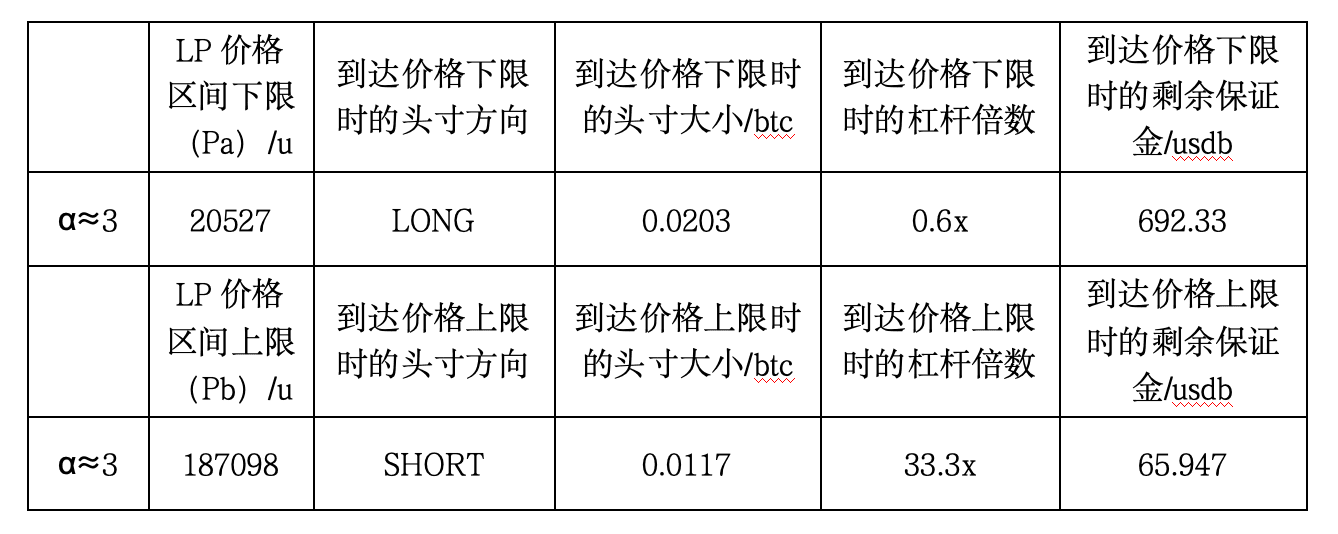
LP position in WBTC/USDB pool when WBTC price is 61,879
5. Progress and Outlook
SynFutures now supports numerous long-tail asset pairs such as $YES, $PAC, $DEGEN, $WIF, and $MERL, surpassing $50 billion in cumulative trading volume. It consistently maintains around 15% daily trading volume share among decentralized derivatives platforms. According to DeFillama data, SynFutures ranks among the top three in daily trading volume for decentralized derivatives exchanges.
The platform continues active updates, including mobile trading and LP functionality, enhanced data visualization in depth charts, and optimized portfolio pages. User feedback is collected promptly and addressed quickly.
Additionally, SynFutures is actively collaborating with major exchanges for broader promotion. We look forward to even stronger performance in 2024, pushing the on-chain derivatives market to new levels of activity.
Join TechFlow official community to stay tuned
Telegram:https://t.me/TechFlowDaily
X (Twitter):https://x.com/TechFlowPost
X (Twitter) EN:https://x.com/BlockFlow_News