Coinbase: A Comprehensive Overview of the Zero-Knowledge Proof Landscape
TechFlow Selected TechFlow Selected
Coinbase: A Comprehensive Overview of the Zero-Knowledge Proof Landscape
This article will conduct an in-depth analysis of the zero-knowledge proof ecosystem from three layers: infrastructure, network, and applications.
 Navigating Web3 tides with focused insights
Author: Jonathan King
Translation: TechFlow
Zero-knowledge proof (ZKP) technology has emerged as a major breakthrough in the field of cryptography. This article will explore the core principles of zero-knowledge proofs, their practical applications, and their impact on blockchain scalability, privacy-preserving applications, and trustless interoperability. With increasing investment in this technology throughout 2023, zero-knowledge proofs have not only advanced theoretically but also demonstrated broad application prospects in practice. We will conduct an in-depth analysis of the ZKP ecosystem across three layers—infrastructure, networks, and applications—revealing how it ushers in a new era of blockchain technology.
Summary
-
Zero-knowledge proofs (ZKPs) and their derivative technologies represent a significant breakthrough in cryptography and are largely seen as the ultimate goal of blockchain design.
-
Today, zero-knowledge proofs are increasingly becoming promising solutions to unresolved issues in web3, including blockchain scalability, privacy-preserving applications, and trustless interoperability.
-
In 2023, over $400 million was invested in zero-knowledge technologies, primarily focused on Ethereum L1/L2 protocol-layer scalability, emerging infrastructure, and developer tools.
-
The zero-knowledge domain can be divided into three layers:
-
1) Infrastructure—the tools/hardware used to build protocols/applications atop zero-knowledge primitives
-
2) Networks—the L1/L2 protocols leveraging zero-knowledge proof systems
-
3) Applications—end-user products utilizing zero-knowledge mechanisms
-
-
Although the zero-knowledge ecosystem is still in its early stages, its rapid development holds promise for ushering in a new era of secure, private, and scalable blockchain solutions.
Introduction

Zero-knowledge proofs (ZKPs) and their derivative technologies are widely regarded as the ultimate objective of blockchain design—particularly in providing solutions that require minimal trust assumptions when verifying information on-chain. At its core, a zero-knowledge proof is a cryptographic technique that allows one party (the prover) to demonstrate to another party (the verifier) that a certain computation is valid without revealing any underlying data used to generate that computation. Originating in 1985, ZKPs have evolved from theoretical constructs into practical applications, overcoming decades of latency through recent advancements in software tools and hardware.
Today, zero-knowledge proofs offer promising solutions to some of the biggest challenges facing Web3, including:
-
Blockchain Scalability: One of the biggest challenges facing Ethereum L1 is scalability. However, the emergence of L2 networks enables faster and cheaper transactions without compromising Ethereum’s security or decentralization. While optimistic rollups remain dominant due to high EVM compatibility and developer-friendliness, adoption of ZK rollups is steadily increasing. Zero-knowledge proofs help summarize complex computations off-chain, enhancing L2 designs for fast and efficient on-chain verification and settlement.
-
Privacy-Preserving Applications: To date, work on privacy within the blockchain space has largely been limited to hiding transactions. However, researchers are gradually moving toward achieving full transaction anonymity and confidentiality on public blockchains. Importantly, novel privacy-preserving concepts using ZKPs are emerging, aiming to break the trade-off between protecting user privacy and ensuring compliance (i.e., preventing illicit activities).
-
Trustless Interoperability: Existing blockchain interoperability protocols rely on trusted systems (e.g., multisig or incentivized validator sets). Zero-knowledge proofs can replace crypto-economic trust assumptions with cryptographic guarantees, paving the way for more secure and robust cross-chain communication. Among the primary applications of ZKPs, however, interoperability remains the most nascent.
According to Messari, over $400 million was invested in the zero-knowledge space in 2023, emphasizing scalability at the Ethereum L1/L2 layers and emerging zero-knowledge developer infrastructure. Although relatively new, the rapidly evolving ZKP ecosystem signals a convergence toward best practices for more secure, private, and scalable blockchain applications. With this framework in mind, let’s take a closer look at the layered landscape of zero knowledge, exploring key players and emerging concepts.
Infrastructure
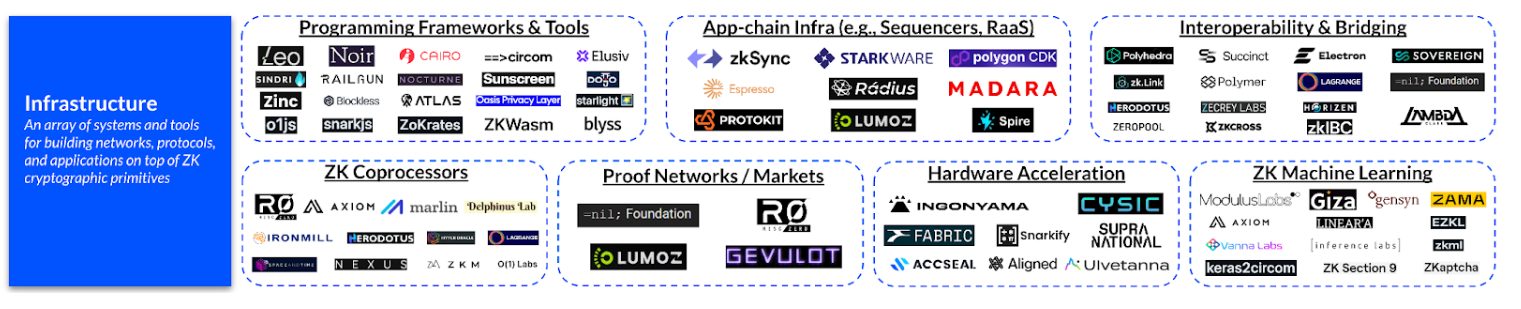
All forms of zero-knowledge proofs must be written in arithmetic circuit languages, which are limited in expressiveness and make converting most blockchain functions into circuit form highly complex. Limitations in developer tools and high-end hardware meant real-world ZKP use cases only began developing recently. Today, we see a growing suite of systems and tools enabling developers to build protocols and applications atop zero-knowledge cryptographic toolkits.
Programming Frameworks and Tools: Domain-specific languages (DSLs) such as Leo, Noir, Cairo, and o1js are programming frameworks designed to develop provable zero-knowledge programs within specific L1/L2 ecosystems (Aleo, Aztec, Starkware, and Mina, respectively). Additionally, general-purpose frameworks like Elusiv and Hinkal are emerging, aiming to allow developers to define standards so transaction data can be shielded on-chain while still being verified via zero-knowledge proofs. Adoption of these frameworks is expected to grow alongside rising demand from potential developers and end-users of ZK-powered applications.
Zero-Knowledge Coprocessors: Zero-knowledge coprocessors provide developers with cost-effective and trustless off-chain computational power while eliminating the need to handle complex ZK components within their tech stack. Teams like RiscZero, Axiom, and Herodotus offer verifiable computing platforms that generate proofs attesting to the execution and validity of arbitrary programs, or enable smart contracts to store, access, and verify historical on-chain data without introducing additional trust assumptions. Over time, ZK coprocessors are expected to become essential for increasingly sophisticated on-chain applications.
Proof Networks/Markets: Most current zero-knowledge networks and protocols rely on centralized proof generation. As ZK adoption grows, teams are likely to seek decentralized proof layers to improve uptime and censorship resistance. Emerging proof networks and markets—such as those offered by =nil; Foundation, RiscZero, Gevulot, and Lumoz—aim to allow applications to outsource proof generation to third-party operators, reducing the overhead of running ZK proof infrastructure.
Hardware Acceleration: Generating zero-knowledge proofs involves intensive mathematical operations, making them costly and computationally heavy. However, significant progress has been made in using specialized hardware such as Field-Programmable Gate Arrays (FPGAs) and Application-Specific Integrated Circuits (ASICs), which help reduce proof generation and verification times. Specialized hardware providers like Ingonyama, Cysic, and Fabric are at the forefront of supplying FPGAs and ASICs for ZK proof systems, and we expect continued innovation and investment in ZK hardware design in the future.
Appchain Infrastructure: Rollup-as-a-Service (RaaS) providers such as Spire, ProtoKit, and Lumoz offer low-code tools for developers to build, test, and deploy general-purpose or application-specific L2/L3 chains powered by zero-knowledge mechanisms. Sequencers like Espresso, Radius, and Madara provide infrastructure for accepting user transactions, ordering them, and publishing blocks to L1 consensus and data availability layers. We believe the next generation of Ethereum scalability will be driven by modular L2 rollup stacks, potentially creating strong demand for these providers in the short to medium term.
Interoperability and Bridges: Bridge systems are becoming more trust-minimized by reducing reliance on humans (e.g., multisig or incentivized validators) and replacing trust with code (e.g., light clients, relays, and zero-knowledge proofs). Teams like Polyhedra, Lambda Class, and Polymer Labs are exploring this direction. Among ZK applications, interoperability is the most nascent, but as access to ZK infrastructure accelerates, we expect to see greater innovation in bridge design philosophies.
Zero-Knowledge Machine Learning (ZKML): ZKML is a cutting-edge area in cryptography focused on using zero-knowledge proofs to verify the correctness of on-chain machine learning (ML) model inference. By integrating ML capabilities, smart contracts can become more autonomous and dynamic, enabling them to make decisions based on real-time on-chain data and adapt to various scenarios—even those unforeseen at contract creation. Teams like Modulus Labs, Giza, and Zama are pioneering unique ZKML use cases that could yield promising synergies at the intersection of AI and crypto.
Networks

Some blockchains face limitations in handling high transaction volumes, leading to slower processing times and increased costs during peak demand. Additionally, popular blockchains like Bitcoin, Ethereum, and Solana operate on public ledgers, but the lack of privacy raises concerns among mainstream participants about full transaction confidentiality and anonymity. New L1 and L2 networks are emerging that leverage zero-knowledge proof infrastructure to address blockchain scalability and on-chain privacy challenges.
Privacy-Focused L1s: Emerging L1 networks like Aleo, Mina, and IronFish offer privacy-first smart contract capabilities based on zero-knowledge proofs, delivering application-level privacy for decentralized apps within their respective ecosystems. L1s like Fhenix and Inco adopt Fully Homomorphic Encryption (FHE), allowing developers to write private smart contracts and perform computations on encrypted data, achieving full transaction anonymity and confidentiality. Given that many of these L1s are currently running incentivized testnets and require developers to learn new programming languages, signs of mass adoption and value capture may take 1–2 years.
ZK-EVMs: ZK-EVMs use zero-knowledge proofs to cryptographically prove the execution of Ethereum-like transactions. Different types of ZK-EVMs—such as zkSync Era, Polygon zkEVM, Linea, Scroll, and Taiko—make varying design trade-offs between EVM compatibility and performance (e.g., proof generation time). We expect continued innovation in this space to expand both Ethereum and Ethereum-based ZK rollups.
ZK-Rollups: Zero-knowledge rollups are Layer 2 scaling solutions that move computation off-chain and use zero-knowledge proofs to validate state changes on-chain. ZK-rollups like Aztec serve as “privacy engines on Ethereum,” aiming to encrypt transaction data while keeping costs low. Zeko is an upcoming ZK-rollup stack built on Mina that enables applications to recursively verify and compose with each other. ImmutableX and LayerN are application-specific ZK rollups targeting gaming and high-performance DeFi use cases, respectively. While optimistic rollups currently hold around 90% of the total L2 market share, demand for ZK-rollups is expected to grow as underlying technologies become more accessible.
Applications

On top of the ZK infrastructure and network layers, a wave of end-user applications has emerged that leverage zero-knowledge proofs for on-chain payments, identity verification, private yet compliant DeFi, and consumer use cases.
Teams like Elusiv offer user-friendly interfaces for private payments and DeFi transactions, implemented via shielded addresses while incorporating compliance mechanisms to decrypt transactions linked to identified illicit actors. In identity verification, zCloak, ZKPass, and zkp-ID use zero-knowledge proofs to allow users to prove verifiable data to third parties without exposing personal information.
DeFi protocols like Lumina and Panther focus on building private yet compliant decentralized exchanges. Renegade combines Multi-Party Computation (MPC) and ZK technologies to offer dark pool trading—a type of on-chain venue that hides order books, enabling large institutions or whale traders to execute trades without exposing their activity to the broader market.
Consumer applications like Sealcaster and Dark Forest utilize zero-knowledge proofs in social and gaming contexts, concealing user identities and game strategies from other on-chain participants.
The Future of ZK
The future of ZK lies in new proof designs that prioritize speed, lower hardware requirements, improved developer tools, and support for decentralized proof generation. While both Optimistic and zero-knowledge scaling solutions are used to verify rollup transactions, each comes with distinct trade-offs in security, latency, and computational efficiency. We foresee these two technology stacks converging over the mid-to-long term to accommodate a wider range of on-chain applications. Finally, the ZK application layer is still in its infancy today, but as end-user demand for privacy on public blockchains grows, expansion is expected. It's also worth noting that most ZK research has been explored within the Ethereum context. However, emerging concepts like Solana’s Token22 initiative with confidential transfers—a privacy feature using zero-knowledge proofs to encrypt SPL token balances and transfer amounts—demonstrate the adaptability and potential of ZK beyond specific ecosystems.
In conclusion, the transformative potential of zero knowledge is unfolding, heralding a future where blockchain solutions achieve greater advances in security, privacy, and scalability.
Note: Projects invested in by Coinbase Ventures appear in the above zero-knowledge proof sector: Aleo, Anoma, Aztec, Consensys, Espresso, Elusiv, Mina, Polygon, Polymer Labs, Starkware, Sunscreen, zCloak, zkLink, zkSync
Join TechFlow official community to stay tuned
Telegram:https://t.me/TechFlowDaily
X (Twitter):https://x.com/TechFlowPost
X (Twitter) EN:https://x.com/BlockFlow_News