How a Silicon Valley Startup Became Venezuela’s Cryptocurrency Lifeline
TechFlow Selected TechFlow Selected
How a Silicon Valley Startup Became Venezuela’s Cryptocurrency Lifeline
Kontigo, a crypto fintech company, recently raised $20 million from institutions including Coinbase, but has been embroiled in a public relations storm for allegedly helping Venezuelans circumvent sanctions.
 Navigating Web3 tides with focused insights
By Ben Foldy
Translated by Luffy, Foresight News
Kontigo, a fintech startup, eagerly embraced Silicon Valley’s playbook: relocating its operations into a residential building in San Francisco and hosting hackathons optimized for TikTok virality; pitching investors with buzzwords galore, proclaiming ambitions to build the “new bank of Latin America”; and even making audacious claims about pioneering the Martian economy.
These tactics helped the small yet flamboyant crypto startup secure a spot in the elite Y Combinator accelerator—and last December, raise over $20 million from prominent Silicon Valley backers including Coinbase Ventures.
But recent U.S. military action in Venezuela has thrust a highly controversial aspect of Kontigo’s business into the spotlight: its role as a critical conduit for funds flowing in and out of Venezuela’s heavily sanctioned economy.
Kontigo is now facing service disruptions from banks and payment networks—including JPMorgan Chase, Stripe, and Bridge—while also contending with allegations that it maintained undisclosed ties to the deposed Maduro regime, which Kontigo denies.
A Kontigo spokesperson declined to answer questions about operational specifics but issued a statement saying the company is reviewing its operating model.
“Kontigo is committed to expanding financial inclusion for underserved populations,” the spokesperson said. “We are conducting an internal review and will share updates at the appropriate time. We strictly comply with U.S. laws, including applicable sanctions regulations, and are evaluating our existing sanctions compliance processes and mechanisms, enhancing them where necessary.”
Founded in 2023 by Venezuelan Jesus Castillo, Kontigo positions itself as the underdog “David” poised to defeat banking giants. The company claims its 1.2 million users across Latin America and South America have processed over $1 billion in transactions via its platform. Its app allows users to exchange hard currency for dollar-pegged stablecoins, enabling payments and access to traditional banking systems.
Outside Venezuela, Kontigo presents itself to investors as a platform helping ordinary Latin Americans cope with hyperinflation. Within Venezuela, however, it functions as a channel to circumvent U.S. sanctions designed to sever key sectors of the Maduro regime from the international financial system.
According to a presentation shown at an invitation-only partner event held in Caracas last December, an economist invited by Kontigo explained how the company’s technology helps the Maduro regime evade U.S. sanctions on Venezuela’s oil exports—and repatriate oil revenues back into the domestic economy in cryptocurrency form.
As sanctions have cut off Venezuela’s traditional financial channels, the government has grown increasingly reliant on stablecoins for oil sales. During the presentation, the economist demonstrated that nearly 80% of Venezuela’s oil revenue during the second half of last year was received in stablecoin payments. These funds were then converted into bolívares via banks, informal exchange booths, and government-authorized crypto exchanges such as Kontigo.
One slide read: “Crypto markets to the rescue.”
For months, Kontigo facilitated transfers between U.S. bank accounts held at JPMorgan Chase through intermediaries—transactions largely prohibited under sanctions.
At the end of last year, JPMorgan abruptly severed this channel. According to sources familiar with the matter, Stripe—which previously handled payments and transactions for Kontigo—has also terminated its partnership with the company.
Sources say that when Kontigo entered into a partnership with another U.S.-based financial institution, company executives told the partner that Kontigo had no physical operations inside Venezuela. That partner has since taken steps to terminate its relationship with Kontigo.

Amid U.S. sanctions, Venezuela turns to stablecoins for oil sales
In the U.S.: A flashy, high-profile startup
Castillo co-founded Kontigo to use blockchain technology to solve everyday financial challenges in Venezuela—a country where hyperinflation and credit scarcity make it difficult for people to preserve savings. Its platform enables users to exchange bolívares for more stable, dollar-pegged stablecoins.
To U.S. investors, Castillo packaged his startup as a team of ambitious immigrant entrepreneurs striving to realize big dreams. Early investors say they were drawn to the vision of helping people in genuine need.
Marketing materials describe how Castillo and his colleagues alternated driving Uber overnight shifts to pay the bills while building the company—aiming to design a financial infrastructure fit for a “multiplanetary age of abundance,” avoiding the export of “Earth’s monetary and economic failures to Mars.”
By mid-2025, according to a promotional video posted on LinkedIn, Kontigo began offering users free “virtual” U.S. bank accounts with JPMorgan Chase. Sources say these accounts were provided via another fintech startup, Checkbook—not directly by JPMorgan Chase. Nevertheless, Kontigo used Chase branding in its advertising.
Last December—just weeks before the U.S. launched a military operation to topple Maduro—Kontigo announced it had raised $20 million, with participation from Coinbase Ventures, Alumni Ventures, and DST Capital. Coinbase, Alumni, and DST did not respond to requests for comment.
After closing the round, Castillo posted a video on LinkedIn boasting about his so-called $23-million Silicon Valley mansion, where he and his seven-person team would live together, isolated from outside distractions, aiming to scale annual revenue to $100 million within 60 days.
“If you’re not willing to move your entire team to San Francisco and lock yourselves in a house until you hit that goal, then you’re not serious—you don’t want success as badly as we do, and you’re destined to fail,” Castillo said.
According to a promotional video, the funding coincided with a rebranding of Kontigo’s services, during which the company claimed users worldwide could buy and sell dollar-pegged cryptocurrencies without submitting identity documents.
“Jamie Dimon, we’re coming for you,” Castillo wrote on LinkedIn, addressing JPMorgan Chase CEO Jamie Dimon—and again touting plans to build the “world’s largest bank.”
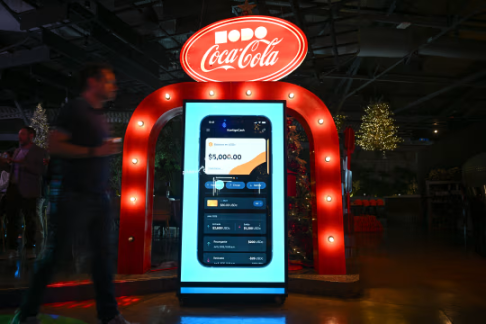
Large screen showing Kontigo’s cryptocurrency app interface, displaying a balance of $5,000 and transaction history
Inside Venezuela: A different narrative
In Venezuela, Kontigo operates under a license granted by Sunacrip, the country’s cryptocurrency regulatory authority, authorizing it to conduct crypto-related business. That license was issued to a Venezuelan company named Oha Technology and signed by Venezuela’s finance minister.
Kontigo has since appeared to distance itself from Oha, claiming it partners with local institutions in all markets. Yet until recently, Kontigo’s official website still displayed the Sunacrip license and listed Oha as its Venezuelan subsidiary. Castillo’s personal webpage states he served as Chief Operating Officer of Oha AI. And in a private group chat reviewed by The Wall Street Journal, Castillo celebrated obtaining the Sunacrip license in January 2025 and shared the license document.
At the invitation-only event in Caracas, a Kontigo representative emphasized the growing importance of cryptocurrency in Venezuela’s economy. Economist Asdrúbal Oliveros told attendees that proceeds from sanctioned oil sales were collected in stablecoins and then funneled into licensed crypto platforms like Kontigo and its competitor Crixto.
Venezuelan Kontigo users can use the app to transfer money into their Venezuelan bank accounts—even if those banks are under U.S. Treasury sanctions.
A turning point
Just weeks after announcing its funding success, Kontigo’s situation began deteriorating rapidly.
At the end of last December, an article in The Information revealed that Kontigo had been cut off by JPMorgan Chase.
Days later, U.S. military action toppled President Maduro. Shortly thereafter, influential independent fintech journalist Jason Mikula published a report accusing Kontigo of having secret ties to one of Maduro’s sons.
Kontigo struck back immediately.
When Klarna CEO Sebastian Siemiatkowski shared Mikula’s article on X, Kontigo’s official account replied that it would “hold accountable those who spread false information damaging to the company’s commercial reputation.”
Kontigo then informed users that the platform had suffered a hack, resulting in losses totaling approximately $341,000 for 1,005 users. The company stated it had fully reimbursed affected users.
In a nine-minute video posted to social media on January 12, Castillo spoke in Spanish, asserting the platform was simultaneously under cyberattack and targeted by critics—and denying any connection between Kontigo and the Maduro regime.
“The truth is that Kontigo’s success is the result of years of hard work, resilience, and perseverance—we are nobody’s son-in-law, nephew, or cousin,” he said.
Nonetheless, as scrutiny intensified, the company’s operations appear increasingly strained. Sources say Stripe and Bridge have both ended their partnerships with Kontigo, and users report PayPal no longer processes payments for the app. The Sunacrip license held by Oha Technology expired on January 8.
Kontigo’s publicly listed primary crypto wallet has seen almost no transaction activity in recent days. For several months prior, the wallet averaged hundreds of thousands of dollars in weekly volume—but since January 19, only a handful of transactions—each around $1—have occurred.
Join TechFlow official community to stay tuned
Telegram:https://t.me/TechFlowDaily
X (Twitter):https://x.com/TechFlowPost
X (Twitter) EN:https://x.com/BlockFlow_News