Vibe Coding Is Killing Open Source
TechFlow Selected TechFlow Selected
Vibe Coding Is Killing Open Source
The boom of Vibe Coding may be built upon the ruins of the open-source ecosystem.
 Navigating Web3 tides with focused insights
By Yitao
Over the past year, Vibe Coding has almost entirely rewritten the way we program.
You no longer need to write code line by line yourself. Simply tell Cursor, Claude, or Copilot: “I want a feature that does X, built with Y tech stack, and feels like Z product”—and let AI handle the rest.
Many people who previously couldn’t write code at all have, for the first time, gained the ability to “build something.” From an individual perspective, this is nearly the golden age of software development.
But there’s an overlooked prerequisite: AI doesn’t generate code out of thin air—it calls upon and stitches together humanity’s existing intellectual output. When you say, “Help me build a website,” AI silently draws on the logic and structure accumulated across countless open-source projects on GitHub.
The core capability of Vibe Coding rests precisely on learning from and recombining these open-source codebases.
Recently, a research team from Central European University and the Kiel Institute for the World Economy published a paper titled “Vibe Coding Kills Open Source”, revealing the hidden crisis beneath Vibe Coding’s boom.
The paper highlights a stark truth:
Vibe Coding may be fundamentally undermining the open-source ecosystem that underpins the entire software world.
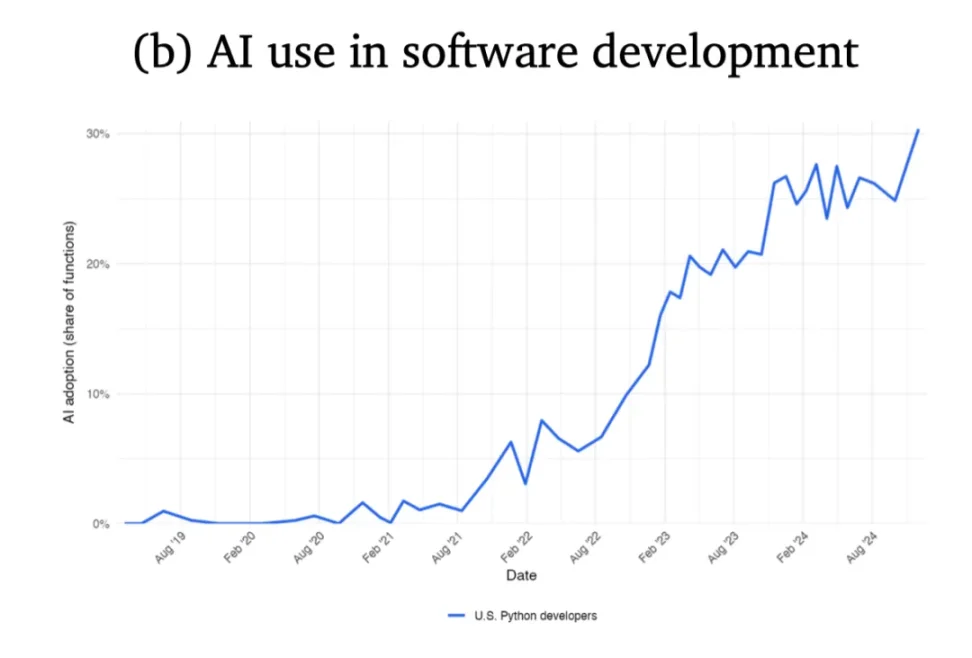
Since August 2022, the proportion of U.S. Python developers using AI for programming has surged dramatically.
The “Invisible Infrastructure” of the Digital World
To understand what this paper is warning about, we must first clarify one thing: What is open-source software—and where does it sit in our daily lives?
Many people may not feel open-source software directly, yet virtually every digital product we use daily runs on open-source software underneath.
When you wake up and pick up your Android phone, its underlying operating system—Linux—is open source;
When you open WeChat to check chat history, the SQLite database storing each message is open source;
When you scroll TikTok or Bilibili during lunch break, FFmpeg—the library handling video decoding and playback behind the scenes—is also open source.
Open-source software is like the sewer system of the digital age: you use it constantly without noticing it at all.
Only when it breaks down do you suddenly realize how indispensable it is.
The Log4j vulnerability in 2021 was a classic example. Log4j is the most widely used logging framework in the Java ecosystem, responsible for recording application runtime events and information.
Most ordinary users had never even heard of its name—but from Apple and Google’s cloud servers to government e-service systems worldwide, billions of devices ran it silently in the background.
At the end of 2021, the “Log4Shell” vulnerability erupted. This flaw allowed hackers to remotely control servers globally as if they were operating their own computers. The entire internet infrastructure was instantly left exposed—forcing global security teams to rush emergency fixes over the weekend. Its scale and difficulty of remediation made it one of the most severe security crises in internet history.
This is the essence of open source: it isn’t a company’s product, but a “public good.” Lacking commercial attributes, maintainers rarely earn direct revenue from their projects.
Their rewards are indirect: gaining reputation through the project, landing jobs at major tech firms; earning income via consulting services; or relying on community donations.
This model has operated for decades—powered by “direct interaction.” Users read documentation, submit issues, and star repositories while using software. These attention flows back to maintainers, fueling continued maintenance.
And this is exactly the connection Vibe Coding is severing.
How AI Is Gradually “Starving” Open Source
Before Vibe Coding, the development workflow looked like this: You download an open-source package and read its documentation; encounter a bug and file an issue on GitHub; find it useful and click “star” to show support.
Maintainers thus gain visibility—visibility that translates into income—forming a virtuous cycle.
With Vibe Coding, you simply tell AI what functionality you need, and AI automatically selects and composes open-source code in the background to produce a “working implementation.”
The code runs—but you don’t know which specific libraries it uses, nor do you visit their documentation or communities.
The paper terms this shift a “mediation effect”: attention and feedback that once flowed directly from users to maintainers are now intercepted en masse by the AI intermediary layer.
What happens if this mechanism persists?
The authors built an economic model simulating the open-source ecosystem. They modeled developers as entrepreneurs deciding whether to “enter the market” at varying quality levels—first investing development costs, then choosing whether to open-source their work based on market feedback. Users, meanwhile, choose among countless packages—and decide whether to use them “directly” or via an “AI intermediary.”
Running the model revealed two opposing forces.
First, efficiency gains: AI makes software easier to use and lowers the cost of building new tools—logically stimulating more developers to enter and increasing supply.
Second, demand shift: As users migrate toward AI intermediaries, maintainers lose the income derived from direct interaction—reducing developer returns.
But over the longer term, if the second force (demand shift) outweighs the first (efficiency gain), the entire system slides into contraction.
Specifically, this manifests as higher entry barriers for developers—only top-tier projects remain worth sharing, mid-tier ones vanish, and ultimately both the number and average quality of packages decline. Though individual users enjoy short-term convenience from AI, long-term welfare falls, as fewer high-quality tools remain available.
In short, the ecosystem enters a vicious cycle. And once this foundational open-source layer thins, AI’s capabilities themselves deteriorate.
This is the paper’s central point: Vibe Coding boosts productivity in the short term—but may lower the overall system’s level in the long run.
This trend isn’t just theoretical—it’s already unfolding in reality.
For instance, public Q&A traffic on Stack Overflow has noticeably declined since generative AI became widespread. Many questions that would once have been discussed publicly in community forums are now shifted into private AI conversations.
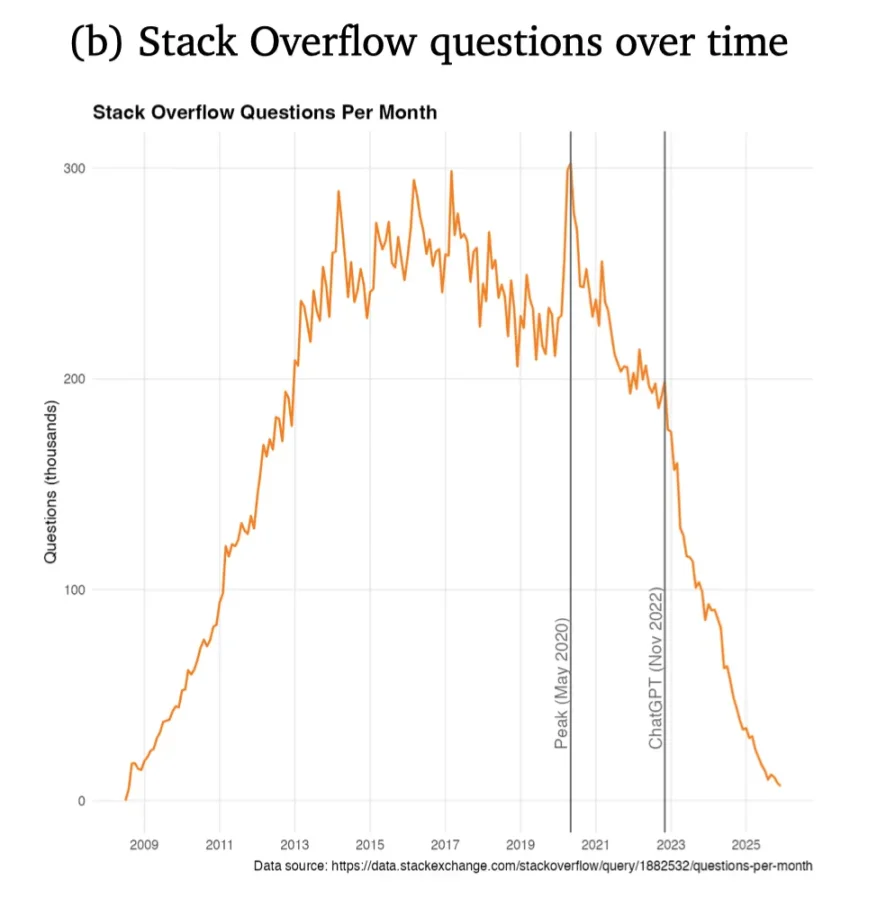
After ChatGPT’s launch, question volume on Stack Overflow began declining significantly.
Another example: Projects like Tailwind CSS continue seeing rising download volumes—but documentation visits and commercial revenue are falling.
The project is being widely used, yet increasingly fails to translate into meaningful returns for its maintainers.
When Will Coding’s Spotify Emerge?
Although Vibe Coding poses such problems, its productivity gains are real—and no one can revert to a world without AI coding.
The deeper issue is that, as AI becomes the new intermediary, the old incentive structures no longer apply.
Under the current setup, AI platforms extract enormous value from the open-source ecosystem without bearing corresponding costs to sustain it. Users pay AI platforms for convenience, but the open-source projects and maintainers being invoked often receive nothing.
The paper’s proposed solution is:
Reconstructing the distribution of benefits.
Just as streaming platforms like Spotify pay royalties to musicians based on play counts, AI platforms could track which open-source projects they invoke—and return a share of revenue proportionally to maintainers.
Beyond platform royalty-sharing, grants from foundations, corporate sponsorships, and government funding dedicated to digital infrastructure are also vital mechanisms to offset maintainers’ lost income.
This requires a mindset shift across the industry—from viewing open-source software as “free resources” to recognizing it as “public infrastructure requiring sustained investment and maintenance.”
Open-source software won’t disappear; it’s deeply embedded in the digital world and cannot be easily replaced.
But the era of open source sustained by scattered attention, reputation-building, and idealism may have reached its limits.
What Vibe Coding brings is not only faster development—but also a stress test on how “public technology” can be sustainably funded.
Join TechFlow official community to stay tuned
Telegram:https://t.me/TechFlowDaily
X (Twitter):https://x.com/TechFlowPost
X (Twitter) EN:https://x.com/BlockFlow_News
 极客公园
极客公园