What happens when a person’s entire life runs entirely on Claude Code?
TechFlow Selected TechFlow Selected
What happens when a person’s entire life runs entirely on Claude Code?
The efficiency gap between those who know how to use AI and those who don’t is widening at an accelerating rate.
 Navigating Web3 tides with focused insights
Author: Jin Guanghao
Every morning upon waking, Molly Cantillon opens her computer to review the “work reports” submitted by eight Claude instances. Each night, these AIs run tasks—some monitor her subscription bills, others analyze social media data, and still others track certain individuals’ stock trades.

Molly Cantillon’s homepage | Image source: X
Over the past month, this system automatically recovered $2,000 in subscription fees for her—money lost to services she’d long forgotten to cancel. Tech companies quietly charged these fees each month, entirely unnoticed by Molly herself.
A Stanford graduate and tech enthusiast, Molly describes her approach to using Claude as surprisingly simple: “I just treat Claude as eight employees I don’t have to pay.”
Reading this, you’re probably wondering: How can one person simultaneously operate eight business lines—and even earn passive income with AI’s help?
01 Breaking Life Down into Eight Business Lines
Molly’s system divides life into eight “business lines,” each assigned its own dedicated Claude instance.
Her logic is straightforward: Everyone’s life consists of several core modules—work, health, finance, social life, learning, etc.—each governed by its own patterns and recurring tasks.
What Molly does is assign a dedicated “employee” to each module.

Molly Cantillon’s insights | Image source: X
Her eight instances are assigned as follows:
Product Claude manages development progress on her side projects, reporting daily on which features to advance and which bugs require fixing. Growth Claude automatically monitors social media metrics, tracking high-performing content and trending topics while generating suggestions for future posts. Health Claude integrates with her WHOOP wearable to track sleep, activity, and recovery metrics, delivering weekly optimization recommendations.
Trading Claude monitors bank statements and subscriptions, automatically initiating refund requests when it detects questionable charges. Writing Claude handles routine text-based work—drafting emails, organizing notes, and generating weekly reports. Three additional Claudes manage personal affairs, metric tracking, and daily summaries, respectively.
Once fully automated, the system delivered results that far exceeded her expectations.
For example, the previously mentioned $2,000 subscription fee recovery was only the beginning. Writing Claude freed her from email overload, automatically processing and replying to all incoming messages.
Even more intriguingly, Trading Claude performed the following:
Each night, it automatically scrapes public stock trade disclosures by influential investors and hedge fund position changes. It then cross-references Polymarket odds, sentiment on X, and earnings reports from companies Molly follows to generate an investment briefing.
Recently, Trading Claude detected heavy buying of Netflix stock by investors and inferred positive momentum for the streaming sector—prompting it to follow up with Warner Bros., a peer company. Three weeks later, related trades were publicly disclosed, and Warner Bros.’ stock price rose accordingly.
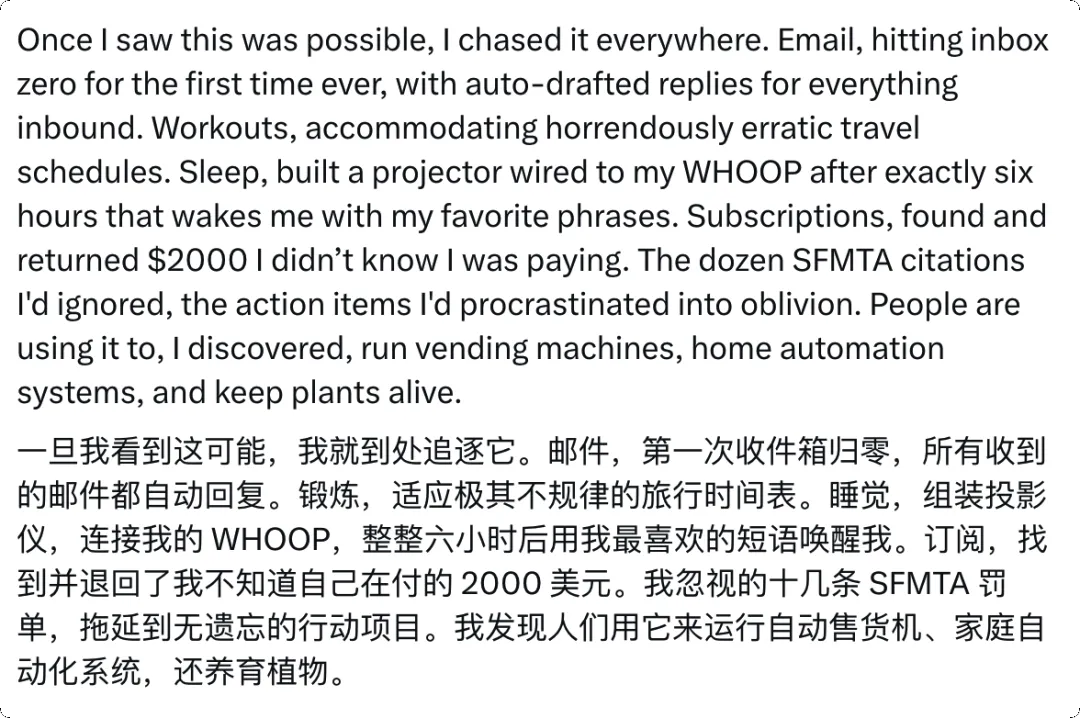
Molly Cantillon using Claude Code for time management | Image source: X
The operation of these eight instances is equally fascinating:
They run in parallel in the background, working independently and exchanging information via the file system. When cross-module collaboration is needed, context is explicitly passed between instances through defined “handoff” mechanisms. They read and write local files—and if APIs become unavailable, they’ll even simulate mouse and keyboard actions directly on the desktop to complete tasks.
Molly uses commands to prevent her system from sleeping, enabling her AI team to run continuously—even at airports or while she sleeps. Upon task completion, the system texts her; she replies directly to trigger the next step.
As Molly once put it, perfectly capturing the essence of this system: “Suddenly, you can be in dozens of places at once—managing your life through a thousand AI avatars.”

Molly Cantillon’s insights | Image source: X
This is indeed the case. A quick calculation shows: eight AI instances running 24/7 equals 192 hours of “work time” per day—granting one person the processing capacity of a small team. And this team can scale infinitely.
You’re likely astonished: When AI begins working for you around the clock, does “time management” even exist anymore?
02 When AI Knows You Better Than You Know Yourself
Yes—once Claude understands your life better than you do, “time management” ceases to be a solitary struggle.
Traditional time management demands that you remember everything, schedule everything, execute everything, and review everything—a model that consumes enormous willpower and attention, and one most people sustain for only a few weeks.
Molly’s model is fundamentally different. She makes decisions; AI handles memory, scheduling, execution, and feedback.
She no longer needs to recall which subscriptions she’s signed up for—Trading Claude remembers for her. She doesn’t manually compile health data—Health Claude automatically synthesizes actionable recommendations. She doesn’t need to monitor market movements either—because every morning, a ready analysis brief awaits her in the /trades directory on her computer.

A new approach to self-management | Image source: nanobanana-pro
These two models differ fundamentally: The former demands that one person grind through every task alone; the latter empowers one person to lead a team.
This reveals a somewhat harsh reality: The efficiency gap between those who use AI effectively and those who don’t is widening rapidly.
The key isn’t whether you know how to code—it’s whether you’re willing to design your life as a system that can operate systematically, and whether you’re willing to trust and delegate authority to AI.
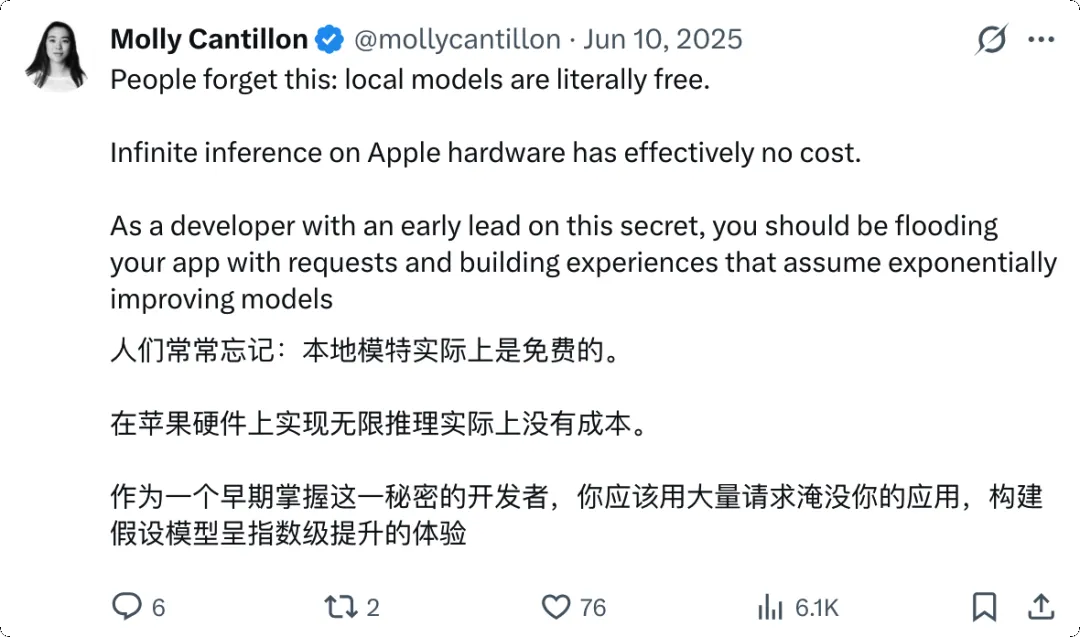
Molly Cantillon’s insights | Image source: X
03 Can Ordinary People Become Molly?
So the question arises: Can ordinary people replicate this approach?
The answer is yes—though it requires first shifting a deeply ingrained mental habit.
Most people use AI as follows: “I have a problem—let AI solve it for me.” This treats AI as a smarter search engine or an on-demand assistant. Molly’s mindset differs: Her question is, “Which parts of my life can be systematized?”
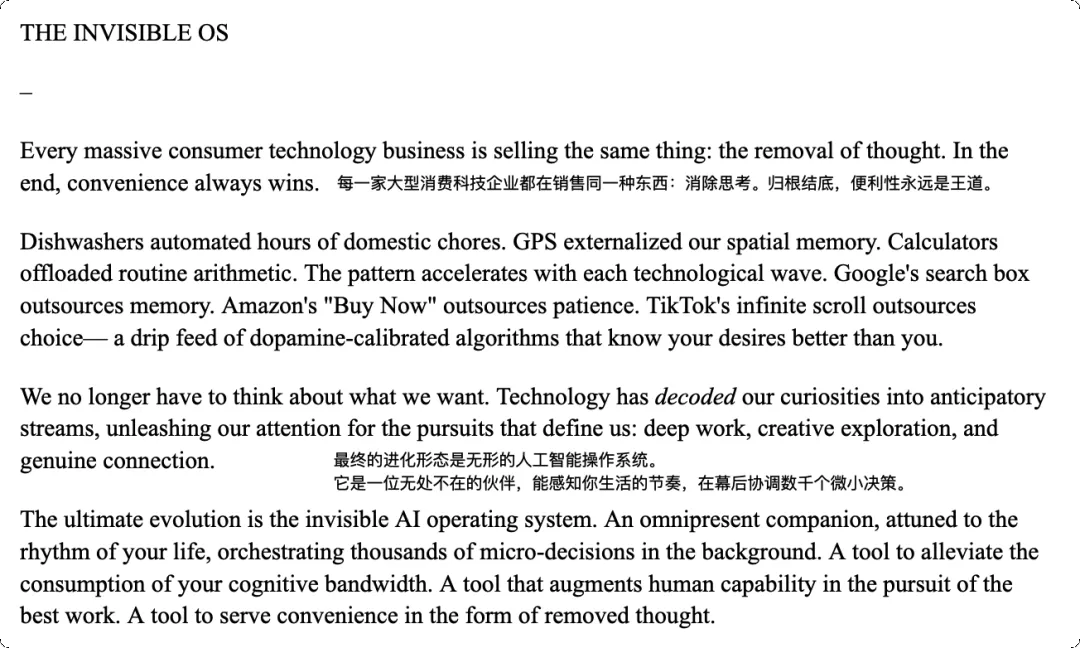
Molly Cantillon’s insights | Image source: Google Docs
This mindset shift is critical.
First, map out your own “life domains”: work, health, finance, social life, learning, family responsibilities, etc. Everyone’s life comprises such modules—list them.
Then, identify which aspects within each domain are “AI-automatable.” For instance, in each module, what tasks do you repeat regularly? Which ones follow clear rules? Which require continuous monitoring? These are precisely where AI can take over.
How exactly do you get Claude to take over?
Tools like Claude Code, Cursor, and Trae function essentially as super agents capable of accessing any local data or files on your device.
You can transform your lived experience into a “Claude Skill.” Then write an instruction set to teach AI the workflow—so it executes automatically going forward.
Take a simple example: You can appoint AI as your daily coach—automatically sorting WeChat and email messages by urgency and generating a “Tomorrow’s To-Do List.” You can also aggregate weekly execution data, prompting AI to suggest adjustments for next week based on last week’s goal completion rate.
You don’t need to build a complex eight-instance system right away. Start with just one—identify the single most painful point in your life, and let AI resolve it first. Once you experience tangible value, expand gradually.
Still sounds daunting?
It’s actually simpler than it seems. Molly’s parents began this way.
During Christmas, Molly taught them command-line basics—even though they’d never strayed beyond Microsoft’s comfort zone. Crucially, Molly didn’t tell them they needed to learn a new technology. Instead, she said: “Just type in plain English what you want to happen—and AI will make it happen.” Her mother tried it, staring at the screen as if witnessing magic. Within days, they were already using the system to manage her father’s accounts receivable.
For twenty years, software had made them feel incompetent. Now, for the first time, they felt their computer was truly listening to them.
If you’re completely non-technical, begin with these three steps:
1. Identify one task you repeat weekly.
2. Download and install Claude Code—or its domestic counterpart, Trae—and clearly document the full workflow of that task so they can help you generate a Skill.
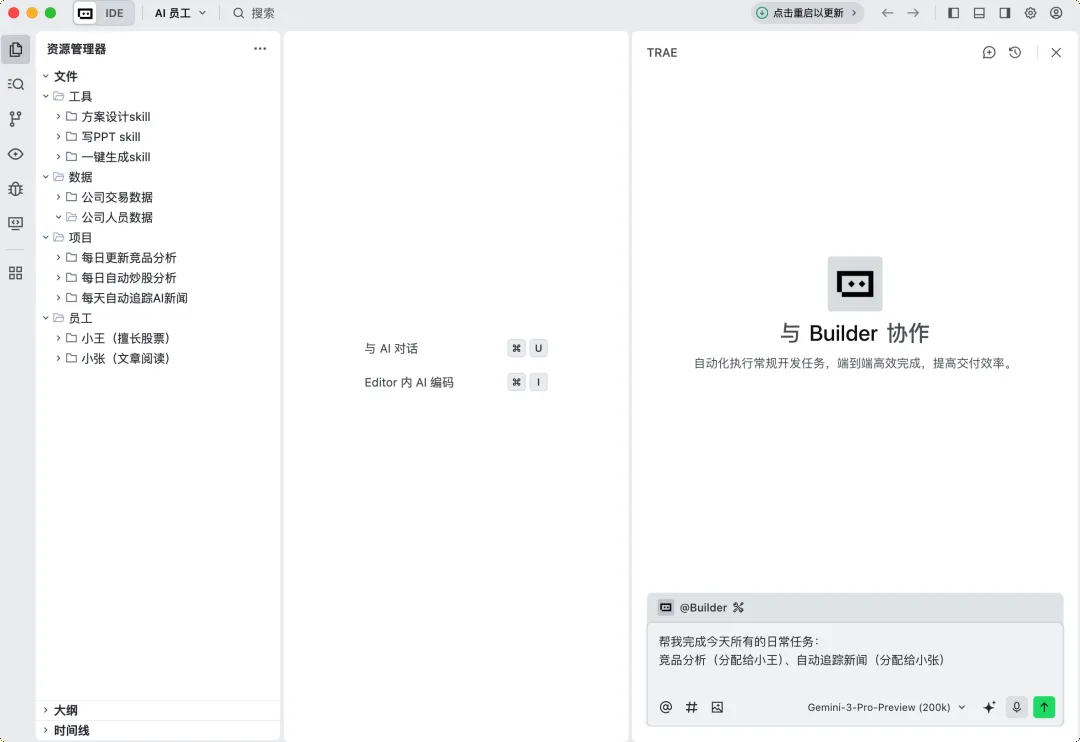
An example of an AI-powered automation project | Image source: GeekPark
3. Whenever the task arises, feed your AI agent the required materials and let it execute according to the instructions. For advanced users, explore how to achieve full automation—so you too can deploy a 24/7 AI team handling tasks on your behalf.
In short: First validate one workflow—then automate it.
04 An Emerging Trend
Molly’s approach may sound like an intriguing personal experiment—but interestingly, her methodology is now being validated by the industry.
Recently, Anthropic officially launched a system built on nearly identical logic: Cowork.
In short, Cowork is a personal assistant capable of managing your entire computer—capable of organizing all your files with a single sentence.
Its design philosophy centers precisely on coordinating multiple Claude instances to operate collaboratively—as a unified team.
This suggests Anthropic is betting heavily on this direction: Individual users should be able to maintain their own AI teams—working 24/7 to handle life’s and work’s mundane tasks.
Video showing file organization via Cowork in one sentence | Video source: X
Of course, Molly also highlights risks inherent in this system.
When your entire life runs inside a single Claude Code directory, you experience a subtle yet paradoxical shift:
The allure of “having AI work overnight for you” is immense—but the cost is hidden. AI will assume control over all your private data, demanding you surrender what was once exclusively yours.
This is a delicate balance: The more tasks you delegate to AI, the higher your efficiency—but the deeper your dependence becomes.
Her advice? Encourage everyone to familiarize themselves with AI early—but remain vigilant not to let AI take control.
05 A New Way of Living
In the past, we spoke of “time management.” Today, perhaps it’s time to speak of “AI management.”
When your AI knows your bills, calendar, health metrics, and investment goals better than you do, your role has fundamentally changed. Traditional time management is essentially “energy management”—allocating high-quality mental energy to high-value tasks, and reserving low-energy periods for leisure and rest to replenish.
Now, however, everything is shifting toward “AI management”: Offload appropriate tasks to AI, and reserve the remaining tasks—and the surplus time—for yourself.
This isn’t to say energy management is obsolete—only that its nature is evolving. Your energy may no longer go toward personally executing every task, but rather toward designing systems for AI, assigning tasks to it, and reviewing outcomes.
Our role is transforming—from executor to AI manager. We’ve entered an era where “everyone is an AI manager.”
Molly’s story may sound futuristic—but it’s becoming everyday reality for increasing numbers of people:
Anthropic’s recently released *Human Economy Index Report* shows that user interaction with Claude is shifting from conversational Q&A toward self-directed task management.
Users increasingly prefer letting Claude persistently iterate on the same task (Task Iteration), rather than relying on isolated, one-off queries.
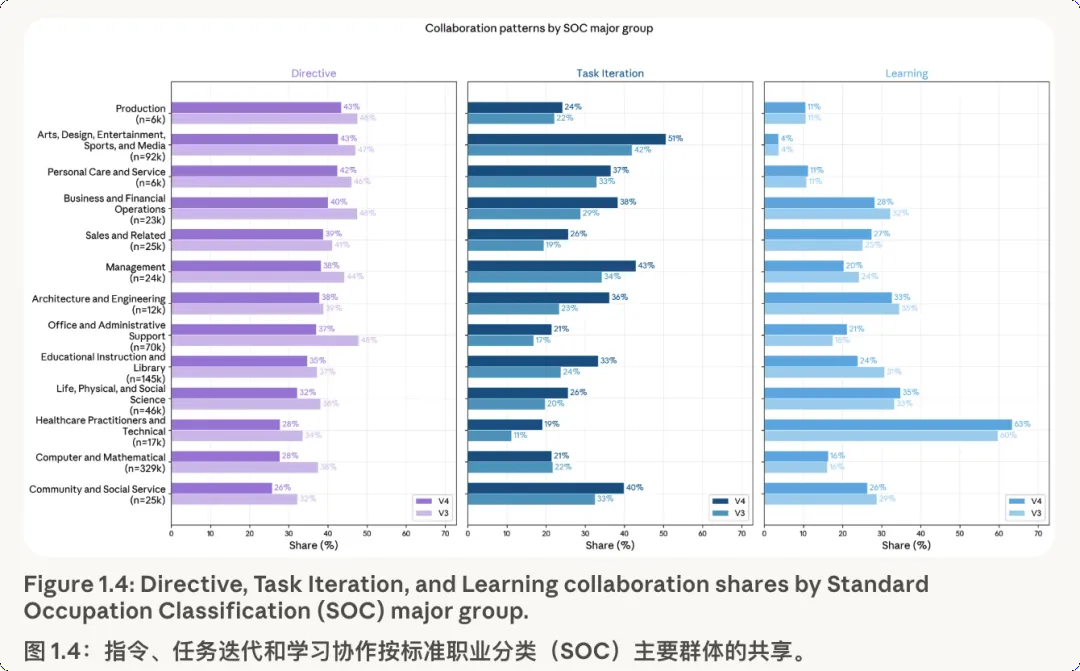
Change in user intent between August 2025 (V3) and November 2025 (V4) | Image source: Anthropic
Looking back in a few years, today may well mark the watershed moment: One group begins using AI to run their lives; another continues wrestling with traditional time management methods.
The gap won’t widen overnight—but it accumulates daily.
How many things has AI already done for you each morning upon waking?
That number may matter more for your future than how hard you work.
Join TechFlow official community to stay tuned
Telegram:https://t.me/TechFlowDaily
X (Twitter):https://x.com/TechFlowPost
X (Twitter) EN:https://x.com/BlockFlow_News