A Non-Coder Single-Handedly Managed Anthropic’s Entire Growth Marketing for Ten Months
TechFlow Selected TechFlow Selected
A Non-Coder Single-Handedly Managed Anthropic’s Entire Growth Marketing for Ten Months
The bottleneck of efficiency often lies not in technical capability, but in whether you’re willing to spend time deconstructing your workflow clearly—and then handing off the parts that can be automated by machines.
 Navigating Web3 tides with focused insights
How much can AI actually boost an individual’s work efficiency?
Recently, a post about Anthropic went viral on social media. The poster, Ole Lehmann, claimed that Anthropic—a company valued at $380 billion—had an entire growth marketing team consisting of just one person: a non-technical marketer who single-handedly managed paid search, paid social, app store optimization (ASO), email marketing, and SEO for nearly ten months.
The post was quickly met with skepticism in the comments, but shortly afterward, the person in question confirmed it himself. Austin Lau, the growth marketer, replied: “At the time that article was written, I truly was the only person doing growth marketing—and I carried that role alone for nearly ten months.”
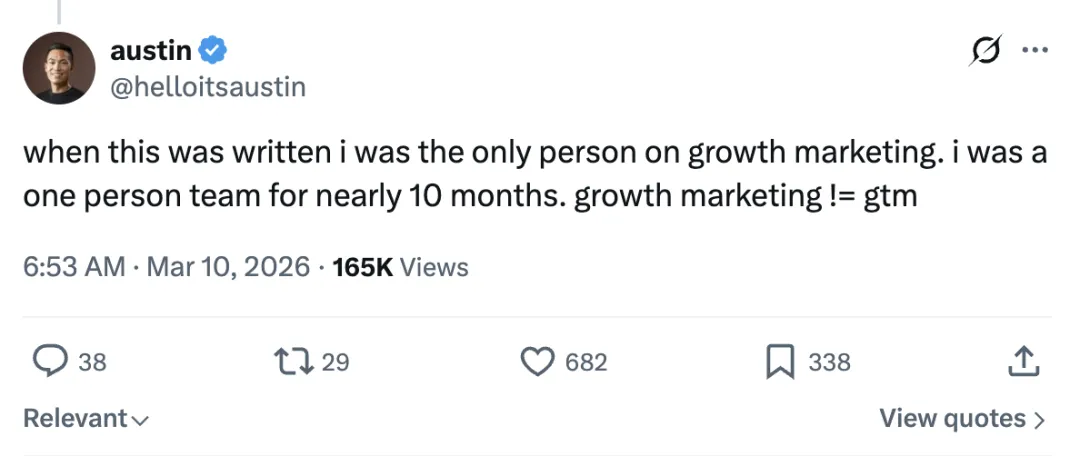
Image | Related X post (Source: X)
In late January this year, Anthropic published an official case study detailing Austin Lau’s workflow. Around the same time, Anthropic also released an internal white paper titled “How the Anthropic Team Uses Claude Code,” covering use cases across ten teams—from data infrastructure to legal—including growth marketing.
The white paper states: “The growth marketing team focuses on channels such as paid search, paid social, mobile app stores, email marketing, and SEO. It is a ‘non-technical, one-person team’ that relies on Claude Code to automate repetitive marketing tasks and build automated workflows traditionally requiring substantial engineering resources.”
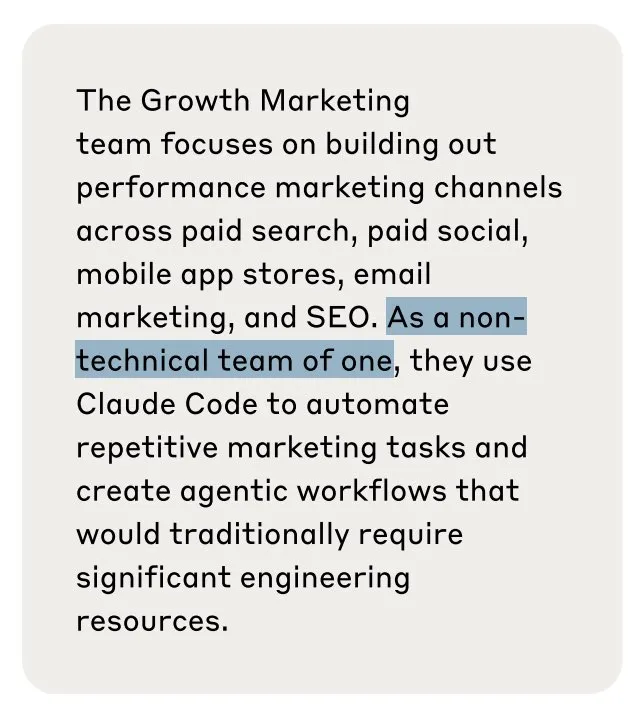
( Source: Anthropic )
Austin Lau is not an engineer. In Anthropic’s official case video, he said he had “never written a single line of code.” When he first encountered Claude Code, he even had to Google “how to open Terminal on Mac.” Upon its initial release, his first reaction was “I had no idea who this product was for”—as a marketer, he saw little obvious utility.
The turning point came when a colleague shared a Claude Code installation guide tailored for non-technical employees in the company’s Slack channel. Out of curiosity, Austin installed it—and within a week, he had built two fully automated workflows that transformed how he worked.
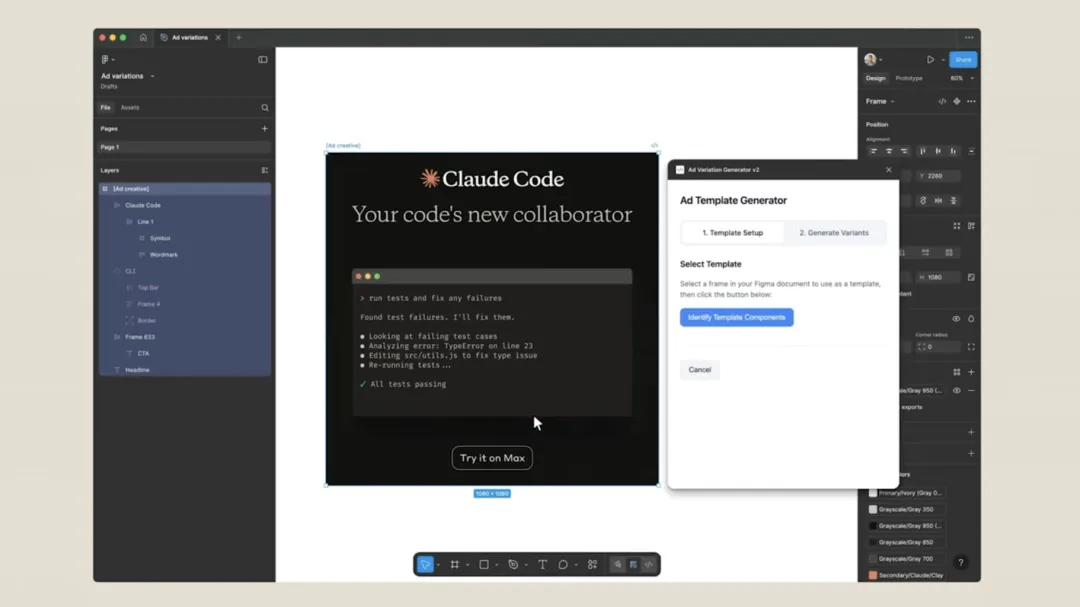
The first was a Figma plugin. For paid social ads and app store marketing, he handled large volumes of visual assets in Figma. Previously, creating multiple copy variants for the same design required manually duplicating Figma frames and constantly switching between Google Docs and Figma to copy-paste headlines one by one. With 10 copy variants to adapt across 5 different aspect ratios, this mechanical labor easily consumed half an hour.
Image | Austin Lau (Source: Anthropic)
He described this pain point to Claude Code in plain English and asked it to build a Figma plugin. During development, he instructed Claude Code to reference Figma’s API documentation, researching and prototyping simultaneously. The first prototype wasn’t perfect—but it was sufficient as a starting point. He iteratively refined it until he had a working plugin.
( Source: Anthropic )
The plugin works like this: select a static image frame; the plugin automatically identifies components such as headlines, call-to-action buttons, and code blocks, then batch-generates independent Figma frames from a pre-prepared list of copy variants—each variant paired with new copy. A single batch can generate up to 100 ad variants, taking roughly half a second per batch. What used to take 30 minutes now takes just 30 seconds.
The second workflow automates Google Ads responsive search ad (RSA) copy generation. Google Ads RSAs impose strict character limits: headlines capped at 30 characters, descriptions at 90. Previously, Austin drafted copy in Google Sheets, manually counted characters, and pasted each item individually into the Google Ads interface.
Austin created a custom slash command “/rsa” in Claude Code. Triggering it prompts Claude Code to request campaign data, existing ad copy, and keywords—then cross-references his pre-defined “Agent Skills,” which include Anthropic’s brand voice, product accuracy guidelines, and Google Ads RSA best practices.
The system uses two specialized sub-agents: one dedicated solely to writing headlines, another exclusively to descriptions—each operating strictly within its respective character limit. This division of labor yields significantly higher output quality than cramming both tasks into a single prompt.
Ultimately, Claude Code packages 15 headlines and 4 descriptions into a CSV file ready for direct upload to Google Ads. Austin emphasizes that the generated copy serves only as a starting point—he reviews each piece individually: Is the value proposition clear? Does the tone match? Does it differentiate us from competitors? But at least the tedious draft-generation and formatting steps are fully automated.
The efficiency gains from these two workflows are already striking—but Austin’s system goes further. He also built an MCP (Model Context Protocol) server integrated with Meta Ads’ API.
Through this integration, he can directly query ad performance metrics, spend data, and individual ad effectiveness inside the Claude desktop app—eliminating the need to open Meta Ads’ dashboard. Questions like “Which ads had the highest conversion rate this week?” or “Where am I wasting budget?” can be asked directly to Claude, yielding real-time answers.
More crucially, it enables closed-loop iteration. Austin built a memory system to record hypotheses and experimental results from each round of ad iteration. When launching a new round of variant generation, Claude automatically retrieves all prior test data—identifying which copy performed well and which didn’t—so the next round builds directly upon historical experiments. With every cycle, the system grows incrementally smarter. Systematic tracking of experiments across hundreds of ads would typically require a dedicated data analyst in a traditional team.
According to Anthropic’s white paper, the outcomes of this approach are: ad copy creation reduced from 2 hours to 15 minutes; creative output increased tenfold; and the volume and breadth of ad variants tested by one person surpass those covered by most full-scale marketing teams.
In that white paper, growth marketing is just one of ten case studies. The data infrastructure team uses Claude Code to debug Kubernetes cluster failures—resolving issues previously requiring network specialists in minutes. Members of the inference team without ML backgrounds use it to understand model functions and configurations, cutting documentation review time from one hour down to 10–20 minutes. The product design team uses Claude Code directly to modify frontend code—engineers noted designers were making “large-scale state management changes you’d rarely see designers do.” A member of the legal team built, in one hour, a predictive text-assist application for a family member with language barriers—despite having zero prior programming experience.
Usage patterns differ across technical and non-technical roles—but the conclusion is consistent: Claude Code is blurring the boundary between “can do” and “cannot do”—a boundary historically defined almost entirely by technical ability.
In the case study, Austin Lau offers a telling summary: “The distance between ‘I wish this existed’ and ‘I can build it myself’ is far shorter than most people assume.”
Of course, it’s important to clarify that growth marketing ≠ the entire GTM (go-to-market) function. Anthropic has full-fledged brand, product marketing, and communications teams. Austin Lau oversees the performance marketing track—paid media, ASO, SEO, and other quantifiable channels.
Anthropic’s Super Bowl TV ad this February, for instance, clearly wasn’t a solo effort. The copy and brand assets underpinning his workflows were originally produced collaboratively by product marketing and copywriting teams—Claude then scales and tests variants based on that foundation.
Austin Lau recently added some context on LinkedIn. He noted that the widely circulated article describes his experience in Q2 2025 as the sole growth marketer—a period now nearly eight months ago. The team has since expanded, though still remains far smaller than outsiders imagine. As he puts it: “Our combat effectiveness far exceeds our headcount.”
Even so, the signal is strong. A company valued at $380 billion post-money, with $14 billion in annualized revenue, entrusted core growth channels to a marketer with zero coding experience for ten months during its fastest-growth phase—and achieved solid results. This strongly suggests AI’s amplification effect on knowledge workers may be substantially greater than current organizational structures and hiring habits assume.
Still, how widely replicable this model is remains unclear. Growth marketing is highly data-driven, process-oriented, and API-friendly—naturally suited to automation. In domains demanding more interpersonal judgment or creative intuition, outcomes could differ significantly.
At the end of the growth marketing section, Anthropic’s white paper offers three recommendations: (1) identify repetitive workflows with API access for automation; (2) decompose complex processes into multiple specialized sub-agents rather than attempting to handle everything with a single prompt; and (3) thoroughly design the overall workflow in Claude *before* writing any code. Fundamentally, these three suggestions highlight that the bottleneck to efficiency often lies not in technical ability—but in whether you’re willing to invest time to rigorously deconstruct your own workflow and delegate machine-executable components.
Join TechFlow official community to stay tuned
Telegram:https://t.me/TechFlowDaily
X (Twitter):https://x.com/TechFlowPost
X (Twitter) EN:https://x.com/BlockFlow_News