Crypto Market Macro Report: Oil Storms, AI Waves, and Bitcoin at a Crossroads
TechFlow Selected TechFlow Selected
Crypto Market Macro Report: Oil Storms, AI Waves, and Bitcoin at a Crossroads
The real game has only just begun.
 Navigating Web3 tides with focused insights
Executive Summary
Global financial markets are undergoing a systemic repricing triggered by geopolitical conflict: the blockade of the Strait of Hormuz sent crude oil prices surging as much as 30%, before G7 emergency reserve releases narrowed gains; stagflation risks have supplanted inflation as the primary concern; the U.S. dollar has become the “sole safe haven,” nearing the 100 threshold; and Asian-Pacific and U.S. equities suffered a “Black Monday” with across-the-board sharp declines. Meanwhile, the AI sector is experiencing stark divergence: China’s National Development and Reform Commission (NDRC) set a target for the AI industry to reach RMB 10 trillion in scale by the end of the 15th Five-Year Plan; and the OpenClaw project’s explosive popularity has driven related stocks into a frenzy. Bitcoin, caught in the macro storm, breached its critical $70,000 support level; 75% of its recent volatility stems from macro factors; market sentiment is extremely fearful (Greed & Fear Index at 8); put options dominate trading volume; yet Bitcoin ETFs still recorded $568 million in net inflows—highlighting an intensifying tug-of-war between bulls betting on the “digital gold” narrative’s resilience amid stagflation and bears anticipating its collapse.
I. The Macro Abyss: The Stagflation Specter and the “Sole Safe Haven” Suction Effect
Global financial markets stand at a perilous crossroads, where a perfect storm driven by geopolitics is unfolding. Last week’s “Black Monday” was not an isolated correction but a profound repricing of asset valuation logic. As smoke from the Strait of Hormuz obscured the world’s energy lifeline, market participants were startled to find that a ghost long forgotten for four decades—“stagflation”—has quietly returned, cloaked in the mantle of geopolitical conflict.
The plunge in Asia-Pacific equities is merely the overture to this crisis. The sharp decline in the MSCI Asia-Pacific Index—and the cliff-like drops in major indices across South Korea, Japan, and Taiwan—clearly depict capital’s deep pessimism about the global economic outlook. This pessimism does not stem from short-term concerns over corporate earnings, but rather reflects a forward-pricing of a persistent, supply-side shock–induced global recession. Energy is the lifeblood of industry; when that blood supply faces disruption, every economy’s limbs inevitably grow numb—and may even necrotize. Concurrent declines in U.S. equity futures, alongside hedge funds building ETF short positions at a pace unseen in five years, confirm the global and institutionalized nature of this panic. Goldman Sachs strategist Ed Yardeni has raised his probability estimate for a U.S. equity market crash this year to 35% and, unusually, singled out the “stagflation” scenario as a distinct possibility—a clear warning signal. The mere emergence of “stagflation”—alongside the “Roaring Twenties” (high growth, low inflation) and outright “crash” scenarios—signals that markets are now seriously entertaining a far more destructive future: simultaneous economic stagnation and inflation, which would utterly dismantle the theoretical foundation of traditional 60/40 stock-bond portfolios.
In this extreme risk-aversion environment, capital flows display astonishing uniformity: sell everything risky, and rush into the U.S. dollar at any cost. The dollar index’s approach to the 100 threshold reflects not U.S. economic strength per se, but rather the fact that, amid a global credit system under strain, the dollar—as the world’s dominant reserve, payment, and pricing currency—possesses unmatched liquidity depth and the sheer scale of the U.S. Treasury market, making it the only “deep sea” capable of absorbing massive volumes of flight-to-safety capital. Global top-tier asset managers like PIMCO are hoarding cash and favoring intermediate-term U.S. Treasuries; Bloomberg strategists bluntly declare “the dollar has become the sole safe haven”—marking a definitive shift in market logic from “risk-on” or “risk-neutral” to full-blown “risk-off” or even “risk-flight.” Gold’s surge-and-fall is especially telling: spot gold briefly pierced the historic $5,100 threshold, only to swiftly retreat back near $5,000—revealing a harsh reality: even gold, the ultimate safe-haven asset, can face profit-taking pressure to cover losses elsewhere at the edge of a liquidity crisis. The dollar’s strength is exerting a powerful suction effect on all non-dollar assets—including gold and Bitcoin. This geopolitically triggered macro tsunami’s first wave has ruthlessly shattered the psychological defenses of all risk assets—and swept digital assets like Bitcoin into the same vortex.
II. The Crude Oil Storm: Supply Collapse and “On-Chain” Speculation Gone Wild
If macro sentiment is the market’s “air,” then crude oil’s price anomaly is the “bone” that moves the entire body. The Strait of Hormuz blockade is no ordinary supply disruption—it is a nuclear-level strike on the global energy order. An abrupt loss of 20 million barrels per day (bpd) of crude supply is a figure that would send chills down the spine of anyone who lived through the 1970s oil crisis. It represents nearly 20% of global daily demand, a shortfall comparable to—or even exceeding—the magnitude of any prior crisis. Forced output cuts or shutdowns in major producers like Iraq, Kuwait, and the UAE mean OPEC+’s core capacity has been instantly neutralized, rendering the global crude supply curve virtually inelastic.
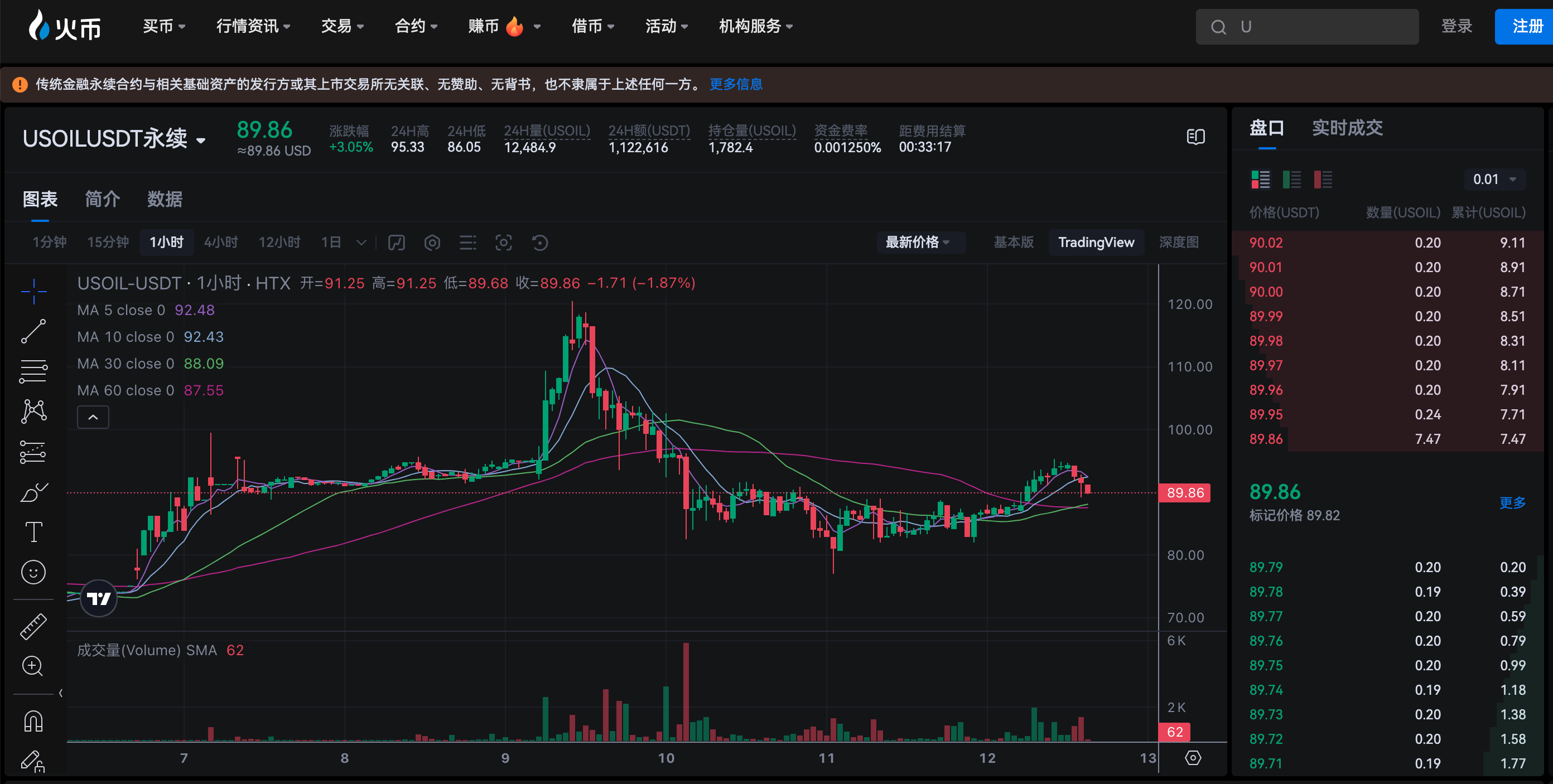
The market’s initial reaction was extreme and violent: oil prices surged as much as 30%, approaching $120 per barrel. This vertical spike reflected not forward-looking expectations, but acute, present-moment panic over “no oil available.” Goldman Sachs warned prices could breach the prior high of $140/barrel; former traders bluntly stated there was “effectively no ceiling”—remarks that, in such extreme conditions, serve less as forecasts and more as objective descriptions of potential nonlinear market collapse. A >60% rally over seven trading days has already lifted oil prices beyond the realm of fundamental analysis and into pure geopolitical premium pricing.
The G7 and International Energy Agency (IEA)’s emergency deliberations on strategic reserve releases were an inevitable market intervention. While the proposed 300–400 million barrels seem enormous, they pale against a daily shortfall of 20 million bpd—making them little more than a symbolic drop in the bucket, effective primarily on the psychological front to signal “we will not stand idly by.” This successfully halved oil’s gains, but only pulled prices back from “uncontrolled frenzy” to “controllable frenzy.” Former President Trump’s comment on the “minor cost” of the conflict further underscores the cold reality that geopolitical objectives currently supersede economic stability—indicating this energy crisis cannot be resolved anytime soon by simply releasing stored oil.
This geopolitically ignited oil storm has, unexpectedly, struck the crypto world with tremendous force. It is no longer a distant, peripheral variable within macro narratives, but has become a direct focal point for speculation *within* crypto markets themselves. The rise of on-chain oil trading is the most Web3-native phenomenon emerging from this crisis. Tokenized crude oil contracts (CL-USDC) on HyperLiquid saw both trading volume and price surge sharply; nearly $40 million in short positions were liquidated amid the price rally; and Sky co-founder Rune boldly deployed $4 million USDC in 20x-leveraged long exposure. This scene is a perfect decentralized-finance replication of traditional finance’s “spot squeeze.”
This phenomenon reveals several profound trends: First, crypto markets are no longer closed casinos—their derivatives markets are now capable of absorbing and amplifying volatility from traditional assets. Second, during extreme market conditions, DeFi derivatives platforms—with their 24/7 operation, permissionless access, and high leverage—demonstrate greater flexibility and appeal than traditional exchanges. Third, it also raises serious risk concerns. When a real-world oil supply crisis converges with on-chain, highly leveraged speculative mania, a sharp reversal in oil prices—or an oracle failure—could trigger cascading liquidations and “liquidity drought” across DeFi, potentially causing damage far exceeding that seen in traditional markets. On Polymarket, 76% of users bet oil will hit $120 by month-end—this is both a market expectation and a reflection of how crypto-native users engage in macro-level wagering via prediction markets. Crude oil—the lifeblood of modern industry—is now flowing into crypto’s capillaries in “tokenized” form, becoming another key determinant of its short-term volatility.
III. The AI Tsunami: Cold Realities and White-Hot Opportunities in a $10 Trillion Arena
While traditional finance trembles amid the energy crisis, another torrent—driven by technological innovation, artificial intelligence—is reshaping capital market narratives and national strategic landscapes at unprecedented speed. The NDRC’s target for the AI industry to exceed RMB 10 trillion in scale by the end of the 15th Five-Year Plan, coupled with over RMB 7 trillion in planned investment into “AI+” infrastructure, injects the strongest policy momentum into this sector. This is no longer conceptual hype—it’s real, hard capital deployment. Data disclosed by the Ministry of Industry and Information Technology (MIIT)—core industry scale exceeding RMB 1.2 trillion, over 6,200 enterprises, and over 600 million generative AI users—collectively sketch a vast, rapidly growing real-world industry.
Within this torrent, the explosive popularity of the open-source agent project OpenClaw (“Crayfish”) exemplifies how technological breakthroughs ignite market sentiment. Its GitHub star count surpassed Linux’s; its founder was recruited by OpenAI; and NVIDIA CEO Jensen Huang lavished praise upon it—these accolades collectively ignite the imagination of any tech investor. OpenClaw’s significance lies in drastically lowering the barriers to developing and deploying AI agents. As Huang stated, it will drive a thousand-fold surge in token consumption, ushering in an era of near-insatiable “compute vacuum.” This directly shifts market focus from large language model (LLM) training to the AI agent (Agent) track—which offers far stronger commercial application prospects.

The swift follow-up by tech giants like Tencent—and the rapid rollout of local government policies like Shenzhen Longgang and Futian District’s “Crayfish Ten Measures”—perfectly illustrate China’s innovation acceleration path: “top-level design → technological breakthrough → commercial application → policy support.” One-click deployment on WeChat and QQ brings AI agents into immediate contact with hundreds of millions of users; the deployment of “Government Crayfish” opens up vast possibilities for AI in public services. This top-down, point-to-plane explosive power is the fundamental driver behind the surge in related stocks. Soaring share prices for companies like MiniMax, UCloud, and SunNet reflect market optimism regarding the broad-based rollout prospects of “AI+” across industries. They are betting that OpenClaw will become the foundational platform for AI applications over the next decade—and that any enterprise involved in compute, deployment, or application development around it will share in this feast.
Yet, amidst the frenzy, MIIT’s high-risk warning serves as a sobering splash of cold water for rational market observers. Cybersecurity and information leakage risks arising from OpenClaw’s default configurations expose the dark side of rapid technology adoption. As millions of developers, enterprises, and government agencies rapidly deploy AI agents, cybersecurity boundaries blur infinitely. A compromised “Government Crayfish” could pose far greater harm than a hacked server. The AI “double-edged sword” effect is starkly evident here: it is both a super-engine driving industrial upgrading and a Pandora’s box for future cyberattacks and data breaches. For capital markets, this means that in the AI race, investors must look beyond “offensive” themes like compute and applications—and recognize that “defensive” sectors like cybersecurity and data privacy hold immense investment potential. Investors need to make clear-eyed trade-offs between “cold” risk awareness and “hot” market sentiment.
IV. Bitcoin’s Dilemma: Crushed by Macro Forces—or Reborn from the Ashes?
As the macro “abyss” stares down all risk assets, as the oil “hurricane” stirs speculative mania on-chain, and as the AI “tsunami” sweeps trillions in capital forward, Bitcoin—the erstwhile “digital gold” and “safe-haven asset”—finds itself in unprecedented embarrassment and predicament. Its price breaching the critical psychological $70,000 level and struggling to hold above $65,000 is not merely a price adjustment, but a severe interrogation of its core narrative.
NYDIG’s research data cuts straight to the heart: 75% of Bitcoin’s recent volatility is driven by macro factors *outside* traditional equity indices. This means it is no longer purely “digital gold,” nor simply a tech stock—it has become a complex asset precisely “targeted” by geopolitical tensions, inflation expectations, and dollar liquidity. Its synchronous rally with the U.S. software sector does not reflect “digital gold” properties, but rather the indiscriminate allocation of excess liquidity to all growth assets. When the macro storm hits, safe-haven capital rushes to the dollar, while speculative capital flees risk assets—leaving Bitcoin in an extremely awkward position: it offers neither the absolute liquidity safety of the dollar nor the millennia-deep consensus on ultimate value storage enjoyed by gold.
Current market panic is unmistakable in the data. The Greed & Fear Index has plunged to 8 (“extreme fear”), and options markets are urgently pricing in extreme black swan events. Put option volume dominates trading, implied volatility (IV) has spiked, and skew indicators have deteriorated severely—all pointing to strong market expectations of a near-term crash. The bearish logic is clear and brutal: geopolitical conflict pushes up oil prices, exacerbates stagflation risks, triggers broad de-leveraging of risk assets, and Bitcoin is the first domino to fall. The loss of the $70,000 level—and Polymarket’s showing 75% of users betting BTC will fall to $55,000—confirm market sentiment has fully tilted bearish.
Yet, the other side of the coin holds steadfast bullish conviction. The bull case is equally compelling. They argue the current crash is merely a violent shakeout within a broader macro bull market—a historical fractal echoing the deep 2022 drawdown followed by rebound. Strong buying persists at key support levels (e.g., the $64k–$65k zone), indicating large players accumulating on dips. PlanB’s Stock-to-Flow (S2F) model still shows the current price far below the cycle average ($500,000), a faith rooted in code and mathematics that anchors the most resolute long-term holders. They view current macro panic as noise, treating every crash as an ideal opportunity to accumulate more “digital sovereignty.” The CME futures gap at $68.1k–$68.2k also acts like a magnet, drawing technical rebound demand.
Thus, Bitcoin stands at a crossroads determining its fate. It could be utterly crushed by the “invisible hand” of macro forces—its “digital gold” narrative collapsing entirely, relegating it to a high-volatility, tech-stock–correlated risk asset whose price becomes ever more tightly tied to Fed interest rate policy, the dollar index, and the intensity of global geopolitical conflict. Or it could emerge reborn from this stress test. If it proves that, when global payment systems face threats from sanctions and geopolitical fragmentation, its decentralized, borderless transfer value is rediscovered; if it proves that, when fiat systems resort once again to massive money printing to combat stagflation, its fixed, immutable supply cap of 21 million coins will ultimately triumph over short-term volatility—then today’s crisis will become its final trial on the path to becoming a true “ultimate safe-haven asset.”
And the sustained net inflows into Bitcoin ETFs represent the brightest wildcard in this exam. The $568 million net inflow on March 9—occurring *despite* falling prices—stands in stark contrast. This signals that traditional capital is not fleeing; rather, it is accelerating entry via compliant channels. These investors may disregard short-term macro noise, instead executing multi-year—or even multi-decade—asset allocation strategies. Their goal is to allocate a small portion of assets to “alternative assets” with low correlation to traditional markets, hedging against systemic risks inherent in fiat systems. Therefore, Bitcoin’s future hinges on this protracted contest: on one side, macro traders conducting high-frequency, high-leverage short-term strikes using options and futures; on the other, ETF investors executing slow-but-steady, long-term accumulation via spot. In the short term, the macro winter and oil crisis will continue testing Bitcoin’s narrative; but in the long term, the real battle has only just begun.
Join TechFlow official community to stay tuned
Telegram:https://t.me/TechFlowDaily
X (Twitter):https://x.com/TechFlowPost
X (Twitter) EN:https://x.com/BlockFlow_News
 @HTXAcademy