Samsung’s 40,000 workers take to the streets in a strike demanding bonus distribution; AI chip profits spark disputes over profit allocation
TechFlow Selected TechFlow Selected
Samsung’s 40,000 workers take to the streets in a strike demanding bonus distribution; AI chip profits spark disputes over profit allocation
Boss, can I get a share of the money AI makes? 🤖
 Navigating Web3 tides with focused insights
Author: Claude, TechFlow
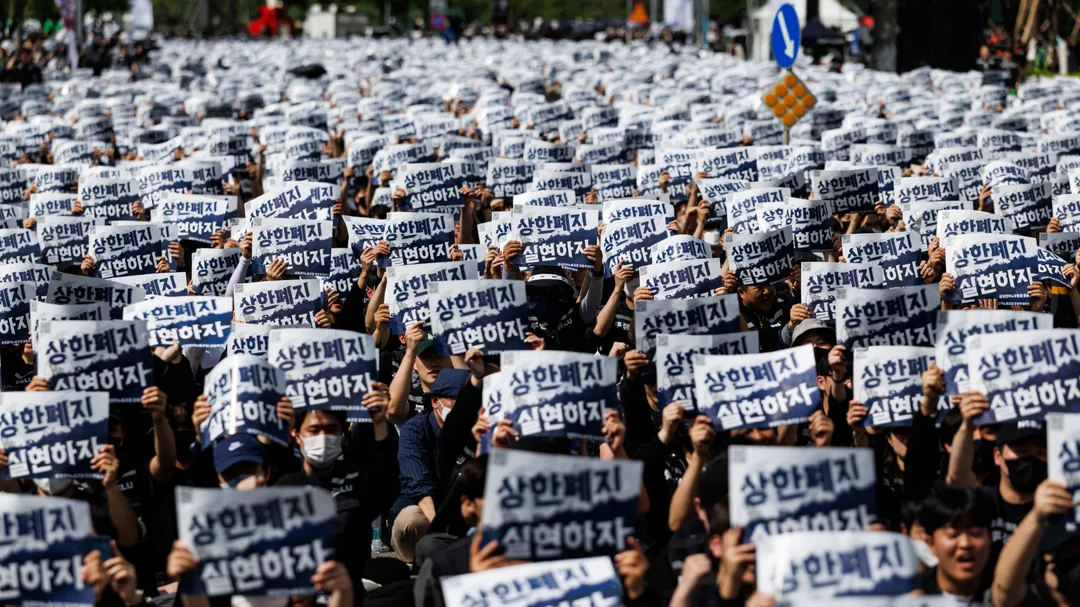
TechFlow Editorial Note: Over 40,000 members of the Samsung Electronics Union gathered at the company’s Pyeongtaek semiconductor complex—the largest labor rally in the company’s history—demanding that 15% of operating profit be allocated as performance bonuses, amounting to approximately ₩580 million (about $400,000) per employee. Management countered with a 10% proposal, which the union rejected. The union has announced an 18-day strike beginning May 21. Meanwhile, rival SK Hynix just posted its strongest quarterly results ever, with employees expected to receive average annual bonuses of ₩670 million—highlighting a growing pay gap that is now fueling a talent war.
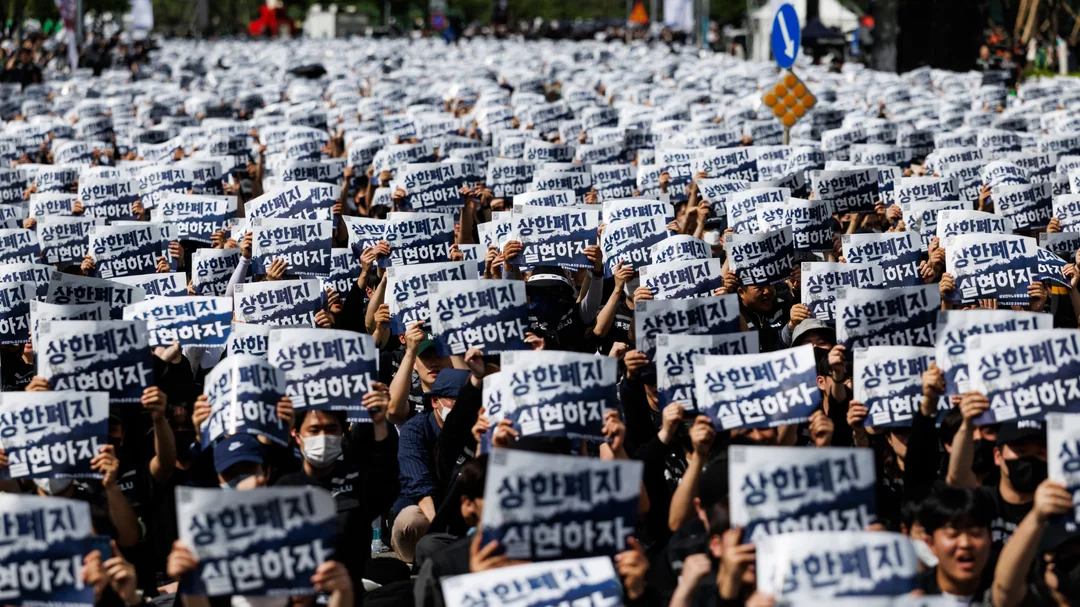
The AI chip boom has delivered extraordinary profits for Korea’s two memory giants—but internal tensions over profit distribution are now erupting violently within Samsung Electronics.
On April 23, more than 30,000 members of the Samsung Electronics Union flooded the company’s flagship semiconductor campus in Pyeongtaek, South Korea, staging the largest labor rally in the company’s history. The union claimed participation reached around 40,000. According to reports by Reuters and TechCrunch, the union’s core demands are: allocating 15% of operating profit as a performance bonus pool for semiconductor division employees; scrapping the current 50% cap on bonuses; and raising base salaries by 7%. Based on analyst forecasts projecting Samsung’s full-year 2026 operating profit at approximately ₩300 trillion, a 15% allocation would translate into a total bonus pool of roughly ₩45 trillion—distributing about ₩580 million (approximately $400,000) per employee across the semiconductor division’s ~77,000 staff.
Samsung management did not entirely shut the door on dialogue. As reported by Korean tech media ZDNet and others, the company proposed allocating 10% of operating profit toward bonuses, raising base salaries by 6.2%, and offering additional benefits including preferential housing loans—while pledging that total compensation for semiconductor employees would exceed that of competitors. The union rejected this proposal outright.
An 18-Day Shutdown Could Disrupt Global Memory Supply
If no agreement is reached, the union has announced an 18-day full-scale strike beginning May 21 and lasting through June 7. According to Euronews, the union estimates daily losses to the company exceeding ₩1 trillion (roughly $720 million).
Union President Choi Seung-ho addressed the crowd via a loudspeaker mounted atop a crane: “Make compensation transparent—and abolish the bonus cap!”
This marks the largest strike action in Samsung Electronics’ history. In 2024, workers staged the company’s first-ever strike in its 55-year history—but it lasted only about three days and had minimal impact on production.
This time, the union has made clear its intent to apply significantly greater pressure. Samsung filed an injunction request with the court last week seeking to prohibit the union from engaging in what it deems “illegal activities” during the strike.
According to Reuters, Park Ju-geun, head of Korean corporate analysis firm Leaders Index, predicts the two sides may ultimately reach a compromise—since prolonged strikes risk triggering public backlash, which would harm the union’s position. On the day of the rally, Samsung’s stock price rose 3% to a record high, suggesting markets remain calm—for now. Yet on the road opposite the factory, some shareholders gathered to protest, accusing the union of “sabotaging” the company at a critical juncture.
SK Hynix’s “Lottery Bonuses” Sting Samsung Workers
Much of the Samsung union’s anger stems directly from comparisons with SK Hynix.
On the very same day as the rally, SK Hynix released its strongest quarterly report ever: revenue of ₩52.58 trillion, operating profit of ₩37.61 trillion, and an operating margin of 72%—all record highs. According to the Seoul Economic Daily’s April 24 report, based solely on Q1 performance, each SK Hynix employee has already secured approximately ₩109 million in bonuses. Analysts project the company’s full-year 2026 operating profit at ₩230 trillion; combined with its policy of allocating 10% of operating profit to a bonus pool—without any cap—average annual bonuses are expected to reach ₩670 million (about $490,000). Korean media have dubbed these payouts “lottery bonuses.”
In September 2025, SK Hynix abolished its bonus cap and tied 10% of operating profit directly to employee performance. In 2025, the company distributed an average bonus of ₩140 million per employee; in 2024, that figure stood at ₩70 million. By contrast, Samsung issued no performance bonuses at all in 2024 due to semiconductor division losses.
According to the Korea Herald, Union President Choi Seung-ho revealed that approximately 200 employees have defected to SK Hynix over the past four months. The union’s own calculations show that, under equivalent compensation structures, bonuses for Samsung’s semiconductor employees are less than one-third those of SK Hynix counterparts. This disparity is already having visible effects at SK Hynix recruitment events: according to the Seoul Economic Daily, recent campus presentations held at 11 universities drew around 400 attendees—double the number of pre-registered participants—and even four-year university graduates who didn’t meet eligibility criteria reportedly inquired about production roles.
AI Chip Super-Cycle: “The Money Isn’t Ours,” Say Workers
The root of the conflict lies in Samsung’s historic profit surge—yet chip workers feel they’re receiving none of the upside.
Samsung Electronics’ April 7 guidance for Q1 2026 showed operating profit reaching ₩57.2 trillion (about $38.9 billion)—a staggering 755% year-on-year increase—with revenue of ₩133 trillion. That single quarter’s profit alone surpassed Samsung’s entire 2025 annual operating profit (₩43.6 trillion). As estimated by analysts cited by SamMobile, the semiconductor division contributed roughly 95% of this profit, driven primarily by HBM (high-bandwidth memory), server DDR5, and enterprise SSDs.
SK Hynix’s performance was equally remarkable: Q1 revenue surged 198% year-on-year, while operating profit doubled. During its earnings call, SK Hynix CFO Kim Woo-hyun stated that customer demand for HBM over the next three years already far exceeds the company’s supply capacity—and customers are prioritizing securing volume over negotiating prices. “Strong pricing trends will persist,” he affirmed.
Today, AI data centers consume roughly 70% of global high-end memory chip capacity. DRAM contract prices have risen for 11 consecutive months, with standard PC DRAM average prices reaching $13 in March 2026. Together, Samsung and SK Hynix control about 70% of the global DRAM market—and both firms are rapidly shifting capacity toward higher-margin AI memory products, further tightening supply of traditional consumer memory.
Join TechFlow official community to stay tuned
Telegram:https://t.me/TechFlowDaily
X (Twitter):https://x.com/TechFlowPost
X (Twitter) EN:https://x.com/BlockFlow_News
 深潮TechFlow