MetaComp Launches the World’s First AI Agent Governance Framework for Regulated Financial Services
TechFlow Selected TechFlow Selected
MetaComp Launches the World’s First AI Agent Governance Framework for Regulated Financial Services
MetaComp is Asia’s leading unified Web2.5 digital financial solutions provider, integrating fiat and stablecoin capabilities via an institutional-grade group platform to deliver core financial services—including payments, treasury management, and wealth management.
 Navigating Web3 tides with focused insights
The StableX “Know Your Agent” (KYA) Framework, unveiled at the Money20/20 Asia Summit, defines how AI agents delivering financial services—including payments, compliance, and wealth¹ management—should implement identity verification, authorization controls, behavioral monitoring, and accountability mechanisms. Developed by a Singapore-based team, the framework is designed for global application.
Bangkok, Thailand, April 21, 2026 – MetaComp Pte. Ltd. (“MetaComp”) today officially launched the StableX Know Your Agent (KYA) Framework. Specifically designed for AI agents operating in regulated financial services—including payments, compliance, and wealth¹ management—the framework systematically establishes governance across identity verification, authorization control, behavioral monitoring, and accountability attribution. Developed under the leadership of licensed financial institutions, it represents an industry-first initiative. MetaComp is Asia’s leading unified Web2.5 integrated digital financial solutions provider, unifying fiat and stablecoin capabilities across payments, treasury management, and wealth¹ management via its group-level platform. The KYA Framework will be made available to financial institutions, regulators, and network partners to advance the secure and scalable deployment of AI agents within regulated financial systems.
This launch coincides with the Money20/20 Asia Summit in Bangkok, Thailand. Concurrently, MetaComp announced the expansion of its AgentX Agent Financial Services Skill ecosystem—the first-of-its-kind ecosystem launched by a licensed financial institution. Available starting April 21, 2026, on Claude, Claude Code, OpenClaw, and other compatible AI platforms, it can be accessed at www.metacomp.ai.
Mrs. Tin Pei Ling, Co-President of MetaComp, stated:
“AI agents are already actively deployed in financial services—initiating payments, making compliance decisions, and managing investment portfolios. Yet, no widely accepted standard currently exists to define these agents’ identities, what they are permitted to do, and who bears responsibility when they act beyond their authorized scope. KYA is our proactive response to this critical gap in regulated financial services. It governs the agent’s entire lifecycle within a single architecture—covering identity, authorization, behavioral monitoring, and inter-agent interaction mechanisms.”
To grasp the real-world significance of this initiative, consider identity—the foundational issue. When an employee leaves an organization, their system access rights are revoked. But when an AI agent completes a transaction, its identity and permissions do not automatically expire. An agent may persist indefinitely in the system long after its authorization period has ended—with no verifiable identity anchor, no traceable accountability chain, and no intervention mechanism. Moreover, without time-bound safeguards and privacy protections, long-term behavioral traces of AI agents could be tracked and exploited. Hence, end-to-end lifecycle governance is essential,” she added.
A Governance Gap Unfilled in Agent Finance
Financial institutions worldwide are rapidly deploying AI agents to initiate payments, execute compliance decisions, and manage investment portfolios. Yet, according to McKinsey’s March 2026 report “State of AI Trust,” fewer than one-third of institutions have established comprehensive governance and control mechanisms to supervise them. Similarly, PwC’s “2026 Global AI Performance Study” notes that while AI adoption among Singaporean enterprises exceeds the global average (67% of Singaporean firms demonstrate higher risk tolerance for AI investment versus 41% globally), only 47% of Singaporean enterprises have formalized responsible AI frameworks—compared to 63% among global AI leaders.
In January 2026, Singapore’s Infocomm Media Development Authority (IMDA) released the “Agent-Based AI Model Governance Framework”—the world’s first cross-sectoral AI agent governance framework. Building upon this, the 2026 National Budget further advanced the agenda by announcing the establishment of a National Artificial Intelligence Council chaired by Prime Minister Lawrence Wong, designating finance as one of four national AI priority domains and pledging to establish regulatory sandboxes for AI innovation.
Mrs. Tin Pei Ling, Co-President of MetaComp, stated:
“We developed the KYA governance framework drawing on IMDA’s ‘Agent-Based AI Model Governance Framework’ and directly solicited feedback from IMDA. We are also actively engaging other regulators and stakeholders. We do not present KYA as a final answer; rather, we are publishing it openly because this challenge cannot be solved by any single institution alone. We call on financial institutions, regulators, and technology partners to adopt, refine, and co-develop this framework with us.”
To MetaComp’s knowledge and based on publicly available information, no licensed financial institution has yet published a governance architecture that—in a single, unified framework—covers agent identity, authorization, scope of action, behavioral monitoring, risk scoring, audit trails, and inter-agent interaction governance, specifically tailored to regulated financial service domains such as payments, compliance, and wealth¹ management.
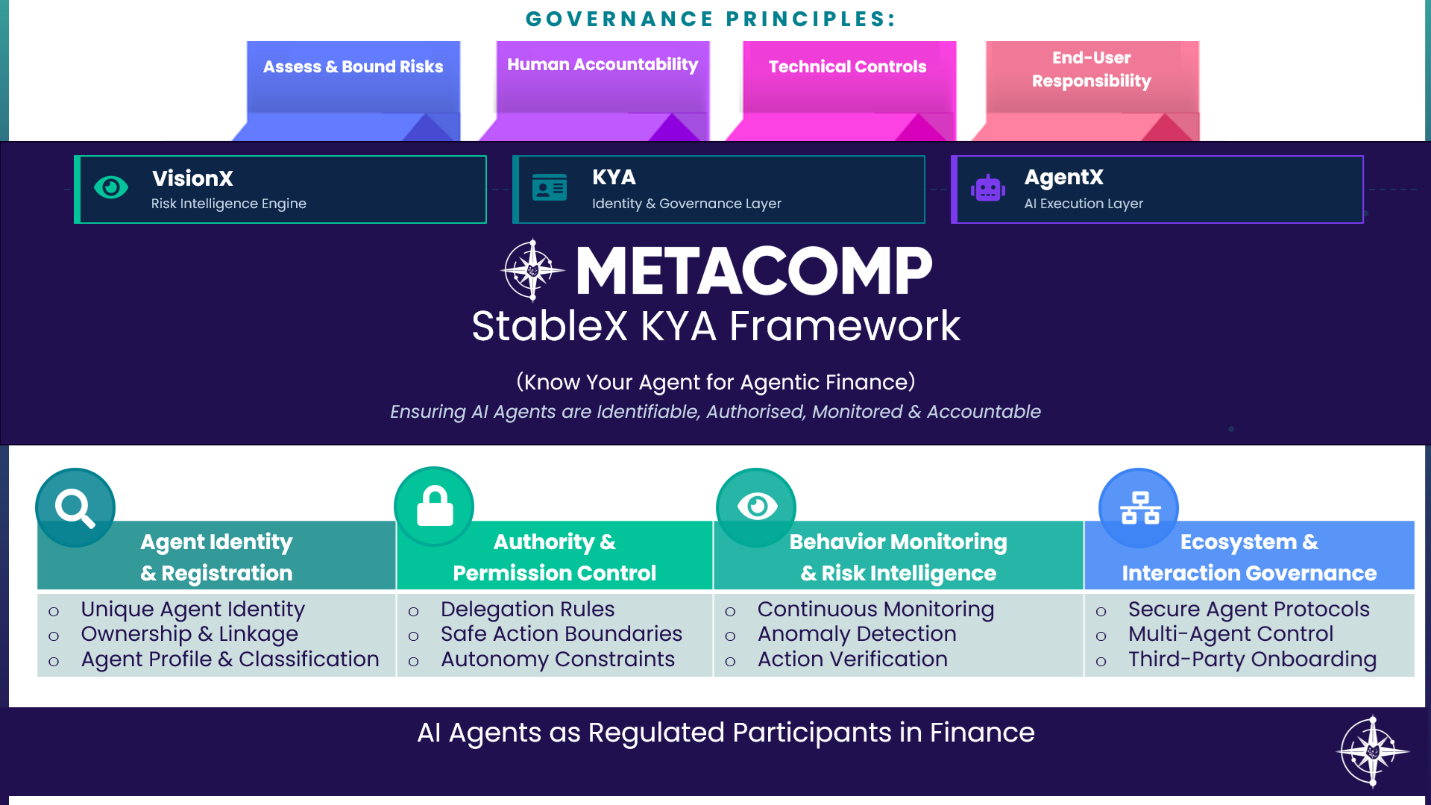
The KYA Framework delivers full operational lifecycle governance for AI agents, explicitly defining who the agent is, what it is permitted to do, what it actually did, and how it interacts. Built around four pillars, the framework comprises: “Agent Identity & Registration”; “Authorization & Permission Control”; “VisionX-Powered Behavioral Monitoring & Risk Intelligence”; and “Ecosystem & Interaction Governance”. Notably, interaction governance extends the core principles of the Financial Action Task Force (FATF) Travel Rule into agent-to-agent interactions, establishing a traceable, verifiable compliance mechanism.
Under the KYA Framework, each AI agent is bound to a verified identity and linked via a tamper-proof registration system to a real-world natural person or legal entity—ensuring clear, traceable accountability from inception. All agents operate strictly within predefined permission boundaries, specifying precisely what data they may access, what decisions they may make, and what actions they may execute. Built-in security mechanisms automatically trigger human intervention whenever operations exceed preset thresholds.
Going beyond traditional controls, the framework introduces continuous, real-time monitoring of AI agent behavior. Its evaluation dimensions extend beyond what the agent did to include how it executed the action and whether the outcome aligned with intended objectives, enabling holistic, multi-dimensional behavioral scrutiny. As agents operate continuously, their risk profiles are dynamically updated, shifting risk management from passive response to proactive identification and intervention. Furthermore, all activities and interactions are cryptographically authenticated and fully logged, generating end-to-end audit trails that provide regulators, financial institutions, and ecosystem participants with a highly transparent and traceable compliance infrastructure.
The KYA Framework extends governance to agent-to-agent interaction scenarios and strengthens the FATF Travel Rule’s core principles: within a unified framework, verified identity and transaction information must be exchanged not only between institutions but also across agent-initiated and agent-to-agent interactions. This design ensures, at the foundational level, that every interaction is traceable, attributable, and compliantly controllable.
The framework applies to all agents operating on the StableX Network, including those accessing MetaComp’s service capabilities through the AgentX Skill ecosystem. Financial institutions and developers can integrate directly with MetaComp’s regulated infrastructure (compliance, payments, and wealth¹ management) via everyday AI platforms—including Claude, Claude Code, and other model-context-protocol-compatible platforms.
The ecosystem’s inaugural Skill—VisionX Transaction Screening (KYT) Skill—packages the Web2.5 VisionX Engine as a compliance layer directly callable by AI agents, enabling parallel integration with data from over four blockchain analytics providers. Additional new Skills targeting cross-border payments, treasury management, and wealth¹ management will launch by end-Q2 2026.
Compliance Foundations & Practical Validation
The framework builds upon MetaComp’s compliance architecture, which has been validated through real-world transaction flows. Today’s cross-border transactions often involve both traditional banking rails and blockchain networks simultaneously. According to FATF data released in June 2025, 73% of jurisdictions globally have enacted Travel Rule legislation—but 59% have taken no supervisory or enforcement action.
Mrs. Summer Yu, Chief Compliance Officer of Alpha Ladder Group, stated:
“Current compliance frameworks assume transactions are initiated by humans. That assumption no longer holds. Our analysis of over 7,000 real transactions shows that even in hybrid fiat-blockchain environments, reliance on a single screening tool may miss up to 25% of high-risk exposures. In AI agent-driven scenarios, such risks escalate further. Without a clear identity layer, well-defined authorization boundaries, and unified accountability standards, any purported control framework collapses. VisionX Web2.5 solves the visibility problem, bridging risk blind spots across Web2 and Web3; KYA establishes the governance layer—defining agents’ identity, permissions, and responsibilities within the financial system. Neither is sufficient alone; both must be built in tandem to enable safe, sustainable, and scalable ‘agent finance’ within regulated systems.”
This launch continues MetaComp’s strong growth trajectory. Within three months, the group completed two Pre-A funding rounds totaling $35 million; subsequently launched the Web2.5 VisionX Engine; formed a joint venture with Maqam International Holding to connect Abu Dhabi’s physical assets with Asian capital markets via the StableX Network; and now unveils the KYA Framework—laying the governance foundation for the next phase of institutional AI agent finance. Funds will be allocated across three strategic areas: deepening compliance capabilities; expanding regulated payment corridors across Asia, the Middle East, Africa, and Latin America; and building institutional-grade standards required for the AI agent era.
¹ All products and/or services related to securities and capital market instruments are exclusively provided and operated by Alpha Ladder Finance Pte. Ltd.
About MetaComp
MetaComp is Asia’s leading unified Web2.5 digital financial solutions provider, integrating fiat and stablecoin capabilities across payments, treasury management, and wealth management via its institutional-grade group platform. MetaComp holds a Major Payment Institution (MPI) license issued by the Monetary Authority of Singapore (MAS), authorizing it to offer Digital Payment Token (DPT) and Cross-Border Money Transfer (CBMT) services. It currently serves over 1,000 institutional and qualified investor clients, with operations spanning major global financial centers.
In 2025, the group platform processed over $10 billion in payments and over-the-counter (OTC) transactions, supporting 13+ stablecoins, with monthly transaction volumes exceeding $1 billion. Through the StableX Network, institutional clients can seamlessly transfer, convert, and manage fiat and stablecoin funds within a unified, compliant Web2.5 financial architecture.
Funding and investment services are provided by MetaComp’s affiliate, Alpha Ladder Finance Pte. Ltd., which holds MAS-issued Capital Markets Services (CMS) and Recognised Market Operator (RMO) licenses. Its wealth solutions now manage over $500 million in assets under management.
To date, MetaComp has raised $35 million in Pre-A funding and achieved full-year net profitability in 2025—demonstrating robust market demand for regulated Web2.5 financial solutions.
For more information, visit **www.mce.sg**, or follow MetaComp on LinkedIn (https://www.linkedin.com/company/metacompsg) and X: @MetaCompHQ.
Join TechFlow official community to stay tuned
Telegram:https://t.me/TechFlowDaily
X (Twitter):https://x.com/TechFlowPost
X (Twitter) EN:https://x.com/BlockFlow_News
 @MetaCompHQ