Claude’s Real-Name Verification Storm: 72 Hours
TechFlow Selected TechFlow Selected
Claude’s Real-Name Verification Storm: 72 Hours
Every policy adjustment by Claude sends ripples across the AI industry, generating massive waves.
 Navigating Web3 tides with focused insights
Author: Zhong Chudi
Lead: At dawn on April 18, Pato Molina, CTO of Argentine startup Belo app, had a meltdown. That day, Claude accounts belonging to over 60 of the company’s employees were collectively suspended.
Belo app was founded in 2020 and is among the earliest Argentine companies to launch physical cards enabling cryptocurrency-to-fiat exchanges. The team relies almost entirely on Claude for daily development, code generation, and process automation—treating it as their core productivity tool.
Suddenly, the workflow for over 60 people ground to a halt: all integrations, custom skills, and chat histories either vanished outright or froze indefinitely. For a fast-moving startup, this was effectively hitting the pause button on the entire project.
All this stemmed from a new policy announced by Claude on April 15: mandatory KYC verification—a financial-grade identity check requiring users to hold government-issued physical ID documents and undergo real-time selfie detection.
The announcement sent shockwaves through the vibe-coding startup community. In the AI era, many who previously lacked coding expertise now treat Claude as their most indispensable tool. Without it, product iteration speed and development efficiency plummet dramatically. Yet its service availability remains strictly region-locked, leaving heavy users perpetually teetering on the edge of suspension—engaging in an endless cat-and-mouse game with the system.
This panic quickly spread domestically. Many users grew anxious, fearing their accounts would be next on the chopping block. Some even got suspended before ever seeing the KYC prompt. Meanwhile, a secondhand platform swiftly launched “KYC proxy verification” services.
Every policy shift by Claude sends ripples across the AI industry—ripples that grow into waves. No matter how skilled or experienced practitioners are, they inevitably get swept up in the turbulence, caught in a relentless tug-of-war between anxiety and dependence.
At 3 p.m. on April 15, when Lao Zhang saw the news about Claude’s mandatory identity verification, he nearly spilled his coffee onto the keyboard.
Lao Zhang is from Shanxi Province but works in Beijing. He also identifies himself—as far as Claude is concerned—as “a Japanese person working in Taiwan.” To avoid suspension, he built this persona deliberately: routing his IP through Taiwan, using foreign-issued credit cards, purchasing Japanese-region Apple gift cards via Amazon Japan, and subscribing to Claude plans through the Apple App Store.
In Claude’s unofficial “account cultivation guides,” persona-building is a key tactic. Lao Zhang’s script is relatively modest.
To evade suspension, netizens have been stacking layers of politically correct symbolism ever higher. On social media, one user shared her “how to beat Claude” strategy: she portrayed herself as a low-income Black single mother stuck in China’s time zone, a Muslim and vegetarian suffering from gender dysphoria.
That still wasn’t enough. Maintaining the persona is a long-term campaign. First, your IP must remain clean; accounts must never be shared. Second, you must communicate in a foreign language. To avoid slipping up, Lao Zhang chats casually with Claude in Japanese every few days. He’s even developed a habit: occasionally asking out of the blue, “Where am I right now?”—to test whether the model has seen through him.
No matter how convincing the “performance,” it crumbles under the platform’s iron fist. Upon learning that KYC required a passport, Lao Zhang lamented in his WeChat Moments: “The sky has fallen!”
Unable to produce a Japanese passport, he temporarily shelved his plan to upgrade to Claude Pro, instead researching which user groups the new verification targeted. Then he opened a secondhand platform and searched for “KYC proxy verification,” hoping to ride out the storm via the AI gray market.
Lao Zhang works as a copywriter. His typical use of Claude involves research and outlining articles—an overkill application, like using a slaughterhouse knife to kill a chicken. Yet at this moment, the entire internet is gripped by “account survival panic.” Even light users can’t help but jump at every shadow.
“Proxy verification” isn’t reliable. Numerous listings have already appeared on secondhand platforms, priced between ¥80 and ¥180. The process is simple: place an order, wait for a “verifier” located in an eligible region to go online, then forward the authentication link Claude generates to the seller.

Figure | Numerous “proxy verification” product links appearing on a secondhand platform
Most sellers only guarantee successful verification—not what happens afterward. If your account gets suspended later due to IP anomalies or chat history, they bear no responsibility. Lao Zhang asked three or four sellers in succession; each was more cautious than he was, repeatedly emphasizing “no refunds for suspended accounts.”
KYC sellers aren’t newcomers. KYC is standard practice at cryptocurrency exchanges, and buying/selling KYC credentials has long formed a large, mature industry—with individual KYC accounts selling for ¥10–¥50.
Social media is flooded with jokes about this trade. One quip goes: “Pay $5 to a local in Nigeria for a verification photo, then resell it to a big-tech engineer in Zhichun Road, Beijing, for $100.” Another hits harder: “Claude’s KYC rollout benefits U.S. street homeless people most.”

Figure | Sellers emphasize: “No liability for suspended accounts”
Above water, cries echo endlessly. Below, reality remains eerily calm.
At the same time, digital nomad Xiao Hai was onsite at a hackathon. When the KYC news flooded his group chat, he didn’t even notice. Later, after reading the discussions, he cracked a few jokes and put his phone away.
Xiao Hai is an AI project founder—and a heavy Claude user. He doesn’t just integrate AI into his workflow; he has completely rebuilt his workflow around AI. Including his premium subscription fee of up to $200 per month, he spends over ¥1,500 monthly on Claude alone.
Spending money is just the baseline. To ensure stable usage, Xiao Hai built a dedicated technical pipeline. He and his friends even reverse-engineer Claude’s source code to identify which data points it collects—and which ones risk exposing their real identities—then consciously minimize outputting those signals during subsequent interactions to reduce suspension risk.
Even so, Xiao Hai has been suspended twice. His last suspension occurred in early March. After receiving the email, he posted a rant on social media that garnered 800 likes—the best-performing post of his career. Beneath it, over 400 comments vented frustration over Claude’s “capriciousness.”

Figure | A flood of complaints beneath Xiao Hai’s post
Unlike Lao Zhang’s panic, suspension only fuels Xiao Hai’s drive to crack the system. In his view, every Claude interception becomes a barrier for future users. He likens himself to a turkey: as long as feed arrives daily, he eats quietly—no need to overthink the farmer’s intentions. Thanksgiving may come tomorrow.
This KYC event triggered no pop-up warnings among Xiao Hai’s circle. Because all mission-critical productivity data resides locally—and Claude is accessed solely via API calls—each interaction with Claude is stateless. He doesn’t truly care if he gets suspended; to him, losing access is like misplacing a hammer—you simply buy another one.
Drake, a big-tech programmer, represents yet another stance. A heavy Claude user, he once spent 5.6 billion tokens on Claude within two weeks. After the KYC announcement, he and his colleagues continued using Claude normally—leading him to conclude ordinary users likely weren’t in Claude’s current crosshairs.
He believes Claude’s subscription model has long been vulnerable to exploitation by intermediaries and other gray-market operators—and that KYC could fix this. Confident he stood on “safe ground,” he not only felt no panic but upgraded to the $200/month Max 20x membership. The next day, however, after switching IPs and logging into Claude, he received a suspension email.
When the KYC news broke, Carson, a Beijing-based architect, received his suspension email instantly. At that moment, only one thought crossed his mind: “It was inevitable.”
Carson has never followed “account cultivation rules.” In conversations with Claude, his IP has jumped from Singapore to Japan—likely one reason for his suspension. Two days before getting banned, he asked Claude where he was. Claude replied: “I see your IP is in the U.S., but I know you’re not actually there.”
Another possible cause lies in model analysis. Two hours before receiving the suspension email, Carson had asked Claude to analyze Claude Code and intermediary models. To the platform, such behavior closely resembles technical distillation—a leading theory circulating on social media.
Fortunately, Carson maintains a backup account. After topping it up with a $20 Pro subscription, he still refuses to follow any usage rules—opting instead to “go with the flow.”
The “suspension mysticism” isn’t entirely unfathomable. Social media users have identified several high-risk behaviors most likely to trigger fraud detection: frequent IP hopping, using unverified virtual credit cards, and logging into the same account from multiple devices in quick succession.
Others have devised a “safety protocol”: one device, one browser, one fixed IP—avoid switching whenever possible. Use an internationally issued credit card registered under your own name, ensuring billing address matches your IP location.
Yet even strict adherence to these rules doesn’t guarantee immunity. Some users still get falsely flagged within the “safe zone.” Pai Daxing, an AI project founder, is among the rare few who actually received the KYC pop-up.
On April 15, upon seeing the news, Pai Daxing found his account still functional. He refreshed the page several times, puzzled: “Why hasn’t Claude suspended me yet?” That evening, the verification prompt finally appeared. Receiving it, he exhaled deeply—like a boot finally dropping from above. “Sure enough, everything unfolded exactly as expected.”
After suspension, he didn’t hesitate: he immediately switched to CodeX. To him, Claude is a sharper—but pricier—tool. Other AIs may be duller, but they’re cheaper; with extra polishing time, results won’t suffer much.
As long as Claude’s suspension problem remains unresolved, he won’t return.
Pai Daxing isn’t the only one fleeing. After Drake’s suspension, he too migrated to CodeX. In his view, CodeX’s engineering capabilities are strong enough—and crucially, CodeX doesn’t suspend accounts.
Even Xiao Hai—who spends hundreds of dollars monthly on Claude—keeps GPT, Gemini, and CodeX installed side-by-side on his devices. In this fast-evolving industry, most surfers prioritize outcomes: they use whichever tool delivers best. Most of the time, that tool is Claude. Xiao Hai calls Claude the purest “green drug”—once used, returning to a life without it becomes nearly impossible.
Across the Atlantic, Pato Molina chose direct confrontation. On the morning of April 18, he angrily posted on X (formerly Twitter), tagging Claude’s official account. He accused Anthropic’s security team of sending only a templated email stating that “system detected numerous violations of terms of service,” followed by immediate revocation of all permissions after manual review—and offering only a Google Form as an appeal channel, with abysmal UX.
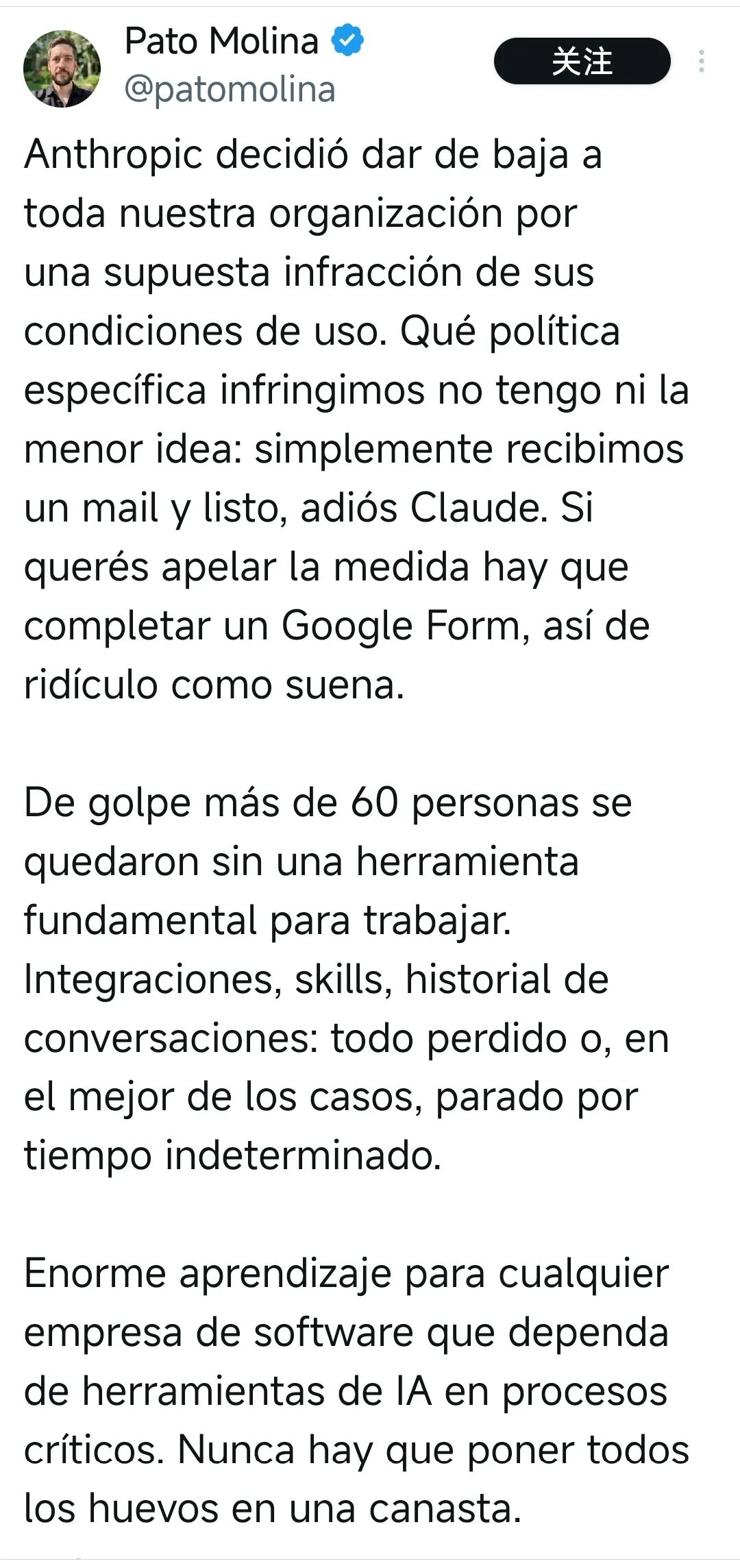
Figure | Pato Molina’s public complaint post
This scenario feels familiar to many: inexplicable account suspensions, perfunctory official responses, dead-end formal complaint channels—forcing users to rely on viral public pressure to compel platform concessions. Previously, many assumed this was a hallmark of domestic Chinese internet platforms—only to witness its identical replication at Anthropic.
Fortunately, Pato’s post went viral rapidly, exceeding one million views. Within十几个 hours, Anthropic restored all accounts and sent apology emails citing “false positives.” But even that brief downtime left deep psychological scars among vibe-coding founders.
Over 60 people losing their most critical work tool overnight delivers a brutal lesson for any software company deeply embedding AI into core processes. Pato Molina reflected: “Never put all your eggs in one basket.”
For these AI industry professionals, their relationship with Claude is primarily productive. From registration onward, Claude demands overseas phone numbers and foreign-issued credit cards for payment—and suspensions are common and unpredictable. Ordinary users rarely use Claude at all, while those who do rely on it heavily have long stopped treating these hurdles as obstacles. For them, this KYC update is merely an extra step—and fresh material for banter.
But for average users like Lao Zhang, what hooks them into obsessive “account cultivation” isn’t just Claude’s powerful capabilities—it’s the chronic anxiety of constantly dancing on the edge of suspension.
Lao Zhang’s account remains active to this day. He continues maintaining his “Japanese person in Taiwan” persona, chatting with Claude daily in Japanese about the weather, and meticulously locking his IP to Taiwan. On April 17, Claude Opus 4.7 officially launched—but Lao Zhang dared not pay. He posted on WeChat Moments: “Just surviving for now.”
Join TechFlow official community to stay tuned
Telegram:https://t.me/TechFlowDaily
X (Twitter):https://x.com/TechFlowPost
X (Twitter) EN:https://x.com/BlockFlow_News