Is Anthropic About to Kill Figma Itself?
TechFlow Selected TechFlow Selected
Is Anthropic About to Kill Figma Itself?
From selling models to building products, Anthropic has taken this step faster than anyone anticipated.
 Navigating Web3 tides with focused insights
Author| Hualin Wuwang
Editor| Jingyu
In 2010, a small company called Instagram was acquired by Facebook for $1 billion. At the time, many people couldn’t understand why so much money would be spent on a filter app. The rest of the story is well known—Facebook wasn’t buying a product; it was acquiring a species capable of threatening itself—and then turning it into its own weapon.
Mike Krieger was the co-founder who helped grow Instagram from zero to hundreds of millions of users. In May 2024, Mike joined Anthropic—a company then at the height of its momentum—as Chief Product Officer.
On April 14, 2026, Krieger resigned from Figma’s board of directors. Three days later, Anthropic announced the launch of Claude Design.
That timing is unlikely to be coincidental.
01 In Just Three Days, an Entire Industry’s Landscape Shifted
Figma’s stock price plunged over 7% that day, dropping from $20.32 to $18.84. Market reactions are always more honest than press releases.
Claude Design is an experimental product powered by Anthropic’s latest flagship model, Opus 4.7, developed internally by the Anthropic Labs team. What can it do? Prototyping, slide decks, one-page summaries, and various visual content—precisely the tasks designers and product managers perform daily in Figma or Canva.
Yet viewing Claude Design merely as “another AI design tool” vastly underestimates its significance.
What truly alarmed industry insiders was the “handoff” mechanism between Claude Design and Claude Code.
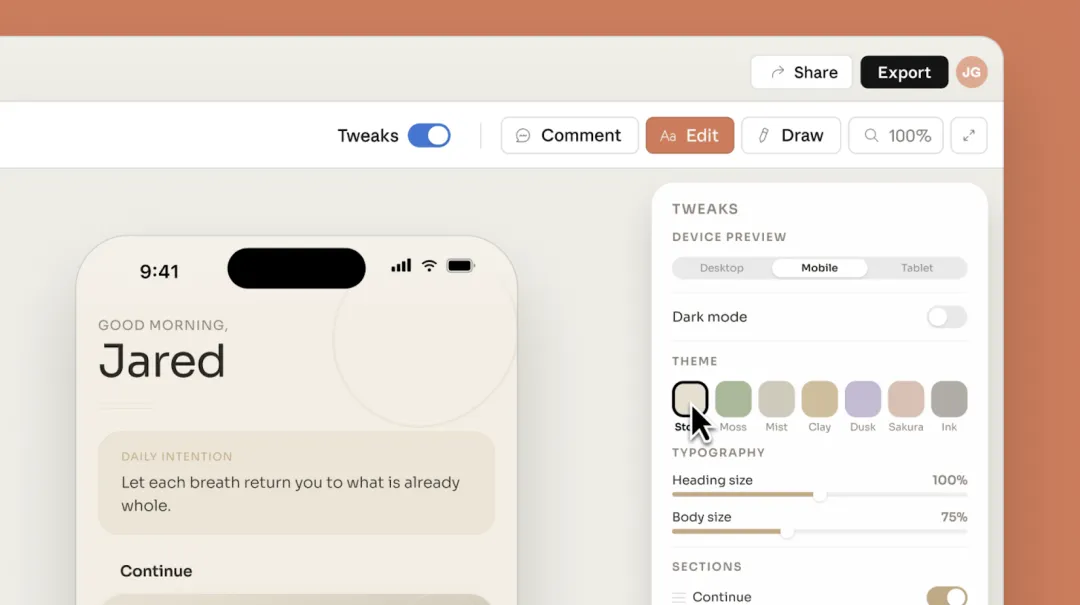
Claude Design interface | Source: Anthropic
Once you complete a UI prototype using Claude Design, the system automatically packages the full design specifications into a “handoff package,” which can be directly passed to Claude Code for development.
Even more crucially, upon activation, Claude Design reads your codebase and existing design files to automatically construct a design system tailored to your team—fonts, colors, layout standards, brand governance rules—all read once and applied consistently throughout.
A developer on Reddit commented that this solves the “most annoying part” of using AI for design tools—re-explaining your brand guidelines to the AI every time a new project starts.
Design-to-development used to involve two tools, two workflows, and two sets of people. Now Anthropic aims to turn this chain into a closed loop.
02 A Clear Strategic Cadence
Placing Claude Design within the timeline of recent weeks reveals an increasingly accelerated pace at Anthropic.
In early April, Anthropic announced the limited release of Claude Mythos Preview. This model can uncover and exploit vulnerabilities hidden for decades inside critical software systems—security risks so severe that the company chose not to make it publicly available. Instead, under “Project Glasswing,” Anthropic granted access exclusively to over 50 top-tier institutions—including Amazon, Apple, Microsoft, Google, and JPMorgan Chase—with each receiving a $100 million usage allowance specifically for defensive cybersecurity research.
On April 14, Opus 4.7 officially launched, delivering stronger coding capabilities, sharper visual understanding, and a new “self-check” feature. Anthropic itself acknowledged that Opus 4.7’s performance falls short of Mythos—but Mythos remains unreleased due to security concerns.
On April 17, CEO Dario Amodei met with White House officials to discuss cybersecurity concerns raised by the Mythos model. On the same day, Claude Design was released.
Also on April 17, foreign media reported Anthropic’s valuation had reached $800 billion, and preliminary IPO discussions were underway with Goldman Sachs, JPMorgan Chase, and Morgan Stanley—with a listing potentially as early as October this year.
This is no longer the behavior of a company simply “selling models.” It’s a company preparing for an IPO—one that must clearly articulate to capital markets “why we’re worth this valuation”—and systematically filling gaps in its product portfolio.
From Claude Code disrupting the developer tools market to Claude Design entering the design workflow, Anthropic’s logic is crystal clear: identify high-frequency tooling scenarios used daily by professionals, rebuild them natively with AI, and use “model capability” as a moat that competitors struggle to cross.
03 Challenging Figma—While Confronting Reality
However, there’s often a gap between an ideal closed loop and real-world usage.
Reviewers who tested Claude Design found that merely building a design system, prototyping a website, and making several iterations already consumed over 50% of their weekly quota. Exceeding the quota incurs additional token fees—cost pressure that cannot be ignored in design scenarios demanding frequent iteration.
Noticeable bugs also persist—for example, the design system preview sandbox fails to correctly load image files, causing broken image links.
At this stage, Claude Design functions more like an internal demo and rapid-prototyping accelerator—not yet a production-grade design tool ready for direct delivery.
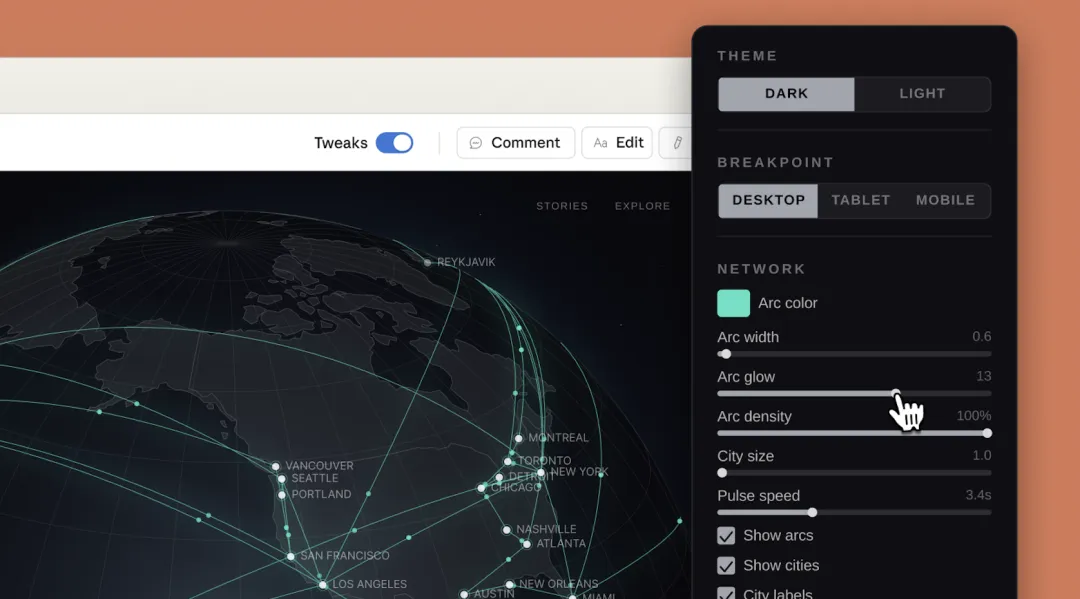
Claude Design interface | Source: Anthropic
This means Canva and Figma aren’t defenseless. Figma has spent years building formidable advantages in collaboration features, fine-grained design system management, and professional designers’ workflows; Canva excels in template ecosystems and ease-of-use for non-professionals. Production-grade output still requires manual refinement—at least in the short term.
But in the AI domain, “short term” is shrinking rapidly.
Anthropic’s true ambition may not be to replace Figma outright—but rather to redefine “who Figma’s target users are.” When an independent developer, a product manager at a small team, or an entrepreneur needing a quick demo can build a “good-enough” prototype in minutes using Claude Design—and seamlessly hand it off to Claude Code for implementation—do they still need to invest time learning Figma?
That’s the real reason behind Figma’s 7% stock drop.
04 From Selling Shovels to Mining Gold
There’s a long-standing Silicon Valley analogy: during a gold rush, the most profitable players aren’t the prospectors—they’re the ones selling shovels. In the early days of the AI boom, OpenAI and Anthropic played precisely that role—providing APIs for developers and enterprises to build applications.
Now, however, Anthropic is digging for gold itself.
Claude Code and Claude Design are both shovels—and both user-time capture points. By building developer tools and design tools directly, Anthropic shifts its relationship with ecosystem companies (which previously built products atop its API) from “partners” to “competitors.”
Microsoft has walked this path. So has Google. Apple has taken it furthest. The difference lies in sequence: those companies first built platforms, then added applications. Anthropic, by contrast, first established trust through model capabilities—and is now extending that trust upstream into the application layer.
Mike Krieger once turned Instagram into a platform—and later watched Facebook leverage that platform to suppress competitors. Two years ago, he joined Anthropic to build products.
History doesn’t repeat itself exactly—but sometimes, the participants do.
Anthropic’s IPO could close as early as October this year. Before then, it will likely make several more announcements—to help capital markets see clearly what kind of company it intends to become.
Join TechFlow official community to stay tuned
Telegram:https://t.me/TechFlowDaily
X (Twitter):https://x.com/TechFlowPost
X (Twitter) EN:https://x.com/BlockFlow_News