Indeed, university graduates are the ones who hate AI the most.
TechFlow Selected TechFlow Selected
Indeed, university graduates are the ones who hate AI the most.
In this inescapable technological cycle, Generation Z has figured it out.
 Navigating Web3 tides with focused insights
Author|Moonshot
Editor|Jingyu
Over the past two years, as generative AI has exploded onto the scene, it’s been widely assumed—almost instinctively—that young people, having grown up as digital natives, are its most fervent believers.
On the surface, this appears true. Data from the Pew Research Center shows that 54% of U.S. teenagers have already begun using tools like ChatGPT to complete schoolwork. Gallup’s latest report, “The Voice of Gen Z: The AI Paradox,” further reveals that over half (51%) of Americans aged 14 to 29 use AI daily or weekly.
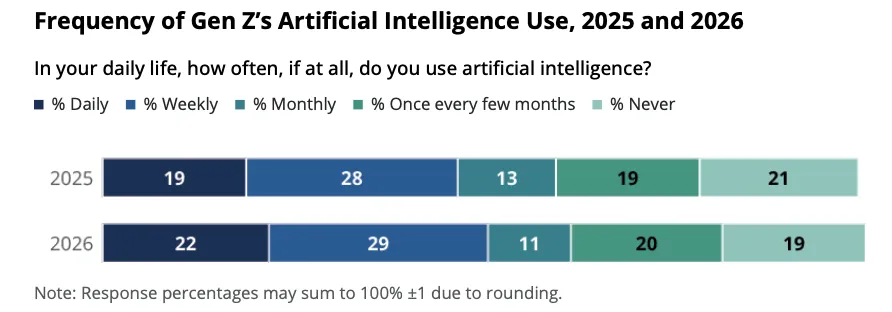
But behavior does not equal willingness. Gallup also found that, over just the past year, the share of respondents aged 14–29 who feel “hopeful” about AI dropped sharply—from 27% to 18%. Nearly one-third (31%) reported feeling “angry,” while a striking 42% experienced persistent anxiety.
High-frequency usage and collapsing trust are occurring simultaneously—a contradictory, conflicted sentiment now spreading across America’s Gen Z cohort (those born between 1996 and 2012).
So why is the generation that uses AI most frequently also the least trusting of it?
01 Anxiety: Keeping the Enemy Close
The group expressing the strongest hostility toward AI consists of those just entering the workforce—or still searching for their first professional foothold.
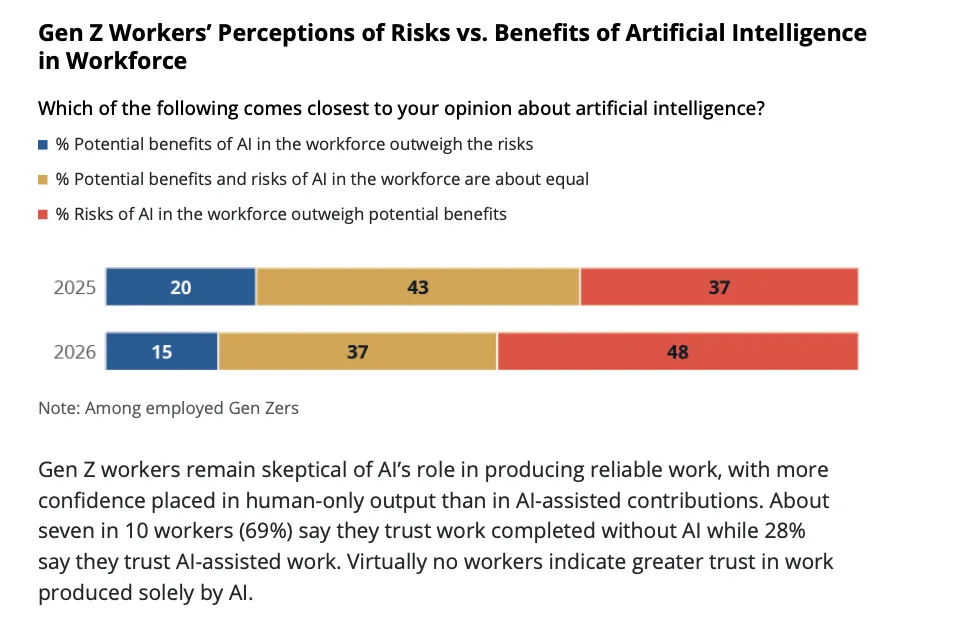
According to Gallup, among employed Gen Zers, as many as 48% believe AI poses greater risks than benefits in the workplace—a figure that surged by 11 percentage points over the past year. Only 15% see benefits outweighing risks.
The reason is straightforward: macroeconomic conditions are poor, and even U.S. graduates are struggling to land jobs.
Data from the Federal Reserve Bank of New York shows that, as of last year’s end, unemployment among college graduates aged 22–27 soared to 5.6%, far exceeding the national average.
Against this backdrop, AI is marketed as an “efficiency booster”—a “digital employee” for corporations. Some AI company executives routinely tell the media that “large numbers of entry-level white-collar roles may be automated within the next few years.”
These very positions—entry-level white-collar jobs—are typically the first rungs on the career ladder for young people. Without them, young professionals cannot even begin building their professional moats.
So although widespread displacement hasn’t yet materialized, the mere anticipation has already reshaped emotions: to young people, AI feels like a potential competitor.
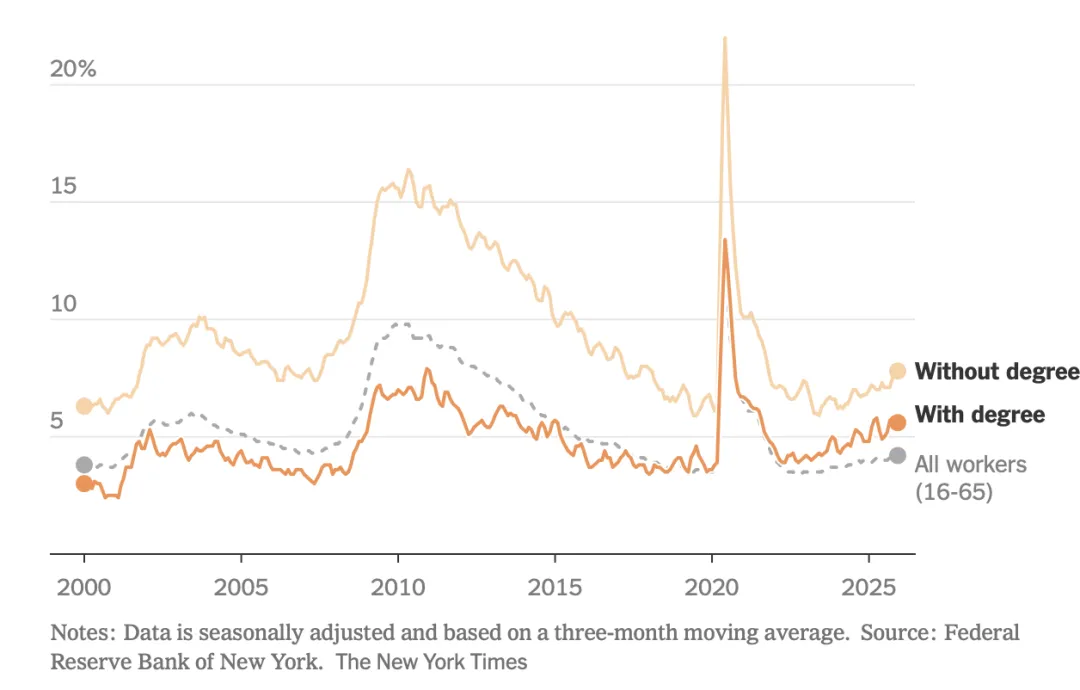
“Job-loss waves” coinciding with AI’s rise|Source: The New York Times
The New York Times’ reporting highlights numerous concrete struggles faced by Gen Zers.
Take Erin, a 22-year-old psychology graduate. To land even a basic business analyst role, she submitted nearly 200 resumes—receiving only four interviews and ultimately accepting a temporary position as a server at a Long Island restaurant. The job search left her physically and mentally exhausted; she has since begun seeking psychological counseling.
Then there’s Sydney, a first-year college student unsure how to choose a major: “I feel like any field I’m interested in could be replaced in the next few years.” Her uncertainty reflects that of most current undergraduates.
Meanwhile, tech giants are cutting staff under the banner of AI deployment. This is today’s stark reality: Silicon Valley elites tout corporate “cost-cutting and efficiency gains,” but for young people, the tangible outcome is losing their foot-in-the-door to the professional world.
Ironically, to avoid being left behind—they open ChatGPT every day to polish their résumés and ask large language models which universities might admit them more easily.
This psychological-behavioral inconsistency is precisely what lies at the heart of Gen Z’s anxiety toward AI.
02 Fear: Using AI Because You Have No Choice
If Gen Z harbors such hostility and distrust, why do 51% still use AI daily or weekly?
New York Times reporter Callie Holtermann uncovered the answer through extended interviews. She found that young respondents don’t actually think using AI is particularly great. What drives them to open the chat window is fear—specifically, the fear that “if I don’t become proficient in this technology, I’ll fall behind in academics or my career.”
Workplace norms have already been reshaped by AI. When browsing entry-level job postings, young applicants often encounter requirements like “applicants must be proficient in ChatGPT or Gemini.”
Writer, an enterprise AI agent company, recently published an even harsher report: 77% of executives explicitly stated that employees who fail to master AI will not be promoted—and 60% of managers are considering outright termination for such employees.
This means that, within today’s workplace and evaluation systems, ignorance of AI equals automatic disqualification.
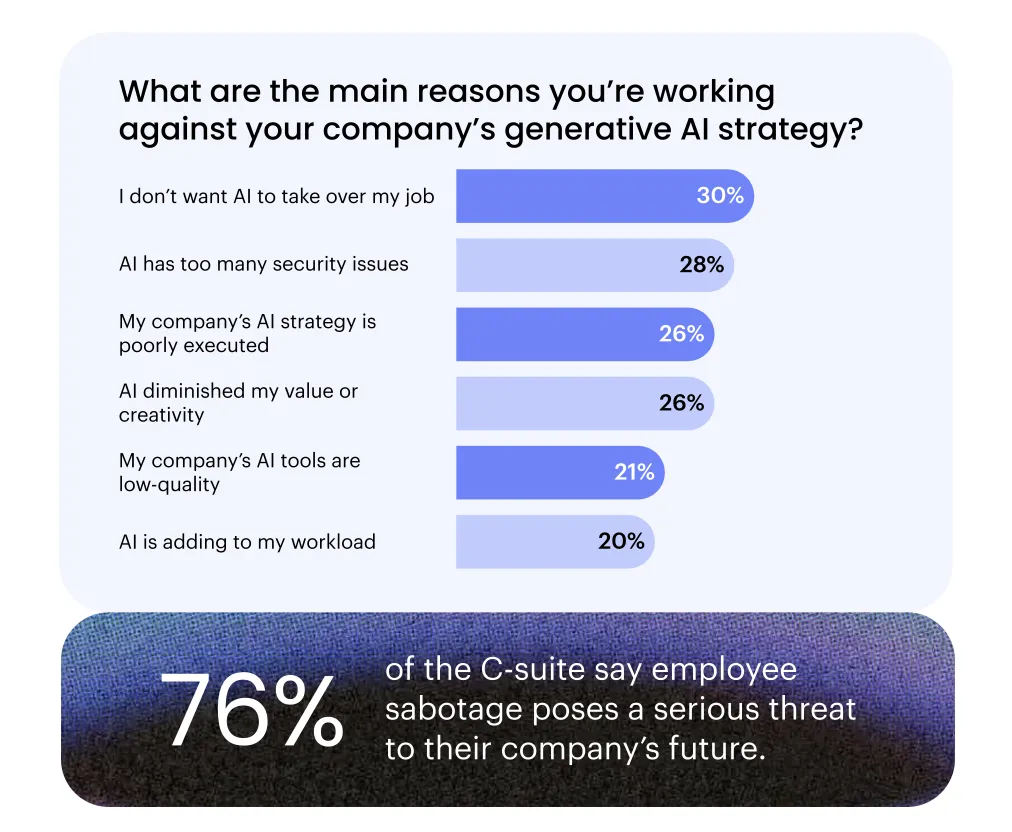
The top reason employees resist AI: fear of being replaced|Source: WRITER
Even after securing a job, this fear doesn’t vanish.
These workers must also contend with FOBO—Fear of Becoming Obsolete. The report notes that 26% believe AI is directly eroding their creativity and core value within their companies.
This constitutes a deep professional dispossession: years of hard-won expertise—be it coding, law, or finance—is rapidly losing market premium. As that value evaporates, so does confidence in one’s own capabilities. In Gallup’s survey, many young respondents expressed concern that AI would weaken their critical thinking and creativity.
And FOBO isn’t limited to frontline workers—it applies equally to management teams pushing AI adoption. Writer’s report shows that 69% of companies are cutting staff due to AI, yet 39% haven’t figured out how AI will generate revenue. Even 73% of CEOs report feeling anxious about their AI strategy.
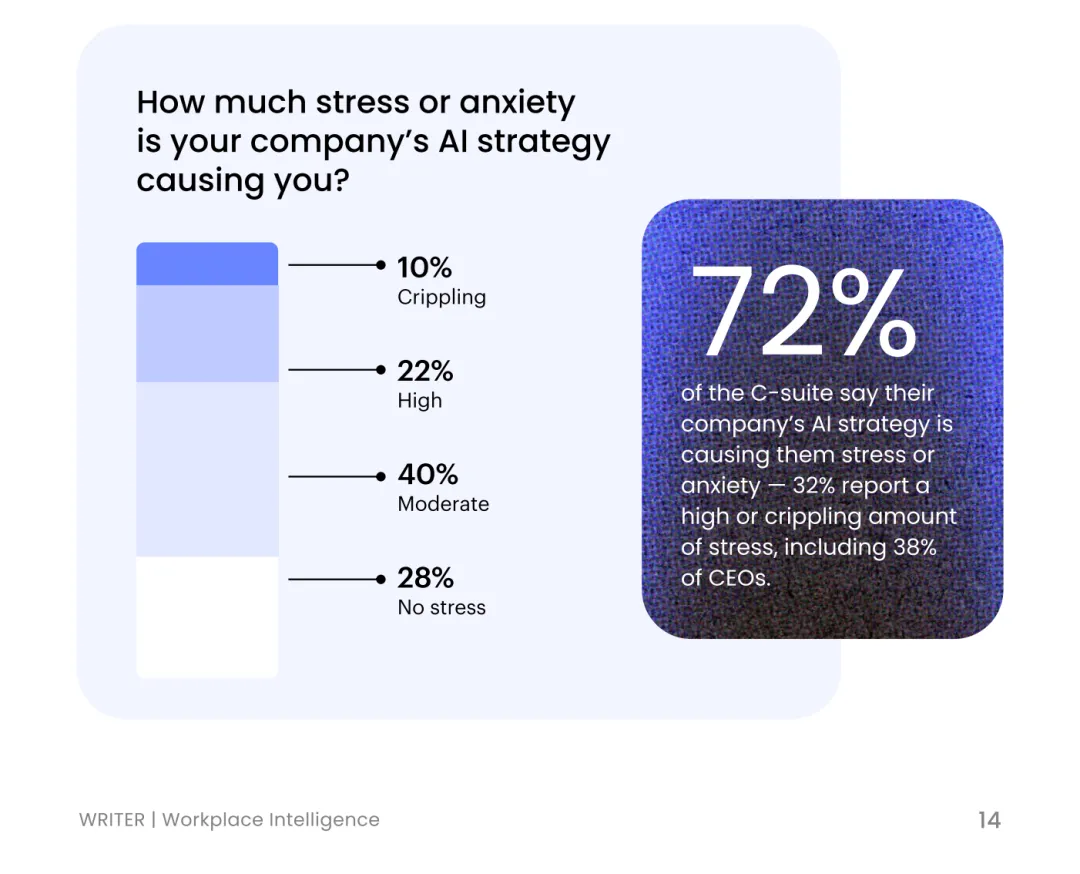
72% of employees feel some degree of AI-related pressure|Source: WRITER
When fear peaks, young people begin pouring sand into the gears of the system.
Nearly half (44%) of Gen Z employees admit consciously hindering AI adoption at their companies—including refusing to use it, misusing tools, or even deliberately reducing efficiency.
Tactics vary widely. Some intentionally feed company secrets into public AI tools to trigger security alerts; others reject approved software outright. In extreme cases, individuals manipulate performance reviews—or deliberately submit low-quality, AI-generated work—to prove to management that “AI simply doesn’t work.”
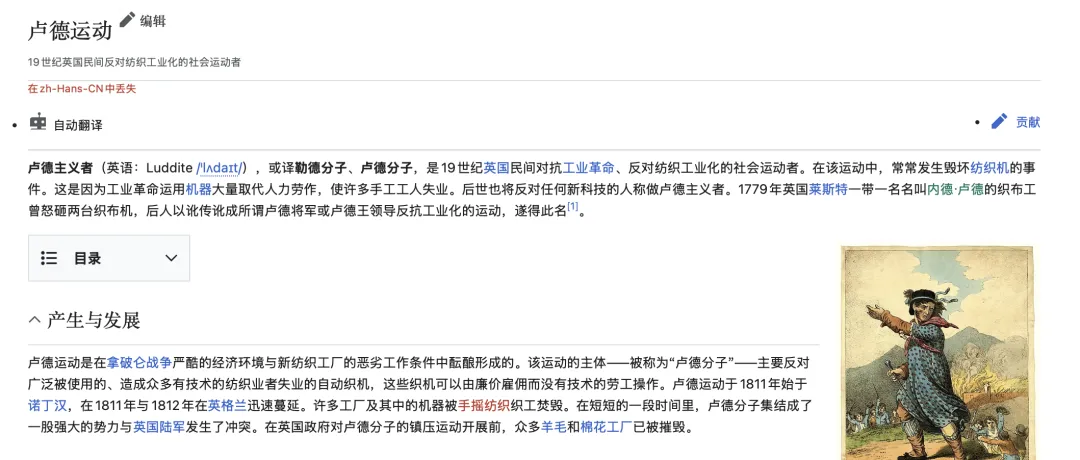
Luddism aimed to resist unemployment and deteriorating working conditions caused by technological change|Source: Wikipedia
This mirrors the Luddite movement during the Industrial Revolution, when textile workers smashed looms.
Even knowing they risk immediate dismissal, these young people adopt passive resistance to confront their inner fears.
03 Caution: Trust Erodes With Use
Faced with anxiety and fear, many young people are growing increasingly cautious toward AI.
This caution manifests in concrete behaviors—the most visible being the deliberate boundaries they set around AI use. They understand well what AI can do—and, more importantly, what it shouldn’t be entrusted with.
The first boundary is drawn around interpersonal relationships.
For example, The New York Times interviewed Abigail Hackett, a 27-year-old tourism industry worker. She regularly uses AI to handle tedious writing tasks at work, saving significant time. But in her personal life, she refuses to use AI for drafting any private messages. Her reasoning is simple: she doesn’t want her “social muscles” to atrophy.
This “cautious trade-off” is common among users: AI may enter workflows—but not social relationships.
Even attitudes toward companion-style AI—tools demanding substantial time investment—have shifted.
Over the past two years, character-based chat platforms like Character.AI surged in popularity among young people. They simulate friends, romantic partners, or fictional characters, offering always-on “companionship.” Yet controversy surrounding these products has also intensified—covering teen addiction, emotional dependency, and even isolated incidents of self-harm or suicide.
Much public discourse has concluded that AI is undermining minors’ social skills.
But long-term observation by University of Sydney researchers challenges this assumption. They found that the vast majority of young people remain highly aware—and do not treat AI as a substitute for real humans. Instead, they view these chats primarily as “play” or entertainment.

After starting a relationship, Quentin and his girlfriend both drastically reduced their use of AI chat apps|Source: The New York Times
For instance, 15-year-old respondent Quentin was once a heavy user of Character.AI—but he clearly states it’s “just a game,” fundamentally nothing more than strings of 1s and 0s.
Once real-life circumstances change—such as making new friends at school or beginning a romantic relationship—time spent on chatbots plummets. At best, chatbots serve as digital “side dishes” for boredom; as soon as real life kicks in, AI is unceremoniously discarded.
Having established boundaries in daily life, young people also withhold trust in AI at pivotal life decisions.
According to Ruffalo Noel Levitz’s 2024 survey, one-third of high school students use AI to plan college applications. They rely on AI to generate long university lists, compile tuition fees, scholarship availability, and acceptance rates into tables for quick initial screening—but they won’t let AI make final decisions.
This caution is built through repeated missteps.
In The New York Times’ reporting, Wisconsin high school senior Brandon developed a strict habit of verifying all AI-provided information—after a large language model confidently recommended several non-existent university scholarships, wasting his time on futile verification.
San Francisco student Tanay saw through AI’s false emotional reassurance: when his AI told him, “You’re 100% getting into Princeton,” he immediately recognized it as hollow, overconfident flattery—offering zero practical help for his college selection.
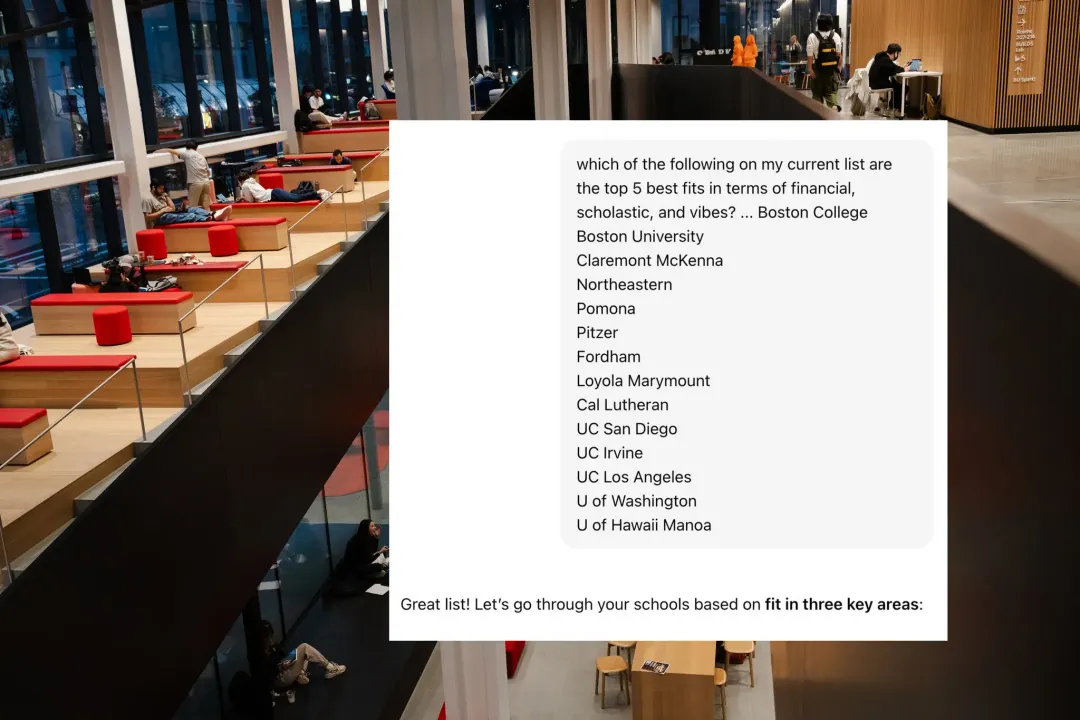
U.S. public high schools average one counselor per 376 students—prompting many to turn to AI for application support|Source: The New York Times
Who hasn’t been driven to laughter—or exasperation—by AI? Once such moments happen a few times, regaining initial trust becomes nearly impossible.
Looking back at Gallup and Pew’s data, the “AI paradox” makes perfect sense.
Over half of young people use AI daily—not out of blind faith, but out of sheer survival instinct, pressured by employment systems and academic competition. Their trust in AI plummeted from 27% to 18% precisely because the more they use it, the more problems they encounter—and thus, the clearer they see the technology’s limits.
Anxiety, fear, caution—even forms of misuse: these seemingly contradictory stances coexist in young people’s attitudes toward AI.
Because in this unavoidable technological cycle, Gen Z has reached a quiet realization:
Tools are just tools. Extract their value freely—but never deify them, and certainly never let them decide for you.
It’s not that they distrust the technology itself. Rather, they’ve grasped earlier than most that the benefits—and the costs—of this technology may land squarely on their own shoulders.
Join TechFlow official community to stay tuned
Telegram:https://t.me/TechFlowDaily
X (Twitter):https://x.com/TechFlowPost
X (Twitter) EN:https://x.com/BlockFlow_News