“CertiK Scanned”: The Security Passport Amid the AI Skill Boom
TechFlow Selected TechFlow Selected
“CertiK Scanned”: The Security Passport Amid the AI Skill Boom
Leverage Skills to Drive Institutional Adoption—CertiK Establishes a Security Gateway for the AI Era.
 Navigating Web3 tides with focused insights
Author: TechFlow
Introduction
According to ClawHub’s official website, the platform currently hosts over 67,300 Skills awaiting user selection and installation—up from fewer than 10,000 at the beginning of the year.
This Skill explosion has driven continuous upgrades in Agent capabilities and permissions: reading files, invoking Shell commands, triggering asset operations—and authorizing a single Skill effectively hands your Agent the keys to your entire digital world.
As supply surges, security blind spots widen accordingly: Snyk’s analysis of nearly 4,000 Skills found that 13.4% contained critical security issues, 36.8% exhibited security flaws, and 76 were confirmed to carry malicious payloads.
While these risks are very real, many official Skill platform documentation pages feature this standard disclaimer:
“Third-party Skills are unverified; users assume all associated risks.”
This may be a pragmatic risk-mitigation measure—but it is certainly not a fundamental solution.
Before AI begins executing tasks on behalf of humans, we need a standardized security gatekeeper for Skills:
- To inform platforms which Skills may be listed
- To guide enterprises on which Skills may safely integrate into internal environments
- To help users determine whether a given Skill can be downloaded, authorized, and invoked with confidence
In May 2026, CertiK launched CertiK Skill Scanner—a security scanning tool tailored for the AI Agent ecosystem—marking tangible progress toward resolving this pain point.
What an AI-Era Skill “Antivirus” Looks Like
Compared to CertiK’s official definition—“A standardized security gatekeeper built for Skill applications in the AI era”—the community offers a more intuitive shorthand: “AI Skill Antivirus.”
This is easy to grasp: before use, a safety evaluation mechanism scans the Skill to identify and flag potential risks for the user.
Traditional antivirus software inspects programs running on computers; CertiK Skill Scanner inspects Skills invoked by AI Agents.
The market is no stranger to generic scanners—but existing tools each have critical blind spots: Web2 antivirus solutions cannot defend against on-chain hackers; traditional Web3 auditing firms focus heavily on static code analysis, with limited depth in dynamic AI invocation flows.
CertiK Skill Scanner’s differentiation lies in its coverage of execution processes:
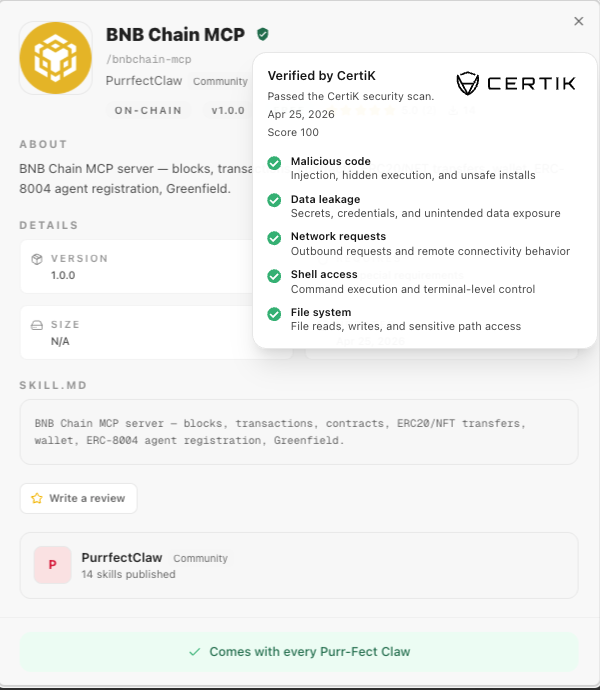
It delivers comprehensive Web2/Web3 protection across five core risk dimensions: malicious behavior, data exfiltration, unauthorized network calls, Shell access, and filesystem abuse—especially critical financial execution risks involving fund transfers.
Its coverage extends beyond execution—and achieves 90.5% precision. In financial execution scenarios involving fund transfers, this level of accuracy is vital for users, especially institutional ones, making CertiK Skill Scanner truly embeddable as a “standardized security gatekeeper for AI Skills” within enterprise security workflows.
This dynamic defense capability in high-stakes financial contexts enabled CertiK Skill Scanner to rapidly gain traction among Skill platforms with exceptionally stringent security requirements upon launch.
Currently, Pieverse—the Web3 AI Agent infrastructure platform—has already integrated CertiK Skill Scanner into its AI Agent Skill Store. Core Skills including “BNB Chain MCP” now undergo this standardized security review process, proactively screening for potential security risks before any user or Agent invokes them.
On this integration, Pieverse CEO Colin stated:
“Only when users and builders trust the Skills executed by Agents can the Agent ecosystem scale sustainably. Pieverse is committed to building infrastructure enabling Agents to conduct transactions and operations securely. CertiK Skill Scanner adds a crucial verification layer that significantly enhances the security and reliability of Agent Skills.”
Meanwhile, collaborations with additional AI Skill platforms—including FinChip.ai—are advancing rapidly. Gary Yang, incubation investor at FinChip.ai, commented:
“Trust is the foundational prerequisite for any ‘Skill Economy’ to scale. CertiK’s emerging Skill security verification framework fills a critical infrastructure gap in this ecosystem—and makes FinChip’s vision of programmable Skill ownership and distribution far more viable.”
While platform partnerships progress across multiple fronts, end-user accessibility for individual users remains under rapid development.
This signals one clear takeaway:
At present, CertiK Skill Scanner prioritizes institutional and platform adoption.
What strategic rationale lies behind this emphasis?
Institutional Users: A Long-Planned Strategic Pivot
Why prioritize institutions?
The answer is straightforward:
In this cycle where “institutions” dominate the narrative, targeting them anchors a fulcrum capable of prying open the entire market.
First, as on-chain finance grows, traditional financial institutions—including asset managers, banks, and custodians—are entering Web3 en masse. They demand institutional-grade security, compliance, transparency, and risk visibility—precisely CertiK’s core competencies.
Second, institutions wield outsized influence: serving one bank establishes a security baseline for all its users; persuading one asset manager to adopt a security standard propagates that standard across its managed assets and client base.
This “point-to-surface” approach is highly efficient—and many projects now view institutional collaboration as a key indicator of future growth potential.
So why did CertiK select CertiK Skill Scanner as the early flagship product for its institutional strategy?
Again, part of the answer is urgency driven by surging demand:
Many institutions have already embedded AI into their workflows—and many more are preparing to do so. According to an IDC report, AI Agent usage among Global 2000 companies is projected to increase tenfold by 2027, while related API and token call volumes will surge one thousandfold.
Yet institutions remain deeply concerned about Skill-related security—particularly around fund transfers, data leaks, and regulatory compliance. Triggering even one “toxic” Skill could result in massive losses and catastrophic reputational damage.
Hence, Skill-level security vetting is non-negotiable for institutions—and CertiK Skill Scanner directly addresses this need, especially through its specialized protection against financial execution risks, aligning tightly with institutional security expectations.
Of course, “spotting opportunity” and “being able to seize it” are two different things.
CertiK is no newcomer to institutional services.
For years, CertiK’s official website has explicitly listed its target audiences as Web3 projects, institutions/enterprises, exchanges/custodians, and regulatory/compliance bodies.
A review of CertiK’s institutional offerings reveals a tightly integrated triad spanning technology, compliance, and AI.
Technically, CertiK covers everything from code audits and penetration testing to proof-of-reserves—addressing foundational security and asset transparency needs.
On compliance, CertiK provides VARA-compliant solutions and advisory services for DORA and MiCA frameworks, helping institutions navigate complex jurisdiction-specific regulatory landscapes.
On AI, beyond CertiK Skill Scanner, CertiK launched AI Auditor in April this year—designed for seamless integration into developer workflows, delivering high-accuracy, low-false-positive vulnerability detection. With 88.6% precision in real-world security incident tests, AI Auditor forms the second pillar of CertiK’s AI security product suite alongside CertiK Skill Scanner.
This integrated triad has already attracted industry leaders—including Ant Group, Binance, numerous banks, funds, custodians, and regtech entities—to join CertiK’s roster of collaborators.
As increasing numbers of institutions express interest in blockchain adoption, CertiK has repeatedly stated its service focus is shifting rapidly—from Web3-native projects toward traditional financial institutions and regulatory/compliance entities.
Still, beyond partnership outcomes, observers are even more curious about why institutions trust CertiK.
As a leader in the security sector, CertiK possesses formidable technical capabilities and deep-rooted expertise others cannot easily replicate in the short term.
It serves over 5,167 clients, has identified over 180,000 code vulnerabilities, and safeguards over $600 billion in digital assets.
These figures—prominently displayed on CertiK’s website—reflect a decade of relentless security specialization, elevating “Audited by CertiK” into a trusted hallmark for countless Web3 projects seeking user confidence.
Beneath this industry reputation lies CertiK’s elite technical DNA.
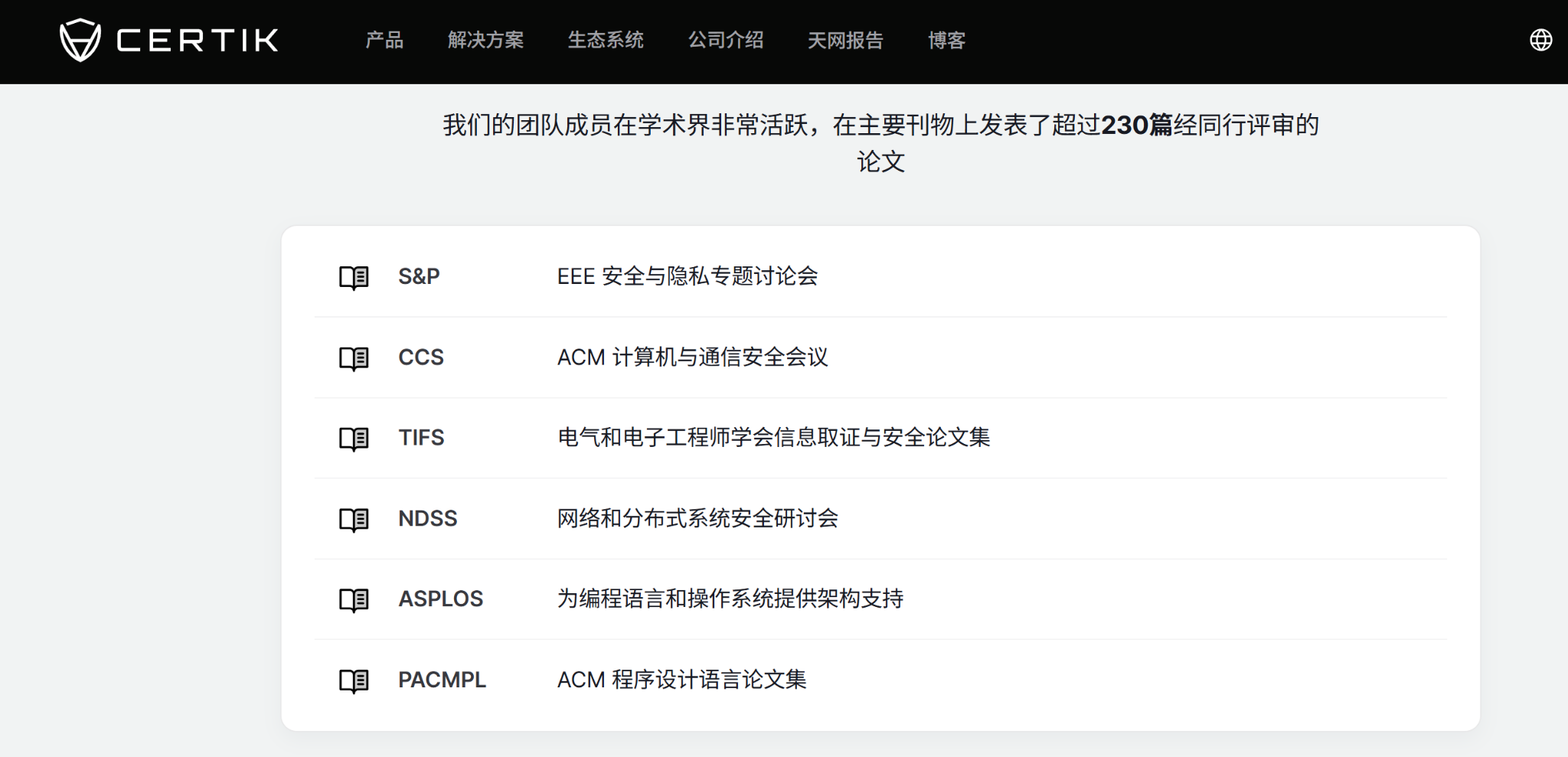
CertiK’s co-founders—Professor Ronghui Gu of Columbia University’s Department of Computer Science and Professor Zhong Shao of Yale University’s Department of Computer Science (also its Chair)—both hail from the pinnacle of global academia.
They led CertiK’s team in bringing the most rigorous formal verification methodologies from academia into the Web3 security domain—forging CertiK’s core technical advantage. Their work has earned Apple’s official recognition five times for discovering critical vulnerabilities across iOS, iPadOS, macOS, and watchOS—powerfully demonstrating CertiK’s security capabilities extend well beyond Web3.
Moreover, compliance is the threshold for institutional trust—and here too, CertiK excels.
CertiK has completed SOC 2 Type II audits and holds ISO 27001 certification—two of the most critical benchmarks traditional financial institutions rely on when selecting security providers.
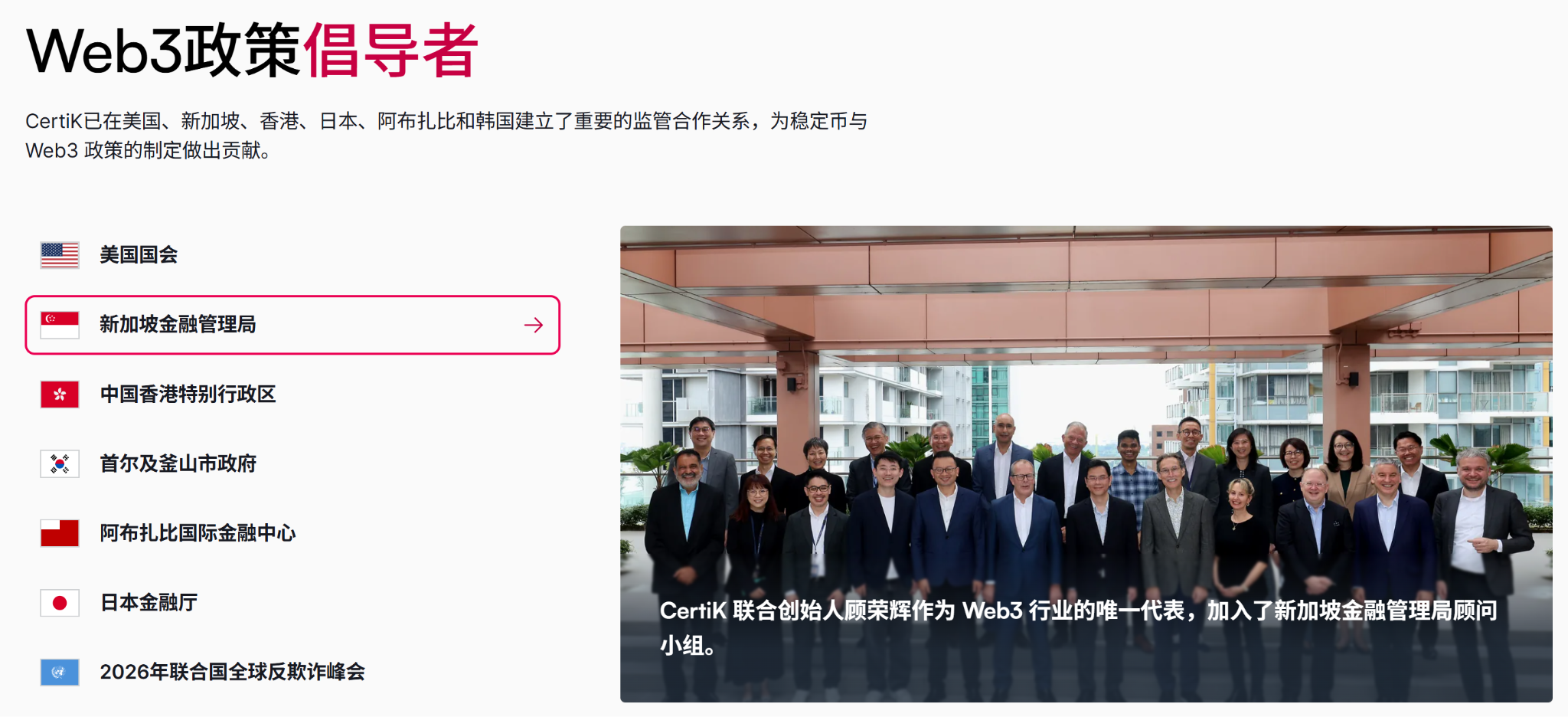
Additionally, CertiK maintains active partnerships with major global regulators—including the U.S. Congress, Singapore’s Monetary Authority of Singapore (MAS), Hong Kong SAR Government, Korean government, Abu Dhabi Global Market (ADGM), and Japan’s Financial Services Agency (FSA). Co-founder Ronghui Gu served as the sole Web3 representative on MAS’s advisory panel, actively contributing to global regulatory policy formulation and implementation.
This positions CertiK not merely as a technical security provider—but as a partner capable of interpreting institutional needs within both regulatory and compliance frameworks.
Only after tracing CertiK’s full spectrum—technology, compliance, and experience—do we realize it cannot be understood through a single-product lens. Its ambition transcends narrow Web3 confines or even just AI Skill security gatekeeping. From day one, CertiK’s mission has remained unwavering:
To become the foundational security infrastructure of the digital economy.
CertiK Skill Scanner is CertiK’s ticket—leveraging a decade of security expertise—to establish the industry standard for the AI era;
And institutions represent the first cornerstone of this bet.
Looking Ahead: CertiK’s Ongoing Evolution
Of course, becoming foundational security infrastructure for the digital economy cannot happen overnight.
At this stage, roadmaps serve as essential indicators of strategic execution.
Regarding the recently launched CertiK Skill Scanner, its next steps are clear:
First, expanding ecosystem partnerships—embedding the security standard championed by CertiK Skill Scanner across more Skill platforms, further establishing the “CertiK Security Score” as a de facto listing requirement for Skills.
Second, completing the onboarding path for individual users—a critical step in evolving CertiK Skill Scanner from an “institutional tool” into a “universal security layer.”
We also note that prior to launching CertiK Skill Scanner, CertiK published an article titled:
“Skill Scanning Is Not a Security Boundary.”
The piece emphasized that static scanning alone cannot constitute a complete security boundary for the AI Agent era.
This insight later became CertiK Skill Scanner’s defining competitive edge.
Yet the article also clarified:
CertiK positions CertiK Skill Scanner as the first security checkpoint in the AI security architecture—designed to perform foundational risk identification and safety assessment before third-party Skills are deployed by platforms, enterprises, or users.
Looking ahead, as AI Agents enter increasingly complex real-world execution scenarios, CertiK’s AI security products offer rich expansion potential—across risk identification, scoring frameworks, reporting capabilities, and beyond.
This effectively lays bare CertiK’s comprehensive AI Agent security strategy:
Extending beyond scanning and admission control into broader AI use cases;
Developing further AI capabilities and products beyond AI Auditor and CertiK Skill Scanner;
And ultimately, building a full-stack security architecture purpose-built for the AI Agent era—moving beyond isolated tools.
Today, CertiK Skill Scanner marks only the starting point of this roadmap.
Conclusion
From what CertiK has accomplished in the past to what it aims to achieve in the future—this is a complete story about “who secures the digital economy.”
Over the past decade, CertiK has proven it can safeguard code, smart contracts, and on-chain assets.
Now, as AI Agents begin executing tasks on humanity’s behalf, new security boundaries are emerging—and CertiK is pushing its own capabilities forward:
From protecting on-chain assets to securing AI invocations;
From institutional adoption to becoming the foundational security bedrock of the digital economy.
This is a company already commanding leadership in its sector—leveraging a decade of accumulated expertise to stake its claim on the next decade’s industry security standards.
Though we stand at the dawn of that next decade—and can currently see only the strategic outline and early-stage products and ecosystem formations—this does nothing to diminish anticipation for a digital economy future defined not by “user assumes all risks,” but by “systemic safety guarantees.”
“Audited by CertiK” once helped countless Web3 projects earn user trust;
Will “Scanned by CertiK” become the next essential credential of the AI era?
CertiK is answering that question—not with rhetoric, but through continuous product iteration and tangible institutional adoption.
Join TechFlow official community to stay tuned
Telegram:https://t.me/TechFlowDaily
X (Twitter):https://x.com/TechFlowPost
X (Twitter) EN:https://x.com/BlockFlow_News
 深潮TechFlow