SpaceX, OpenAI, and Anthropic: Which of These Three AI Giants Is Most Worth Betting On as They Rush Toward IPOs?
TechFlow Selected TechFlow Selected
SpaceX, OpenAI, and Anthropic: Which of These Three AI Giants Is Most Worth Betting On as They Rush Toward IPOs?
If forced to rank them, he believes Anthropic > SpaceX > OpenAI
 Navigating Web3 tides with focused insights
Compiled & Translated by TechFlow
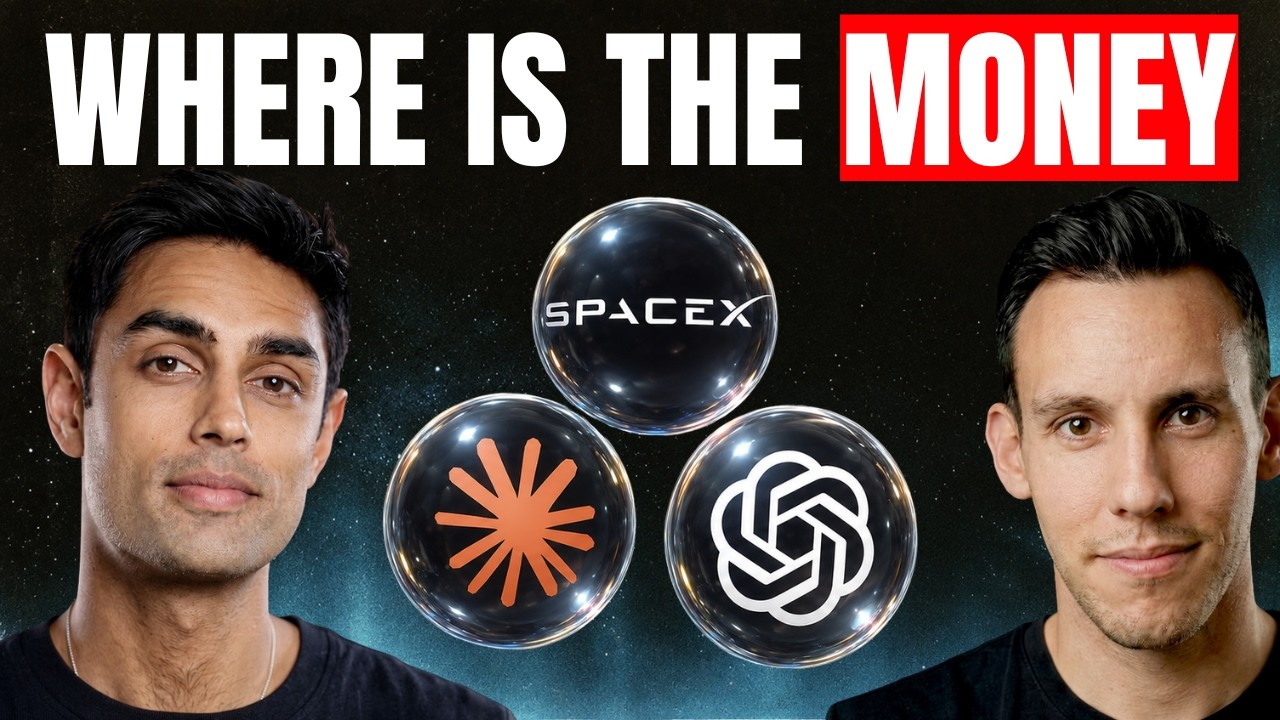
Hosts: Josh Kale; Ejaaz Ahamadeen
Podcast Source: Limitless Podcast
Original Title: Money is Running Out for the Biggest IPOs in History
Air Date: June 3, 2026
Key Takeaways
This episode centers on SpaceX, OpenAI, and Anthropic simultaneously racing toward IPOs, examining how AI infrastructure development is pushing private capital—and tech giants’ balance sheets—to their limits. The hosts argue this is not merely a story about individual company fundraising, but an unprecedented concentration of capital: enterprises need more compute, data centers, power, and chips—and public markets, index funds, and pension funds are all being drawn in.
The episode also compares SpaceX’s unproven space-based data center business model, Anthropic’s already-demonstrated enterprise revenue growth, Google’s urgent external financing to double down on AI, and OpenAI’s ongoing capital needs to expand data centers for model training and inference. Ultimately, while both hosts remain cautious about bubble risks, their overall assessment leans optimistic: so long as compute supply continues to lag demand, AI infrastructure spending resembles building the foundational layer for next-generation technology—not just financial speculation spinning its wheels.
Key Insights Summary
Concentrated Mega-IPOs: Is AI Infrastructure Exhausting Capital?
- “The combined IPO fundraising target for OpenAI, Anthropic, and SpaceX is expected to reach $180 billion—exceeding the entire internet bubble’s total funding of $164 billion over three years, and that sum involved dozens of companies, not just three.”
- “Why now? Why the urgency? In my view, the answer is simple: AI capital expenditures are proving far costlier than these companies originally anticipated—and they’re choosing to double down. Their free cash flow is no longer sufficient to meet current demands.”
- “Whether via debt leverage or other financing mechanisms, we’ve already jumped off the cliff. If you don’t go all-in now, you’ll end up with nothing.”
SpaceX Rewrites IPO and Index Rules—Retirement Funds Passively Buy In
- “By going public, SpaceX is effectively rewriting market rules to satisfy its massive funding requirements.”
- “Over $30 trillion in passive 401(k) assets—i.e., retirement funds—will be forced to buy SpaceX stock at IPO valuation levels. Rough estimates suggest approximately 24% of SpaceX’s IPO shares will be absorbed by these passive funds—a scale of passive buying unprecedented in history.”
- “Some indices require only a 5- to 15-day observation window: as long as the post-IPO share price holds at a certain level for several days, the company qualifies for inclusion. In other words, Elon Musk only needs to ensure short-term price stability to meet the bar effortlessly.”
- “It (SpaceX) has yet to truly validate its revenue model. It claims, ‘We’ll launch AI data centers into space…’ Yet this business model remains unproven… It’s more of a ‘trust me’ promise.”
Anthropic’s Revenue Leap and IPO Motivation
- “They (Anthropic) hit that figure ($20 billion) in just the first six weeks of 2026. Recently, their annualized recurring revenue (ARR) has reached $45 billion—driven primarily by the success of Claude Code and Claude Co-Work, plus a series of enterprise contracts.”
- “Anthropic expects to generate roughly $550 million in profit by month-end. While trivial relative to trillions in capital expenditures, it would make Anthropic the first major AI lab to achieve profitability.”
- “Anthropic’s penetration among the Fortune 10—i.e., nine of the world’s top 10 companies—are using Anthropic, especially Claude Code. Their net dollar retention rate… has surged 500%. In other words, these companies plan to spend five times more.”
Google’s $80 Billion Financing: An IPO Without Going Public
- “Google founders Larry Page and Sergey Brin stated clearly about a year and a half ago that they’d rather risk losing everything than lose the AI race. So they’ll keep spending until they achieve enough breakthroughs. They’ve reverted to founder mode.”
- “Google is a public company—but raised $80 billion… Of that $80 billion, roughly $30 billion may go toward covering employees’ tax obligations upon stock vesting over the coming months. In other words, much of this financing won’t actually fund AI capex expansion… There’s a whiff of desperation here.”
- “They (Google) lack focus. They’re building agents, yet also chasing better coding models; pursuing stronger general-purpose LLMs, while simultaneously building TPU infrastructure—and selling TPUs to competitors, leaving insufficient compute to train Gemini… Even Gemini 3.5 Flash, despite all this spending, still lags frontier models.”
OpenAI and AI Infrastructure: Money Hasn’t Been Spent Yet—But Bottlenecks Are Already Physical
- “I (Ejaaz) may hold a slightly controversial view: the money soon to be raised—and spent—will ultimately be a good thing. Fundamentally, this won’t be a bubble; it will build essential infrastructure.”
- “We’re currently constrained by the physical world… No matter how much leverage you apply or how much capital you raise, you may not actually be able to spend it—due to regulatory timelines, physical data center construction speed, and silicon chip production capacity. ASML is one company. Nvidia is one company. TSMC is one company. Expanding AI’s physical infrastructure is extremely difficult. Until I see this bottleneck lifted, I don’t believe we’re in a bubble.”
- “GPUs from four or five years ago now rent for even higher prices than they did back then. They’ve become more valuable… What we’re seeing now is the opposite: buyer demand is so strong that we simply lack enough silicon and compute to meet it.”
- “We’re living through a historically unique moment—unprecedented in U.S. history, unprecedented in the history of capitalism—where such vast sums of capital and value are being concentrated on a single idea… America is undergoing reindustrialization in a meaningful way.”
Concentrated Mega-IPOs: Is AI Infrastructure Exhausting Capital?
Josh:
The three largest IPOs in history may file prospectuses within weeks—SpaceX, OpenAI, and Anthropic. On the same day, Google raised $80 billion externally to support its own AI buildout.
Interestingly, financial interdependence among these companies has grown remarkably complex—they’re, in effect, using each other’s capital to prop up each other’s balance sheets. Over recent weeks, markets have even begun modifying rules designed to protect passive investors—so they can participate in IPOs earlier.
A construction boom of historic proportions is now underway under capitalism—forcing us to ask: Is there enough money? That these companies are choosing to go public almost simultaneously is clearly no coincidence. The chart displayed on screen is staggering: The combined IPO fundraising target for OpenAI, Anthropic, and SpaceX is expected to reach $180 billion—exceeding the entire internet bubble’s total funding of $164 billion over three years, and that sum involved dozens of companies, not just three.
The scale is extraordinary. We must answer key questions: Is this a circular economy moment? Are these companies running out of cash? Have they grown too large for private capital to sustain? There’s much to unpack. Ejaaz, let’s start with SpaceX.
Ejaaz:
SpaceX, OpenAI, and Anthropic are all preparing mega-IPOs—but the real story isn’t any single company’s fundraising. It’s that they may all go public within weeks of each other. Their targets are all set for completion by Q4 at the latest, and their combined fundraising size is enormous—unprecedented in history.
Individually: SpaceX filed its S-1 on April 1, signaling clear IPO intent. Market rumors suggest it could go public this month—or at the latest, early July. Roughly ten days ago, OpenAI reportedly filed its S-1 confidentially in preparation for an IPO. And just yesterday, Anthropic filed its confidential S-1. Thus, all three are sprinting toward mega-IPOs within nearly the same time window.
This raises a question: Why now? Why the urgency? In my view, the answer is simple: AI capital expenditures are proving far costlier than these companies originally anticipated—and they’re choosing to double down. Their free cash flow is no longer sufficient to meet current demands.
To date, these companies have largely spent private capital—either funds raised from investors or generated from revenue. Now, they’re turning to public markets, essentially asking investors: “We need more money—to build more data centers, buy more GPUs, train more models—to meet surging demand.”
If you ask these companies, none will admit to lacking demand. Indeed, Google—and I recall Amazon, Microsoft, and Meta—have all reported profitable quarters despite massive AI capital expenditures. These four companies alone plan to invest nearly $1 trillion this year—but even that falls short. So they need more capital to sustain this buildout.
What truly worries me is whether we’ve passed the point of no return. We discussed this before recording: once you cross this threshold, there’s no turning back. Whether via debt leverage or other financing mechanisms, we’ve already jumped off the cliff. If you don’t go all-in now, you’ll end up with nothing.
SpaceX Rewrites IPO and Index Rules—Retirement Funds Passively Buy In
Josh:
What surprised me most is not just that these companies are going all-out—but that institutional investors, ordinary retail investors, and even Wall Street’s major fund firms are participating in these IPO bets—and modifying rules to accommodate them.
A recent illustrative case is the SpaceX IPO. To accelerate its inclusion in indices, index providers relaxed traditional profitability requirements and shortened the observation period from 90 days to just 5 days. Under traditional rules, a company must first demonstrate operational viability and sustained profitability before index funds are required to buy its stock. Now, index funds can buy earlier—even if some investors don’t actively want to invest in SpaceX, their retirement accounts, 401(k)s, and portfolios holding these index funds will passively acquire SpaceX shares faster than ever before.
Ejaaz:
This has never happened in history. By going public, SpaceX is effectively rewriting market rules to satisfy its massive funding requirements.
A few data points stand out. First, over $30 trillion in passive 401(k) assets—i.e., retirement funds—will be forced to buy SpaceX stock at IPO valuation levels. Rough estimates suggest approximately 24% of SpaceX’s IPO shares will be absorbed by these passive funds—a scale of passive buying unprecedented in history.
Second, under traditional rules, inclusion in key indices like the NASDAQ-100 or Fortune 500 typically requires proof of substantial revenue and stable performance across one or two consecutive quarters—usually requiring three to six months. Now, those rules have been dramatically relaxed. Some indices require only a 5- to 15-day observation window: as long as the post-IPO share price holds at a certain level for several days, the company qualifies for inclusion. In other words, Elon Musk only needs to ensure short-term price stability to meet the bar effortlessly.
Josh:
This shift is genuinely concerning. For decades, major indices adhered to two core rules designed to protect ordinary investors—especially those investing via retirement or standard brokerage accounts. The first rule required four consecutive quarters of profitability; the second mandated a minimum free-float threshold of 5%–10%.
These rules were introduced after the 1999–2000 internet bubble burst. At the peak, many indices included high-growth, persistently unprofitable companies—causing 401(k) holders and retirees to passively hold those stocks, suffering massive losses when the bubble collapsed. These rules were instituted precisely to shield ordinary investors.
Now, history seems to be repeating itself—in reverse. Companies no longer need four consecutive GAAP-profitable quarters—just 15 days of solid performance. This threshold has been significantly lowered versus the past. It gives me pause. While relaxing these rules may strongly support SpaceX’s share price—given massive passive buying—it could also inflict serious harm on ordinary investors who passively hold SpaceX stock if things don’t unfold as expected.
Ejaaz:
Josh, I think many external criticisms of the SpaceX IPO are valid: It has yet to truly validate its revenue model. It claims, ‘We’ll launch AI data centers into space via rockets.’ Yet this business model remains unproven—even concept validation hasn’t been achieved. Though it has launched rockets, we haven’t seen GPUs in orbit actually training frontier AI models. So, in a sense, this is more of a ‘trust me’ promise.
However, one company differs markedly: it has already proven its revenue generation capability—and its growth pace is astonishing. That company is Anthropic. Just yesterday, Anthropic filed its S-1 draft registration statement with the SEC, signaling plans for an IPO within the coming months.
Anthropic’s Revenue Leap and IPO Motivation
Ejaaz:
Anthropic’s story differs from SpaceX in several ways. Its CFO, Krishna Rao, previously said the company had no immediate IPO plans and would proceed gradually. At that time, they’d already reached $9 billion in annualized recurring revenue and projected ~$20 billion for all of 2026—yet they hit that $20 billion mark in just the first six weeks of 2026. Recently, their annualized recurring revenue has reached $45 billion. This stems mainly from the success of Claude Code and Claude Co-Work, plus a series of enterprise contracts. They’re also engaged in numerous joint ventures, raised capital from Blackstone, and advancing multiple initiatives.
So unlike SpaceX, Anthropic is already generating substantial revenue—making its push for further scale logical. It’s aggressively acquiring compute, competing directly with OpenAI—training frontier models, serving frontier models, and delivering them to as many users as possible. That’s why I believe it’s pursuing an IPO.
That said, no details were disclosed, right? It’s more of a mandatory filing. OpenAI apparently doesn’t need to do this—but Anthropic chose transparency. Josh, what’s your take?
Josh:
Fascinating—it’s a “confidential disclosure about a confidential filing.” Ironic, yes. But it’s genuinely surprising to many. Almost no one anticipated this pace. When I checked Polymarket, consensus expected OpenAI to IPO before Anthropic—yet this news flipped those odds entirely.
Data from The Information may already be outdated—I’ve recently heard rumors that Anthropic’s growth is outpacing even prior expectations. It’s exhibiting an incredible growth trajectory driven by genuine enterprise value creation and exceptionally strong model capabilities.
Consider Mythos. They announced this model just two months ago—meaning its training was completed even earlier. These models are truly powerful. I get the sense Anthropic is highly confident about going public.
This topic also raises another question: How much capital can the market absorb for these fundraisings?
We know SpaceX will go first. Rumors suggest it may list around June 12—within the next two weeks. That could absorb $100 billion in capital. Though its target is $75 billion, I expect it to exceed that. So how much capital remains for Anthropic? And if OpenAI follows shortly after, how much will be left for it? We’re making enormous capital demands on public markets. Private markets may already be depleted—or not yet. But we’ll soon see how quickly public-market reserves deplete, given each company’s staggering fundraising targets.
Ejaaz:
Here’s how I see it: One investor cohort will buy these stocks because their thesis is simply “long AI.” Another large group of retail investors will say: “I use Claude daily—it helps me immensely—so of course I’ll buy this company’s stock.” Or they’ll say the same about ChatGPT.
Ultimately, both groups converge on the same action: buying these companies’ stocks. From the companies’ perspective, their IPO rationale is equally clear. Anthropic’s CFO Krishna Rao said it. OpenAI’s CFO Sarah Friar said it. Elon Musk said it: “We need more compute. More compute yields better AI. Better AI yields better products. Better products serve more customers—and generate more revenue.”
Specifically for Anthropic, rumors about its AGI model Mythos are highly credible. Breaking news today says it’s advancing Project Glasswing—a phased, sandboxed rollout of Claude Mythos, expanding to 150 new organizations globally. It also recently stated in a release that a public launch is imminent in coming weeks. So all this happening now feels less coincidental—and more intentionally timed.
Another distinction for Anthropic is that it expects to generate ~$550 million in profit by month-end. Trivial relative to trillions in capex—but it would be the first major AI lab to achieve profitability. Its growth pace is truly astounding. Among these IPOs, I’m probably most bullish on Anthropic—but each has its own roadmap.
Google’s $80 Billion Financing: An IPO Without Going Public
Josh:
We previously speculated whether large tech firms like Google might begin spending beyond their revenue capacity—i.e., funding buildouts via debt.
Now we’re seeing signs the market is edging into that zone. Google’s income statement no longer covers its needs, so it’s seeking external capital. This isn’t an IPO—Google’s been public for years—but it still needs more money. So what did it do? It raised $80 billion to support AI buildout—an enormous sum.
I don’t recall their committed total capex figure, but I estimate this amount represents ~30%–40% of their annual planned capex. Notably, Berkshire Hathaway—Warren Buffett’s firm—wrote a $10 billion check to participate. This is a major deal: $30 billion from an underwritten public offering, $40 billion from a market issuance program beginning this quarter, and $10 billion from Berkshire’s private placement.
We previously deep-dived into Google’s balance sheet—its revenue, its expenses. Back then, it was still positive. Now, is it heading toward losses—or merely pre-emptively building a larger safety cushion?
Ejaaz:
I think it’s going all-in—and its books may turn red. Google founders Larry Page and Sergey Brin stated unequivocally about a year and a half ago that they’d rather risk losing everything than lose the AI race. So they’ll keep spending until they achieve sufficient breakthroughs. That’s founder mode—they’ve reverted to founder mode, with Sergey Brin returning to Google specifically to rekindle this mindset.
This is my favorite IPO story this week—even though it’s not an IPO. Google is a public company—but raised $80 billion. The question is: What exactly is this $80 billion for? The headline is clear: “We’ll use this $80 billion to fund more AI capex—build more TPUs, deliver more compute, etc.”
But many overlook another angle: ~$30 billion of this $80 billion may cover employees’ tax liabilities upon stock vesting over the coming months. In other words, a large portion of this financing won’t actually fund AI capex expansion.
Setting that aside, I don’t consider Google a bad actor. It’s been unusually transparent about its AI spending and plans. It’s genuinely trying. But this reminds me of our discussion last year about OpenAI’s status: We noted then that OpenAI was somewhat distracted—building random AI products and missing the coding-AI opportunity entirely—until it declared “Code Red” and refocused.
I feel Google has drifted into similar overextension. It lacks focus. It’s building agents, yet also chasing better coding models; pursuing stronger general-purpose LLMs, while simultaneously building TPU infrastructure—and selling TPUs to competitors, leaving insufficient compute to train Gemini, causing Gemini to fall behind. Even Gemini 3.5 Flash—despite all this spending—still lags frontier models. Now it needs more capital to train better models. It truly needs to lock in its focus.
In terms of financing structure, $80 billion is enormous—almost equivalent to Google conducting its own IPO to fund its buildout. I’m uncertain whether allocating $30 billion to cover tax obligations is optimal. It carries a whiff of desperation. Still, I remain optimistic—because in past cases where major companies raised similar public financings, Berkshire Hathaway’s $10 billion participation correlated strongly with subsequent strong performance. So I hope Google follows suit. But this story is undeniably fascinating.
Josh:
Trust Berkshire, trust eternity—right? Its track record is exceptional, and its discipline is legendary. We hope that continues. Another noteworthy point: Google holds large private stakes in several soon-to-be-public companies. It’s a major private shareholder in both SpaceX and Anthropic—so their stock price appreciation directly benefits Google.
Yet these figures grow increasingly daunting. We seem numb to the scale of hundreds of billions. Google’s $180–190 billion capex this year would’ve been unimaginable just a few years ago. So when it says “all-in,” it means doing so at a scale we’ve never seen.
I think this is also a central theme of this episode: We’re living through a historically unique moment—unprecedented in U.S. history, unprecedented in the history of capitalism—where such vast sums of capital and value are being concentrated on a single idea. The implications will be profound. Whether or not it’s a bubble, we’re building real value. Real intelligence is being constructed. As the fruits of these expenditures enter the market, civilization-level transformations will begin to manifest.
These colossal numbers can easily overwhelm—but they’ll ultimately yield genuinely valuable tools. We often joke about Google’s lack of new frontier models lately. Yet I’m actively using its tools and services—and can clearly sense they’re growing smarter. Next week’s WWDC coverage will show how Apple plans to roll out these tools and make them smarter. We’ll see exactly where this capex flows.
There’s one IPO we haven’t yet addressed: OpenAI.
OpenAI and AI Infrastructure: Money Hasn’t Been Spent Yet—But Bottlenecks Are Already Physical
Ejaaz:
We mentioned earlier that OpenAI filed its potential IPO documents roughly ten days before Anthropic did—the same confidential filing. Though “confidential,” it leaked anyway—so better to disclose it yourself.
Josh:
Interestingly, OpenAI’s IPO market on Polymarket rose before Bloomberg and Financial Times reported it—so insider information was clearly circulating.
Ejaaz:
Essentially, Goldman Sachs and Morgan Stanley are reportedly helping OpenAI prepare its IPO behind the scenes. If you ask why, the reason remains the same: they need more capital to build more data centers. They reportedly broke ground on a new data center just days ago. So it’s full throttle.
I may hold a slightly controversial view: the money soon to be raised—and spent—will ultimately be a good thing. Fundamentally, this won’t be a bubble; it will build essential infrastructure. This infrastructure will land in the West—especially domestically in the U.S.—becoming the foundational base for next-generation technological innovation.
You need compute. You need power transmission lines. You need all the underlying physical materials to get GPUs and silicon chips up and running to serve customer demand. We’re currently constrained by the physical world. That may sound abstract—but I mean it literally. I align with Gavin Baker’s camp: No matter how much leverage you apply or how much capital you raise, you may not actually be able to spend it—due to regulatory timelines, physical data center construction speed, and silicon chip production capacity. ASML is one company. Nvidia is one company. TSMC is one company. Expanding AI’s physical infrastructure is extremely difficult.
So even if you design complex debt structures and pile on leverage, it’s futile—you have nowhere to spend the money. You’re physically constrained. Until I see this bottleneck lifted, I don’t believe we’re in a bubble.
Josh:
Regarding Gavin Baker’s perspective, he often draws parallels to dark fiber during the internet bubble. Back then, vast amounts of fiber were laid—but the internet lacked enough applications to utilize it. Much of that infrastructure went unused and unmonetized—and eventually collapsed.
But this time, as we’ve repeatedly noted: GPUs from four or five years ago now rent for even higher prices than they did back then—they’ve become more valuable. Interestingly, Michael Burry—the “Big Short” figure—keeps saying, “No, this is wrong—it’ll all collapse.” Yet so far, he’s been completely wrong.
So far, every signal and indicator we’ve seen is green—positive. Everything looks promising. Capex appears to be delivering real value. Earlier, you mentioned rumors that Anthropic may become profitable soon—that’s critically important. Because if it can absorb all this financing and deploy it with sufficient capital efficiency to generate revenue, that would be astonishing. OpenAI, I recall, has no such plan before year-end.
These signals are broadly positive. Personally, one thing I’ll watch closely is whether any company begins cutting AI spending. I’ve seen news about Amazon’s unexpected $500 billion bill—but I’m unsure how factual those details are.
Ejaaz:
As long as companies continue extracting value from AI systems, they’ll keep spending—because it boosts their own revenue and margins. So far, it’s working well. Let’s hope this trend continues.
Have you seen that wild data point Christian cited on the Invest Like the Best podcast? Anthropic’s penetration among the Fortune 10—i.e., nine of the world’s top 10 companies—are using Anthropic, especially Claude Code. Their net dollar retention rate—comparing budget at Jan 1 vs. projected spend at year-end—has surged 500%. In other words, these companies plan to spend five times more.
But they’re doing this voluntarily—not out of coercion—because they’re achieving very high ROI on the backend. So the question becomes: If this trend continues in the right direction, the classic definition of a bubble involves excessive leverage and insufficient buyer demand. What we’re seeing now is the opposite: buyer demand is so strong that we simply lack enough silicon and compute to meet it. That’s why Google raised $80 billion—and why these companies are IPOing at such lofty valuations. They’re servicing this demand. Maybe I’m drinking my own Kool-Aid—but that’s my call.
Which Company Is Most Worth Participating In? Long-Term Bets Behind Three IPOs
Josh:
We should also consider downstream impacts—which will be enormous. Right now, we’re building all this infrastructure in the U.S.—and we have the capacity to build it. Next, focus will gradually extend beyond software. Software remains vital—but I just saw news that OpenAI is hiring for a robotics division to start building robots. Elon’s ecosystem is advancing Optimus. I suspect they’ll stage a demonstration around IPO timing to attract more attention.
I think we’re witnessing a massive transformation: America is undergoing reindustrialization in a meaningful way. We’ll launch satellites into space, data centers into orbit. This requires enormous capital. But consider the value it creates: replicating the internet—and placing it in low-earth orbit. That makes it resistant to nation-state interference, eliminates downtime, and prevents service interruptions. It’s astonishing technology—and it’s being propelled by this capex and massive expenditure. Now the public has a chance to participate.
Ejaaz, a question for you: Among these three companies—if any—which excites you most, and which would you most likely invest in at IPO?
Ejaaz:
Honestly, I’m excited about all of them. If forced to rank, I’d pick Anthropic, then SpaceX, then OpenAI—but the gap between them is razor-thin. It’s incredibly hard to choose. They’re all building extraordinary things—and I genuinely believe the products and services these three companies create will form the foundation for all future businesses and infrastructure.
The question is: How do you value such companies? We’ve never seen anything like this. We’ve never seen a technological disruption penetrate every industry imaginable—even hardware. Think about what happens when robotics scales. You’ll need robot models—and data to train them—and that’s precisely what these AI labs will provide. You’ll need near-limitless compute potentially deployed in space. You’ll need exceptionally intelligent models—perhaps from Anthropic or OpenAI—trained via reinforcement learning to execute these tasks.
These three companies represent the clearest bets. So if I adopt a long-term horizon—which is how I typically invest—I’ll buy at IPO and see what unfolds. How long have you followed SpaceX?
Josh:
Over a decade—since Falcon 9. I remember watching every livestream. In fact, my YouTube channel is probably 14 or 15 years old. My first video was shot with a handheld camera pointed at a Falcon 9 launch on screen.
It’s truly astonishing—watching them evolve from Falcon 1, with a single rocket engine, to Starship’s first and second stages totaling ~39–40 engines. The progress is mind-boggling. It reveals an awe-inspiring opportunity. Being able to invest in this company—and participate—is deeply exciting for me.
I know some criticize its relatively high valuation. But if you consider its post-success future vision—and the team required to pull it off—you’ll struggle to find a better opportunity. You can’t assemble a better team or a better company to attempt this shot. So at minimum, it’s worth excitement—and worth supporting this attempt: civilization is undertaking something we’ve never done before—in a cool, thrilling way—with the potential to benefit everyone.
That’s why I’m excited about SpaceX. I’ll try to participate. I hope its IPO isn’t at a $4 trillion valuation—I hope it lands close to the offering price. Another thing to watch is how high its premium climbs post-listing—we know the market will be extremely hot.
Ejaaz:
Finally, I’d like to remind listeners that Josh and I approach these topics with a near-exaggerated optimism. We occasionally try to ground ourselves—but overall, we maintain an optimistic stance on AI and frontier technology. So none of this constitutes investment advice.
Join TechFlow official community to stay tuned
Telegram:https://t.me/TechFlowDaily
X (Twitter):https://x.com/TechFlowPost
X (Twitter) EN:https://x.com/BlockFlow_News
 深潮TechFlow