
Goldman Sachs Research Report Analysis: AI Momentum Volatility Intensifies, Three Non-AI Themes Emerge
TechFlow Selected TechFlow Selected
Goldman Sachs Research Report Analysis: AI Momentum Volatility Intensifies, Three Non-AI Themes Emerge
The commonality of the three themes is very simple: they are all unrelated to AI, and they are all not expensive.
 Navigating Web3 tides with focused insights
By: Rita
TechFlow Guide
The sharp volatility of AI infrastructure stocks is changing market rules. Over the past three months, Goldman Sachs' momentum factor annualized volatility reached 36%, the highest level for this factor in non-recession periods in its 45-year history. During this week's five trading days, the momentum factor fluctuated by more than 2% on four days.
Meanwhile, the S&P 500 Equal Weight Index continues to hit new highs, while correlation between individual stocks has fallen to decades-low levels. The market is shifting from "AI for everyone" to differentiated stock selection.
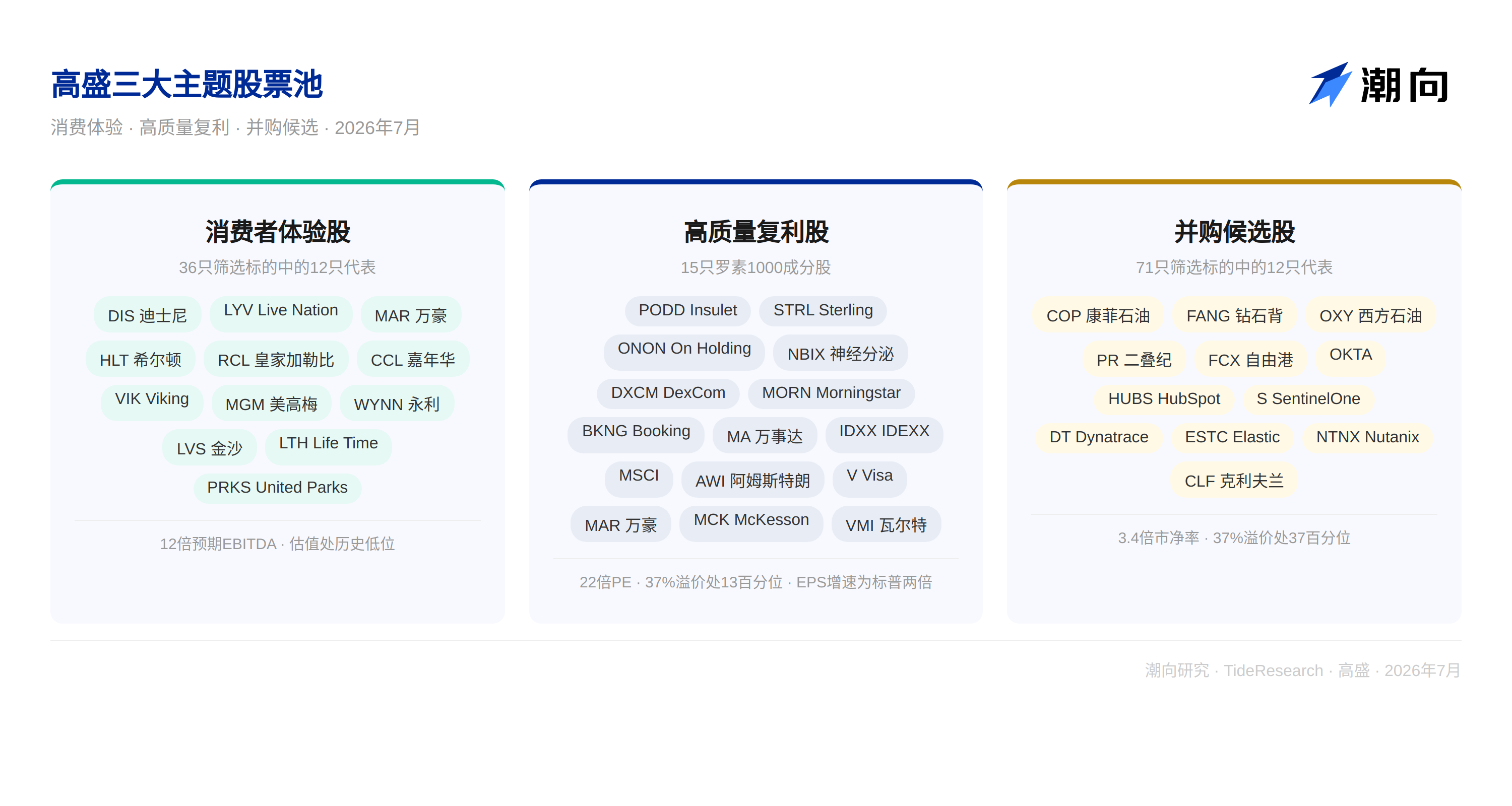
Goldman Sachs' weekly outlook report on July 17 specifically addressed investors' most pressing question: Besides AI, what else can be bought now? The report provided three directions unrelated to AI and with extremely low correlation to the momentum factor: consumer experience stocks, high-quality compounding stocks, and M&A candidate stocks.
The Extreme Volatility of AI Momentum Has Not Ended
Goldman Sachs' momentum factor (going long on the best-performing stocks and short on the worst-performing stocks) recent performance basically reflects the structure of AI trades, overweight in semiconductors and tech hardware, underweight in software. But this trade is undergoing a drastic deleveraging.
The annualized volatility of the momentum factor has reached 36%, the highest level for this factor in non-recession periods since 1981. During this week's five trading days, the momentum factor fluctuated by more than 2% on four single days, as the market digests inflation data, bank earnings, and uncertainty surrounding AI infrastructure stocks.
Historically, after experiencing similar rapid rises, the momentum factor usually enters a consolidation period, very similar to the recent decline. Goldman Sachs' data shows that although hedge fund positions on AI trades have decreased significantly, they remain far higher than the average level of the past few years.
Extreme volatility reinforces itself; it encourages further position cuts, forming a vicious cycle. A fundamental catalyst that could change the situation should be signals regarding ROI on AI investments given by hyperscalers during this quarter's earnings season. But Goldman Sachs believes it is too early now; companies are unlikely to provide spending guidance for 2027 in the current earnings season.
Low Correlation Is Suppressing Index Volatility
Although volatility in AI-related stocks is extremely high, the volatility of the S&P 500 Index remains low. The reason is that correlation between individual stocks is declining sharply.
The 3-month implied average single-stock correlation tracked by Goldman Sachs fell to a historical low of 0.14 this week. This means the average implied volatility of S&P 500 constituents (about 40%) is 2.8 times the index implied volatility, also a historical record.
Volatility at the index level is masked by low correlation, but risk at the individual stock level is much greater than it appears on the surface. Goldman Sachs' conclusion is: in a low-correlation market, stock selection ability becomes more important than ever.
Theme 1: Consumer Experience Stocks, Accelerating Growth, Reasonable Valuation
Consumer spending growth on "experiences" is accelerating, from 1% in Q1 2025 to 6% in Q1 2026, while broader service spending growth is only 2%. Goldman Sachs screened 36 companies with market caps over $2 billion focused on physical consumer experiences, including cinemas, casinos, hotels, cruise lines, and leisure facilities.
This portfolio has risen 17% this year, outperforming the S&P 500 Equal Weight Index by 3 percentage points and outperforming the Equal Weight Consumer Discretionary sector by 17 percentage points. But valuations remain reasonable; the median stock trades at 12x expected EBITDA, which is at the 45th and 21st percentiles since 2016 relative to the valuations of the S&P 500 Equal Weight and Consumer Discretionary sectors, respectively.
Theme 2: High-Quality Compounding Stocks, Faster Growth, Lower Valuation
Goldman Sachs screened 15 Russell 1000 constituents that exceed the index median on quality metrics such as earnings per share growth, free cash flow conversion, return on invested capital, and Altman Z-score. Over the past three years, these companies' EPS growth rate was more than double the S&P 500 median, and market consensus expects them to maintain this advantage over the next two years.
But year-to-date, this portfolio has underperformed the S&P 500 Equal Weight Index by 7 percentage points, with valuations near 10-year lows, at 22x P/E, and a 37% premium relative to the S&P 500 Equal Weight, which is at the 13th percentile since 2016.
Goldman Sachs believes macro background and earnings growth prospects should support valuations for these companies. But if the Federal Reserve turns dovish or economic growth improves comprehensively, it may further suppress the relative performance of high-quality stocks.
Theme 3: M&A Candidate Stocks, Trading Volume Rising, Valuations Lagging
Total announced M&A transactions in the US this year reached $1.2 trillion, up 32% year-over-year, with transaction volumes climbing month by month. Goldman Sachs equity analysts screened 71 stocks assessed to have a greater than 15% probability of being acquired; these stocks have outperformed the Russell 1500 Equal Weight Index by 8 percentage points since the end of the first quarter.
But valuations have not yet reflected M&A premiums. The median M&A candidate stock trades at 3.4x price-to-book, 37% higher than the Russell 1500 median stock, but this premium is at the 37th percentile of the historical range over the past 15 years. M&A candidate stocks in the biotechnology sector have higher valuation premiums, but the average acquisition premium for biotechnology transactions this year reached about 60%; valuations for M&A candidate stocks in TMT and other industries are roughly flat with industry peers.
Goldman Sachs believes loose financial conditions, robust economic growth, healthy CEO confidence, and a friendly regulatory environment will continue to support M&A activity. Some investment bank stocks focused on M&A advisory will also benefit, but recent valuation expansion has compressed upside space.
TechFlow Perspective
Consumers are willing to spend money on "experiences," and spending more and more. This trend has nothing to do with AI, nothing to do with semiconductor inventory cycles, and only relates to consumers' income allocation tendencies. 12x expected EBITDA is considered cheap over the past decade.
Compounding stocks have strong earning power, but because they are not in the AI narrative, they are ignored. 22x P/E is not cheap, but if based on the past decade as a standard, it is now at floor prices. When the market starts rewarding quality again depends on when the macro environment changes.
M&A transaction volumes are rising, but the market hasn't given these potential acquisition targets enough premium. Except for biotechnology, where M&A premiums have been partially digested. For M&A candidate stocks in TMT and other industries, there is still room for valuation repair.
The commonality of the three themes is simple: they are all unrelated to AI, and they are all not expensive.

Disclaimer
This article is a compilation and interpretation by TechFlow Research of a third-party brokerage research report (Goldman Sachs, July 17, 2026). Ratings, target prices, earnings forecasts, and related judgments cited in the text are the views of the brokerage analysts, representing only their affiliated institution's stance, not representing the views of TechFlow Research, nor constituting any investment advice.
The market has risks, decisions must be independent. This article should not be used as a basis for buying or selling any securities.
Join TechFlow official community to stay tuned
Telegram:https://t.me/TechFlowDaily
X (Twitter):https://x.com/TechFlowPost
X (Twitter) EN:https://x.com/BlockFlow_News
 @chaoxiangooo