Dialogue with a16z Partner: Large Models Have No Network Effects, Ultimately Can Only Earn a "Toll Fee" Like Carriers
TechFlow Selected TechFlow Selected
Dialogue with a16z Partner: Large Models Have No Network Effects, Ultimately Can Only Earn a "Toll Fee" Like Carriers
AI will not end SaaS, but will redefine the boundaries of software.
 Navigating Web3 tides with focused insights
Compiled by: Yanlin Hang, Z Finance
June 2026, Silicon Valley. Anthropic's annualized revenue has more than quintupled over the past 12 months, reaching $47 billion. The AI capital expenditure guidance for the four major tech giants this year totals over $700 billion, nearly twice the total investment of the global telecommunications industry.
As the entire industry convinces itself that "the risk of underinvestment is greater than overinvestment," Benedict Evans talks about the 2008 mobile data crisis in the a16z podcast studio.
Those were chaotic years following the iPhone launch. AT&T launched unlimited data plans, users went crazy watching YouTube, the network crashed instantly, and carriers spent hundreds of billions of dollars expanding capacity. Ultimately, all the cool apps were made by others, and carriers only earned "pipe fees."
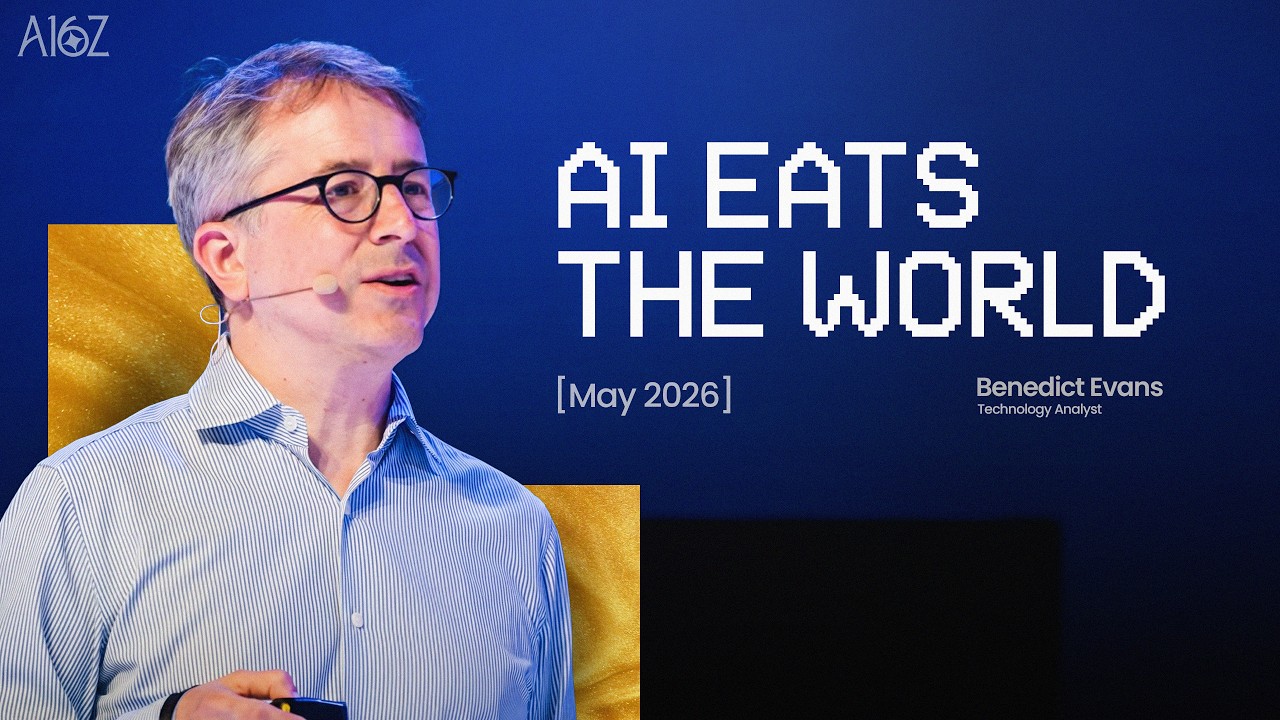
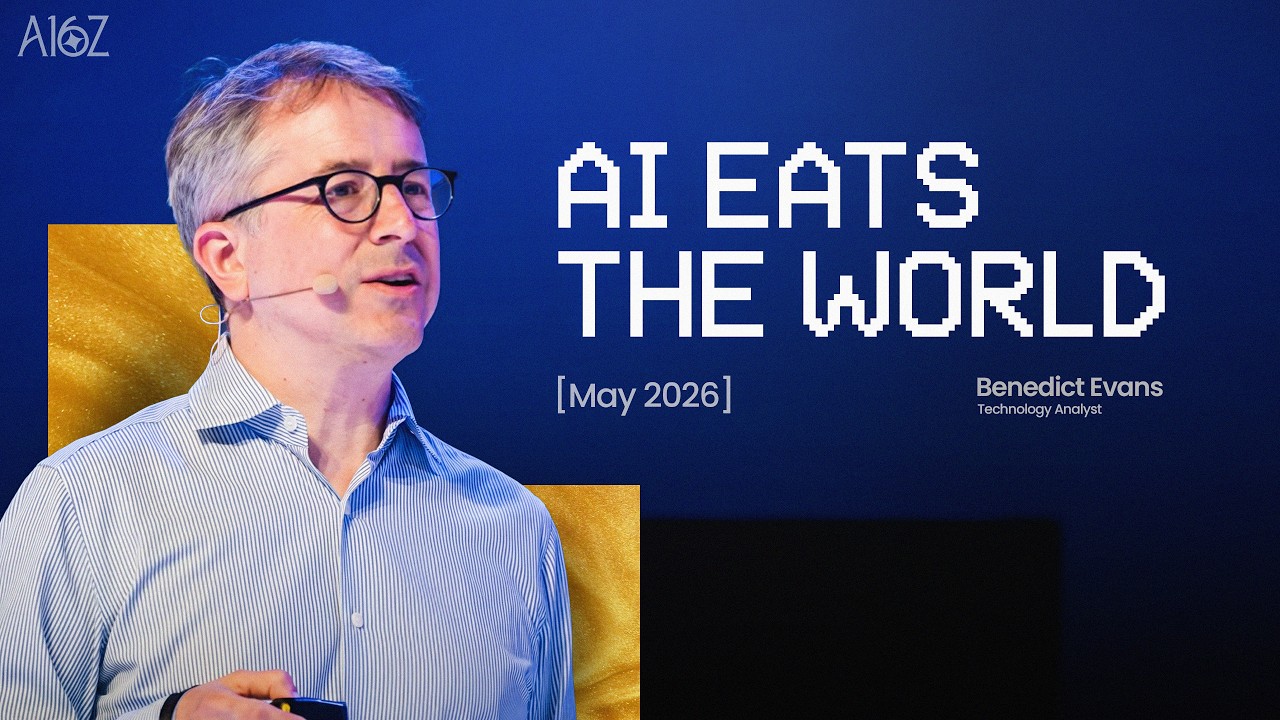
Evans releases a presentation titled "AI Eats the World" every year, regarded by Silicon Valley as an important coordinate for observing technology cycles. Unlike most optimists, he is accustomed to finding bad news in history. In his view, the gap between today's $20/month ChatGPT subscription and the tens of thousands of dollars in Token costs behind it stems from the same illusion as the $500 billion sky-high data bills back then. Pricing and costs are severely disconnected, yet everyone pretends not to see it.
"All bets are still open." He admits he cannot predict the endgame. But when model efficiency improves by 100 to 200 times annually, and nearly a trillion dollars of capital flows into this sector globally, he believes at least one thing is certain: today's luxury of "pricing based on ROI" will not last long.
The following are Evans' six judgments on the core contradictions of AI economics:
1. Foundation models are not products; value will eventually shift upstream. Model companies are likely to become water sellers, repeating the mistakes of chipmakers, ISPs, and mobile carriers. They build amazing infrastructure but fail to capture the most profit.
2. Programming is currently the only field that has truly found PMF. Agentic Coding has leapfrogged from "somewhat useful" to "changing everything," but beyond that, most scenarios remain on the edge of "opening ChatGPT once a week to mess around."
3. The pricing system is collapsing. When model efficiency improves by 100-200 times annually, and CapEx flows in on a trillion-dollar scale, today's luxury of pricing based on ROI will not persist. Tokens will eventually become commoditized like mobile data, heading towards a price war.
4. AI will not end SaaS, but it will redefine the boundaries of software. Should probabilistic LLMs be placed at the top or bottom of the tech stack? Enterprise software will usher in a new round of chaotic gaming between "Excel vs. Specialized Software," meaning more software, more competition, and more uncertain profit margins.
5. History can only explain, not predict. Analogies from the mobile internet, cloud computing, and PC eras are useful, but none can tell you whether OpenAI will become the next Windows or the next Netscape.
6. The real questions are leaving the tech circle. What does AI mean for law firms, investment banks, consulting companies, and Hollywood? The answers are not in San Francisco, but in the hands of industry insiders who know "what junior employees actually do."
01 Divergence in Strategies Between OpenAI and Anthropic
Erik Torenberg: Benedict, welcome back to the a16z podcast. Last time you were here, we discussed the first version of your presentation "AI Eats the World." It's been nearly a year and a half since you finished writing it. You always start your presentations with "what are the big questions." But this time I want to ask first: What have we learned since you initially gave that presentation? Which predictions came true? Let's review.
Benedict Evans: Let's talk about what happened in the past year first. I think we see more clearly the divergence in product strategies, and we see competitive tension—this competition is no longer just about "making models bigger, faster, and投入 more compute."
OpenAI's strategy has undergone several shifts—from "betting on all directions at once yesterday" to "maybe we should double down on programming." Obviously, Agentic Coding has truly started to work. Therefore, all focus in the tech world is highly concentrated on this field; it has achieved absolute product-market fit, and customer demand is so strong it's almost overwhelming. Of course, this also brings supply shortages. The contradictions surrounding capacity, pricing, supply-demand imbalance, and capital expenditure pricing are exactly what we are seeing now. This is the node we are currently at—once we thought this thing was somewhat interesting and exciting, but weren't entirely sure what to do with it. Now it确实 works for programming, and as for whether it can be used in other fields, the answer is almost certainly yes, but programming is where it is truly functioning.
Now the focus has become much narrower. Beyond that, data continues to rise: models are getting larger, CapEx continues to grow, and usage is increasing; people are using it more and more. But most of the fundamental questions you raised two or three years ago still remain unanswered. For example, we don't know if there will be an absolute winner in the model field, whether they can capture value at the upper end of the value chain, where the boundaries of model capabilities lie, or when consumers will shift from weekly usage to daily usage with current technology. So, all these questions remain悬而未决.
Erik Torenberg: Speaking of programming, was it possible for us to predict back then that it would become the first application scenario to truly explode?
Benedict Evans: If you look at it from a deterministic perspective, you can reason this way: Who likes to play with these things the most? Software developers. And what do software developers want to try using these things for most? Of course, software development itself. So from this very plain perspective, software development has the highest priority. I often analogize this moment to the internet in 1997 or 1998, or the personal computer era in the late 70s and early 80s—everything was very exciting back then, but it wasn't quite clear what this thing was actually for, because it hadn't truly matured. In the early days, the main thing people did with personal computers was to make more computers, and nowadays the first thing people do with LLMs (and larger LLMs) is also to make more compute. So this is not surprising.
But a clear shift happened early this year: Agentic Coding went from "somewhat useful" to "truly changing everything." I'm not sure if anyone could accurately predict when it would happen, nor know that it would be the first application to break out. Some people claim in hindsight that they expected it all along, but I don't think anyone could deterministically predict that all this would happen at this specific point in time, and in the form of programming.
Erik Torenberg: Then at the organizational level, what have we learned? What does it mean for junior engineers, senior engineers, and for the job landscape and team organization forms?
Benedict Evans: I think nothing can be said for sure yet. Six months ago this thing was fundamentally unusable. Now everyone is scrambling to figure out what it actually means. If you get too immersed in the noise and details, grabbing onto something someone said at an event and thinking the sky is falling, you will fall into chaos. All this will take at least two or three years to stabilize, not to mention anything else, just the pricing issue has huge supply-demand contradictions, leading to various surprises. So we simply don't know what future teams will look like.
I think people are starting to ask some new questions, the most obvious one being: Do you still hire junior staff? If so, what do they do? Why did you hire junior staff in the past? Did you hire them to do what they themselves could do, or to do other things? If you automate a whole class of work that was previously done by humans, what happens? This question has become more real in the software development field because you are indeed automating a lot of things previously done by people. So these questions have moved from the theoretical level to reality. But I think no one can say they know what the market structure will look like in the next three to five years, or what the career path for software engineers will become—if you think you know, that's crazy.
Erik Torenberg: Let's talk about OpenAI. What surprised you the most? How do you understand their strategic evolution and the future problems they face?
Benedict Evans: This has always been a place full of dramatic conflict. Obviously, their CEO took leave for medical reasons, which changed the situation somewhat.
In the second half of last year to the fourth quarter, the question raised externally was: The models themselves are not bad, but what else? How do you get people to use these things to do other things? It was almost like saying "go ask ChatGPT for 15 ideas on how to build value based on infrastructure, then do them all," and OpenAI pretty much did just that. Meanwhile, Anthropic had relatively weaker financial strength, and they said: We are focusing on coding. And then they actually delivered on coding. Whether it was intentional or accidental, let others judge. But obviously this move worked.
But the problem remains: Currently, what is truly functioning is software development, and some partial scenarios in other fields. There are still many people just excitedly testing the waters on the edge, using it in some scenarios. The divergence within Silicon Valley is also quite obvious—on one side are those who bought piles of Mac Studios and run open-source models around the clock, on the other side are the other forty or fifty percent who think this thing is indeed somewhat useful, but only used it once last week. The question is, how do you bridge this gap? I don't think there is a simple answer to this question. Software development did leap over that gap, but many people in other fields are still scratching their heads, using it only superficially.
Additionally, many enterprises are using AI to automate certain specific backend processes—in this case, you are not letting users explore what this new tool can do themselves, but directly telling them: Here is a problem we can solve. I communicate with companies outside the US and tech industry, and also talk with consultants and investors, and they are all examining these point solutions one by one.
For example, I talked with a commodity company a couple of days ago; they want to use LLMs to improve cash flow forecasting because they deal with many small producers and aren't sure when they will receive payments, and this is a low-margin business, so cash flow forecasting is a big problem for them. This is completely different from going to ChatGPT or Claude and casually saying "help me write something."
Erik Torenberg: Compared to early adopters using it weekly or daily, how do you see it?
Benedict Evans: I think this can be answered from several different dimensions. First, we are always standing on the shoulders of giants to progress, and progress is accelerating. The mobile internet didn't need to wait for the internet to appear before being born; it only needed to wait for cellular data networks to be in place. The internet didn't need to wait for personal computers to普及, personal computers didn't need to wait for consumer electronics and semiconductors to mature first. So adoption speed has been accelerating. Back when your boss Marc Andreessen made Netscape, there were only tens of millions of personal computers globally. You couldn't have 900 million weekly active users—because there weren't 900 million computers. So the acceleration has always existed.
The second point is: In the early stages of these transformations, no one can see clearly how it will work, and actually nothing is usable. I'm old enough to remember these things. I don't know how old you are, but people in their thirties might not remember that era—you're working halfway, everything on the screen suddenly freezes, you have to crawl under the desk to unplug the power, and then pray that at least part of what you did in the last hour can be recovered. This kind of thing will never happen again now.
Back in the 80s, you'd spend $300 on a sound card, and the computer might not even make sound properly. That $300 spent, plus a weekend to get it working. I remember those days of struggling. The internet was the same. You had to get a floppy disk with TCP/IP protocol first, it was painfully slow, and there were no ready-made tools for what you wanted to do. The mobile end was the same. We are at that stage now. Of course, the key question is: Which of these things will eventually succeed? It's the same now: Will browsers succeed? Can this thing truly站稳? How does all this fit together? There is a gap between those extremely exciting things and the small group of people willing to invest effort to make them work, and what we need to do is turn it into something that can be done with one click.
02 Pricing Crisis and Historical Lessons from Platforms
Benedict Evans: The third point is: unit economics have become more tangible. I observe that the pricing compression we are currently mentioning is very similar to what happened in the mobile data field from 2009 to 2010. On one hand, people suddenly received data bills as high as $5,000 or even $10,000; on the other hand, if you were on an unlimited data plan—like the one AT&T exclusively launched with the iPhone in the US—everyone bought an iPhone and started using it, 3G networks turned on, everyone started watching YouTube, and the whole network crashed because there simply wasn't enough capacity to support it. Interestingly, there are still people in the tech circle who don't understand that cellular networks have marginal costs. They must expand capacity, and expanding capacity costs money. Carriers had to scramble to adjust the cost curve to align with the infrastructure pricing system, align with underlying costs, and align with perceived user value—they roughly achieved this through tiered plans, fair usage policies, speed throttling, etc.
But the other side is exactly what we are seeing now: You pay $20 a month, but can use Tokens worth tens of thousands of dollars; conversely, if you play around casually for two days and suddenly receive a $10,000 bill, you will definitely exclaim what the hell is this. Now you can see identical news stories; this is exactly what happened from 2008 to 2010, and also exactly what happened in the GPU field from 2001 to 2003.
But the more interesting part of this analogy or comparison is: Since then, mobile data traffic has grown about 1500 to 2000 times. The total revenue of the global mobile internet network is approximately $1 trillion, annual CapEx is about $200 billion, and ARPU has not grown for 20 years. All those cool new things were made by others. Carriers originally thought all the good stuff would be built by themselves—I once worked at a telecom company with a banking license because they thought they would do mobile banking themselves—which seems completely crazy now. But the key is here: They built this amazing global, extremely complex, extremely expensive infrastructure, usage continued to grow, changed everyone's lives, we are all paying for it—yet they themselves didn't make much money from it, because all value shifted upstream.
And this is exactly the core problem facing LLMs: Can the model itself do everything? Or do 300 apps need to be built on top of it? Can you directly tell the model "help me file my taxes," or do you need tax filing software, which uses 10 different AI methods internally to process? If the answer is the latter, then as a provider of underlying foundation models, what is your positioning?
Will it become a commodity infrastructure sold at marginal cost? Currently, this seems like a concept that is hard for people to accept. Because you can sell all the Tokens you can produce now, so you can price based on ROI. But in the next few years, with about $1 to $2 trillion in CapEx investment, and model efficiency improving by 100 to 200 times annually. New models will emerge. Will models consume more or fewer Tokens? We will reach a different equilibrium point. And when models have similar performance, do the same things, and use the same chips, on what basis can model companies still have pricing power?
Looking back at history: Chip companies did not capture value, ISPs did not capture value, and mobile carriers did not capture value. Windows and iOS captured it, but they were doing something completely different: They had various levers to move upstream, and network effects, while models do not. So the question is: Will model companies end up like the infrastructure layer, or like the operating system layer capturing value and deciding what others can do? Ironically, the Netscape story illustrates this exactly—Marc Andreessen famously declared back then that he was going to turn Windows into a bunch of poorly debugged device drivers, and then Microsoft squeezed into the market. But ultimately, the web browser itself was not the key—the value was elsewhere. So these whirlpool-like big questions remain悬而未决,eventually returning to what I said earlier: There are some things you can know, but you simply don't know how it will ultimately end.
Erik Torenberg: Yeah, it's unclear now whether this will be more like the internet (most value and better profit margins at the application layer happen at the application layer), or more like cloud (value seems to be at the hardware layer, currently Nvidia looks like it's earning the most, with higher profit margins). But will it stay like this? Or will it become more like the internet? How to start predicting this answer?
Benedict Evans: I have two answers to this. There are many famous quotes about how history works—my favorite is: The only thing history teaches us is that something will always happen, and you can always explain afterwards why it was inevitable, but it wasn't obvious at the time. Especially I remember about 15 years ago, many very smart tech people got iPhones and Androids, and said: This is another round of open vs. closed, we are going to kill the iPhone, but of course that didn't happen. I can explain the reasons afterwards, but all these analogies are useful, yet none are predictive. History is always obvious only in hindsight.
Interestingly, I recently did a few podcasts and released this presentation, and then there was a type of comment saying: Benedict, you didn't do your job, you should tell us what will happen in the future, your responsibility is to make predictions. But you look like you only know how to say "we don't know." There are two issues here. One is that in some places I did say what I think won't work and what will—such as I think foundation models are not products, chatbots are not products, value will be upstream. But on the other hand, at this stage of the cycle, there are too many variables, you don't know which one it will ultimately be. If you insist on saying "I think it's that one," you might be right, but you must realize how much uncertainty there is, how many different paths are possible. This is the essence of this stage of the cycle: All bets are still open.
When the S-curve starts to go up, it will narrow. There was once a time when Windows Phone seemed like it could also succeed—hindsight says of course unlikely. There was once a time when it was unclear how the mobile end would go, later it became clear—this is what is happening, and then we move to the next question.
One characteristic of tech is: When you truly understand something, know how it works and where it's going, that's exactly when you should move to the next thing. You should always be looking for those quiet corners where we don't know the answers yet. I haven't updated my Apple spreadsheet in five years—because we already know the result. I don't care what the next iPhone looks like, nor do I follow their market share in China. The result is settled, next question.
03 Foundation Models Are Not Products, Value Is Upstream
Erik Torenberg: You just said you don't think foundation models are products, you think value will move upstream. Please explain your reasoning and what this might look like.
Benedict Evans: I think we can put three or four building blocks on the table for discussion.
The first is: Currently, it is difficult to build a model that is fundamentally forever better than others and can continuously maintain a differentiated advantage. It has no network effects, nor levers you can pull, or strategic positions like Instagram, YouTube, Google Search. LLMs have nothing corresponding. Of course, different models have different focuses—maybe this one is slightly better than that one, maybe you prefer this one, but there are no fundamental differences between them, the only difference is how much you are willing to spend.
The second question: Chatbots themselves are a strange, functionally limited V1 version of a UI. They are indeed very useful in certain scenarios, for certain people, and for certain tasks, but most of the time you still need a bunch of other things. You need toolchains, need correct configuration, need suitable data, need various controls and user interfaces configured. Someone needs to think seriously about how this tool should work, because people who are good at using tools to complete work, and people who are good at deciding what tools should be made, are usually two different groups.
People good at print publication design are not the ones who should be making InDesign, that's another set of skills. People good at financial consulting are not the right people to design financial robots—that requires different skills, different people. Now we are fumbling in the middle ground: Claude has this, Claude has that, and Skills etc. In my view, this is a bit like, who makes the Skill? Another question is, this looks a bit like the templates you see when you select "New File" in Excel—they can only go so far, at some point you break through the template. I have a slide in my presentation quoting something someone said to me on Twitter many years ago: He said he was a consultant, half his job was teaching others to use Excel as a database, the other half was teaching others to use databases as Excel.
So there is a vague, chaotic zone here: Do you need specialized software? Do you need horizontal software or vertical software? Or do you just get everything done in Excel? We have all seen examples of entire departments running on a 10MB Excel file—my own business also uses Numbers spreadsheets. But at some point, you will surpass that limit.
Can model companies make all these? Of course not, just like Microsoft or Apple cannot make every App on Windows and iOS. So do model companies have that leverage effect? Are they Windows or iOS? Ask again: Are there network effects?
For example, you are now a law firm, you want to buy a set of software—a16z has invested in many enterprise software companies, will this law firm or manufacturing enterprise or bank ask "does this use Claude or OpenAI? Because we uniformly use Claude"? No, that's not how it works at all. It wasn't like this in the cloud era either, you wouldn't say "our company uniformly uses AWS," you don't even know which cloud a certain SaaS product runs on. This is the key, it is stripped away, not something you need to worry about. So in this sense, foundation models are more like cloud service providers—they may have some competitive advantages, but they don't have that leverage effect, no network effects, no control.
This also reminds me of another comparison: The semiconductor industry—each generation gets more expensive, fewer participants. Overall, models are essentially a different commodity, chatbots are not the correct UI or product, model companies cannot make everything themselves. So they are underlying infrastructure. Then do they have pricing power?
In the future, there will be about 3 to 6 companies making frontier models, annual investment—no one knows exactly,大概 $200 billion to $2 trillion—plus a batch of edge models and open-source models. So ultimately there will be five or six companies competing in this market to sell these products. Where does price discipline come from? Especially since some of these companies have completely different business models. For example, Google makes money from advertising, their attitude towards pricing is not the same as OpenAI.
I think the difficulty lies in: There is a gap between the state we are currently in and the state we should ultimately reach—this is actually a topic discussed in introductory economics courses. We are currently in a period of extreme imbalance between supply and demand, pricing, CapEx, and capacity. But demand for Tokens is infinite, this does not mean you cannot reach a different price equilibrium point—because mobile data went through this. Demand for data bits grew 1500 to 2000 times over the past 15 years, but you still saw market price equilibrium of supply and demand, and fierce price wars between operators still exist in most parts of the world. Fundamentally, you are selling a commodity, customers can switch suppliers at any time—developers will also switch back and forth.
Of course, I fully accept this could be wrong. Maybe ultimately only two companies in the world can build LLMs, they have pricing power. Or we enter a world where almost everything is integrated into the model itself, models have leverage upstream. But my core point is: Just like the iOS vs. Android debate—of course you can say it went this way the past three times, but that doesn't prove it will be the same this time. But at least you should raise these questions, and also admit that the current situation is temporary. We are in this state of extreme scarcity, followed by pricing systems, free markets, and about $1 trillion in CapEx flowing in. So these multiples will change.
04 Where Is the Next Breakthrough After Programming
Erik Torenberg: This leads exactly to what you said earlier "we already know what Apple looks like." So what is the next question you are most focused on currently? Or what should we pay most attention to?
Benedict Evans: We have already talked about some issues, such as how far the model capability stack can go, whether models can achieve differentiation, etc. Another obvious question is: At what point will we see that in more and more categories of use cases, models are already good enough, and we no longer need the most expensive, fastest, largest, heaviest models on the cloud? We can use old models, open-source models, or models running on-device. This is exactly the story Apple is going to tell next—how much stuff can be pushed to the device end, where compute is free (or at least free to you, no marginal cost to developers).
Another classic question is: The questions themselves have started to move out of the tech field. For example, if you look at a law firm, a consulting company, an investment bank—basically all traditional professional service firms adopting a pyramid structure—if you can automate a large part of the work done by those at the bottom of the pyramid, what happens? I can only say, if you haven't worked in a law firm, haven't worked at Bain, BCG, McKinsey, you probably can't figure out what's going on, because you probably don't know what those junior employees specifically do, nor know what clients are actually paying for. How will those roles be restructured? What does AI mean for finance? Including both internal hiring structures, and the types of products and profit margin structures you can create. What does it mean for the consulting industry? For the Big Four, Big Three, Accenture, large law firms and advertising agencies?
You probably know some of these questions, but if you are not in the industry, you simply don't know what the answers are. This reminds me of a phrase I often said when I was at a16z "Content is not King." I also wrote "Netflix is not a tech company"—what I wanted to express is: Netflix's entire business is supported by infrastructure built by the tech industry. But all the problems Netflix faces are Los Angeles problems (content problems): Which shows to choose, how many shows to shoot, what type of shows? How much to spend on talent? Should we go for awards? Make movies or not? Buy sports rights or not? These are all Los Angeles problems, not San Francisco problems. San Francisco doesn't even know what the correct questions are—they are media industry problems. All truly important questions for Netflix have become media industry problems.
Similarly, whether Tesla is a car company or a tech company has always been a focus of debate. What I want to say is: What AI means for the legal industry, this question is both a tech person's problem, and more so a lawyer's problem—you need to deeply understand how law firms actually operate, what clients are actually purchasing. Similarly, what does generative video mean for Hollywood? Ben Affleck probably knows much more than I do—he founded a company and sold it for hundreds of millions of dollars. So this is the second category of questions: Questions are moving out of the scope of AI itself, becoming half-AI, half-other field hybrid problems.
The third layer—perhaps I should have said this earlier—what is fundamentally different about all this compared to previous platform transformations is: During the 3G, iPhone, web eras, although you didn't know what would happen next, you knew the physical limits. For example, in 1995, you knew telecom companies wouldn't install broadband for the whole world next week; you knew not everyone in the world would go buy a PC, because a PC cost $3,000. So you knew where the basic impossibility boundaries were.
But on generative AI, we don't know. Maybe after we finish recording this episode, phones will push a notification saying OpenAI's new model is released, price is only 2% of before—because of a new technical breakthrough. I don't think this is very likely, but we don't know the answers to these types of questions. How much bigger will models get? How much better? How much faster? How much cheaper? In what aspects? How will model characteristics change? We don't know. This is different from all previous platform transformations—before you knew where the basic constraint conditions were. And this will derive a series of new questions.
In a sense, I mentioned earlier: Currently the only field with product-market fit is programming. Other fields do not have PMF to the same degree. I can safely say: Anthropic's revenue grew from a $9 billion run rate last year to $47 billion now—all from software development. So, if someone in other fields makes something usable, what will happen?
Erik Torenberg: For example law firms, banks... If you had to guess, besides programming, which use cases might generate daily active usage?
Benedict Evans: The presentation I released a few weeks ago is roughly divided into three parts. The first part talks about capital, CapEx, infrastructure, and differentiation of foundation models—this is what we just chatted about. The second part is: How do you use these things to build software? What does this mean for the software industry? What will software look like? What changes will happen to profit margins and company landscape?
The third part I call "Change." I started by quoting a famous saying by Yogi Berra: Prediction is very difficult, especially about the future. I think a backtesting perspective is quite interesting: Imagine asking these types of questions about the internet in 1997, what would you get? What wouldn't you get? I think one way to look at it is: This is a type of automation, it turns a class of things people did but couldn't automate into things that can be automated. What does that mean? I proposed three or four buttons that can be pressed.
The first is price elasticity, which is also what Gerber's PowerDNS is really doing: If the cost of doing things decreases, do you do the same amount of things with less money, or do more things with the same money? Or because you do more, do you charge more? Is there anything that couldn't be done before, now becomes cheap? Is there anything that was very expensive before, an entry barrier—like owning a printing press for a newspaper—now this barrier disappears? Is there anything that unlocks new possibilities in business models or competitive spaces because your costs decreased?
The last question is: What are things that were completely impossible before, completely due to costs being too high so no one ever thought about them, now become accessible? Examples I often use are steam engines making trains possible, you could buy再多 horses and not build a train across east and west. A more modern example is YouTube or Spotify. Spotify says: Look at the history of the music industry over the past 25 years, the first half is "you don't need to spend $1.50 to buy a CD just for that one song," the second half is "$15 a month to listen to all the music you can find," this was completely impossible before.
The problem with this type of prediction is: On one hand you play smart and say some obviously correct things, but you actually don't know what it means in specific industries. For example, in the late 90s we said the internet would destroy the value of physical distribution—this meant completely different things for newspapers and movie companies: Newspapers were destroyed, while movie companies were hardly affected. So it still depends on the specific situation.
There is also a part where I think we can ask some more useful questions. One that I am quite curious about is: How will AI change advertising, e-commerce, brands, and our consumer behavior? Advertising is a trillion-dollar market, retail is $25 trillion, this is a considerable scale of addressable market. What I have been thinking is: Google, Meta and Amazon actually don't truly know what those commodities are. They know SKUs, know what publishers entered in metadata fields, know "people who bought this also bought that," but they don't know why, nor know what those things actually are. So jokes like this appear: Amazon, I bought a toilet seat, but I'm not collecting toilets—because Amazon actually doesn't know what a toilet seat is, nor know normal people wouldn't buy two. Actually they should be able to know using frequency analysis, but they don't do this. And with LLMs, in principle you can know what those things are, why people buy, what other things people will buy.
Of course the word "know" is hard to define. But at least AI systems can provide a statistical color of a completely different dimension—this is why Google and Facebook's advertising revenue and conversion rates are soaring every quarter—they integrated AI into advertising systems, recommendation engines and prediction algorithms. You will see more things you like, the ads you see are also more likely to be things you want to buy. So their advertising revenue saw a sudden acceleration.
Overall, look at how these systems operate now: They say "people who bought that also bought this." And now you should be able to do: Here is a picture of a coat: What is this? Where can it be bought? Ten years ago this was absolutely impossible, five years ago maybe also impossible, now it should be possible. Then you can also say: Help me recommend 10 similar coats, different price points, tell me where to buy them, and list the pros and cons of each, these you can also basically get. Further: Look at my Instagram, help me recommend a winter coat I should buy, change my style, but not too much. Three years ago this was completely science fiction, now you would feel indeed a roughly usable thing can be made.
And these changes—what computers can know, what can be automated, what suggestions can be made—return to the most fundamental question. Every time a new technology appears, you first use the new technology to do old things: More spreadsheets, more PowerPoint, more emails, better emails. But the important thing is not doing old things better, but doing new things that old technology fundamentally couldn't do. This is a very cliché observation, but we often forget. So what are things that you can only do with this new thing, not just automate old things?
The enterprise version might be: You recorded all Zoom calls with customers, you have all email flows in Salesforce, you also have all user behavior analysis data and metrics. Then how should you adjust pricing to improve churn rate? This is what LLMs might achieve, it's different from "do sentiment analysis on call centers, tell me which customers are angry." You have undergone multiple shifts in the abstraction level of analysis capabilities. Of course, this will spawn new companies, destroy old companies, create new businesses. But having said that, we are now in 1997, and I want to predict Uber and Airbnb. If I could really predict that, then we would be living in a parallel universe. VC hit rates wouldn't be one in ten, but ten in ten.
Erik Torenberg: Yes. One of the questions we are asking now is: What things were ridiculously expensive before, now become possible? For example rebuilding YouTube from zero? Or rewriting the Linux kernel?
Benedict Evans: Interestingly, the observation on the other side is: New companies always say "we are going to redo old things with new things. Of course, we are going to redo Office with open source, we are going to rebuild it on the Web." And then? Look at Google Docs, market share about 20%—because that's not the key at all.
What's truly interesting is making something completely new, shifting the abstraction level, to discover those problems that simply didn't exist before. Sitting in a VC firm listening to project pitches all day, you will find some things sound somewhat useful, some things you feel are unlikely to succeed. But there are some things like filling a hole in the universe—when someone explains it to you, you immediately feel: Wow, why has no one done this before? Why did no one discover this problem existed? This is the most fun part of looking at startups. And this is exactly what people will use AI to do—people will suddenly discover a method, realize a problem has always existed, and including those who have the problem, no one realized that problem existed, then they will go make a tool to solve it.
This also returns to my point earlier: This is why I don't think models can handle everything. Think about all the project pitches you've seen at a16z, how many are problems people in the industry already knew existed? The answer is often no. Actually no one in the industry feels that's a problem, usually it takes two years to explain, let them believe that problem indeed exists, then this new thing can help them solve it. This is the problem, you can't expect an ordinary manager in a finance department to use this tool to solve a huge global industry problem—because no one knows that industry problem exists, let alone think of the correct tool solution.
05 Will the SaaS Landscape in the AI Era Be More Fragmented or Concentrated?
Erik Torenberg: Does this mean the SaaS environment in the AI era will be more decentralized than before? Less bundling, fewer giants like Microsoft Enterprise Suite?
Benedict Evans: Back to the topic of SaaS. Let's put some building blocks in place first. Obviously, building software will become cheaper and faster. Obviously, there will be a bunch of things that can be done with software that were completely impossible before. Therefore competition will be more intense. Of course, this also comes with new profit margin structures. But as we just chatted, we don't truly know what that profit margin structure will look like.
Will it move towards outcome-based pricing? Linking every keystroke in enterprise software to the income statement is very difficult, sometimes it can be done in Salesforce, but for most software it's hard to say "the work I did today had this much impact on earnings per share, so we should pay this much for it." I don't think this makes sense, at least not in the long run. But how will pricing structures evolve? There will definitely be more competition, building software will be easier and faster.
I have two useful frameworks for thinking about this problem. The first is: Look at today's enterprise software group, there are three major categories. The first category is large horizontal systems—SAP, Workday, CRM, human capital management software, payroll management software etc. The second category is vertical software—a typical large US company probably has 300 to 400 SaaS Apps, plus another thousand internal purchased or built Apps running on Teams. The middle ground is the vague improvised space composed of Excel, email and shared file systems, things will move back and forth between these three. In principle, every SaaS App is doing something you could originally do in SAP or Excel, for example you can manage campus recruitment in Workday.
But at some point, for example I talked with people, if you are PwC, recruiting thousands of graduates every year to train as accountants, you might have a set of self-built specialized software, or you hired Accenture to build a set, and you probably still hate it. But if you are a company that only recruits 5 graduates a year, you get it done in email and shared Google Sheets, because why would you specially buy a set of software? The middle ground can be done with Workday, Excel or specialized Apps. Now you add ChatGPT: Do you use LLMs to do this? Is there an LLM tool that lets you do things in Salesforce you couldn't do before? Or do things in your vertical software you couldn't do before? You use LLMs to build a tool for yourself—just like some department in a company runs on a 10MB Excel file built 15 years ago, no one knows how it works, but everyone still uses it. So LLMs enter this vast, scattered, complex landscape, becoming another set of options for completing tasks.
I think another thinking framework is: Is LLM placed at the top or bottom of the stack? On one hand, placing it at the bottom is a feature inside Salesforce, you are in Salesforce, the system looks at history with that customer, context of all other sales calls, business goals, then helps you generate an email or suggests what you should say when calling the customer. This is a controlled feature, with toolchains, with guardrails, driven by that specific use case. On the other hand, it's the example just now: Go check Salesforce, Workday, all emails and Google Analytics data, then synthesize an analysis that was impossible before. So the dilemma is: Where do you put probabilistic, potentially error-prone software? Where do you put deterministic system software? Where does the database go? Where does the LLM go? Top of stack or bottom? Possibly both, depending on what you are specifically doing.
Ultimately, this is about what software means—more software, far more software. The reason all software companies exist is to solve problems created by other software companies. This is that classic joke: The reason all security software exists is to solve problems created by other security software. Obviously, the SaaS era has already let us experience a software explosion of one or even two orders of magnitude. This time we should expect the same thing to happen.
As for saying SaaS doom, investors looking at all these companies say, we don't know which companies will be taken down by all this. Definitely some companies will finish, a certain proportion of existing SaaS companies will be wiped out by this wave, but you don't know which ones, so you shouldn't directly devalue the entire industry by 50%. But you definitely have to say: Before I figure out exactly what all this is about, I temporarily won't All in long SaaS.
Erik Torenberg: You mentioned in your conversation with Ben Thompson: Software is when someone sits down and designs a workflow, then says from now on this is the correct way to do this thing. But you also said processes grow out of how business operates. Does this need time? Or do we need more experimentation and iteration—from those vertical AI startups—to find the correct form of future software?
Benedict Evans: In a sense, there is an interesting overlap between what strategic consulting firms and software companies do: They both observe what is happening inside a company, say "doing it this way is too bad, changing to a better way can achieve your goals." Software companies encode this way into software, strategic consulting firms encode it into workflows, job responsibilities, processes, training and goals, also might suggest they buy a set of software to do this—or now increasingly, directly help them build that set of software.
There is also a point that needs to be discussed: How much work inside an organization is implicit, undocumented, not in training data, not something anyone in the company can sit down and draw a flowchart to explain to you clearly. This accounts for a large part of the value of BCG and McKinsey. They have the right to enter a company, talk to everyone, including those in different departments, not allowed to talk to each other (and won't be fired for it), to figure out "how this thing actually works," not "how it should work"; and why people are not executing the strategy, because actually their bonus goals depend on them not executing that strategy. Then they as an external team give you the answer, you can push the responsibility onto them.
These are all problems in organizational management and personnel operations—how people operate, how they explain what they do—these are hard to write down, and hard to directly bake into a Skill saying "here you go, maybe make a PPT." So here is a bigger challenge: How to get people to use these technologies? How to get users to adopt new tools? How to help people adopt new tools and find new things that can be done with them, this similarly happened in the cloud, Web, mobile, internet, PC and spreadsheet eras.
Erik Torenberg: Do you think there will be a co-evolution between AI-native software and new interfaces? For example new customer service AI platforms might not need so much human-facing UI, or record system software simply has no frontend? Because its main users are AI Agents querying it directly?
Benedict Evans: These are all very interesting ideas, I find it hard to have strong opinions, because I haven't dived deep into the details of how enterprise infrastructure is built. I am curious about how new these questions are. I remember about 10 to 15 years ago Chris Dixon said: API is the new boundary, software no longer needs software companies, you just need to open your API. So, old things always come back in new forms: Now you don't need APIs, you just need an MCP server, Agents will connect directly. I don't know.
I think the biggest challenge with this type of thing is: All decisions are essentially exception handling. The question is always: What can you not automate? What needs someone to make decisions, make judgments, have their own opinions—because that thing may have never been written down, never happened, or looks different from before.
The distinction method I used in the presentation is: The difference between tasks and jobs. Tasks used to complete a certain job might change, but the job itself might not change much, or what this job delivers to customers doesn't change much. Think about accountants 50 years ago and accountants today—almost none of the core things they do are the same. But to customers it looks about the same thing, just done in completely different ways, through a series of completely different tasks.
I think a deeper or more abstract way to think about it is: In which places do you want the App to give "answers everyone does this way"? That's the answer everyone wants, the answer anyone would give, the answer any junior employee would do, the answer anyone would give me. And in which places do you not want this kind of answer? In which places do you want an answer to a new question, a different answer or different idea? Because LLMs will be very good at anything you can describe how people do, and what you want is what ordinary people would do. Where they are not good at, is where you cannot explain why you do it that way, and what you do is different from others.
06 The Commoditized Fate of Models and Historical Mirrors
Erik Torenberg: Many people including the Google CEO say, the risk of underinvestment is greater than overinvestment. Is there a CapEx level where this statement no longer holds? Are we currently approaching that point?
Benedict Evans: First there is a problem of financial gravity: Microsoft, Meta and Google's CapEx this year reached about 50% of revenue. The telecommunications industry is considered capital intensive, but their CapEx is only 15% to 20% of revenue. The four major companies' guidance this year is $700 billion. The telecommunications industry total is $300 billion, mobile is $200 billion. Oil and gas, depending on how you calculate, is roughly between $700 billion to $1 trillion. So $700 billion a year is not an impossibly huge number—this is the normal cost of large global infrastructure, it's just a lot of money.
Obviously, these companies cannot spend $1.5 trillion next year, if they really did, they would have to borrow money, and cannot maintain this spending level long term. So at some point, growth must slow down, because there is no more money. Of course you can talk about ROI, talk about investment return ability. Capital markets are also willing to provide funds within a certain range. But pick a number—we cannot spend $10 trillion on AI infrastructure every year—because there simply isn't $10 trillion in the world to spend. So there is some physical upper limit.
I currently don't dare to say anything more specific than this. I almost return to what I said initially: We now have a bunch of multiple problems—demand far exceeds supply. But on the other hand, efficiency is also improving significantly. We don't know what the next model will be like. We don't know when edge computing and open-source models will join the battle. And you are always chasing the latest model. This is the main thread running through everything, a model only stays relevant for 3 to 6 months, 6 to 9 months, and it cost billions of dollars and how much infrastructure to make.
I think this situation hasn't truly stabilized yet. Obviously there are many very smart semiconductor analysts spending a lot of time trying to assign values to these numbers—this is a bit like valuing internet bandwidth in the late 90s—you don't even know what the rows in the spreadsheet are, let alone what the values are. You can only say it can't be infinite, there are physical limits.
Another way to answer: If you are Google, Meta, Microsoft, Amazon or Apple, this to some extent is a matter of survival. You have a FOMO problem. On one hand, your current investment return is very positive. On the other hand, you cannot let others run away in your absence, otherwise the company is finished. You don't want to be like Microsoft in the 2000s, IBM in the 90s, or Intel in the 2010s, always being beaten badly by Apple. If this is the future of the computing ecosystem, you must participate. But at the same time, the CFO sits there saying: Okay, but to what extent do we participate? Obviously at some point, CapEx growth must slow down, because you simply can't get that much money.
Erik Torenberg: Will there be a reckoning moment about Token waste? Is it possible companies overused AI, and when they do formal ROI studies they will cut back?
Benedict Evans: Obviously, some people use the most expensive models to chat online—like mobile in 2010, you receive a $10,000 bill, then say "wait, I thought this was an unlimited data plan." So there will definitely be some silly and painful jokes. But I think the more interesting question is: As I have already said several times, we are in a seriously imbalanced Ponzi moment, pricing must realign with costs, usage must align with pricing and ROI.
The difficulty is, in this early stage, it's hard to know what ROI is. This is a bit like the internet in the late 90s, you say "go become more efficient." If you look at the Deloitte and Federal Reserve surveys cited in my presentation—go ask CFOs if they saw returns, currently most returns are those things hard to quantify: More precise analysis, better customer support, higher productivity, you can make more slides faster, do analysis faster. It's difficult to assign financial value to it. It has financial value, but it's not the same as what you say "we used AI to make new products, brought how much revenue, or saved how much money." Establishing a new revenue line is far faster than sending everyone AI to do Excel.
Another answer of course is consumer surplus—just like Excel back then. If making a DCF valuation model takes a week, you might only do one or two. If making one only takes 10 seconds, you can do 50—but you can't charge more for this. So part of the result is, these become competitive necessities—everyone must buy, must use. But the cost savings or productivity gains you get from it, will be eaten by competition. You can't charge more.
If you are McKinsey, Bain or BCG, a certain analysis previously took a week, now only takes a day, you might do 5 times the analysis volume, but charge clients the same money. Your cost structure hasn't changed either, this is what happened in the investment banking and financial analysis fields before: You did much more analysis with fewer people, charging clients the same fees.
Erik Torenberg: One of the core points of your paper is that models will ultimately become commodities. However, currently the field with the fastest and highest amount of financing is precisely these foundation model companies. Regarding this, what advice do you have for them, whether overall, or for a specific one?
Benedict Evans: I'm not sure they will definitely become commodities. My stance is more like: Here is a chain of reasoning, deterministically looking, these things look very likely to become commodities—then please explain to me why they won't. I only commit to this degree. As for raising so much money, I return to the previous point about the mobile industry, although this is not predictive, it is a noteworthy observation: The mobile industry scale is very large, spent a lot of money, but profits are not high, all cool stuff was made by others.
Then you can look at return on capital, the answer depends on whether you are in the US, Europe, India or China. But at the same time, this thing is worth doing, and indeed brought returns to some people, but ultimately mobile carriers did not control the whole situation, others gained greater value from it. What was Google's net profit last year? About $50 billion? What is the net profit of the entire telecommunications industry? I should subscribe to a Bloomberg terminal to answer this question directly, but I can say with confidence that the sum of profits of Google, Meta, Amazon, Microsoft, Apple exceeds the entire telecommunications industry.
So this is a puzzle: You are pushing the frontier forward, you fall into a trap, you must continue to compete, otherwise others will make it, you will fall behind. There is also a point we completely haven't talked about: Are we building AGI? Are we going to build a "God Box"? Some people already believe it, although hard to analyze, but maybe it is like this. So anyway you will continue to build.
But the actual question is: How do you make things people want to use, that are not software? Software is a good business, but is it the only business? If spending hundreds of billions of dollars makes the software industry more efficient, that's good, that's worth $1 trillion. Then what? How do you extend it to other parts of the economy? Extend to everyone else? So you will see these discussions—cooperating with private equity, cooperating with consulting firms—as we just discussed, if you are running a physical company, figuring out what to do with these things is actually hard. So you will go find Bain, BCG, McKinsey, Infosys, Cognizant, IBM, Accenture or private equity shareholders. So on one hand, you are building larger and larger models, you feel you must continue to do this. But on the other hand, what are people actually using it for? Why do most people open ChatGPT, and still can't think of anything good to do today?
Erik Torenberg: Last question: Is there anything in your presentation you particularly hope the audience remembers?
Benedict Evans: I used an IBM ad last year, and used it again this year, from the early 50s, the image shows a large group of engineers holding slide rules, the ad copy says "One IBM Electronic Calculator Equals 150 Professional Engineers." How many slides like this have you seen at a16z? We remember whenever these fundamental technology transformations happen—once every 10, 15 or 20 years—they bring amazing changes, completely change everything, and completely different from anything that happened before. So AI is amazing, transformative, completely different from anything that happened before.
But mobile was also a huge transformation, internet was too, PC was too, computers themselves were too—all these were also very big things at the time, and also very hard to predict what would happen next at the time. So as a baseline situation we should assume: Okay, we are going through this again. This will produce a bunch of things that destroy people's lives, will make a batch of people unemployed. There will be some things we are not very happy about, also some things we all feel are great. 20 years later, we will forget there was once a world where computers couldn't do those things.
We are sitting in this call for an hour now, computers didn't crash, we are still transmitting HD video to each other. Of course it works normally, in fact I am still using an iPhone to do this. My iPhone is transmitting video to my Mac via WiFi, like magic, and we no longer feel anything amazing about it. I think this is my description of what I consider the endpoint of all this: It will become magic, 20 years later, we will say: Of course, computers have always been able to do this.
Erik Torenberg: This is a great ending. This presentation is called "AI Eats the World," on Benedict Evans' website, the content is very wonderful, there is also a lot we didn't have time to chat about. Benedict, this conversation was great, thank you very much for coming.
Benedict Evans: Thank you, had a great chat.
Join TechFlow official community to stay tuned
Telegram:https://t.me/TechFlowDaily
X (Twitter):https://x.com/TechFlowPost
X (Twitter) EN:https://x.com/BlockFlow_News
 a16z
a16z