Podcast Notes | Silicon Valley AI Frontline Staff Deep Dive into FDE, the Hottest Role in the AI Industry Today
Compiled & Translated by: TechFlow
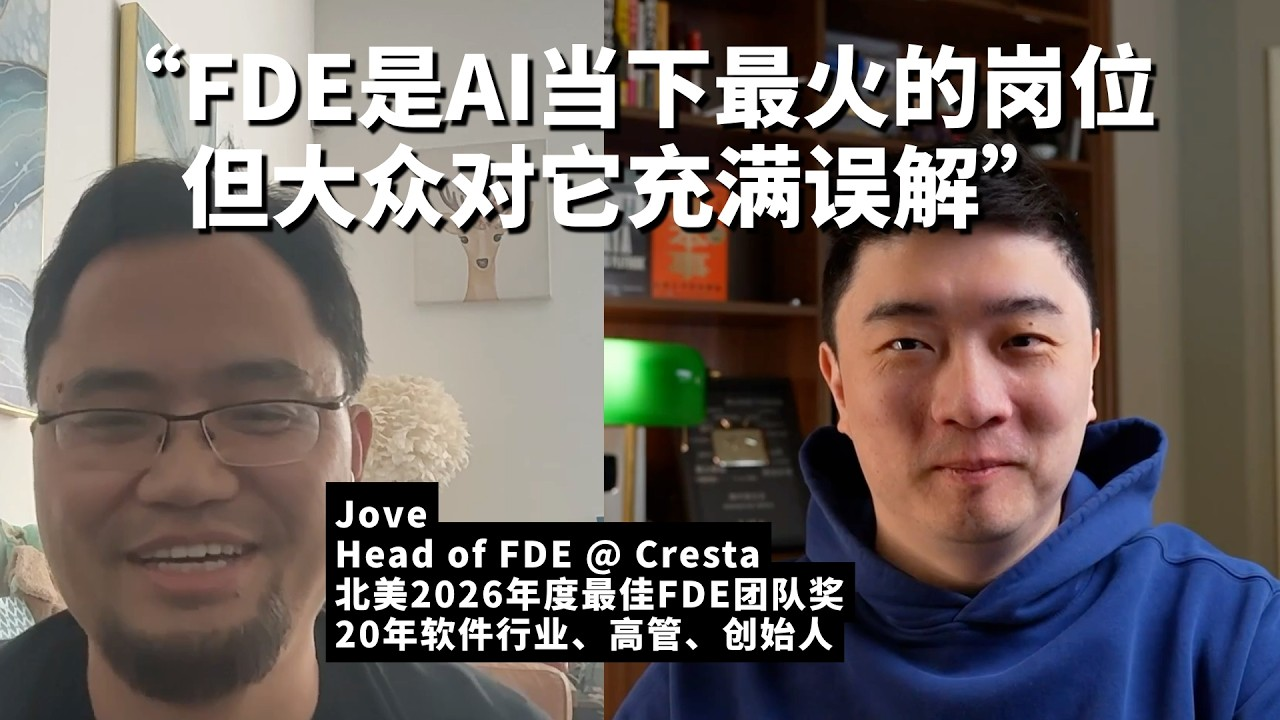
Guest: Jove Zhong (Zhong Qianjie), Head of FDE (Forward Deployed Engineering) at Cresta, leads the Frontline Deployment Team for AI Agents.
Host: Sun Yuzheng (Course Representative Li Zheng), Founder of Superlinear Academy, former Evangelist at Statsig (acquired by OpenAI).
Podcast Source: Li Zheng (Course Representative)
Original Title: His FDE team grew from 30 to 100, so why do engineers at many major tech companies not even know this role exists?
Air Date: July 17, 2026
Key Takeaways
Jove currently leads the FDE team at Cresta, an AI-powered customer service company. Since taking over last year with just a few people, the team has grown to 30, with a target of 100 globally this year. Cresta itself is a nine-year-old enterprise SaaS company serving clients like Marriott and United Airlines, historically focused on optimizing customer experience. With the AI wave, it has naturally transitioned into AI Agent deployment.
The core tension of this conversation lies in this: FDE is being hailed by top AI companies like OpenAI and Anthropic, as well as the VC community, as "the most promising role of the AI era." However, when Jove hosted events in Silicon Valley, he found that engineers from major tech firms like Meta and Google hadn't even heard of the role. Jove's stance is clear: the AI Agent FDE is not a traditional outsourced or on-site engineer; it is a new species. You must understand every pitfall of AI implementation (hallucinations, RAG latency, VAD debugging, model version switching), earn the trust of client CTOs face-to-face, and bring frontline lessons back to the company to improve products. Essentially, it's about hiring a group of "startup CTOs" to drive AI adoption.
Key Insights
The Essence of FDE
"FDE is like hiring a group of startup CTOs. You need to close deals, implement AI, and lock in clients; but at the same time, acting as a CTO means you aren't just constantly asking how to make the product better—you have to revolutionize yourself."
"The FDE of the AI era and the previous FDE are two different things. Earlier FDEs weren't much different from outsourced on-site engineers, but the AI Agent FDE is a new species."
The Last Mile of AI Implementation
"These models aren't hard to get. If you're willing to pay, you can access the best models. But so what? You still might not know how to use them properly."
"An FDE is like a barista. You can buy an expensive La Marzocca coffee machine and high-quality beans, but you still might not brew a great cup of coffee. Clients want an outcome—they want a solid AI Agent experience."
Who Is Suited for FDE?
"If someone has experienced plenty of failures, that's actually a good thing for me. They can share their past lessons learned: when talking too much caused problems, or jumping to conclusions too early."
"You're a great AI engineer? That's pretty much filler now. If any software engineer today isn't already an AI engineer, they're already behind. You must have developed and tested AI Agents."
Why FDE Is Hard to Replace with AI
"In the past, having one skill was enough to survive, but that no longer applies. However, you can take responsibility for results. The closer you are to delivering outcomes, the harder you are to replace, because AI cannot be held accountable for those results—change a prompt, and it says something completely different."
FDE in China vs. North America
"In North America, labor costs are inherently high, there's a strong demand for paying for outcomes, and SaaS is mature, making the FDE model relatively easy to implement for AI Agents. In China, I can only feel a few seconds of sympathy for practitioners."
Part I: When a Role Is Championed by VCs and Top AI Companies, Yet Unknown to Big Tech
Course Representative Li Zheng: How many FDEs do you have under your command now?
Thirty, probably reaching a hundred this year. Over the past seven or eight months at Cresta, I've personally felt that FDE is truly an effective way to drive AI adoption, get customers to pay, and create real-world impact right now.
Course Representative Li Zheng: I'm particularly surprised that both OpenAI and Anthropic are hiring many FDEs, and VCs say it's the most needed role in AI. Yet at events, especially among people from big tech like Meta and Google, they always ask, 'What is an FDE?'
Exactly, the awareness gap is indeed huge. I first got to know FDE during Palantir's growth wave. As the creator of this model, Palantir's business is highly specialized since not every vendor can serve military clients. Ten to fifteen years ago, when we started, many military clients were reluctant to state their needs explicitly. You had to meet face-to-face, go into the same military tent, see the data, before they'd be willing to provide detailed requirements.
So Palantir hired two teams: one focused on front-line on-site software engineers, and another focused on business leaders who understand combat or rescue workflows. One leans technical, the other non-technical. Conventionally speaking, an FDE is still a highly technical role.
Part II: AI Agent FDE Is a New Species—Do Not Confuse It with Traditional On-Site Engineers
Course Representative Li Zheng: First, explain what FDE actually is to those unfamiliar with the term.
FDE stands for Forward Deployed Engineer. Its hallmark is that it remains an engineer, but one deployed forward into projects. But I believe FDE must be viewed through the lens of AI Agents.
If this were a traditional scenario—involving data ETL, data transformation, or network setup—the difference between an FDE and an on-site engineer, consultant, or outsourced developer would be hard to define. But in the context of AI Agents, it's entirely different: many people now want AI Agents. You can get newer model access, use voice models like ElevenLabs or Deepgram, but you may not have the capability to build an AI Agent that fits your specific business scenario.
The role of the FDE is to: integrate your business logic, leverage all features on the AI Agent platform, and build an AI system tailored to your specific needs, complete with guardrails, tests, and evaluations. Clients find it difficult to learn these themselves. They might have an engineering team that knows how to build a website or mobile app, but building an AI Agent is a whole different matter: handling hallucinations, ensuring low-latency and high accuracy for RAG or knowledge bases, involves numerous complex and non-intuitive challenges.
That's why AI companies like ours adopt the FDE model: to have AI experts clearly understand what the platform offers and what the client wants, then build and refine the solution, rather than forcing the client to learn it themselves. Even if they could learn it, it would take six months to a year, by which time competitors would have already moved ahead.
Course Representative Li Zheng: So you're saying AI Agent FDE and previous FDEs are two different things. The old FDEs weren't much different from outsourced on-site engineers, but the AI Agent FDE is a new species—they are highly AI-native and truly understand the various pitfalls encountered when building AI products. Everyone has model access and features, but if you really want to excel, the gap is massive.
Exactly, and we are willing and capable of providing close-knit service to clients. We have a saying: focus on API-level technical dialogue rather than surface-level chatter. You can quickly build relationships with clients and earn the trust of CEOs, CTOs, or API leads. Since we're all engineers, we share a common language, allowing you to quickly grasp what they want and understand our own limitations.
Part III: FDE = Client-Facing CTO, FDPM = Client-Facing CEO
Course Representative Li Zheng: That sounds incredibly demanding. You need deep AI expertise (which is scarce), strong communication skills to earn user trust, and a solid understanding of the client's business.
We're essentially hiring a group of startup CTOs. These individuals know where to focus efforts, where to say no, and how to use AI skills to execute effectively.
But everyone's bandwidth is limited. Partially inspired by Palantir, beyond the FDE team, Cresta also has an FDPM team (Forward Deployed Product Manager). They don't need to be as technical. Just as a company has a CEO and a CTO, the FDPM focuses more on business logic, acceptance criteria, risk management, and timelines.
Often when we meet with clients, they haven't aligned internally on what they actually want, and SOPs differ from person to person. If FDEs attended every meeting, it wouldn't be the best use of their talents. The FDPM handles these non-technical tasks to organize everything. The FDE ensures technical feasibility and robust testing, then brings insights back to the company to improve the product.
You can think of the FDE as a Forward Deployed CTO, and the FDPM as a Forward Deployed CEO. The FDE handles industry best practices for AI, developing SDKs, toolkits, and CLIs. The FDPM manages specific requirements, escalates risks, and even drives upsells—for example, turning three initial use cases into six. Separating these roles prevents the hiring bar from becoming unrealistically high.
Course Representative Li Zheng: It's natural for engineers to transition to FDE. Are there other paths? Do PMs transition to FDPM?
Yes. The baseline for an FDE is an engineer. My interview includes a step where you write a simple Python program without using any AI tools—not LeetCode style, just to prove you know how to code. There's also a round assessing engineering practices: whether you understand concepts like unit testing, end-to-end testing, and layered architecture.
If someone with absolutely no technical background becomes an AI Agent FDE, it might seem to work, but they won't realize which parts are problematic. For instance, building a login page that appears functional but dumps everything on the frontend makes it trivial for users to delete the DOM tree or tamper with sensitive data. Without engineering fundamentals, many things may look like they work but lack best practices.
On top of that, a consulting background at firms like Accenture or McKinsey is great. But be careful not to judge deal sizes using old methods or billing by the hour. We are fundamentally a SaaS company, and the FDE is a forward-deployed product engineer, part of the product engineering division. A major responsibility of the FDE is to validate product-market fit by deploying AI Agents, then iterate on the product itself—updating REST APIs, microservices, UI, CLIs, and documentation. It's not just about successfully executing each deployment, but continuously maturing the product.
Course Representative Li Zheng: So you're not just on-site solving client problems; you also come back to improve your own product.
Exactly. I am part of product engineering. My peers work on microservices and Kubernetes infrastructure; we all report to the VP of Engineering, who reports to the CEO. I know some companies place FDEs under customer success, professional services, or even pre-sales. We didn't do this because our ultimate goal is to build a platform company, hoping our AI Agent platform can enable numerous different use cases.
The ideal state for FDEs is: routine tasks are replaced by automation and platform improvements, while FDEs become increasingly specialized—becoming domain experts in payments, networking, or RAG—and focus solely on progressively harder challenges. This prevents us from evolving into a consulting firm employing hundreds of people for repetitive manual labor.
Part IV: Why AI Implementation Relies Heavily on FDE? Because End Users Want Outcomes, Not Models
Course Representative Li Zheng: I highly value FDE precisely because AI capabilities are now incredibly strong, yet most people lack implementation skills. Many traditional industries desperately need AI but have zero talent for it. Having someone step in to turn uncertainty into certainty makes adoption simple for a restaurant owner. Instead of worrying about whether it will work, an FDE simply says, "Use our platform, and I'll handle everything." Implementation becomes straightforward.
Absolutely correct. Expecting a restaurant owner or their IT team to grasp AI Agent nuances like VAD (Voice Activity Detection)—that it should interject while I'm speaking but not interrupt me; pauses when giving phone numbers or emails shouldn't trigger them to chime in; how to handle background noise—is asking too much. Even VAD alone has multiple approaches: silence-based, LLM-based, or semantic-based. Asking restaurant IT staff to learn this is far too much.
Clients ultimately only care about: whether the brand targets youth or maturity, how to present dishes, and how to reserve tables for VIPs. These are specialized business-level requirements. The FDE rapidly applies best practices, selects the optimal components, and makes them work. Moreover, by working with a dumpling shop today and a Western restaurant tomorrow, the FDE accumulates industry know-how regarding table turnover rates and polite client refusal scripts. Eventually, we might understand the restaurant business better than the restaurants themselves.
Course Representative Li Zheng: Sequoia's analysis noted that the software market isn't actually that large, but the entire labor market is massive. What AI aims to replace is precisely this labor market. For AI to truly displace labor, it requires professionals who understand both AI and business to execute flawlessly.
Part V: What Cresta Does: Bringing AI to the Customer Service Centers of Marriott and United Airlines
Course Representative Li Zheng: Explain how these traditional industries are adopting AI, what your company is doing, and how wide you see the gap.
Cresta was founded in 2017 and has been operating for nine years, consistently focusing on customer experience, primarily centered around call centers. During the era of purely human customer service, onboarding new hires was a massive challenge: agents needed to deliver mandatory disclosures (e.g., "This call may be recorded") and retrieve historical records when calls were transferred. Countless tasks could be augmented by AI, significantly boosting human agent efficiency.
Today, we handle even more: not every case requires a live human response. For example, during Black Friday, companies hire temporary staff but lay them off once the peak passes, leading to high turnover rates. Yet if you lose a credit card and call to request a replacement, that process can be entirely automated by AI.
We have long-standing clients like Marriott and United Airlines who have operated within call center and human agent environments. Introducing them to an AI Agent product acts more like an upsell. They can select low-hanging fruit use cases for the AI Agent to handle.
My team currently has 30 people, potentially growing to 50 or 100 as we hire worldwide. We are currently focused on North America but also recruiting in Europe and APAC. Our goal is to optimize the experience for more calls and chats through AI. Nobody wants to sit on hold listening to music for half an hour, or have a call with two purposes, only to be transferred again and wait another thirty minutes.
Course Representative Li Zheng: What are the top three tracks for AI applications, and how do you view them?
First is coding, where Cursor, Claude Code, and Codex have done immense work. Second is multimedia, generating music, images, and video, backed by heavy spending from major tech companies. Third is enterprise AI, particularly voice AI and AI Agents.
Coding has proven to be a strong market, and FDEs can freely utilize coding tools, but the space is intensely crowded, making it rare for new players to enter. Image and video generation appear viable but require massive capital. Enterprise AI, however, is where over 50% of 100 business owners express desire. If you can use AI to reduce headcount and shorten customer wait times, why not? Furthermore, the technology is nearly ready—just not fully—so you simply need the right personnel and vendors to execute.
Course Representative Li Zheng: But it's hard to imagine a nearby restaurant needing call-center-grade voice AI, right?
Actually, yes. Beyond traditional call centers, we increasingly encounter clients without dedicated call centers but who need an "AI receptionist." When customers or prospects call, manual answering isn't required each time. The AI acts like a front desk operator: What do you need? Shall I schedule an appointment? Who are you trying to reach? I can send a text or summary to the owner.
Whether it's a dentist, café, florist, or even an individual like myself—many people might want to chat with me, but you can let AI filter inquiries first.
Part VI: The Bar for Becoming an FDE: AI Agent Experience Is the Ticket, Startup Failure Experience Is a Plus
Course Representative Li Zheng: Who is suited for FDE? What does your candidate profile look like?
First, we are not hiring juniors currently. An FDE needs at least three years of experience and must already be a strong engineer. Previous experience as a founder, co-founder, or founding engineer is a plus. Consulting or customer-facing background demonstrating proficiency in customer communication and negotiation is also a plus.
The absolute key requirement: you must have built AI Agents. I see stacks of resumes claiming "I'm an AI engineer, I'm proficient with Claude Code and Codex," which is basically filler. At this stage, any engineer who doesn't use Claude Code is as obsolete as someone who doesn't know how to type. Proficiency with coding assistants is meaningless unless you can actually build AI Agents.
To what level should your AI Agent experience go? I refer to a six-tier AI product maturity model: Tier 1 is a prompt wrapper, Tier 2 is grounded AI (knowledge-augmented), Tier 3 is tool-using AI, and Tier 4 is LLM workflow (automated multi-step processes). Tier 4 is roughly sufficient for us. For voice AI customer service, you often need to issue refunds or process returns automatically without asking the customer, "Is this okay? Should I give you a 50% or 30% refund?" Instead, you need to swiftly reference the knowledge base and SOPs, executing low-latency tool calls.
Our interview includes a 90-minute hands-on practical session where you use Claude Code or Cursor to build an agent based on our provided APIs and knowledge base, proving its high quality by designing tests, evaluations, and handling edge cases. This is far more concrete than asking hearsay questions or reviewing toy projects.
Course Representative Li Zheng: Building trust is crucial, yet many struggle with it. What traits distinguish those who successfully win trust?
If a candidate has learned from past failures, that's beneficial to me. They can articulate situations where they spoke too much or jumped to conclusions prematurely, or how they can empathize with a client's motivation, frame proposals effectively, or even guide the client to present solutions themselves, rather than forcefully rejecting or pushing ideas.
Here's a major red flag: if I ask a question during an interview and the candidate delivers a 6-to-10-minute monologue, it severely penalizes them. It shows a lack of communication awareness and poor control over information density. Listing ten points is worse than explaining two or three clearly. Obsessively dumping every thought is not a positive signal for an FDE role.
Course Representative Li Zheng: Truly trustworthy candidates possess two qualities: first, a willingness to listen and think from the other party's perspective; second, low ego. Know what you know, admit what you don't, and focus on getting the job done. If the other party senses you're overly protective of your ego, they won't trust you.
Part VII: Comparing FDEs to Baristas and Sushi Chefs: Anyone Can Buy the Best Ingredients; Making Something Great Is the Real Skill
I view an FDE much like a barista. You can purchase an expensive Italian La Marzocca machine costing thousands, but even after calibrating it, you might not brew excellent coffee. Buying premium beans alone doesn't guarantee the technical skill to execute properly.
Clients want an outcome—a superior AI Agent experience. Just as you'd visit Blue Bottle for a comfortable conversation with friends over a perfect coffee, the FDE uses high-quality raw materials, premium beans, sophisticated machinery, and refined skills. They engage in conversation, read your mood (whether you're feeling down or energetic), craft a custom blend, and ensure the overall experience is excellent.
It's akin to Omakase (chef's choice): you don't need to ask what's available today; you simply trust us to deliver an outstanding experience using the finest techniques and ingredients. In the AI realm, these ingredients—coffee beans or fish—are equivalent to models. Models aren't hard to acquire; money grants access to the best ones. But so what? You might still not know how to properly utilize that model.
Take a simple example: dealing with a complex mapping relationship, do you format it as a Markdown table or a wall of bullet points? Which is more efficient? While saving tokens matters, which approach reduces execution errors? We notice that each ChatGPT update (5.1, 5.2, 5.3, 5.4) behaves differently. FDEs have ample time to master these evolving AI best practices.
At the same time, you develop keen situational awareness and personal rapport with clients. AI inherently relies on probabilities, making perfection elusive. When errors occur, the FDE plays a critical role in swift recovery and relationship preservation, leveraging strong interpersonal charisma and trust.
Course Representative Li Zheng: This personifies trust. It's the difference between nouns and verbs. Nouns are limited and can be learned in ten minutes. But true mastery lies in the verbs—infinite complexity that remains hidden until studied or practiced. Telling one person routes prompts better than another tells you nothing about the profound depth of skill required.
Part VIII: Why FDEs Are Increasingly Valuable: Models Force Continuous Iteration
Another interesting point: I spent many years at IBM and EMC building enterprise software, where the prevailing mindset was: if it isn't broken, don't fix it, especially for on-premise deployments.
Now, with AI Agents, if you stop updating, your model may become obsolete or APIs break. For instance, you might start with version 4.1, but it gets deprecated, forcing an upgrade to 5.x. Whether billed as a 20% maintenance fee, for new use cases, or via fresh Statements of Work, you must continuously engage, applying the best or most appropriate models to steadily improve outcomes. This is not a one-time transaction.
This is actually beneficial for the company, driving adoption of an ARR subscription model. We don't offer any on-premise deployments; SaaS is mandatory. Combined with integrating the best voice engines and models into your SaaS, it naturally sustains ARR. Clients won't constantly ask, "When can you finish setting this up locally so I can ditch you?"—they simply can't walk away.
Course Representative Li Zheng: Furthermore, FDE is a profession resistant to AI displacement. Previously, mastering one skill ensured survival, but that's no longer true. However, you can own the results. The closer you stay to the final outcome, the harder you are to replace, because AI merely shifts wording with a changed prompt—it cannot be held accountable for actual results.
Part IX: FDE in China: Strong Concept, Harsh Reality
There's one more topic worth discussing. We have friends and viewers based domestically. Both Kingdee and numerous other enterprises harbor significant reservations regarding the FDE model.
My view is: where you plant the orange tree matters greatly. In North America, labor costs are inherently high, demand for paying on outcomes is strong, and SaaS is mature. Collectively, these factors make the FDE model highly viable for AI Agents. As for database implementation, data cleaning, or government initiatives, the FDE model struggles with such complex, fragmented engagements.
I feel a brief moment of sympathy for domestic practitioners. China's SaaS landscape faces numerous issues, primarily the absence of a robust enterprise market and thus, paying customers. There genuinely aren't many massive domestic enterprises, or perhaps... while FDE is a relatively mature and effective solution in North America, its applicability in China remains highly debatable.
Join TechFlow official community to stay tuned
Telegram:https://t.me/TechFlowDaily
X (Twitter):https://x.com/TechFlowPost
X (Twitter) EN:https://x.com/BlockFlow_News
 深潮TechFlow