Global AI Unicorn Landscape: 30 $10 Billion Companies, Chinese Firms Break Into the Top 10
Author: Tencent Tech, Xiao Jing
On November 15, Deedy Das (@deedydas), a partner at veteran Silicon Valley venture capital firm Menlo Ventures, shared a global ranking of AI company valuations and revenues on social media.
Founded in 1976, Menlo Ventures is one of the oldest venture capital firms in Silicon Valley, having invested in well-known tech companies such as Uber and Chime. In recent years, the firm has focused on AI as a key investment area and released the widely circulated "State of Generative AI in the Enterprise" report at the end of 2024. Menlo Ventures was also an early investor in Anthropic, participating in its Series C financing round in 2023, and co-establishing the $100 million AI investment fund, Anthology Fund, with Anthropic in 2024.
This list tallies globally unlisted AI companies with valuations exceeding $10 billion and publicly disclosed annualized revenues of over $100 million as of November 14. Thirty companies meet both criteria.
The gap between the top "duopoly" continues to widen significantly. OpenAI remains in the lead with a valuation of approximately $1.25 trillion, while Anthropic closely follows at around $96.5 billion. The two have already created a trillion-dollar valuation chasm compared to their competitors.
However, if ranked by annualized revenue, their positions have flipped: Anthropic has surpassed OpenAI. While they remain far ahead in valuation, the competition in revenue is seeing new shifts.
Among Chinese companies, DeepSeek and Moonshot have entered the global top ten. DeepSeek ranks fifth with a $89 billion valuation, while Moonshot ranks seventh at $50 billion. According to the list's disclosed data, both companies have reached annualized revenues of approximately $1 billion.
Nevertheless, looking at the overall list, the United States still holds an absolute advantage. Of the 30 companies, 23 are based in the US, covering multiple sectors including foundational models, AI programming, and cloud computing services. Two Chinese companies made the list, while the remaining five hail from Canada, France, Germany, and the UK respectively.
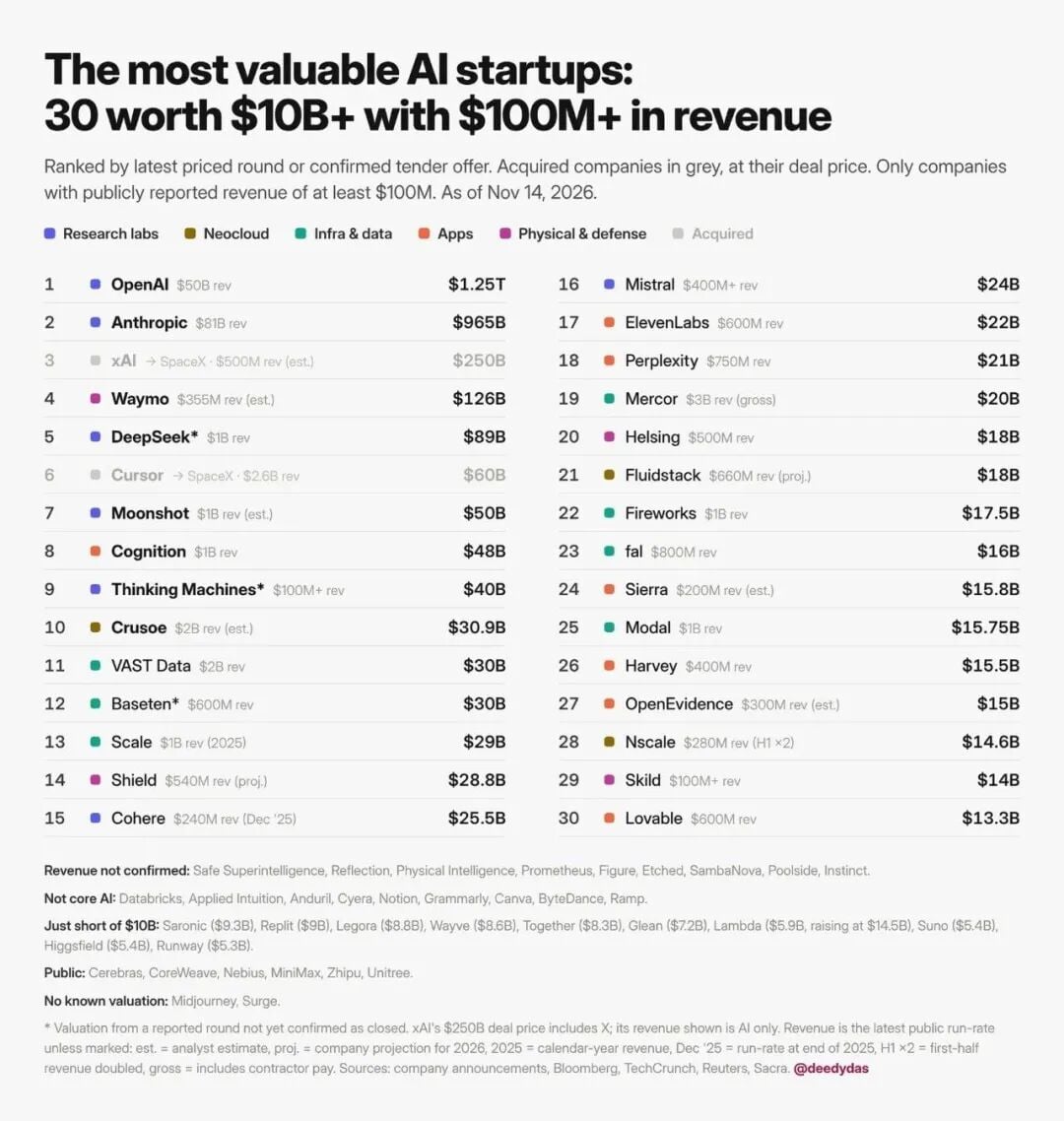
Image: Global Ranking of Unlisted AI Companies with Valuations Over $10 Billion
Widening Lead by the "Duopoly"
If we go back a year, OpenAI was still "far ahead."
By the end of 2025, OpenAI's annualized revenue had already reached approximately $20 billion, while Anthropic stood at $9 billion. At that time, there was still a revenue gap of more than double between the two companies.
However, entering 2026, Anthropic's growth rate began to clearly surpass OpenAI's. As of the end of September this year, OpenAI's annualized revenue was approximately $50 billion; by the end of October, Anthropic's annualized revenue had reached $65 billion, overtaking OpenAI.
In terms of actual revenue, this shift is equally evident. In Q3 this year, Anthropic generated roughly $17 billion in revenue, while OpenAI brought in about $10 billion. Although there are still discrepancies in how the two calculate cloud platform revenue—for instance, whether Anthropic includes hosted revenue portions on Amazon Bedrock and Google Cloud—its rapid penetration into the enterprise market is directly reflected in its revenue growth curve.
The leading positions of both companies remain solid. The top-tier competition in the global foundational model market has now entered the trillion-dollar valuation stage.
More noteworthy is that Anthropic is leveraging this growth momentum to race toward an IPO. On November 10, Anthropic announced an IPO price range of $70 to $78 per share, expecting to list on Nasdaq on November 19 under the ticker symbol "ANT." Based on the upper end of the price range, its fully diluted valuation would reach $96.5 billion, making it one of the largest technology IPOs globally this year.
OpenAI's approach differs. Previously, OpenAI stated it would not go public in 2026, pushing its IPO plans to 2027. On November 6, OpenAI completed its first tranche of approximately $11 billion in a new funding round, bringing its post-money valuation to $1.25 trillion. The round was led by SoftBank, with participation from Microsoft, Coatue, and Thrive Capital. This capital not only set a record for a single funding round for a global startup but also temporarily alleviated financial pressure on OpenAI's compute expenses.
A year ago, OpenAI held clear advantages in the model market, user base, and commercial revenue. Today, Anthropic has already taken the lead in overtaking in revenue growth and is preparing to jump the queue for its IPO.
Chinese Companies Break Through
Chinese AI companies have also successfully entered this global ranking of high-valuation AI firms.
DeepSeek ranks fifth with a $89 billion valuation and approximately $1 billion in revenue; Moonshot ranks seventh with a $50 billion valuation and similarly around $1 billion in revenue. Both companies make the top ten and are the only two Chinese enterprises on the list.
Although both DeepSeek and Moonshot boast annualized revenues of roughly $1 billion, their corresponding dynamic P/E ratios based on valuations differ at 89x and 50x, respectively. This indicates that the market's pricing for these two companies depends not solely on current income, but also comprehensively factors in their technological roadmaps, commercialization strategies, and future profitability potential.
Besides US and Chinese companies, Canada's Cohere is valued at $25.5 billion with annualized revenue of about $240 million; France's Mistral carries a $24 billion valuation with annualized revenue exceeding $400 million.
German defense AI company Helsing ranks 20th with an $18 billion valuation and roughly $500 million in annualized revenue; UK compute infrastructure provider Nscale sits at 28th with a $14.6 billion valuation and approximately $280 million in annualized revenue.
Super M&A Activity Kicks Off
Two companies highlighted in gray on the list stand out particularly: xAI and Cursor.
The two companies carry transaction valuations of $250 billion and $60 billion respectively, both noted as being integrated into the SpaceX ecosystem. Specifically, xAI's $250 billion valuation includes the value of the social platform X, but the $500 million revenue listed on the chart does not include ad revenue from X. For xAI, joining SpaceX means it can leverage the latter's extensive satellite internet and energy infrastructure to build a larger-scale data center cluster.
Another acquired company, Cursor, is a rapidly growing AI coding tool developer in recent years. Its transaction valuation reaches $60 billion, with revenue of approximately $2.6 billion. According to the list, Cursor's revenue scale already surpasses many compute service providers and vertical application companies. Leveraging the extremely high penetration of AI coding among developers, it quickly converts users into frequent paying customers.
These two transactions involve foundational models and AI application products respectively, indicating that top-tier enterprises are expanding their business boundaries through capital integration. The connections between model R&D, application products, and commercialization channels are strengthening, and competition in the AI industry is beginning to evolve from single technological advantages to ecological scale.
Thriving Compute and Data Infrastructure
While foundational model companies occupy the top spots on the valuation list, another batch of noteworthy firms provides compute, data, and inference services for the entire AI industry. As demand for model training and application deployment grows, these companies have been the first to establish viable commercial cycles.
Companies Directly Providing Compute Support
Crusoe primarily engages in AI data center construction and cloud computing services, holding a $30.9 billion valuation and approximately $2 billion in revenue. Fluidstack provides computational power to AI companies through GPU resources and cloud services, valued at $18 billion with similarly around $2 billion in revenue. CoreWeave ranks 14th with a $23 billion valuation and annualized revenue reaching $3.2 billion.
The business models of these companies resemble those of traditional cloud vendors, but they build infrastructure specifically around AI training and inference needs, requiring continuous heavy investment in purchasing GPUs, constructing data centers, and securing long-term client contracts.
Data Infrastructure Service Providers
VAST Data is valued at $30 billion with roughly $2 billion in revenue, primarily providing large-scale data storage and management services for enterprises. Scale AI, valued at $29 billion, generated approximately $1 billion in revenue in 2025, specializing in AI data labeling, model evaluation, and high-quality synthetic data generation.
As AI models continue to evolve toward complex reasoning, multimodality, and agents, the quality of training data, processing efficiency, and the importance of model evaluation are rising. Cutting in from data storage and data processing respectively, VAST Data and Scale AI have become indispensable service providers for large model training and enterprise implementation.
Rapidly Growing Model Inference Service Platforms
Baseten is valued at $30 billion with revenue of approximately $600 million; Fireworks AI carries a $17.5 billion valuation and about $1 billion in revenue; Modal has a $15.75 billion valuation with roughly $1 billion in revenue; Together AI is valued at $15 billion with about $840 million in revenue; fal holds a $14 billion valuation with approximately $1 billion in revenue.
These companies mainly assist developers and enterprises in deploying and running AI models, reducing inference costs, and improving operational efficiency. Among them, fal focuses particularly on inference services for generative AI models such as images and videos.
Compared to large model companies, these infrastructure firms can simultaneously serve multiple model and application providers while supporting diverse technical roadmaps. As more AI applications enter actual operational stages, model invocation volumes, compute consumption, and data processing demands continue to expand, allowing infrastructure companies to rapidly scale their revenues.
However, this does not necessarily mean infrastructure represents a more stable business. Compute providers face hefty capital expenditures, while inference service platforms must contend with continuously declining model invocation prices and competition from major cloud vendors. Whether demand growth can ultimately translate into healthy profit margins remains a question these companies must answer.
Intensifying Divergence in the Application Layer
Compared to foundational models and compute infrastructure, the AI application layer presents a different competitive landscape: although company valuations are generally lower than those of top model enterprises, the revenue growth and valuation multiples of some application companies are already quite remarkable.
High-Frequency Scenarios Achieve Scale First
Among these, the first to achieve scale are high-frequency applications such as AI coding, voice, and search.
Cognition, leveraging the AI coding agent Devin, holds a $48 billion valuation with annualized revenue of roughly $1 billion; ElevenLabs secures a $22 billion valuation for its voice generation and voice agent business, generating about $330 million in revenue; AI search engine Perplexity is valued at $18 billion with revenue of approximately $200 million.
lovable, founded in 2024, focuses on enabling ordinary people without programming experience to develop software through natural language. Its valuation has reached $13.3 billion, with annualized revenue of approximately $600 million.
Vertical Professional Fields Build Deep Moats
Perhaps the most noteworthy changes are occurring in vertical industries such as legal, healthcare, and enterprise services.
Legal AI company Harvey is valued at $15.5 billion, with annualized revenue exceeding $400 million. It has penetrated 80% of the top 100 law firms in the US, assisting lawyers with professional tasks such as contract review, legal research, and due diligence.
Enterprise customer service agent company Sierra has reached a $15.8 billion valuation. Its business model is also highly representative: customers pay based on the problems actually resolved by the AI, such as successfully handling a post-sale inquiry, rather than simply paying for software licenses.
Healthcare AI platform OpenEvidence offers free clinical research and medical information retrieval services to certified doctors, generating revenue through ads targeted at the pharmaceutical industry. According to estimates by Sacra, its annualized revenue has reached $130 million, with a valuation of approximately $10.5 billion.
The common thread among these companies is that they are beginning to take over workflow steps originally handled by professionals like lawyers, doctors, and customer service reps. Compared to simply offering an AI chatbot, they need to understand industry regulations, integrate with existing enterprise systems, and even redesign business processes. This gives them not only a clear willingness to pay from clients but also makes it easier to build competitive moats within vertical scenarios.
This also makes the valuation logic of the application layer more fascinating. Simple calculations based on the list show that the valuations of some vertical AI application companies reach dozens of times their annualized revenue, sometimes even exceeding that of many compute infrastructure firms. Investors are increasingly looking beyond mere software sales volume to assess the long-term space available for replacing traditional human services within specific industries.
This trend is mirrored in other studies. On November 11, investment firm Leonis Capital released its "2026 AI 100" report, showing that the number of vertical industry AI companies on the list increased from 28 last year to 43, and the focus of enterprise AI services is accelerating its shift from general-purpose tools toward vertical sector penetration.
The AI application market is accelerating its divergence. As foundational model capabilities continuously improve, the functional advantages of general AI applications are becoming increasingly easy to replicate, making it difficult for products merely wrapped in model capabilities to sustain high valuations over the long term.
In contrast, the capital markets are beginning to favor companies deeply rooted in vertical industries, possessing unique data and professional barriers to entry. These firms typically require long-term accumulation of industry expertise, client trust, and business workflows; once they penetrate core operations, switching costs for clients become significantly higher.
Amidst the nightmare of models consuming everything, the opportunity for AI startups may very well lie in the application layer.
Join TechFlow official community to stay tuned
Telegram:https://t.me/TechFlowDaily
X (Twitter):https://x.com/TechFlowPost
X (Twitter) EN:https://x.com/BlockFlow_News