Crypto exchanges no longer need cryptocurrency
By: Xiao Bing
A wave of sharp declines has sent cryptocurrency investors back into a deep bear market.
Many still cling to a persistent notion: once Bitcoin breaks key support and altcoins go extinct, major exchanges like Binance will lose their livelihood and inevitably be forced to step in to pump prices and save the market.
This may be an illusion rapidly going bankrupt.
The crypto industry is undergoing an extremely covert crisis. The threat no longer comes from external regulation or hacking attacks, but from the very core of power within the industry itself: crypto exchanges.
As altcoins endure a long winter of liquidity drought, trading platforms are surrendering their prime shelf positions to Nvidia, Tesla, and the S&P 500 index to protect fee revenue.
Crypto exchanges are personally executing a commercial migration toward "de-cryptoization."
On-Chain Leader Changes Heart First: One-Third of Hyperliquid's Realm Now Belongs to "US Stocks"
To track the shift in exchange business focus, decentralized perpetual contract leader Hyperliquid is the first template to validate the model.
A year ago, Hyperliquid was purely a cryptocurrency casino.
The turning point arrived after the HIP-3 protocol upgrade, when the platform allowed third-party deployers to launch perpetual contracts for individual stocks, indices, commodities, and forex, enabling these traditional assets to share a single USDC margin account with Bitcoin contracts.
Traders voted with real capital.
Datawallet and on-chain statistics show that by the end of Q3 2026, Hyperliquid's 30-day trailing perpetual volume reached $216.9 billion, while cumulative turnover for stock, commodity, and index markets operated by external builders surpassed $548 billion, stabilizing at roughly 30% of total volume.
During July 2026's trading peak, non-crypto asset transaction share briefly surged past 51%, directly overtaking crypto assets themselves.
The shift in position structure tells the same story.
In Hyperliquid's open interest, the proportion of Real World Assets (RWA) skyrocketed from 6% at the start of the year to 24%.
Within stocks and commodities individually, single-stock perpetual contracts accounted for 67% of trading volume. US tech giants like Nvidia (NVDA) became the most actively traded targets by on-chain capital, and the platform even launched round-the-clock pre-market contracts for unlisted private companies such as SpaceX and Anthropic.
The "US Stock Revolution" of Centralized Giants
After on-chain protocols proved the business model, centralized exchanges (CEX) followed much faster than anyone anticipated.
According to a statistical report published by CryptoQuant, from late February to late October 2026, tokenized stock trading volume across 16 mainstream global exchanges experienced explosive growth.
Binance alone recorded approximately $67.6 billion in tokenized stock turnover during this period, capturing nearly 60% of daily market share, with single-day peaks touching $12.1 billion.
Zooming in on the week just passed, this structural reversal becomes even more startling.
Data compiled by crypto KOL Bidao for the five standard US equity trading days from November 9 to 13 (excluding weekend closures) reveals Binance's total contract turnover reached $335.83 billion, exposing a drastic internal shift:
- BTC & ETH Primary Contracts: $135.27 billion traded, accounting for 40.28%.
- TradFi US Stocks & Commodities Section (237 contracts): $130.18 billion traded, a staggering 38.77%, averaging $2.604 billion daily.
- All remaining 561 crypto altcoins (encompassing SOL, XRP, PEPE, and all other mainstream & speculative tokens): Combined only $70.37 billion, dropping to 20.95%.
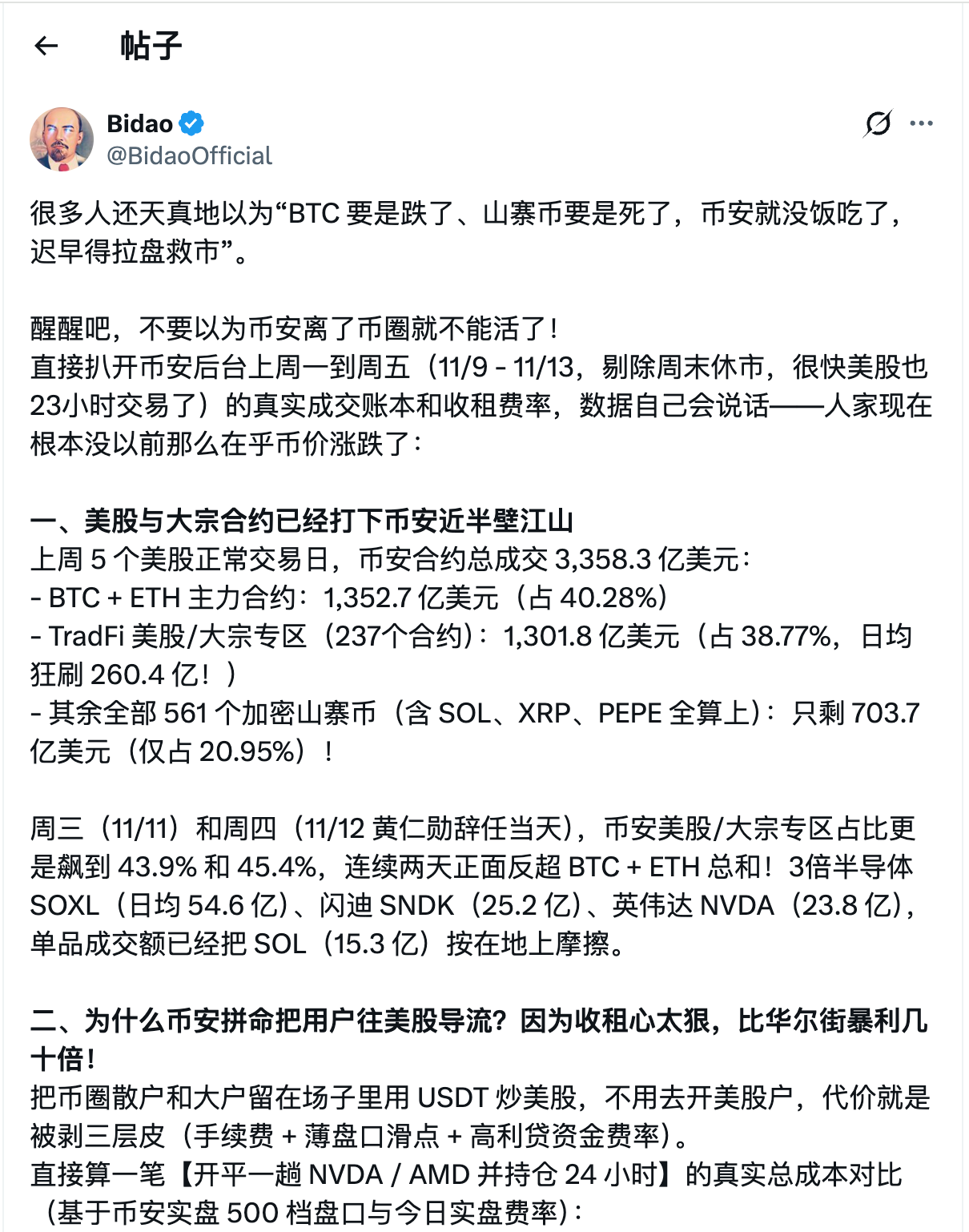
The combined turnover of those 561 altcoins is merely a fraction of the TradFi US Stocks & Commodities section.
On Wednesday (November 11) and Thursday (November 12), Binance's US Stocks & Commodities section share soared to 43.9% and 45.4% respectively, surpassing the combined total of BTC and ETH—the two bedrock crypto assets—for two consecutive days.
At the individual asset level, the 3x Leveraged Semiconductor ETF (SOXL) averaged $5.46 billion in daily turnover on Binance, SanDisk (SNDK) reached $2.52 billion, and Nvidia (NVDA) hit $2.38 billion.
The daily liquidity of these traditional US equity targets has left public chain leader SOL, with a $1.53 billion average daily volume, far behind.
Major exchanges like OKX and Bybit are also frantically expanding their US stock offerings.
In July 2026, OKX unified its tokenized stock order book, launching spot and futures contracts for over 40 US stocks simultaneously. Bybit leveraged its TradFi & Gold/FX section to establish a 24/7 channel allowing direct trading of US equities, the Nasdaq 100 index, and spot gold using USDT margin.
They have locked numerous high-frequency contract heavyweights, who previously only traded altcoins, into traditional asset order books.
Tokenized US stocks, once treated as mere decorative accents at the fringe of a bull market, have become fixed entry points on exchange homepages.
The Twilight of Altcoins
From a trader's perspective, this transformation is reshaping capital flows across the entire market.
In trading rooms across Shenzhen or Singapore, quant teams and hot money that once monitored screens waiting for a specific public chain ecosystem to ignite are now running Bitcoin and Nvidia K-line charts side-by-side in their trading terminals.
Within a single margin account, capital can chase rising US tech stocks at 2 AM, then switch back to Bitcoin for swing trades at 8 AM, requiring no withdrawal and bypassing the lengthy fiat bank clearing cycles entirely.
When the core trading channels tilt all R&D resources, liquidity incentives, and traffic entry points toward US stocks, gold, and crude oil, severe structural divergence is unfolding within the cryptocurrency sector.
Bitcoin, backed by spot ETFs and institutional reserves, remains the stable cornerstone of the crypto world; Ethereum and Solana retain their footing thanks to their infrastructure attributes.
But the vast majority of altcoins ranked outside the top 20 are losing the last stronghold they relied on for survival.
Over the past decade, an implicit symbiotic relationship existed between crypto exchanges and altcoin projects: exchanges needed altcoins to generate high volatility and get-rich-quick legends to attract retail leverage, while projects required exchange liquidity for distribution and exits.
Whenever markets slumped, all parties expected exchanges to revive trends through new listings, market-making incentives, or even active price defense.
Today, that symbiotic logic has completely collapsed.
Countless high-valuation, low-float altcoins hit their peak upon listing, exhausting retail capital and trust. Market makers refuse to provide depth, leaving volume stagnant.
For exchanges, hosting hundreds of unwatched altcoins yields negligible fees while constantly posing risks of project founder absconding, front-running exposures, and community backlash triggering compliance and PR crises.
Conversely, Nvidia, Tesla, semiconductor ETFs, and gold come with global-level earnings and macro event drivers. Their volatility is genuine and intense, never lacking long-short speculators, and carries zero risk of founders absconding with funds.
When exchanges realize that keeping existing USDT within their own systems to trade US stocks generates stable cash flow multiples higher than altcoins, completely unconstrained by crypto bull/bear cycles,the fate of those 560 altcoins has been pushed to the absolute bottom of the platform's commercial priorities.
Abandon your illusions.
Join TechFlow official community to stay tuned
Telegram:https://t.me/TechFlowDaily
X (Twitter):https://x.com/TechFlowPost
X (Twitter) EN:https://x.com/BlockFlow_News
 深潮TechFlow