
Year-to-date, Bitcoin's -22% return ranks at the bottom among various asset classes.
Author: Kuli, TechFlow
TechFlow Summary:
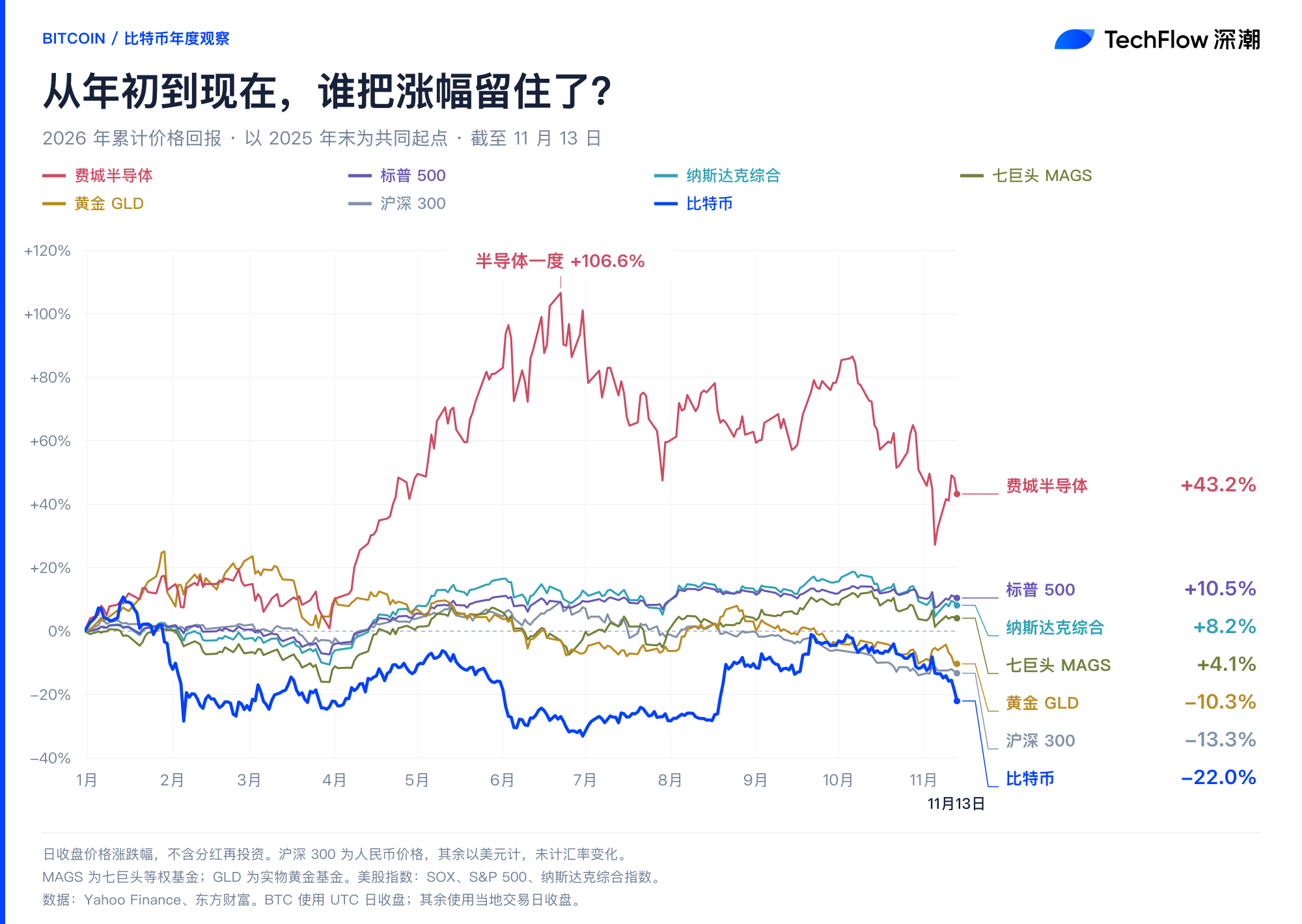
In the 2026 broad-asset return ranking as of November 13, the most striking gap is not between US stocks and A-shares, but between semiconductors and Bitcoin. After surging to a peak of 106% mid-year, the Philadelphia Semiconductor Index experienced a sharp pullback but still retained a cumulative gain of 43.2%; the S&P 500 and Nasdaq Composite also firmly maintained positive returns of 8% to 10%.
Bitcoin, the asset most heavily relied upon, briefly returned to breakeven in September before diving again, finishing at -22.0% and ranking last among major assets across the market. This means Bitcoin failed to act as an amplifier for the tech rally; instead, in a volatile market lacking sustained incremental capital, it became the liquidity ATM that investors rushed to sell first.
If you held onto Bitcoin through mid-November and then glanced at this year's broad-asset return curves, your mood would likely be far from calm.
The most dramatic scene in the entire market so far this year is fully captured in the chart below:
Leading the pack, the Philadelphia Semiconductor Index once soared 106.6% mid-year, followed by a ruthless cut in half, but even with such a drop, it still showed a 43.2% gain on paper as of November 13.
And what about Bitcoin? Instead of catching this wave of liquidity, it struggled underwater for most of the year.
Broke below water in February, dragged along the bottom mid-year, barely crawled back to near zero in September and October, and was just about to break the stagnation when November brought another cliff-like plunge. The cumulative loss widened directly to -22.0%, placing it dead last among all major assets.
Even the widely ridiculed weak performance of the CSI 300 (-13.3%) and the recently corrected Gold ETF (GLD) (-10.3%) sit ahead of it.
Many coin holders' plan at the start of the year was: US stocks up, AI up, so crypto, as a high-beta asset, should deliver even more exaggerated multiples. But reality delivered an extremely ironic result, high volatility was indeed realized, but only for the downside part.
Semiconductor Pullbacks Are Valuation Digestion, While Bitcoin's Drop Is Losing Bids
Facing the same rollercoaster ride, why did semiconductors manage to keep their gains while Bitcoin spit them all back out?
The core difference lies in whether there is genuine capital backing the buys.
The Philadelphia Semiconductor Index this year followed a typical pattern of industrial windfall profits and sentiment-driven trading. In H1, global tech giants frantically scooped up computing power, with hardware supply chain orders booked well into the following year, driving valuations sky-high; in H2, the market began doubting the monetization speed of large models, leading to a coordinated stampede of profit-taking that wiped out over 60 percentage points. Yet even with such a terrifying drawdown, it remains underpinned by tens to hundreds of billions in capital expenditures from major tech giants. As long as orders continue to ship, it has a fundamental earnings floor that cannot be breached.
What Bitcoin lacks precisely is this fundamental floor.
From 2024 to 2025, with the launch of spot ETFs, Wall Street's old money basically swept up all the strategic base positions they were supposed to allocate. Entering 2026, the macro tailwind of flood-level liquidity injection hasn't arrived, and the crypto sector itself lacks new narratives capable of breaking out and locking in holdings, causing ETF net inflows to gradually shift from a raging river to a seasonal trickle.
Once there is no continuous stream of new buying in the market, high beta turns into a slow bleed. In favorable conditions, it acts as an accelerator for funds chasing bubbles; but in limited-market competition, it becomes a position everyone wants to offload at higher prices. That rebound in September may have looked fierce, but without attracting fresh outside capital, any minor disturbance—exacerbated by various CEX hacks and negative headlines surrounding quantum computing—would quickly send it crashing back to reality.
Neither a Safe-Haven Asset nor a Tech Proxy
More awkward than ranking last in declines is how Bitcoin's positioning in asset allocation is losing focus.
In recent years, the crypto circle loved slapping two labels on Bitcoin: one is digital gold, used for inflation hedging and safe-haven status; the other is a high-volatility tech stock proxy, used to capture the premium from macro liquidity.
But look at this year's charts, and those two labels have been completely torn apart.
As tech giants drove the Nasdaq and S&P 500 steadily upward through volatility, Bitcoin not only failed to keep pace with the Nasdaq's 8.2% and S&P's 10.5% solid gains, but actually traded sideways while tech stocks celebrated. If you claim it's a tech proxy, all the real tech capital went straight into buying NVIDIA and wafer fabs, with absolutely none spilling over to the blockchain.
You call it digital gold, but when global assets collectively contracted in November due to shifting macro expectations and gold saw a sharp synchronized drop, Bitcoin fell faster and harder than anything else.
To put it bluntly, after Wall Street accepted Bitcoin, its actual assigned role is not a safe haven, but rather a highly liquid, 24-hour open, instantly cashable tool for portfolio liquidation.
When institutions face margin calls in other markets or need to lock in year-end profits, the easiest asset to sell on weekends and during off-hours is precisely Bitcoin.
I mean, crypto has certainly gained institutional acceptance; but the result of being served by old money isn't sitting down to share the cake, but rather frequently being picked first to foot the bill.
Join TechFlow official community to stay tuned
Telegram:https://t.me/TechFlowDaily
X (Twitter):https://x.com/TechFlowPost
X (Twitter) EN:https://x.com/BlockFlow_News
 深潮TechFlow