The Day NVIDIA Lost Its CEO: The Shadow War Between Semiconductor Capital Expenditures and Crypto Liquidity
Author: Alea Research
Compiled by: TechFlow
TechFlow Briefing: The sudden resignation of NVIDIA CEO Jensen Huang has shaken the global tech industry, yet the Philadelphia Semiconductor Index declined only slightly by 0.54% the next day as market funds rapidly flowed into competitors like Broadcom and AMD amid the panic.
Meanwhile, with U.S. October inflation data remaining stubbornly high, traders on prediction markets have pushed the probability of a Federal Reserve rate hike in December to the highs, and Bitcoin fell below institutional average cost basis during deleveraging.
Alea Research has deeply dissected the chain stretching from cloud service providers' excessive capital expenditure and semiconductor supply chain rebalancing to the contraction of crypto asset liquidity, revealing the real money game behind macroeconomic turbulence.
Key Takeaways
After losing its leader, the chip index held firm for only one day before experiencing volatility. On November 12, shares of competitors AMD and Broadcom rose, while Micron and Arm fell less than 2%. However, on the following day, November 13, a pullback in AMD wiped out all of the previous day's gains.
In the crypto market, Bitcoin's drop on November 12 was approximately twice that of Ethereum. Leverage funds accelerated their exit from Bitcoin futures on Friday, with the closing price trading 9.47% below Strategy's average holding cost.
Following the release of October Producer Price Index data, a December rate hike became nearly a consensus among traders. Traders on Polymarket placed the probability of rates remaining unchanged in December at just 2.35% at Friday's close. Despite a slight moderation in inflation data, Bitcoin's rebound fizzled out within just an hour.
As real yields and the U.S. dollar climbed, gold hit a one-year low, while crude oil prices staged a rebound. January Brent crude accumulated a 3.94% gain across November 12 and 13, with market concerns over geopolitical tensions driving energy volatility.
Beyond the imminent official listing of Anthropic, the crypto derivatives market assigned a valuation far exceeding its IPO pricing range, with contract trading prices reflecting a 37.6% premium over the midpoint of the IPO pricing range.
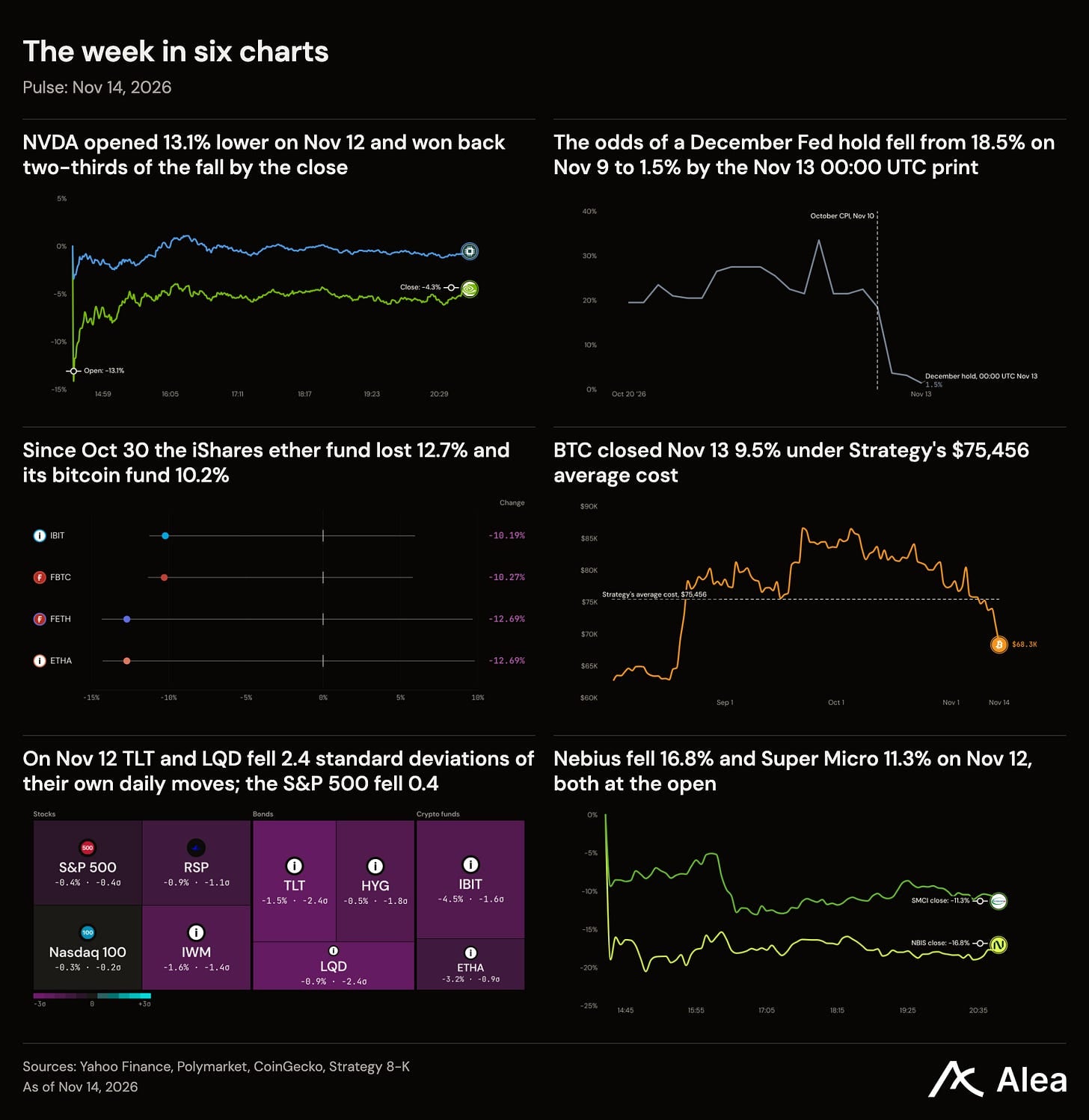
Chart: Cross-market multi-asset volatility comparison
NVIDIA Loses Its Leader in Three Days
From the board launching an investigation to appointing an interim CEO, NVIDIA took merely three days. On the evening of November 8, the board stated that independent directors would collaborate with external legal counsel to review reports regarding Jensen Huang being targeted by foreign intelligence activities. The board found no signs of national security breaches or leaks of NVIDIA secrets. Subsequently, Huang admitted to the company a breach of loyalty to his wife.
On November 9, a shareholder filed a lawsuit against NVIDIA and Huang, sending the stock down 4.27% that day.
On November 11, the board accepted Huang's resignation, appointed Chief Financial Officer Colette Kress as interim CEO, and named director Harvey C. Jones as Chairman.
For customers purchasing NVIDIA chips, the board promised business as usual: Jones stated that daily operations, customer commitments, and the product roadmap will proceed without disruption.
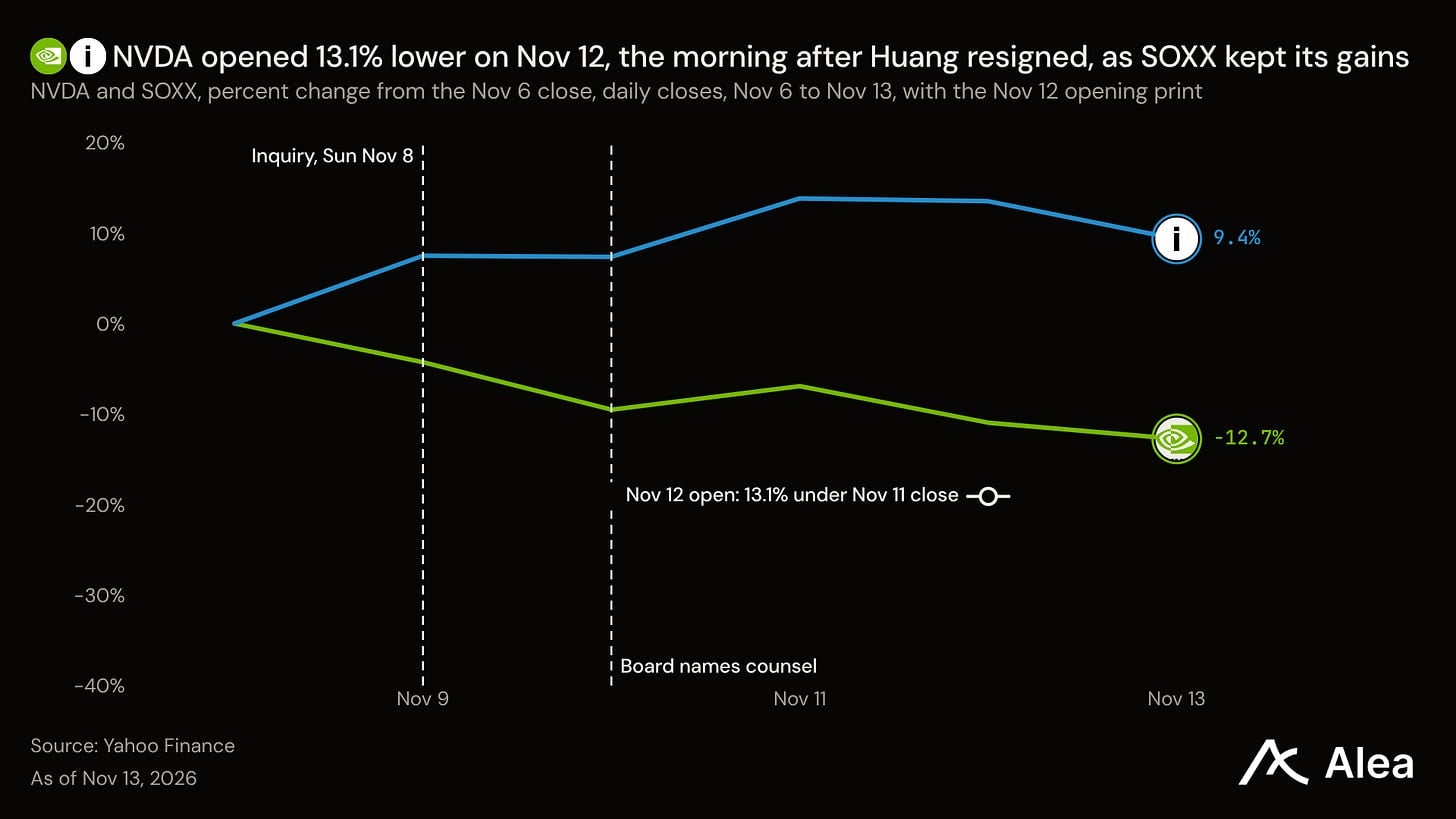
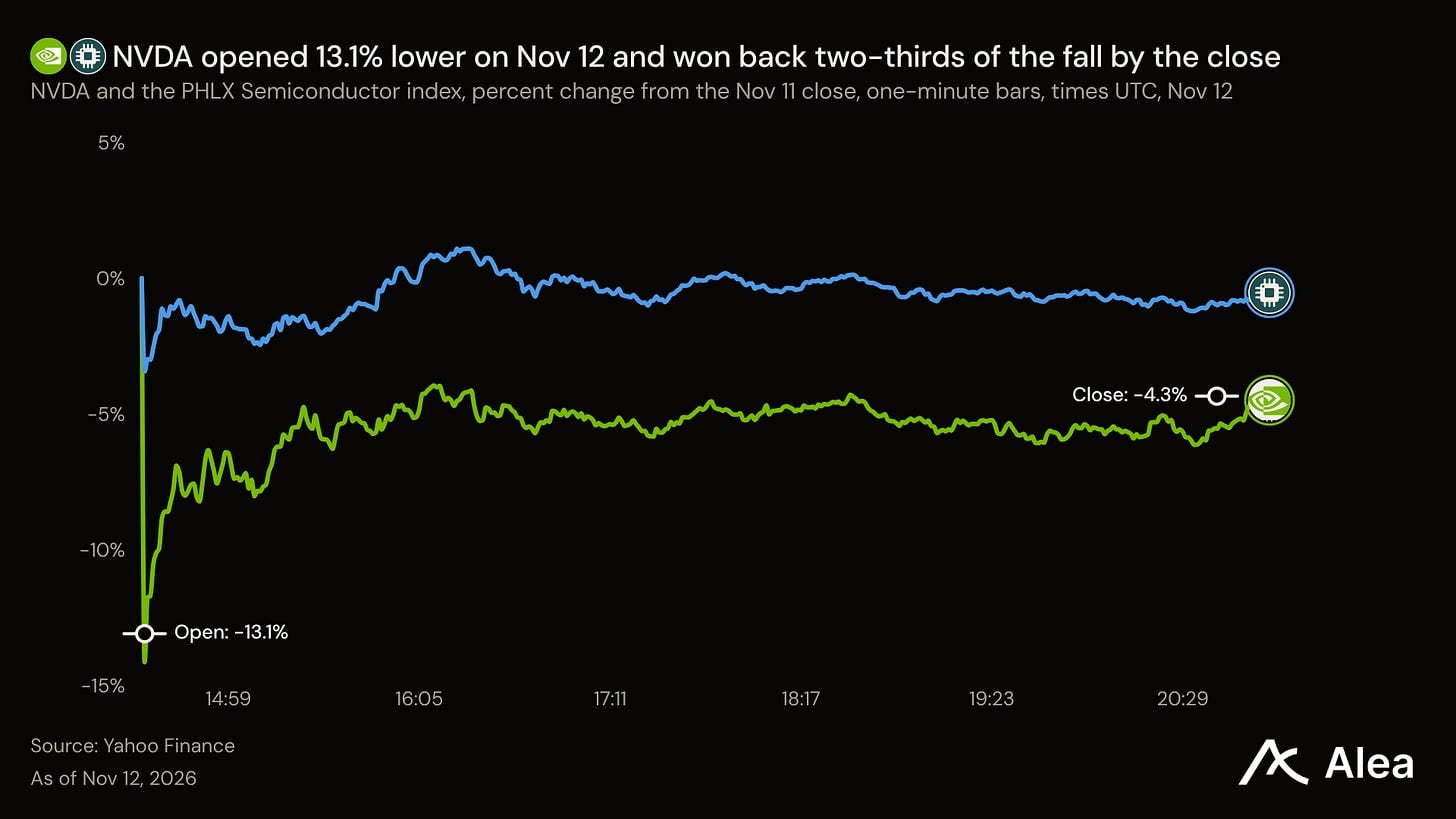
Chart: Comparative trend of NVIDIA and semiconductor indices
The chip index trended relatively flat on November 12, with peers' gains offsetting NVIDIA's decline. Given the index's strong 5.66% jump on November 11, it dipped only marginally by 0.54% on the 12th, compared to a 0.35% drop in the S&P 500 over the same period.
Although Micron produces memory for NVIDIA's compute acceleration cards, both it and Arm fell less than 2% that day. Competitor AMD rose 5.86%, while networking chip giants Broadcom and Arista both gained more than 5%.
However, Super Micro Computer and compute leasing firms faced a double blow at the open. Server manufacturer Super Micro Computer plunged 11.30% on November 12. Before the opening bell, compute leasing firm Nebius lowered its 2026 revenue guidance to the lower end of its range, primarily due to compute deployment being pushed back to 2027.
Nebius closed down 16.84%, while peer CoreWeave fell 6.86%.
By November 13, chip stocks erased most of the previous day's rebound. The chip index fell overall by 3.43%, AMD plummeted 8.75%, and NVIDIA dropped 2.01%, with the broader chip sector facing clear pressure.
Macro Perspective: CPI Data Compels Traders to Price In December Rate Hike Expectations
Following the October CPI release, traders viewed a December rate hike as nearly inevitable. On November 10, core CPI rose 0.3% month-over-month, hitting the threshold Fed Governor Waller had set earlier that day to consider a 50-basis-point rate hike. Dallas Fed President Logan stated that the committee needs at least two more rate hikes of 25 basis points each.
Polymarket's December contracts showed an 18.5% probability of rates staying unchanged prior to the CPI release, which plummeted to below 2% just two days later.
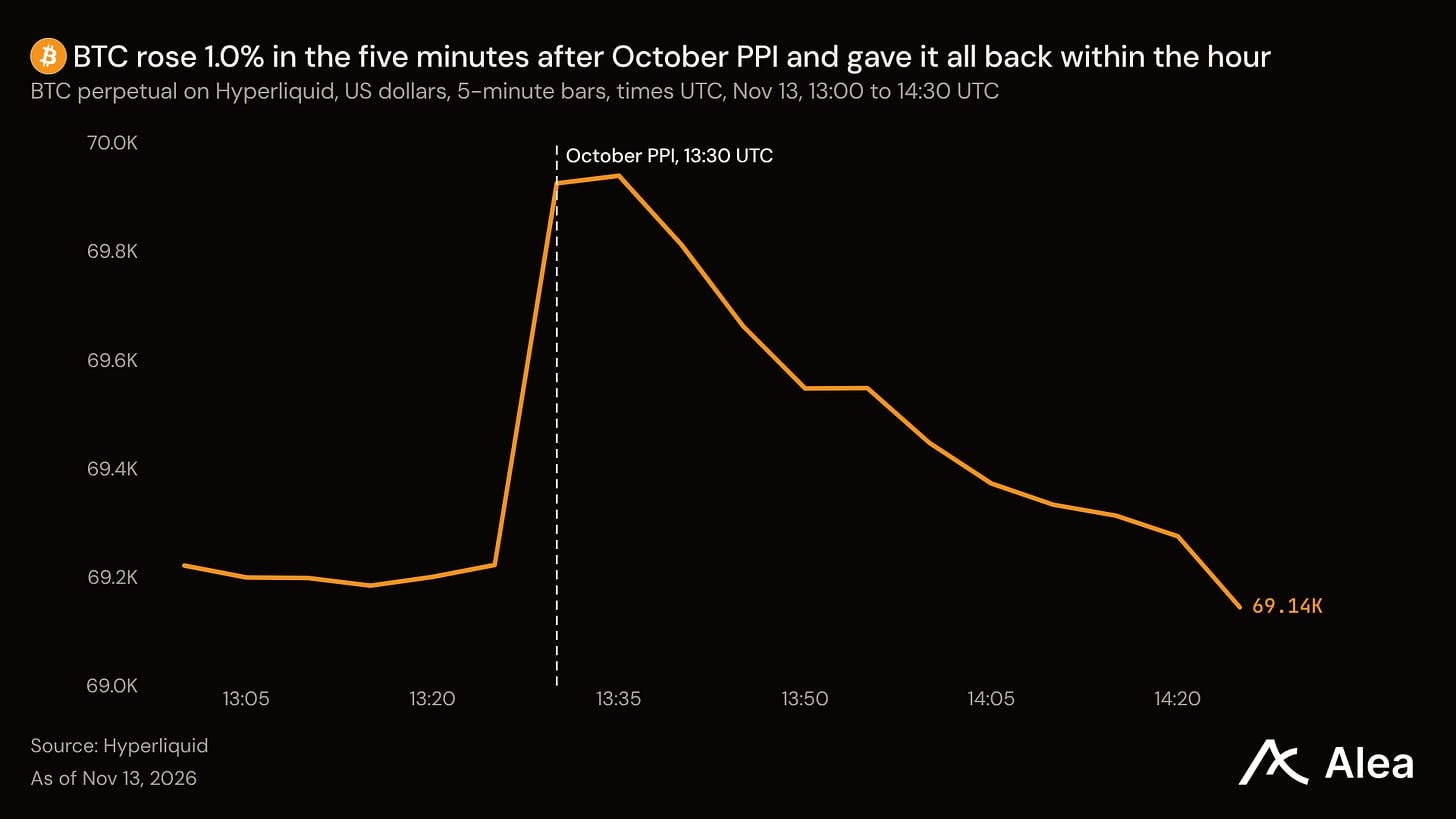
Chart: Market microstructure following inflation data release
PPI data offered less than an hour's respite. The Friday-released October PPI rose 0.3% month-over-month, below economists' expectations of 0.4%, but its 12-month year-over-year growth still reached 6.5%, marking a new high since November 2022.
Bitcoin rallied 1.0% within five minutes of the data release, but gave up all those gains within an hour. Anticipation for a larger rate hike warmed throughout the day, with prediction markets ultimately closing at 10.3% probability for a 50-basis-point or larger increase.
Between November 9 and the close on the 12th, U.S. 2-year Treasury yields rose 30 basis points to 4.86%, with the majority of that gain occurring on November 10.
Crypto Watch: Bitcoin Falls Further Below Strategy's Cost Basis
Since November 8, Bitcoin's closing price every trading day has fallen below Strategy's average holding cost. The 850,364 Bitcoins held by Strategy carry an average cost of $75,456. At Friday's close, Bitcoin traded 9.47% below this average, resulting in unrealized losses of approximately $6.07 billion for the company.
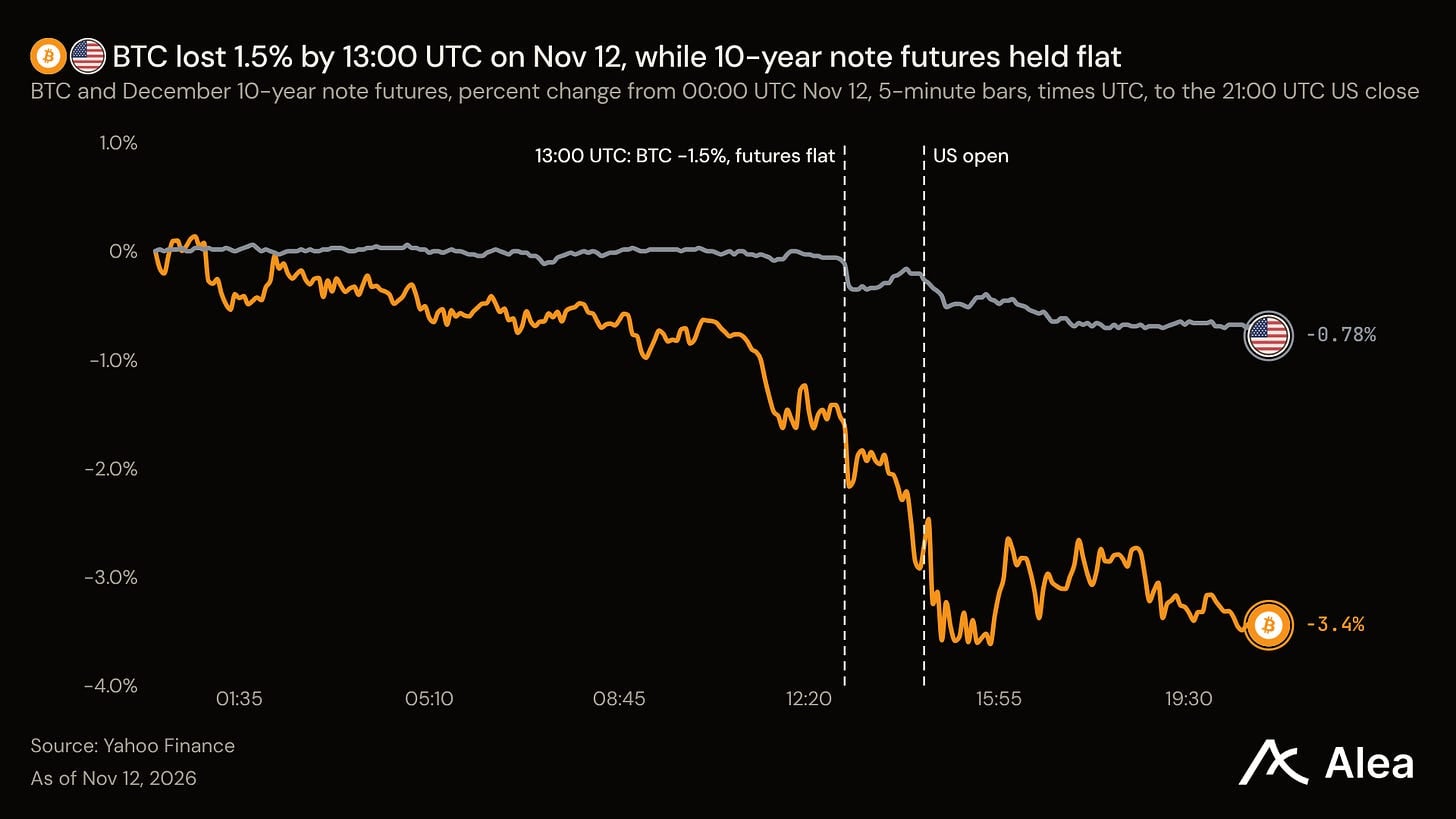
Chart: Intraday trends of Bitcoin and Treasury futures
In the week ending November 8, Strategy spent more repurchasing its own preferred shares than buying Bitcoin. The company allocated $188.3 million to repurchase its STRC preferred shares, while funds used to purchase Bitcoin amounted to only $81.9 million.
Funds tracking the MSCI index will sell Strategy positions ahead of the November 30 close, as MSCI is set to remove the company from the index.
Bitcoin's decline preceded unusual movements in Treasury futures by several hours. Prior to 13:00 UTC on November 12, Bitcoin had already fallen 1.49%, while Treasury and Nasdaq futures remained essentially flat. Open interest on Binance's Bitcoin perpetual contracts increased by 4.3% during these hours, as traders continuously added to long positions amid the downturn.
As Bitcoin broke below $68,000 on Friday, leveraged positions were forced to liquidate. Between 00:00 and 06:00 UTC, open interest for Bitcoin on Binance, Bybit, OKX, and Hyperliquid decreased by approximately 4,060 BTC.
Perpetual contracts on Hyperliquid briefly touched $67,474, with funding rates for longs plummeting sharply to 0.0013%.
US Equities Insight: Three of the Top Four Cloud Giants See Capital Expenditures Exceed Operating Cash Flow
In the last quarter, capital expenditures for Google's parent company Alphabet, Meta, and Amazon all exceeded their operating cash flow, with Microsoft being the only one whose operating cash flow could cover its cash capital expenditures at 1.47 times.
Alphabet's capital expenditures doubled year-over-year to $51.4 billion, and the company suspended share buybacks. Meta's spending similarly outpaced operating cash flow, bringing its stock repurchase program to zero. Amazon's operating cash flow could only cover 55% of its expenditures. These massive capital outlays are precisely the order sources chip manufacturers rely on to survive.
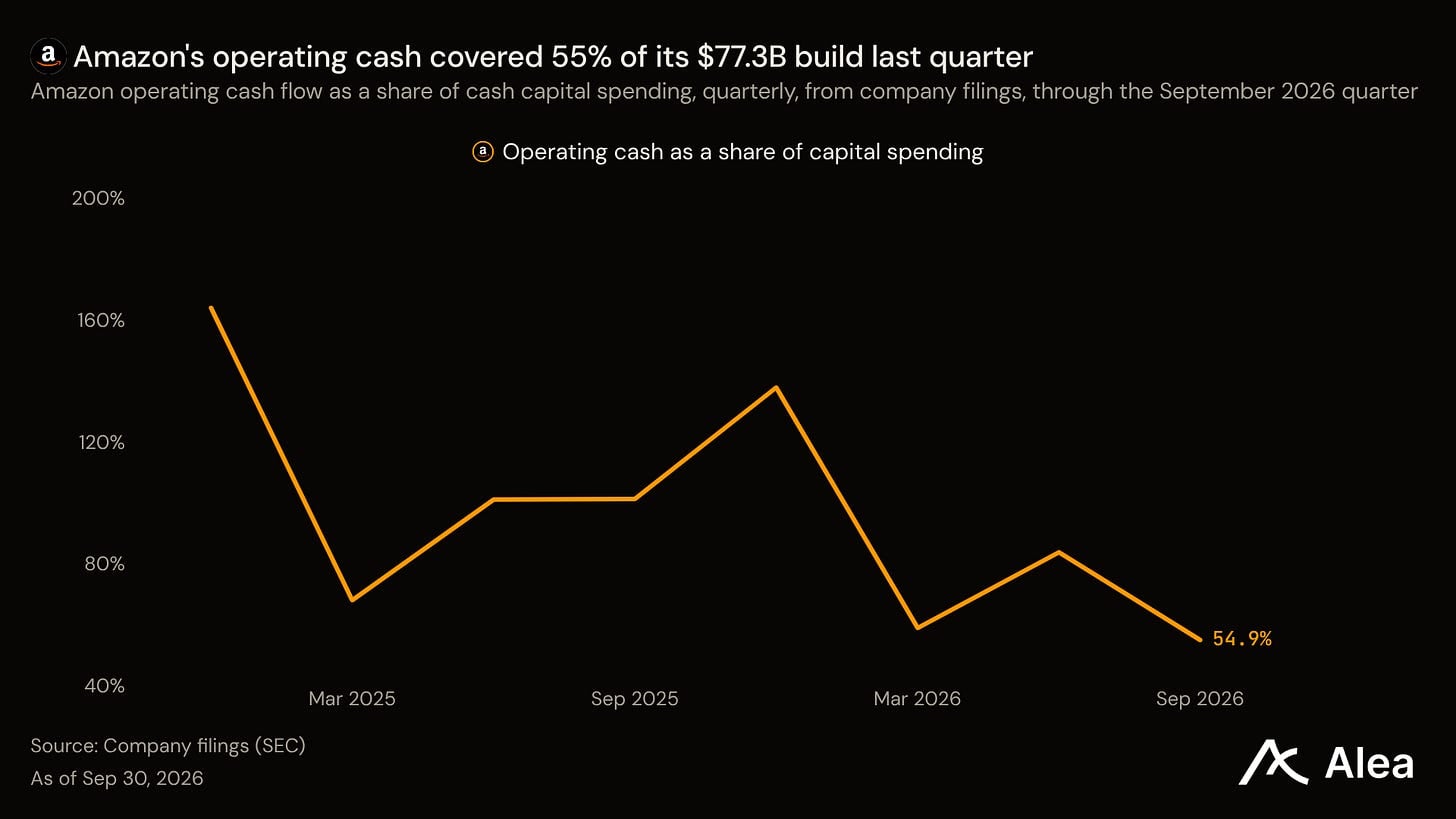
Chart: Amazon operating cash flow vs. capital expenditure ratio
Crypto Derivatives Market Assigns Valuations to Anthropic Far Exceeding IPO Range
Traders have already assigned a significant premium to Anthropic in crypto contracts. As of 00:00 UTC on November 14, related contracts on Hyperliquid valued Anthropic at $1.782 trillion.
Based on the equity corresponding to the contracts, the midpoint of its IPO pricing range at $74 implies a valuation of $1.295 trillion, making the current contract price premium as high as 37.6%.
Even pricing at the upper bound of the IPO range at $78, combined with the historical average 17.9% first-day pop for large IPOs since 2001, results in a valuation of only $1.609 trillion. The contract market still shows a premium of 10.8%. Currently, seven companies have committed to subscribing to $26 billion worth of shares at the IPO offering price, with NVIDIA and Google each committing approximately $10 billion.
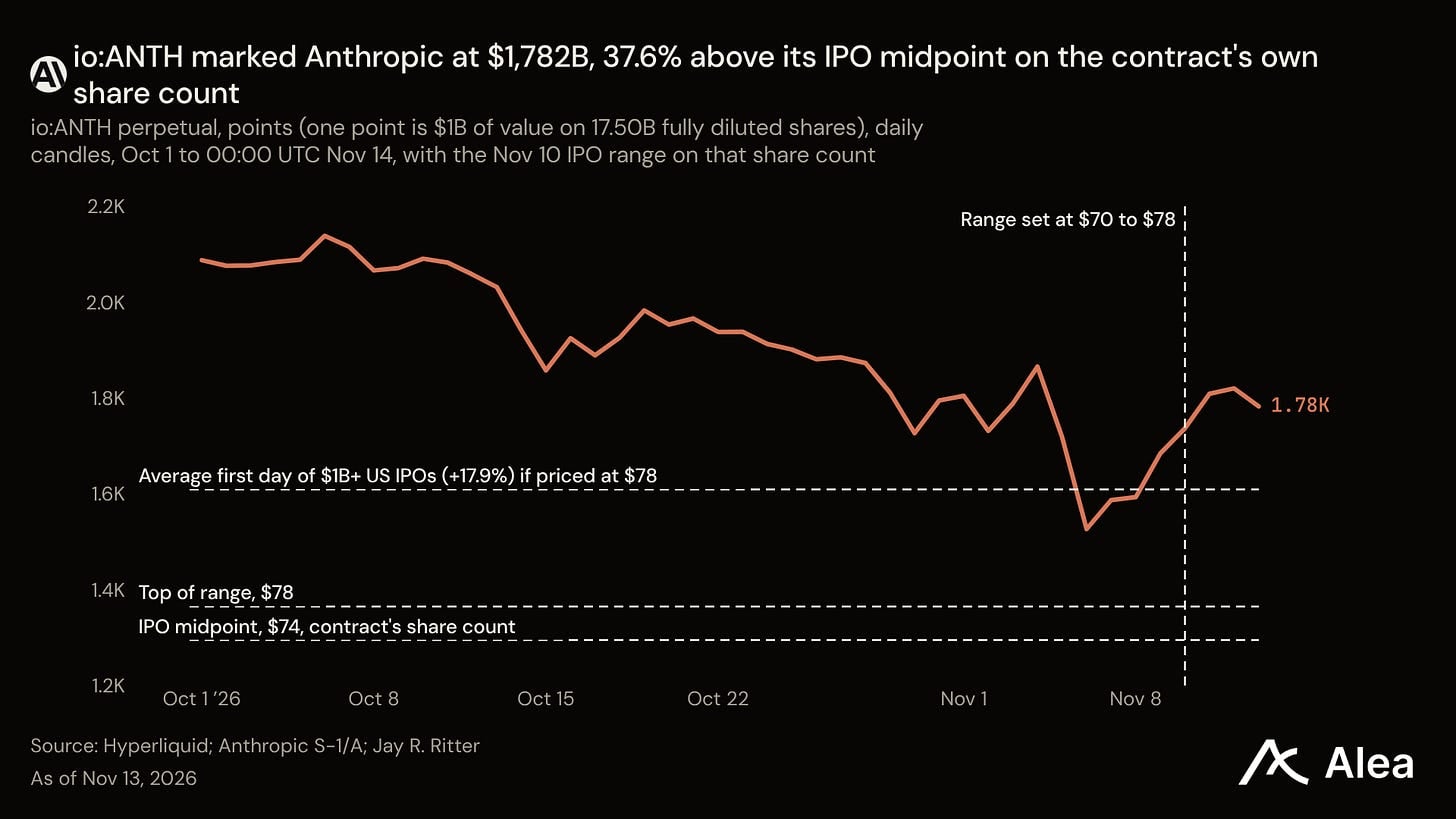
Chart: OTC contract price trend for Anthropic
AMD also has its own strategic ties. Anthropic has procured AMD compute racks equipped with MI450 AI chips. AMD struck a deal in July to subscribe to up to $5 billion in Anthropic equity upon rack delivery.
Commodities: Gold Hits One-Year Low, Crude Oil Boosted by Geopolitical Risks
December gold futures closed at a one-year low on November 12. U.S. 10-year real yields have climbed 25 basis points since November 9 to reach 2.91% at Friday's close. The U.S. Dollar Index posted its highest closing level in the past year, while speculative funds have consistently reduced their net long positions in gold futures.
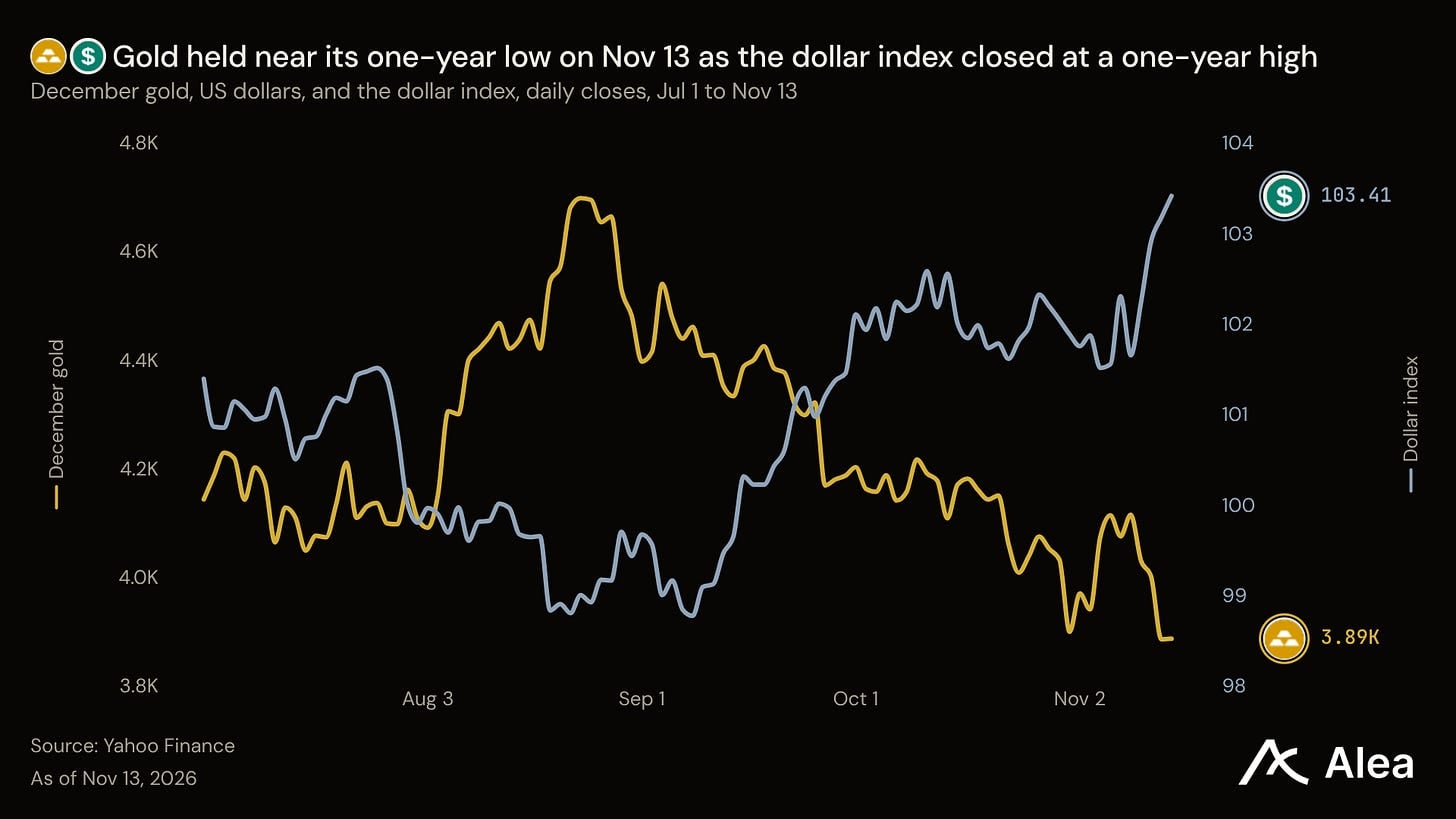
Chart: Comparative trend of Gold and the U.S. Dollar Index
Meanwhile, January Brent crude accumulated a 3.94% gain across two trading days due to diminished market expectations for a ceasefire agreement. The natural gas market staged a sharp reversal amid heavily crowded short positions; December natural gas has surged 13.10% since the November 2 close, with a significant increase in demand for speculative shorts to cover.
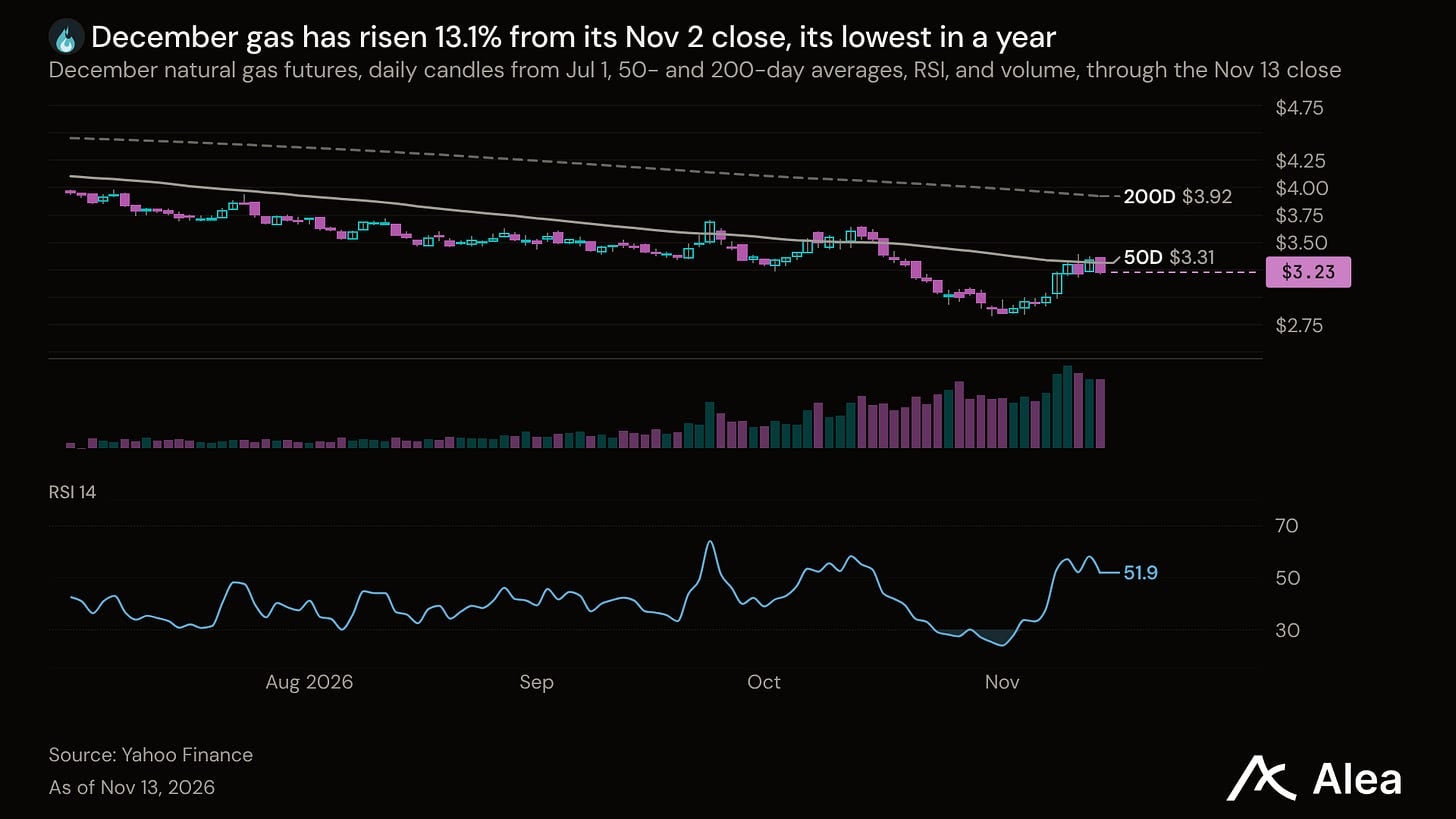
Chart: Natural gas futures price trend
The Transmission Scope of NVIDIA's Volatility Across the Semiconductor Supply Chain
On November 12, although NVIDIA's stock came under pressure, the semiconductor index remained broadly resilient, with AMD and Broadcom climbing and suppliers Micron and Arm posting minor declines. While Super Micro Computer and compute leasing firms pulled back, this was compounded by their own downward revisions to earnings guidance.
The chip sector made up for lost ground on November 13, suggesting the market may be slowly digesting the shock or normalizing the premiums previously paid for chasing rival equities. Multi-sided trading dynamics remain undecided within the current pricing framework.
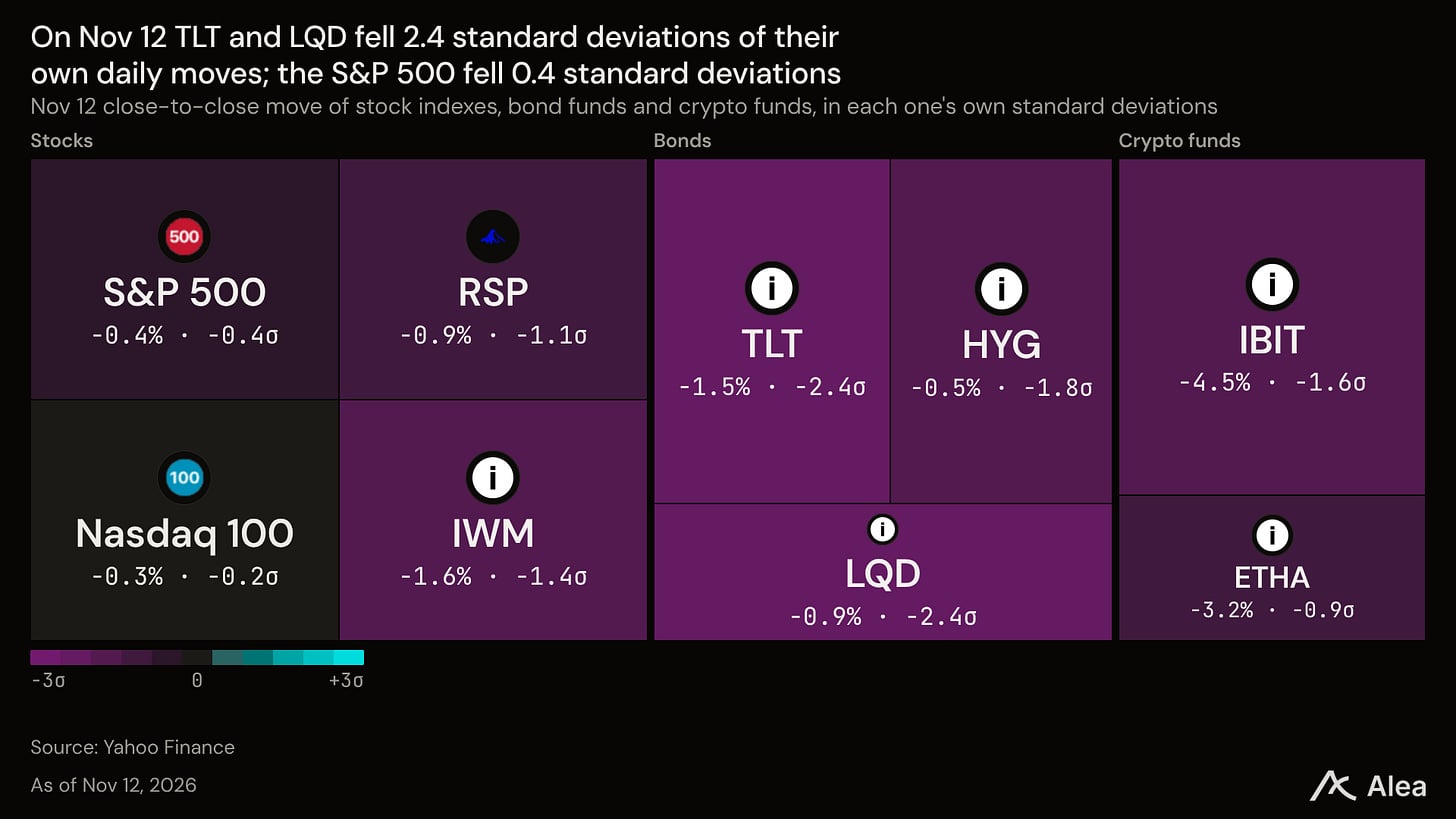
Chart: Performance after volatility adjustment across multiple assets
Key Timeline Review
The latest Commitments of Traders report will be released on November 16, providing a basis for gauging speculative fund flows.
NVIDIA will release its first financial results following the departure of Jensen Huang on November 17. The current market cap corresponds to a valuation multiple of 9.1x based on its annualized revenue guidance.
The Federal Reserve will publish its meeting minutes on November 18, around the time Anthropic's IPO is expected to officially price.
At the close on November 30, MSCI will officially remove Strategy from the index.
The Federal Reserve will officially announce its latest interest rate decision on December 9.
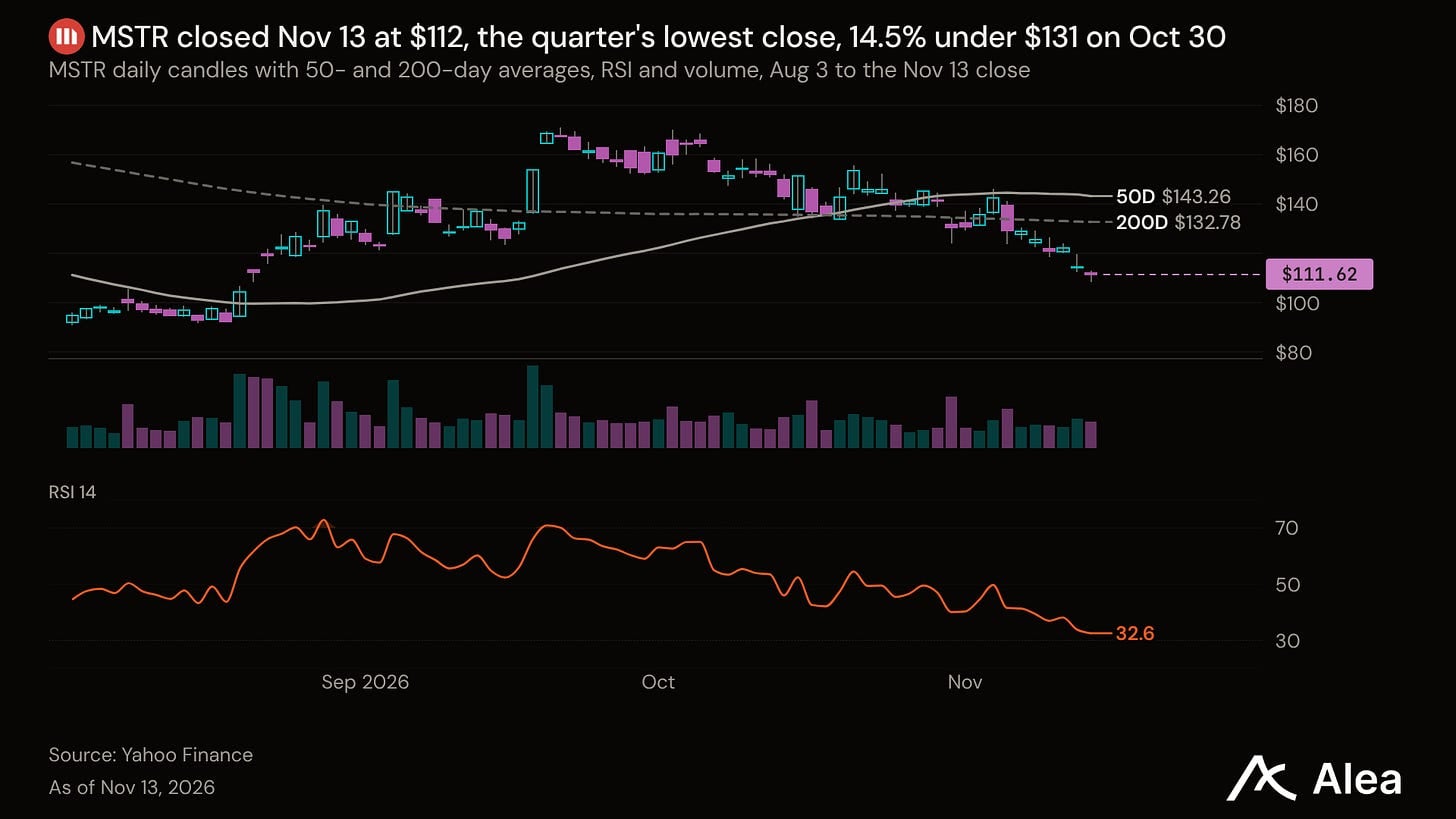
Chart: Strategy stock price and moving average trend
Join TechFlow official community to stay tuned
Telegram:https://t.me/TechFlowDaily
X (Twitter):https://x.com/TechFlowPost
X (Twitter) EN:https://x.com/BlockFlow_News
 @AleaResearch