Why Must Decentralized Currencies Be Public? Unpacking the Overlooked Privacy Trade-offs in Satoshi Nakamoto's Whitepaper
Author: Lithos.eth
Translated by: TechFlow
TechFlow Guide:The public ledger of Bitcoin, while breaking the monopoly of traditional financial intermediaries, simultaneously exposes all transaction inputs, outputs, and amounts unreservedly under the spotlight. As early as Section 10 of its whitepaper, Satoshi Nakamoto clearly identified this architectural flaw, proposing anonymous public keys as a defense line. However, this merely provides pseudonymity rather than true confidential transactions.
From early blind signatures and zero-knowledge proofs, to on-chain confidential transfers in Monero and Zcash, to smart contract programmable privacy in Aztec and Oasis Sapphire, and Ethereum's Kohaku which addresses wallet query leaks, the crypto world is moving beyond the misconception of relying solely on mixers. Privacy is never about hiding everything; it is about empowering individuals with the right to selectively reveal their data to the world.
Bitcoin allows anyone to independently verify complete transaction histories without seeking permission from banks.
However, precisely this publicly visible record can leak personal privacy far beyond what users anticipate. Satoshi Nakamoto addressed this thorny issue back in Section 10 of the original Bitcoin whitepaper.
Since then, cryptographers and developers have continuously explored technical paths that both protect information secrecy and maintain transaction verifiability. After years of evolution, how far have we truly come?
When you make a payment to someone using Bitcoin, from the moment the funds are confirmed, that transaction becomes an indelible part of the global public ledger.
Anyone in the world can access it at any time.
They can see the input source of each spent transaction, the output address receiving the funds, the specific amount allocated to these outputs, as well as the block height and timestamp when the transaction was packaged and confirmed.
Analysts may temporarily not know your real name, but once even one of your addresses is linked to an identity in the real world, all your past and future on-chain activities become extremely easy to trace.
Your salary income, savings scale, business payment flows, and daily spending habits could all leave traces on the same public ledger.
For a system originally designed to enable free fund transfers independent of the banking system, this is undoubtedly a thought-provoking compromise and trade-off.
Moreover, Satoshi did not overlook this point. In the initial Bitcoin whitepaper, the title of Section 10 is precisely "Privacy".
To understand the future trajectory of blockchain privacy, we need to revisit Satoshi's original arguments from back then, review the explorations of cryptographic pioneers before Bitcoin's birth, and objectively assess the advantages and limitations of current privacy solutions.
Before the Birth of Bitcoin, Pioneers Were Already Exploring Solutions
Discussions regarding digital currency privacy did not begin with Bitcoin.
As early as 1982, David Chaum published the classic paper "Blind Signatures for Untraceable Payments".
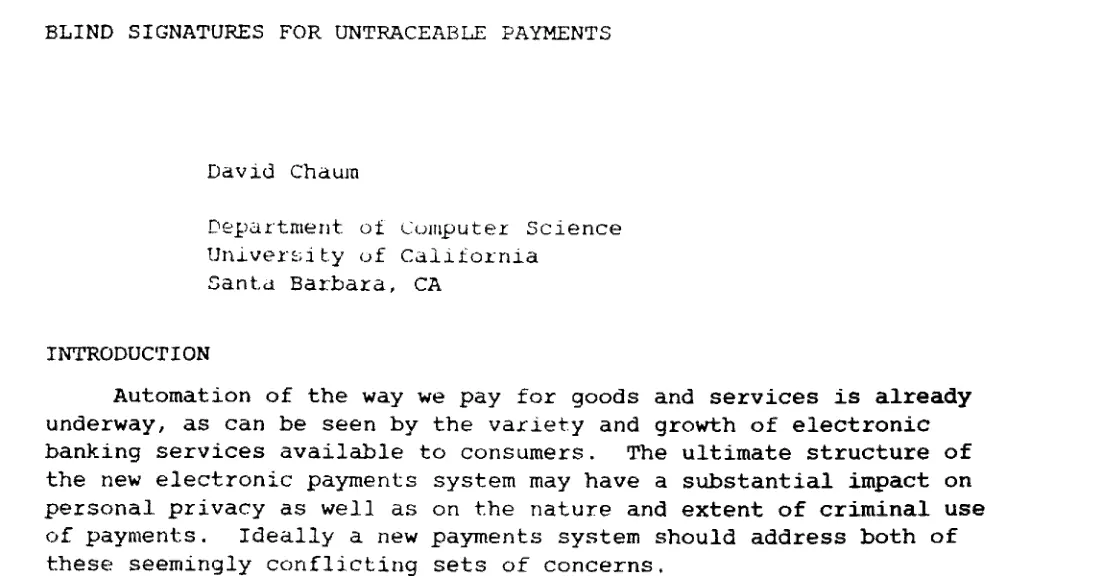
Fig: David Chaum's 1982 paper on blind signatures, Blind Signatures for Untraceable Payments
In the paper, Chaum explored how users could obtain digitally signed payment credentials without allowing the issuing authority to link the credentials to the final transaction.
This concept is crucial because the information leaked by a single payment extends far beyond the mere transfer of funds. It also reveals who is transacting with whom, when interactions occur, and the frequency of trades.
Chaum's research established an important milestone for e-cash, but his model still relied on centralized issuing institutions. Protecting payment information and eliminating trust in central authorities are two entirely distinct challenges.
Other researchers and programmers continued to explore in this direction, with the cypherpunk community determined to take a bigger step forward.
In September 1992, a group of cryptographers, programmers, and privacy advocates organized around a mailing list hosted by John Gilmore. Jude Milhon is credited with coining the term "cypherpunk" for this collective.
Their interests extended beyond digital currency, passionately debating strong encryption algorithms, anonymous communication protocols, digital identity, information freedom, and the ability of individuals to protect themselves using open-source software.
Timothy C. May wrote "The Crypto Anarchist Manifesto" in 1988 and distributed it via the network during early gatherings of the movement in 1992.
Subsequently, on March 9, 1993, Eric Hughes officially released the historic "A Cypherpunk's Manifesto".
One declaration within it remains strikingly resonant more than thirty years later: In the electronic age, privacy is essential to a free society.
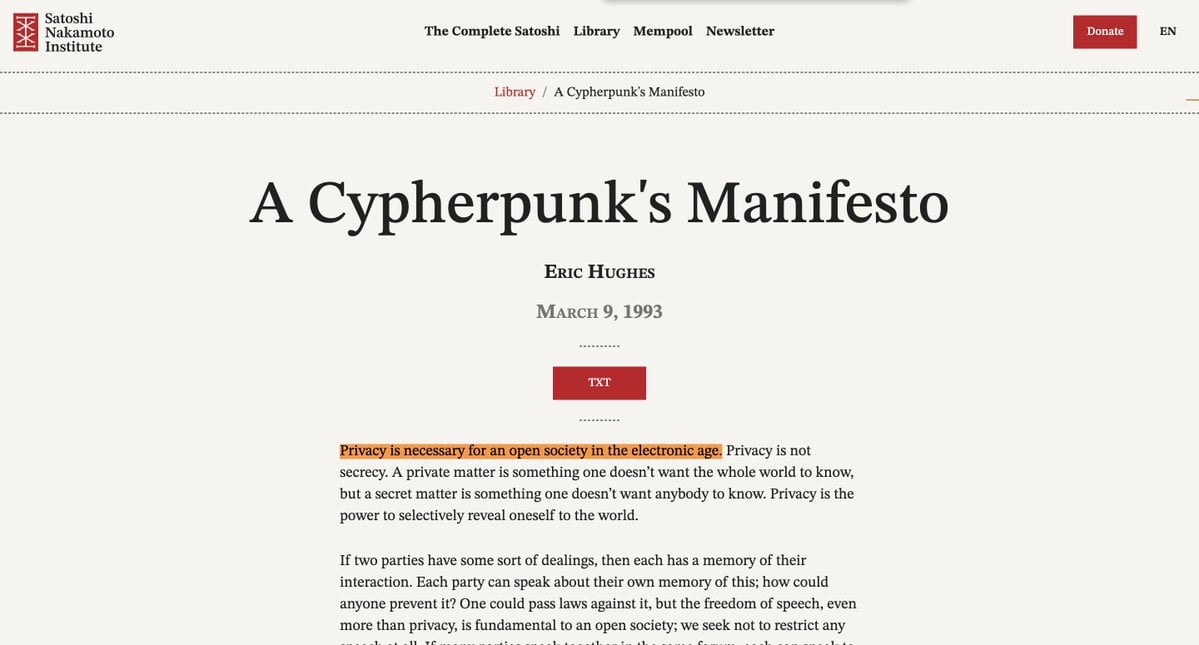
Fig: Eric Hughes's 1993 publication, A Cypherpunk's Manifesto
But Hughes put forth another, more profound argument in the manifesto that remains highly relevant when examining blockchain privacy: Privacy is the power to selectively reveal oneself to the world.
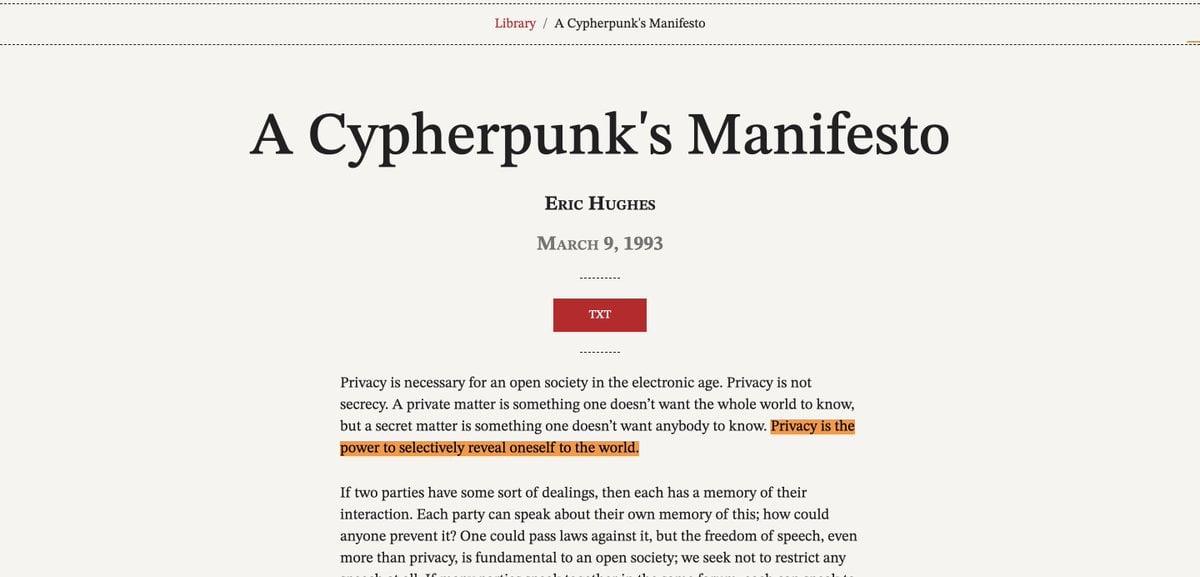
Fig: Eric Hughes proposed in the manifesto that "privacy is the power to selectively reveal oneself to the world"
He did not advocate hiding everything; instead, he emphasized that individuals must possess absolute discretionary power over what they choose to present to the outside world.
A merchant selling you a product does not need to view your lifelong financial records; a payee receiving a transfer has no need to snoop into every other transaction happening in your wallet.
Hughes stated it thoroughly: the parties to a transaction should only know the information necessary to complete that transaction, with no extraneous details involved. This vision remains at the core of privacy discussions today.
Cypherpunks never believed privacy would be granted as a favor by others; they firmly believed it had to be built firsthand through code. Their most famous motto is exactly that: Cypherpunks write code.
The Cornerstone Ideas Leading to Bitcoin
The emergence of Bitcoin was certainly not out of thin air; beforehand, several pioneers had been deeply cultivating different technical components of digital currency for years.
Hashcash (Adam Back, 1997): A proof-of-work mechanism designed to significantly increase the marginal cost of spamming and certain resource abuse behaviors.
b-money (Wei Dai, 1998): An anonymous, distributed electronic cash system proposal.
bit gold (Nick Szabo): A proposal building digital scarcity value around computational workload, followed by Szabo publishing a detailed technical exposition in 2005.
Reusable Proof-of-Work (RPOW, Hal Finney, 2004): Attempted to allow the computational results of proof-of-work to circulate as transferable digital tokens.
These explorations were distinct. Although none directly evolved into Bitcoin and they focused on solving different problems, they collectively outline the profound academic and intellectual breeding ground from which Satoshi emerged.
At that time, a serious technological wave had already swept through the industry, attempting to construct an independent digital currency completely detached from commercial banks, government agencies, or centralized clearinghouses.
Satoshi's Bitcoin whitepaper explicitly cites Hashcash and b-money in its references.
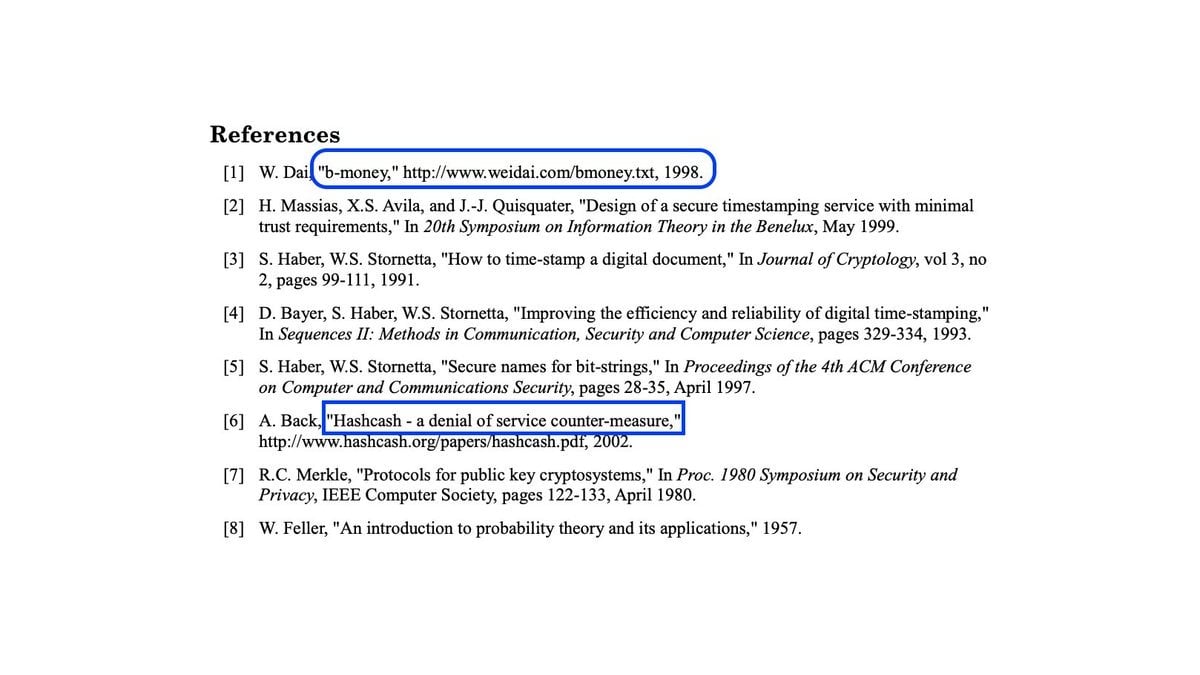
Fig: Citations of Hashcash and b-money in the Bitcoin whitepaper references
Bitcoin integrated the crystallized wisdom of early research and conquered an extremely difficult core proposition: How to achieve network-wide consensus on a shared ledger without a centralized arbitrating institution preventing double-spending?
This was a milestone breakthrough in the history of cryptocurrency development, but its cost was equally obvious: all transaction data had to be made public to the entire network.
Satoshi's Authentic Discussion on Privacy
On October 31, 2008, Satoshi released the whitepaper titled "Bitcoin: A Peer-to-Peer Electronic Cash System," with Section 10 dedicated specifically to privacy.
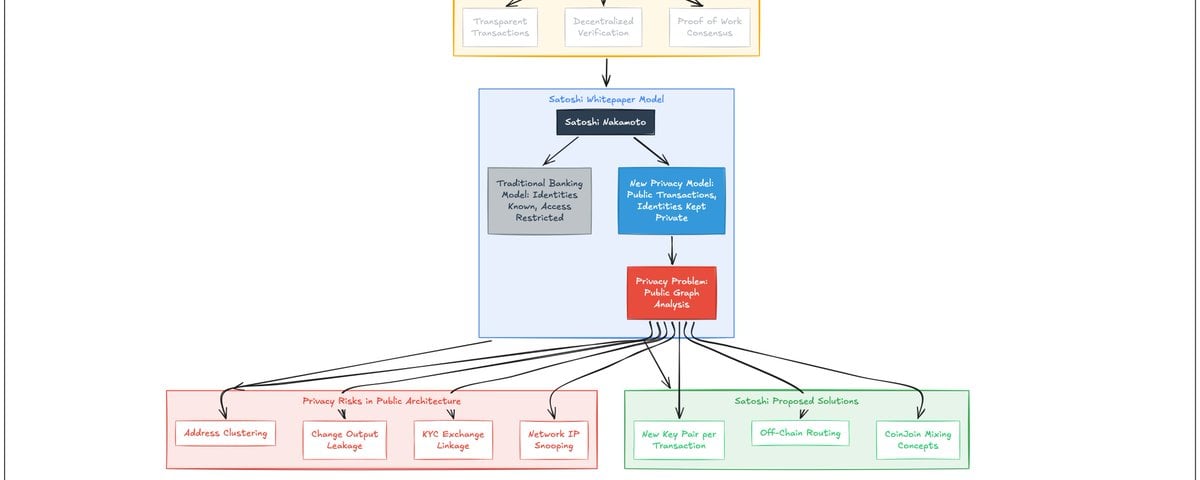
Opening this chapter, it contrasts Bitcoin's public transaction mechanism with the privacy norms traditionally accepted in banking operations.
In traditional banking models, transactions are completely transparent to the bank, but the general public cannot peer into others' account balances and statements.
Bitcoin's operating logic is diametrically opposite: the transaction itself must be broadcast publicly to the network, while users' real identities are hidden behind anonymous public keys.
Satoshi wrote: "The requirement to publish all transactions publicly eliminates the traditional method, but privacy can still be maintained by cutting off the flow of information at another stage: keeping public keys anonymous."
The specific strategy he proposed includes generating a brand new key pair for each transaction, thereby increasing the difficulty of tracing multiple related payments back to a single individual.
However, Satoshi also candidly pointed out the inherent weakness of this model: when a transaction merges multiple inputs, these inputs mathematically prove that they belong to the same owner.
As long as even one of those addresses is linked to a real-world identity, other on-chain activities associated with that address will be gradually connected and traced like pulling a vine to find the melon.
This is a critically important conceptual distinction: Bitcoin's native design provides pseudonymity, not true confidentiality.
Although your real name is not directly recorded on the ledger, the details of every on-chain transaction are exposed outward, and auxiliary data from off-chain sources is sufficient to match on-chain addresses with real individuals.
Satoshi never claimed this was perfect privacy; he simply proposed a pragmatic compromise in a distributed system heavily reliant on public verification, aimed at minimizing the association between transactions and real-world identities as much as possible.
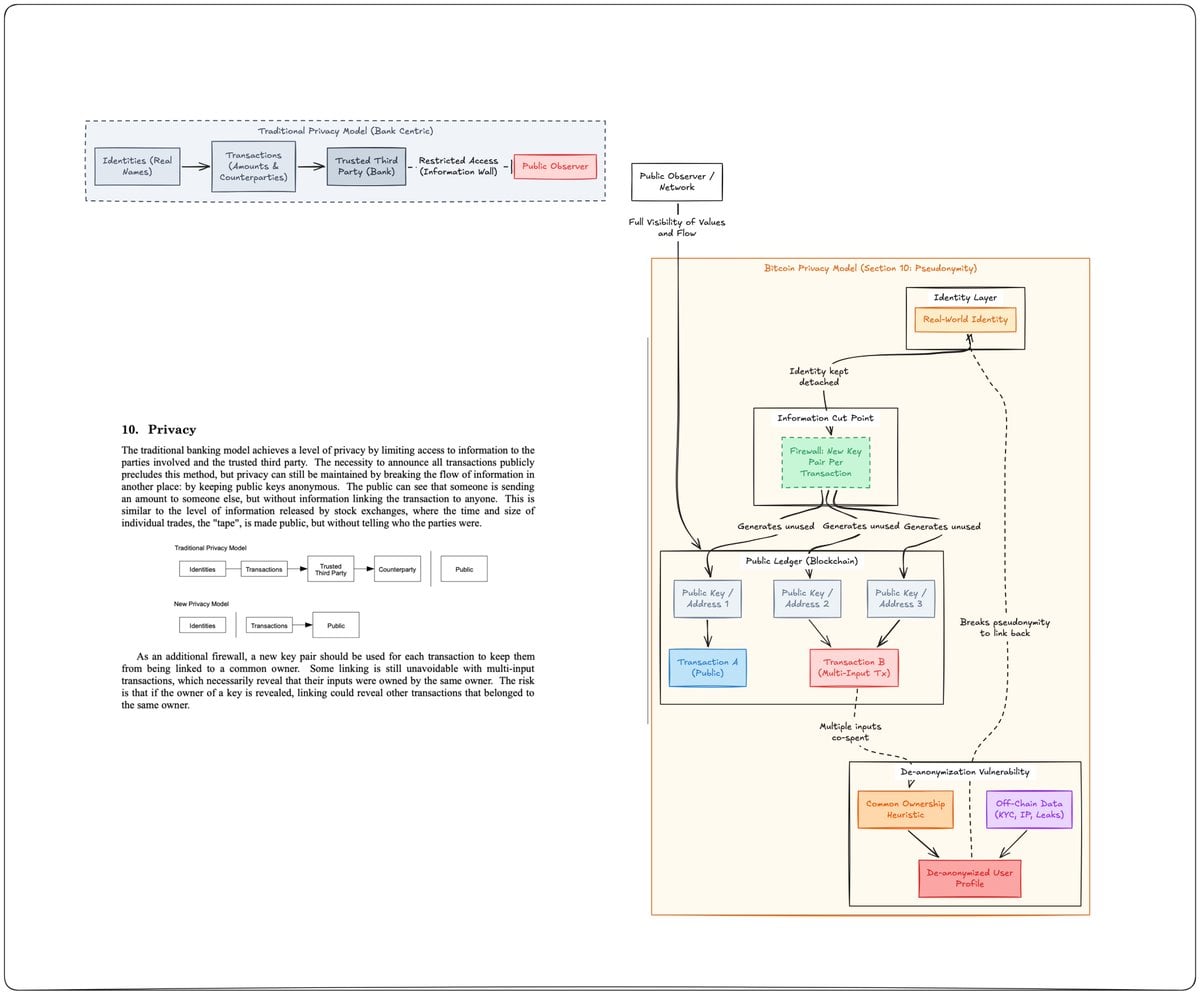
Fig: Comparison drawn by Satoshi in Section 10 of the whitepaper between the traditional privacy model and Bitcoin's new privacy model
What Can Others Deduce from a Bitcoin Transaction?
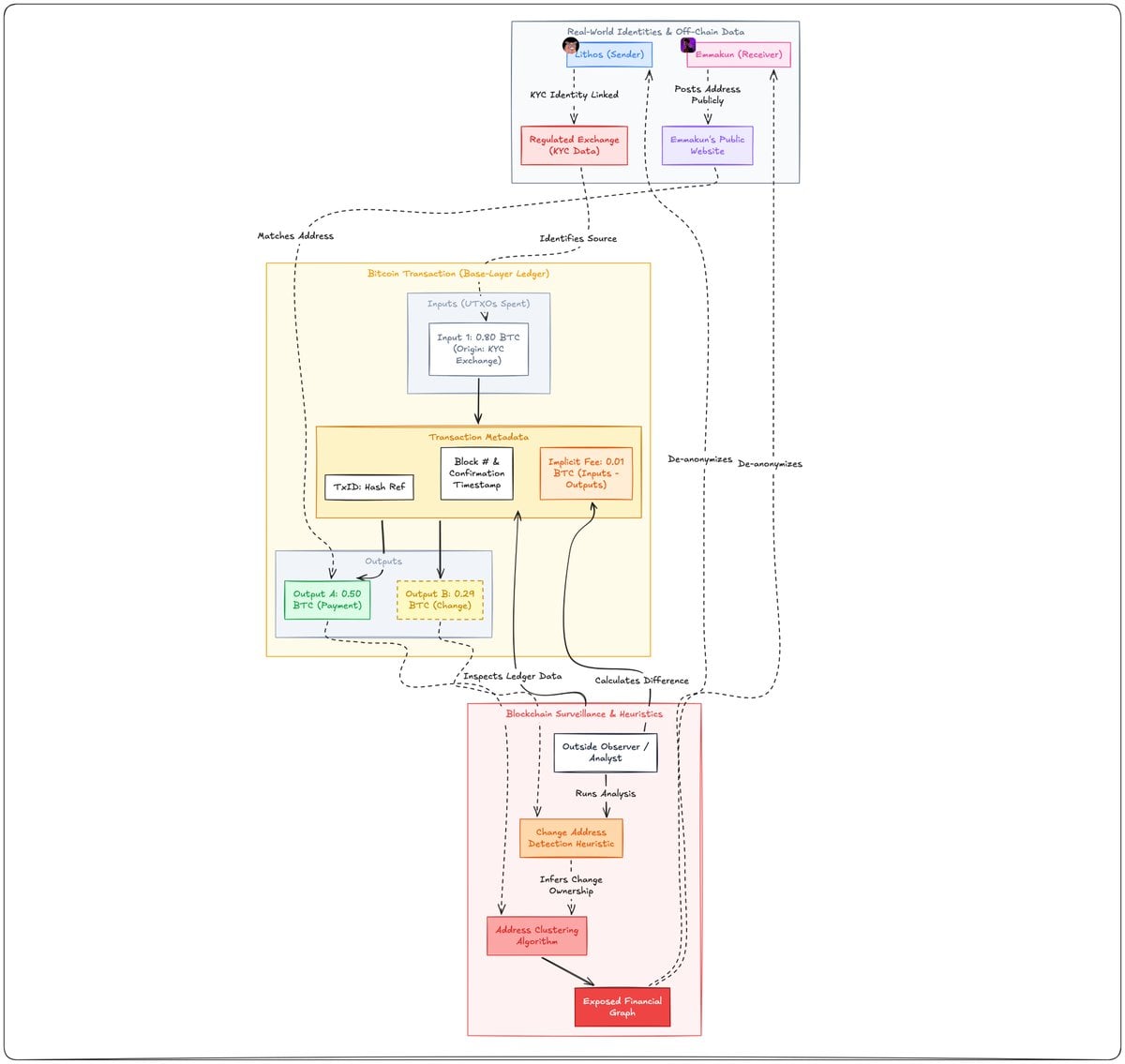
Let's look at a concrete everyday payment scenario.
Lithos intends to pay Emma 0.5 BTC, constructing a payment transaction using his existing unspent transaction outputs (UTXOs).
This transaction is broadcast across the network, packaged into a block, and permanently written to the blockchain ledger.
At this point, any off-chain observer can clearly verify the following elements:
· The specific input UTXO spent in this transaction;
· The target output address receiving the funds;
· The exact Bitcoin amount allocated to each output;
· The transaction fee (precisely calculated through the difference between the total input and total output values);
· The specific block height and timestamp when the transaction was confirmed and included in a block.
Observers may initially not know the real-world identities of Lithos or Emma.
But assume Lithos's funds came from a compliant exchange implementing strict real-name identity verification, or Emma once published her donation address on a personal public webpage.
Then on-chain analysts could easily lock these addresses to real-world identities and subsequently trace back their entire historical transaction trails.
In reality, there is complex interference from change outputs: when a transaction generates change, the funds typically return to the sender rather than being paid to the recipient.
On-chain analysis firms often rely on specific algorithmic assumptions to guess which output represents change. Although these heuristic rules are not always accurate, they are sufficient to sketch highly valuable fund flow maps.
The key conclusion lies in this: even if Bitcoin never directly records names, its fully transparent transaction history can expose a vast amount of sensitive personal information.
This is exactly why we must absolutely never confuse "anonymity" with "privacy" when discussing Bitcoin. Its addresses are pseudonymous, while its underlying transaction history is completely public.
Satoshi Was Still Contemplating Privacy Challenges in 2010
There is yet another highly instructive anecdote in Bitcoin's developmental history.
On August 11, 2010, Satoshi participated in a deep technical discussion on the BitcoinTalk forum titled "Not a suggestion".
The core agenda at the time was: Could Bitcoin avoid storing all historical transaction data in full, just as it initially did?
The bottleneck of this consideration lies in preventing double-spending: if a network node lacks sufficient information to trace the entire transaction history, how can it confirm that a coin has not been previously spent?
Satoshi explained that verifying the non-existence of double-spending logically requires nodes to possess a global understanding of all related transactions on the network.
Immediately following this, he wrote a profoundly significant remark: "Under such circumstances, it is hard to think of ways to apply zero knowledge proofs."
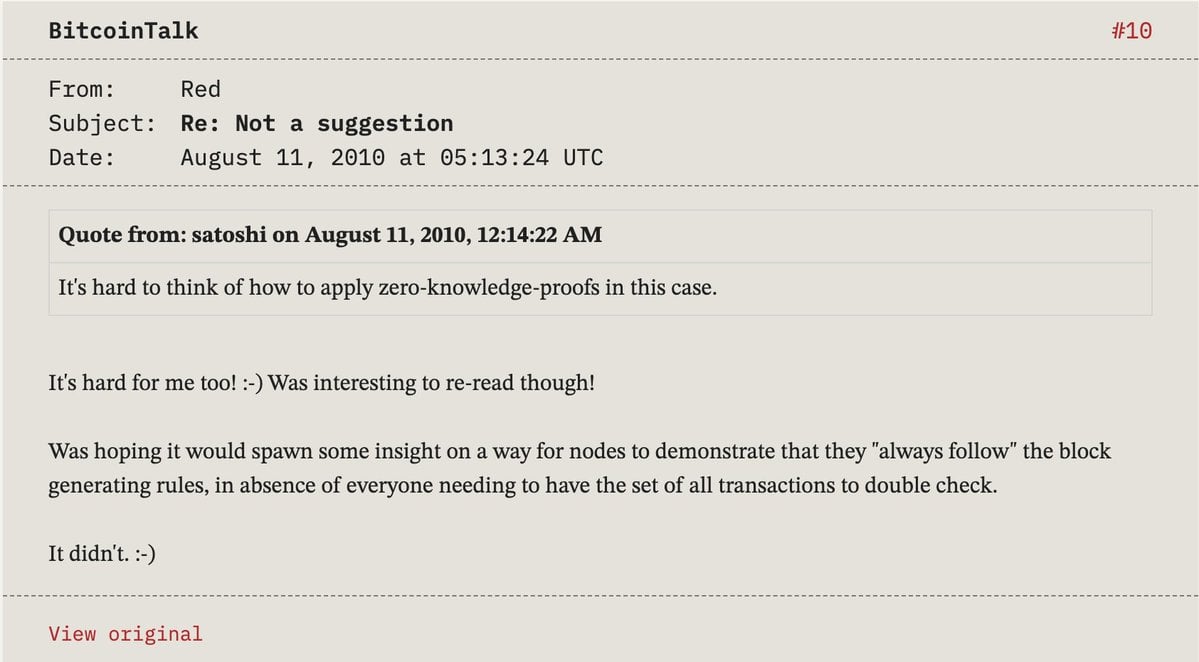
Fig: Satoshi's 2010 discussion on BitcoinTalk regarding zero-knowledge proofs and double-spend verification
The context of this passage is extremely important: Satoshi definitely did not believe zero-knowledge proofs were useless; he was exploring a specific technical challenge: How can nodes prove that an asset has not been double-spent without possessing the full transaction history?
In other words, how does the network verify a certain type of "non-existence"? This is a completely different technical dimension from whether "proofs can hide the detailed parameters of a payment."
Clarifying this historical detail is crucial because many contemporary discussions on privacy mistakenly assume that Satoshi completely overlooked zero-knowledge cryptography back then.
Historical facts are far richer than rumors: Satoshi not only understood the concept of zero-knowledge proofs but also deeply contemplated the massive engineering challenges of applying them to Bitcoin's double-spend verification.
Subsequent cryptographic explorations took root and flourished precisely in this soil: researchers pioneered a new paradigm of using zero-knowledge proofs to conceal transaction details while still allowing network nodes to verify transaction legitimacy.
From Concealing Identity to Concealing Payment Details
The pace of cryptographic research did not halt with Bitcoin's maturation.
In 2013, academia published the groundbreaking paper "Zerocoin: Anonymous Distributed E-Cash from Bitcoin".
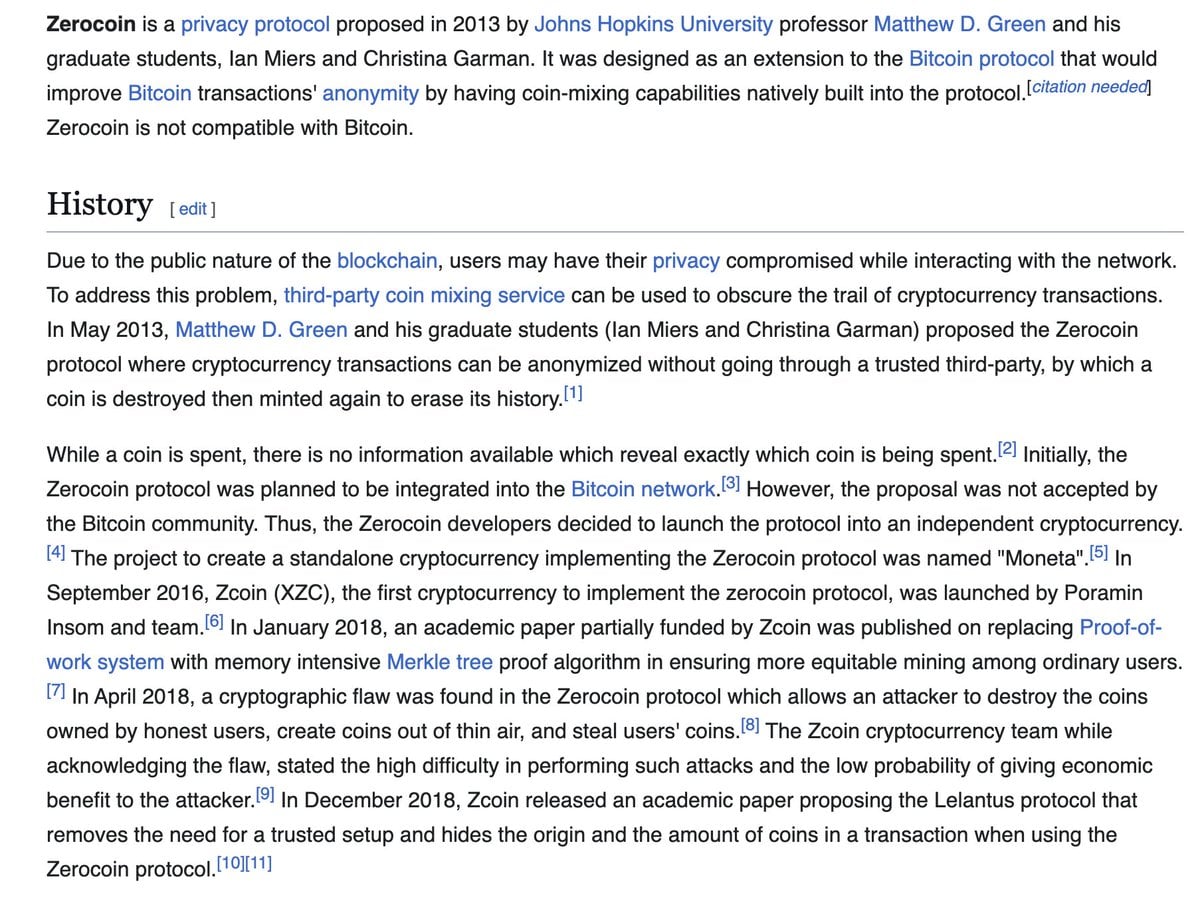
Fig: The 2013 published paper Zerocoin: Anonymous Distributed E-Cash from Bitcoin
The paper accurately pinpointed Bitcoin's fatal flaw: a fully public ledger structure means its privacy protection rests entirely on fragile pseudonymity.
Zerocoin explored how cryptography could break the link between transactions and their sources, but it still exposed the destination of payments and the amount paid, showing obvious limitations in payment flexibility.
By 2014, the research team had advanced further, releasing "Zerocash: Decentralized Anonymous Payments from Bitcoin".
Zerocash introduced the non-interactive zero-knowledge proof technology zk-SNARKs, successfully achieving a complete protocol that comprehensively conceals the sender, receiver, and transfer amount of transactions, while still allowing network nodes to rigorously verify transfer validity.
This represented a profound elevation of Satoshi's original privacy model.
Bitcoin attempted to decouple public addresses from real-world identities; whereas Zerocash explored how to directly and completely erase the transaction data itself from public view.
This was a highly milestone-worthy shift: a decentralized network does not need to know every plaintext detail of a payment to confirm whether it complies with monetary rules.
Through concise zero-knowledge proofs, the system can mathematically prove to the entire network that a transaction is legitimate and compliant without disclosing the transaction's structural parameters to anyone.
This is precisely the core reason why zero-knowledge cryptography has become the crown jewel of blockchain privacy research.
What Exactly Are Contemporary Mainstream Privacy Systems Protecting?
In everyday discussions about blockchain privacy, people often tend to lump all projects together.
But concealing the payee is not equivalent to concealing the amount; concealing the amount is not equivalent to concealing the on-chain transaction topology; and concealing on-chain data cannot automatically prevent network communication leaks prior to initiating a transaction.
It is necessary to clearly segment and analyze these technical schools of thought.
Some systems can hide the receiver while keeping the amount public; some systems mask the transaction amount but expose query traces at the wallet end or network RPC nodes; others allow users to prove eligibility without leaking their full identity.
These belong to security protections of entirely different dimensions. We can look at a few representative technical implementations.
Bitcoin and Payjoin
Although Bitcoin maintains transparency at the base ledger layer, this does not mean developers have been inactive in improving privacy.
Community developers designed a set of mechanisms that drastically reduce the reliability of traditional on-chain graph analysis, among which Payjoin defined in BIP 78 is particularly representative.
Payjoin allows the payer and payee to collaboratively construct a payment transaction, with the payee proactively contributing an input UTXO to this transaction.
Why is this crucial?
Traditional on-chain tracking analysis usually relies on a core assumption: all input addresses in a single transaction belong to the same person. But if the payee injects an input in a Payjoin transaction, this universal assumption completely fails.
Payjoin does not hide transaction amounts nor transform Bitcoin into a confidential payment system; it simply greatly increases the difficulty and uncertainty for external institutions conducting on-chain fund aggregation analysis.
This improvement is highly practical, but it must absolutely not be confused with end-to-end completely confidential transactions.
Monero
Monero takes a different path, directly embedding robust privacy guarantees by default into its underlying transaction mechanism.
It operates through a synergy of several core cryptographic components, comprehensively obscuring various dimensions of a single payment:
· Ring Signatures: Confuse the actual sender, making external observers unable to discern which output was truly spent from the obfuscated ring;
· Stealth Addresses: Generate one-time target addresses for every receipt, severing the link between the transfer and the receiver's public address;
· Ring Confidential Transactions (RingCT): Encrypt and hide the specific transaction amount while still allowing the network to verify currency issuance and conservation laws.
However, this system also has boundaries: sender privacy possesses probabilistic attributes, depending on the transaction ring setup and the auxiliary data accessible to external observers.
Monero also introduced the Dandelion++ protocol to reduce the physical node traceability when transactions are broadcast on the P2P network, but its official documentation clearly warns that this still cannot withstand all network-level eavesdropping.
Users' broadband providers, VPN service providers, or malicious remote nodes may still potentially collect network-layer interaction signals.
Zcash
Zcash transformed the academic research outcomes of Zerocash into a mature encrypted asset system.
Its core trump card is Shielded Transactions, which rely on zero-knowledge proofs to conceal the core information of transactions.
During transfers between shielded addresses, the public ledger completely exposes neither the sender, receiver, transfer amount, nor memo content; network nodes only need to verify the zero-knowledge proof to ensure asset legitimacy.
This offers a far more robust on-chain confidentiality guarantee compared to Bitcoin's native pseudonymous model.
But Zcash simultaneously retains Transparent Addresses, where interactions involving these addresses remain completely visible to the outside world.
The usage rate of shielded transactions, fund flow paths between transparent and shielded pools, wallet support across different platforms, and the overall size of the anonymity set all directly determine the actual intensity of privacy protection users receive.
Additionally, Zcash introduces an observation key mechanism, allowing users to disclose transaction details to specific auditors without surrendering the power to spend assets, demonstrating a design philosophy that "privacy and disclosure are not a zero-sum game."
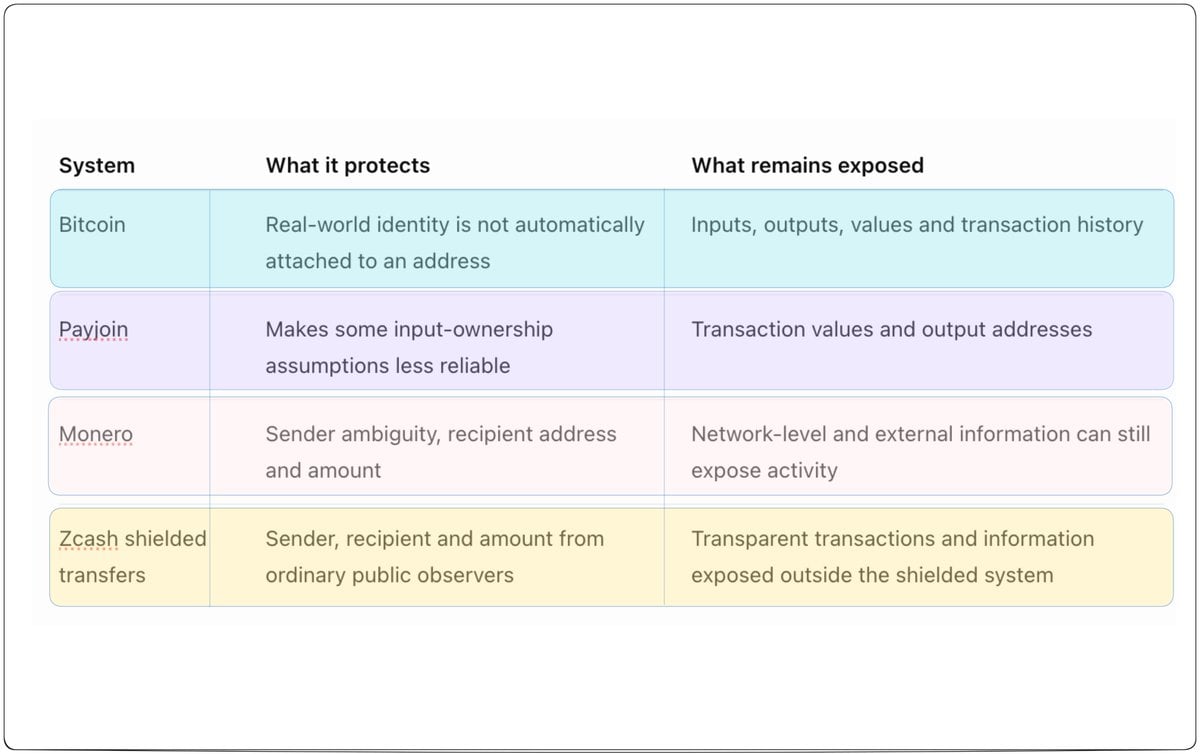
Fig: Comparison of on-chain privacy features between Bitcoin, Payjoin, Monero, and Zcash
It is crucial to emphasize that the above comparison only describes on-chain information external observers can obtain from the blockchain ledger itself, and does not cover off-chain risks such as IP address leaks, device compromises, or exchange-based real-name aggregation.
Privacy is absolutely not a single static feature, but rather a set of coordinated, complementary depth-defense systems.
New Privacy Challenges for Application-Layer Smart Contracts
Since the birth of Bitcoin, the industry's greatest evolution has not been limited to developing tokens that obscure transaction details, but rather injecting privacy concepts into the design DNA of smart contracts and decentralized applications.
Nowadays, human behavior on-chain far exceeds simple transfers: lending staking, decentralized trading, DAO governance voting, asset allocation management, and proof-of-eligibility.
None of these interactions fail to release sensitive commercial and personal data: traders do not want their hidden position cards to be tracked and monitored in real-time by the whole network; enterprises refuse to transparently disclose treasury fund flows to competitors; ordinary users need to prove eligibility without exposing their full real-world identities.
Programmable confidential smart contracts were born precisely to resolve this contradiction. Their core objective is to allow decentralized applications to efficiently execute complex businesses without making every piece of data involved in the process publicly available in plaintext.
Currently, the industry is breaking through from different architectural dimensions:
Aztec: A Layer 2 Balancing Private and Public Functions
Aztec is dedicated to building a privacy-focused Layer 2 on Ethereum, whose smart contracts at the code level allow developers to flexibly mix declarations of private functions and public functions.
The core dividing line lies in where the code executes:
Private functions are deployed and executed within a Private Execution Environment (PXE) on the user's local device, completing confidential computations locally and generating corresponding zero-knowledge proofs before submitting only the proofs to the network;
Public functions are executed across network-wide sorters and nodes, utilizing globally readable public states. A single on-chain interaction can smoothly interlink both.
Taking decentralized anonymous voting as an example: voters complete ballot signing in a local private environment without publicly revealing their specific choices to the outside world; public functions then uniformly aggregate vote tallies and update totals on-chain. The entire network can verify the final tally is correct, yet cannot deduce anyone's individual ballot.
But this is not without limitations: when a local client queries network status from a remote node, the remote node can still learn which data the user is monitoring. Running a full node is required to further mitigate such information leakage.
Oasis Sapphire: Confidential Contracts Based on Hardware Trusted Execution Environments (TEE)
Unlike Aztec's technical path focusing on client-side proofs, Oasis Sapphire adopts an entirely different technical paradigm: running confidential smart contracts within hardware-isolated trusted execution environments.
Trusted execution environments rely on hardware physical isolation to protect executing code and confidential data. Sapphire supports fully end-to-end encrypted transaction inputs and confidential smart contract internal states, enabling contracts to securely process sensitive parameters.
Client-side zero-knowledge proofs and hardware TEEs each have their trade-offs: TEE introduces a trust prerequisite in hardware manufacturer security and microcode implementation; whereas zero-knowledge systems rely on the flawless completeness of arithmetic circuit design and mathematical proof systems.
Umbra: Focus on Internal Transfers Within Shielded Pools
Within the Solana ecosystem, Umbra demonstrates an architectural evolution from V1 to V2.
Version 1 utilized encrypted token accounts as intermediaries for entering the shielded pool, while V2 has comprehensively restructured into a fund flow system centered on the shielded pool, allowing users to complete direct confidential transfers within the pool.
But it must be recognized that depositing and withdrawing from the shielded pool will still leave traces on-chain; the specific amounts and time windows of inflows and outflows may still provide clues for on-chain analysis. Its core privacy protection focuses on the intra-pool transfer phase.
Privacy Pools: Enabling Selective Compliance Disclosure
Privacy Pools, created by the 0xbow team, is a compliance privacy protocol across multiple chains in the Ethereum ecosystem, inspired by the academic paper co-authored by Vitalik Buterin et al. in 2023.
Users deposit assets from regular wallets into the shielded pool. Assocation Set Providers (ASPs) screen incoming funds to exclude illicit money, while the entire system operates without centralized KYC or global backdoor viewing keys.
Upon withdrawal, users leverage zero-knowledge proofs to demonstrate that their funds belong to a screened, compliant set, without needing to disclose exactly which pool deposit they are referring to. This protects the secrecy of legitimate personal finances while cutting off the possibility of illicit funds contaminating the compliant pool.
This is a perfect manifestation of the selective disclosure concept proposed by Eric Hughes decades ago in the modern DeFi realm: compliance and privacy are no longer mutually exclusive.
Kohaku Questions the Core Pain Point: What Did Wallets Expose Before the Transaction?
In the field of blockchain privacy, there exists another crucial yet long-ignored vulnerability.
A user employing even the top-tier confidential transaction protocols could potentially leak everything before the transaction is even initiated, through the wallet's own routine network requests.
When a wallet opens to refresh account balances, it typically initiates data queries to remote RPC nodes. This request directly informs the service provider which address the user is closely monitoring.
Similar leaks frequently occur during routine operations like querying historical transaction streams, simulating contract transaction pre-executions, or fetching token metadata. The transaction itself might be confidential, but the network requests sent prior to it are riddled with vulnerabilities.
This is precisely the domain where leading-edge privacy project Kohaku in the Ethereum ecosystem focuses its efforts. As an open-source privacy-preserving wallet and SDK specification, Kohaku aims to rebuild defenses from the foundational layer of wallet infrastructure.
Kohaku introduces Private Information Retrieval (PIR) technology: in traditional balance queries, the server receives a plaintext address and returns data; under the PIR framework, the wallet constructs special encrypted queries that allow the server to return the target result while remaining completely unaware of which specific account the user actually queried.
Wallets serve as the primary gateway for users to manage private keys, accounts, signing permissions, and application interactions. If this entry point continuously leaks metadata, secure closed-loop protection can never be achieved relying solely on underlying confidential transactions.
Have We Surpassed Satoshi's Privacy Model?
Judged by specific technical indicators, the answer is unquestionably affirmative.
Satoshi's initial design was based on pseudonymous public keys and completely transparent transaction history. Yet in today's cryptographic world:
- Regarding transaction confidentiality, the shielded transactions of Monero and Zcash have achieved comprehensive on-chain concealment of inputs, outputs, and amounts—something Satoshi could not realize back then;
- Regarding verifiable computation, modern zero-knowledge proof systems can now mathematically prove the compliant execution of complex logic to the entire network without exposing plaintext inputs;
- Regarding application expansion, Aztec brings programmable privacy contracts, Oasis Sapphire enables hardware-based confidential computing, Privacy Pools pioneers compliant selective disclosure, and Kohaku strives to solve wallet client query leaks.
But if asked whether the privacy problem has been completely solved, the answer remains negative.
A confidential transaction cannot hide physical IP leaks during broadcasting; a privacy contract cannot erase temporal patterns of public function interactions; a shielded fund pool cannot neutralize fund correlations going in and out; a TEE hardware setup cannot escape security assumptions tied to chip manufacturers; and a brilliant mathematical proof cannot protect a local device already compromised by malware.
True privacy security must cover the entire process chain: from terminal wallets, physical hardware, application interfaces, network transmission, smart contracts, all the way to the ultimately settled on-chain data.
What Should Be Public, and What Should Remain Confidential?
For years, the blockchain industry has always been built upon the cornerstone of global public state.
Total transparency brings permissionless independent verification capabilities, but also lays bare the lives and financial veins of ordinary individuals and commercial entities.
We do not advocate locking all information on the blockchain into a black box; this is precisely the core logic behind "selective disclosure":
- Public governance bodies and public fiscal expenditures must remain openly transparent, subject to strict oversight by all sectors of society, and the enforcement of network rules must allow for universal verifiability;
- But private savings, wage income, daily micro-payments, investment positions, and commercial contracts of ordinary citizens should absolutely not be forced to be exposed unreservedly to the world simply because blockchain technology is used.
The two can perfectly coexist: individuals can prove to service providers that they meet admission criteria without handing over an entire household registration archive; enterprises can smoothly settle accounts without exposing their strategic financial positions to competitors; voters can cast their sacred ballot while voting results undergo complete public audit; wallets can query assets without exposing any specific accounts to service providers.
This is not about pursuing absolute obscurity, but defending the control rights over one's own data.
As Eric Hughes so aptly wrote over thirty years ago: Privacy is the power to selectively reveal oneself to the world.
Bitcoin Opened the Curtain, But the Journey Is Far From Over
Whenever we revisit the words Satoshi wrote in Section 10 of the whitepaper, what commands the deepest reverence is not that Bitcoin unilaterally and forever solved every privacy proposition, but rather that Satoshi clearly perceived the deep tension between public ledgers and personal privacy from day one, offering a pragmatic engineering balance under specific historical conditions.
The relentless questioning pursued by cypherpunks over decades remains unchanged: How can people enjoy convenience in the digital age without being forced to relinquish personal data that should never be subject to prying eyes?
Bitcoin took the most critical first step for this era, with succeeding researchers and engineers continuously pushing forward along this path.
When evaluating current privacy projects, we cannot merely rest on project marketing slogans, fashionable cryptographic jargon, or simple "confidentiality supported" tags.
We need to calmly scrutinize: What exactly does this system hide? Which pieces of information still remain exposed to broad daylight? Whose credibility are its security assumptions built upon? What will actually happen when it enters the real commercial world and operates?
That initial question posed by cypherpunks still warrants deep reflection from every practitioner to this day: On what basis should a technical system acquire extraneous information beyond what is strictly necessary to fulfill its core function?
Bitcoin allowed us to achieve currency verifiability without banks; while the puzzle piece contemporary privacy systems are striving to complete is, while guarding this verifiability, returning the dignity and power to choose how to present oneself intact to every independent individual.
References and Further Reading
Early Digital Cash and Cypherpunks
· David Chaum, Blind Signatures for Untraceable Payments (1982)
· Timothy C. May, The Crypto Anarchist Manifesto (1988)
· Eric Hughes, A Cypherpunk's Manifesto (1993)
· Wei Dai, b-money (1998)
· Adam Back, Hashcash (1997)
Bitcoin and Its Privacy Model
· Satoshi Nakamoto, Bitcoin: A Peer-to-Peer Electronic Cash System (2008), Section 10
· Satoshi Nakamoto, BitcoinTalk discussion: Not a suggestion (2010)
· BIP 78: A Simple Payjoin Proposal
Privacy Academic Research and Frontier Protocols
· Miers et al., Zerocoin (IEEE S&P, 2013)
· Ben-Sasson et al., Zerocash (IEEE S&P, 2014)
· Monero Technical Specifications & Dandelion++
· Zcash Documentation: Addresses and Value Pools
· Aztec Network: Private Execution Environment (PXE)
· Oasis Sapphire Confidential EVM Documentation
· Umbra V2 Shielded Pool Documentation
· Privacy Pools (0xbow) Research Paper & Documentation
· Kohaku: Ethereum Privacy Preserving Wallet & SDK
· Ethereum Foundation Reads: PIR for Wallets
Join TechFlow official community to stay tuned
Telegram:https://t.me/TechFlowDaily
X (Twitter):https://x.com/TechFlowPost
X (Twitter) EN:https://x.com/BlockFlow_News
 @Lithos_eth