Crypto Morning Brief: SpaceX Catches Returning Starship with Tower for First Time, Petition Demanding Jensen Huang's Reinstatement Exceeds 100,000 Signatories
Author: TechFlow
Yesterday's Market Highlights
Michael Saylor Releases Bitcoin Tracker Update Again, Hinting at Further BTC Accumulation
According to a post by Strategy Chairman Michael Saylor, he shared a Bitcoin holdings tracker chart accompanied by the caption, "This dip might need some orange," suggesting that Strategy may continue to accumulate BTC.
Ai Yi Reviews Long Positions' P&L: 'Big Target Bro' Reclaims Over $93 Million in Profits
On November 15, on-chain analyst Ai Yi reported that following recent market declines, several long traders experienced significant drawdowns in their profits or assets.
Among them, "Big Target Bro" gave up over $93 million in cumulative profits, leaving approximately $17.76 million remaining; 48Clublan's assets shrank by $91.36 million; and "Iron-headed Bulls" recorded unrealized losses of $50.75 million.
Kava Lend Lending Protocol Attacked, Approximately 55.2 Million KAVA Borrowed
According to The Block, on-chain data shows that an attacker borrowed approximately 55.2 million KAVA tokens from the Kava Lend lending protocol on the Kava chain, valued at around $3.76 million based on pre-attack prices.
The report notes that the attacker exploited idle mechanisms in the BUSD market to amplify deposit value by roughly 243,000 times, repeatedly borrowing KAVA using inflated collateral. Subsequently, about 49.2 million KAVA were bridged to BNB Chain via LayerZero, with most sold in exchange for approximately $2.09 million worth of BNB and USDT.
Kava previously stated that the incident does not involve unlimited minting and the impact is limited to Kava Lend; cooperating exchanges have suspended KAVA deposits and withdrawals, and the team has also paused the Axelar cross-chain bridge.
SpaceX Successfully Catches Returning Starship Capsule with Launch Tower for the First Time
According to SpaceX, the launch tower Mechazilla successfully caught the returning Starship spacecraft.
SpaceX CEO Musk subsequently shared a recovery video, referencing the previous three booster recoveries and this capsule recovery. SpaceX previously noted that the 15th Starship flight originally aimed to return both the capsule and Super Heavy booster to the launch site for tower capture.
Petition Demanding Huang Renxun's Reinstatement Surpasses 100,000 Signatures
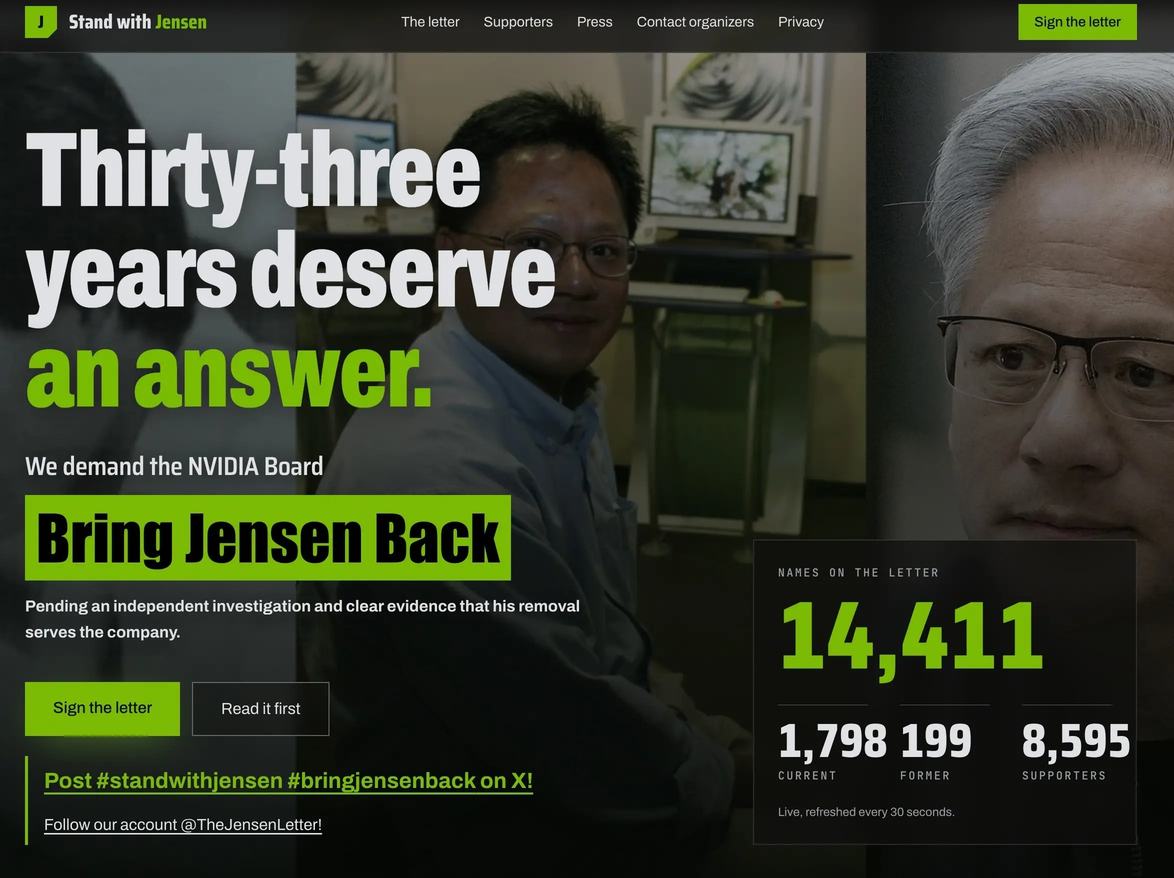
According to Jinshi Data, as of publication, the "Stand with Jensen" petition calling on NVIDIA's board to reinstate Huang Renxun during an independent review has gathered over 100,000 signatures.
Tesla CEO Musk and other industry figures have participated in the petition.
Ethereum Foundation Affiliate Wallets Sell Cumulative 7,500 ETH Over Four Days
Motion monitored by Onchain Lens shows that Ethereum Foundation affiliate wallets again sold 2,500 ETH via CoW Swap, exchanging it for 4.597 million USDS, with proceeds subsequently transferred to a multi-signature Safe wallet.
Over the past four days, these wallets cumulatively sold 7,500 ETH in exchange for approximately 14.52 million USDS.
Meta Internally Tests Points-Based Prediction Market App Takes
According to The Block, Meta has begun an internal pilot of the prediction market application Takes with employees, allowing users to predict outcomes using points instead of real funds.
Sources familiar with the matter revealed that the app uses a point system called "cred," awarding points for correct predictions and deducting them for incorrect ones. The project was previously unveiled under the name Arena, and Meta CEO Mark Zuckerberg had tasked employees with developing an independent prediction market application. Meta declined to comment on its public launch timeline.
Zhang Yiming and He Yi Suspected on Pro-Huang Renxun Petition List as Signatures Exceed 20,000
On November 14, the Stand with Jensen petition website saw a signature from "Yiming Zhang (ByteDance)" with the message "Stand with Jensen," suspected to be ByteDance founder Zhang Yiming.
The list also included a signature from "Yi He, Binance Co-founder and Chief Customer Officer" with the remark "I wear leather jackets too, I disagree." He Yi had previously retweeted Musk's post supporting Huang Renxun on X.
Additionally, the list features a16z co-founder Marc Andreessen, Epic Games CEO Tim Sweeney, Y Combinator CEO Garry Tan, Palo Alto Networks CEO Nikesh Arora, Cohere co-founder Aidan Gomez, and others.
Website data indicates the total number of signatures has surpassed 20,000, including 2,107 claiming current NVIDIA employment, 267 former employees, and 12,406 shareholders. Signatories self-report their identities, and the website does not verify them; none of the aforementioned individuals have publicly confirmed their signatures yet.
Musk: Petition to Restore Huang Renxun as NVIDIA CEO Is Ongoing, I Will Also Sign
On November 14, when responding to a follower on X, Musk stated that a petition demanding the reinstatement of Huang Renxun as NVIDIA's CEO is underway, adding, "I will sign it too."
The post Musk replied to was published by X user Yun-Ta Tsai. Tsai argued that if NVIDIA employees want Huang Renxun to return, they should collectively resign under the slogan "NVIDIA is nothing without its employees"; superior GPU engineers are harder to find and replace than machine learning engineers, and it is engineers, not the board, who define the company's mission.
Previously, NVIDIA employees internally initiated a petition calling for Huang Renxun to return to the CEO role.
Binance to Adjust Size and Ticker for Pre-IPO Perpetual Contract on Anthropic
According to a Binance announcement, Binance Futures will adjust the size of the ANTHROPICUSDT pre-IPO perpetual contract at 16:30 Beijing Time on November 17, changing the ticker to ANTUSDT, with completion expected at 19:00 that day.
The announcement states the revised estimated share count is 13.116075288 billion shares, with an adjustment factor of 13.116. If the actual share count used to determine the current contract size upon formal listing differs from the November 17 revised estimate by less than 3%, no contract size adjustment will be made.
During the adjustment period, trading, position closing, order placement, funding rates, and liquidation functions for the contract will be paused, and all existing orders will be canceled; open positions will be closed out first and re-established after adjustments. Positions held by relevant strategy bots will be automatically closed at 16:15 Beijing Time and will not be restored post-adjustment.
Today's Market Overview
Recommended Reading
Musk Leads Petition Signing, Silicon Valley Backs Huang Renxun, Thousands Urge "Return of the Founder"
https://www.techflowpost.com/article/35377
This article focuses on the wave of founder reinstatement petitions sweeping Silicon Valley after Huang Renxun stepped down as NVIDIA's CEO. Musk publicly stated he is signing the petition to support Huang Renxun taking the helm again, with the related website surpassing 14,000 signatures and even facing server strain due to traffic spikes.
Supporters argue that Huang Renxun is not merely a manager at NVIDIA but the core of its technological roadmap and corporate culture. Former NVIDIA GPU engineer and current Tesla senior engineer Yun-Ta Tsai warned that improper handling by the board could trigger a mass exodus of core hardware engineers. Investor Naval Ravikant cited Steve Jobs leaving Apple and Travis Kalanick being ousted from Uber to emphasize that founders' strategic vision and organizational cohesion are difficult for typical professional managers to replace, a view also openly endorsed by Musk.
The article's core argument is that the risks posed by Huang Renxun's departure extend far beyond a simple CEO succession, potentially meaning NVIDIA loses the key figure defining its technical direction and rallying top talent. For a company heavily reliant on technological innovation, founder culture itself serves as a crucial competitive moat.
Concern Mounts Among a NVIDIA China Employee
https://www.techflowpost.com/article/35376
This article focuses on the career uncertainty faced by NVIDIA's China-based employees following Huang Renxun's resignation as CEO. Although NVIDIA has not announced plans to shrink its China team, with ongoing hiring for R&D, GPU architecture, circuit validation, and autonomous driving roles in Shanghai, Beijing, and Shenzhen, employees are already concerned about potential organizational restructuring due to leadership changes.
The article notes that Huang Renxun has historically played a pivotal role in driving China's business and team expansion. In 2025, he revealed that NVIDIA's China region employs nearly 4,000 people, with a turnover rate of only about 0.9%. However, as U.S. chip export controls continue to tighten, China's contribution to NVIDIA's data center business has significantly dropped: in fiscal year 2026, mainland China and Hong Kong customer revenue amounted to approximately $19.68 billion, representing 9.1% of global revenue, with advanced data center chip operations facing particularly severe restrictions.
For Chinese employees, the issue extends beyond whether the business will contract; it also includes potential changes to the existing organizational structure, resource allocation, and regional strategy following the new CEO's appointment. The article mentions that some staff have begun reassessing their career choices and are even preparing to seek new opportunities.
Key Takeaway: The impact of Huang Renxun's departure may extend beyond leadership changes at NVIDIA headquarters, potentially cascading into restructuring, resource shifts, and strategic realignment in the China region. For this team of nearly 4,000, the greatest risk is a future change in how priority is assigned to the Chinese market within NVIDIA's global strategy.
Crypto Protocols Approaching $14 Billion in Annual Revenue: Why Token Buybacks Are Key to Outperforming the Market?
https://www.techflowpost.com/article/35364
This article argues that the crypto market in 2026 is shifting from pure narrative speculation to fundamental investing, with genuine revenue and token buybacks becoming critical pillars for long-term project value. As of November, mainstream crypto protocols have generated approximately $11.68 billion in on-chain revenue year-to-date, with full-year projections nearing $13.9 billion.
The article highlights that among the 12 revenue-generating projects actively conducting buybacks in 2026, average price gains reached 62.2% year-to-date, whereas the 4 projects without active buybacks averaged a 31.6% decline. The author posits that buyback effectiveness hinges not on the amount spent, but on three factors: whether real business revenue supports it, whether new token issuance offsets buyback demand, and whether the team allocates capital efficiently.
The article highlights several case studies: Hyperliquid and Pump.fun lead in buyback volume; World Liberty Financial dedicates USD1 reserve earnings to WLFI buybacks; AI platform Venice burns VVV through subscription and API revenues; and Bittensor subnets experiment with repurchasing and burning subnet tokens using AI compute service income.
The core thesis is that what truly matters going forward are not just large-revenue crypto projects, but those capable of consistently converting real commercial income into token demand. However, buybacks do not equate to shareholder dividends nor guarantee price appreciation; token unlocks, market conditions, and capital deployment efficiency ultimately dictate performance.
Ethereum Treasury Company BTCS Cuts Losses Selling ETH, Faces $64.1 Million Loan Liquidation Risk
https://www.techflowpost.com/article/35362
Ethereum treasury-listed company BTCS is facing elevated on-chain leverage risks. According to its 10-Q quarterly report filed with the U.S. SEC, as of November 9, the company holds approximately $64.1 million in outstanding borrowings on Aave, collateralized by 46,676 ETH valued at around $99.3 million at the time, resulting in a health factor of just 1.24. Should ETH fall below $1,717 without additional collateral from the company, the position risks triggering smart contract liquidation. To mitigate risk, BTCS has begun selling portions of its ETH below cost basis to proactively repay debt and lower its loan-to-value ratio.
More alarming is the company's cash flow posture: as of September 30, cash and cash equivalents stood at merely around $463,000, while most ETH remains locked as collateral on Aave and cannot be freely utilized until the loans are settled. As of November 11, forced liquidation has not occurred, but interest continues to accrue and liquidation thresholds may progressively rise.
This incident exposes the risks of listed companies combining ETH treasuries with DeFi leverage: it amplifies capital efficiency during bull markets but can force distress sales during downturns due to collateral depreciation and insufficient cash reserves. BTCS now faces not just ETH price volatility, but dual pressures on asset liquidity and solvency.
Join TechFlow official community to stay tuned
Telegram:https://t.me/TechFlowDaily
X (Twitter):https://x.com/TechFlowPost
X (Twitter) EN:https://x.com/BlockFlow_News
 深潮TechFlow