Bank of America Research Report Analysis: Bull-Bear Indicator Rises to 9.6, Historical Level Corresponds to "Sell Signal"
TechFlow Selected TechFlow Selected
Bank of America Research Report Analysis: Bull-Bear Indicator Rises to 9.6, Historical Level Corresponds to "Sell Signal"
Bank of America's conclusion: Retreat or rotation; adding positions is not an option.
 Navigating Web3 tides with focused insights
By: Rita
TechFlow Guide
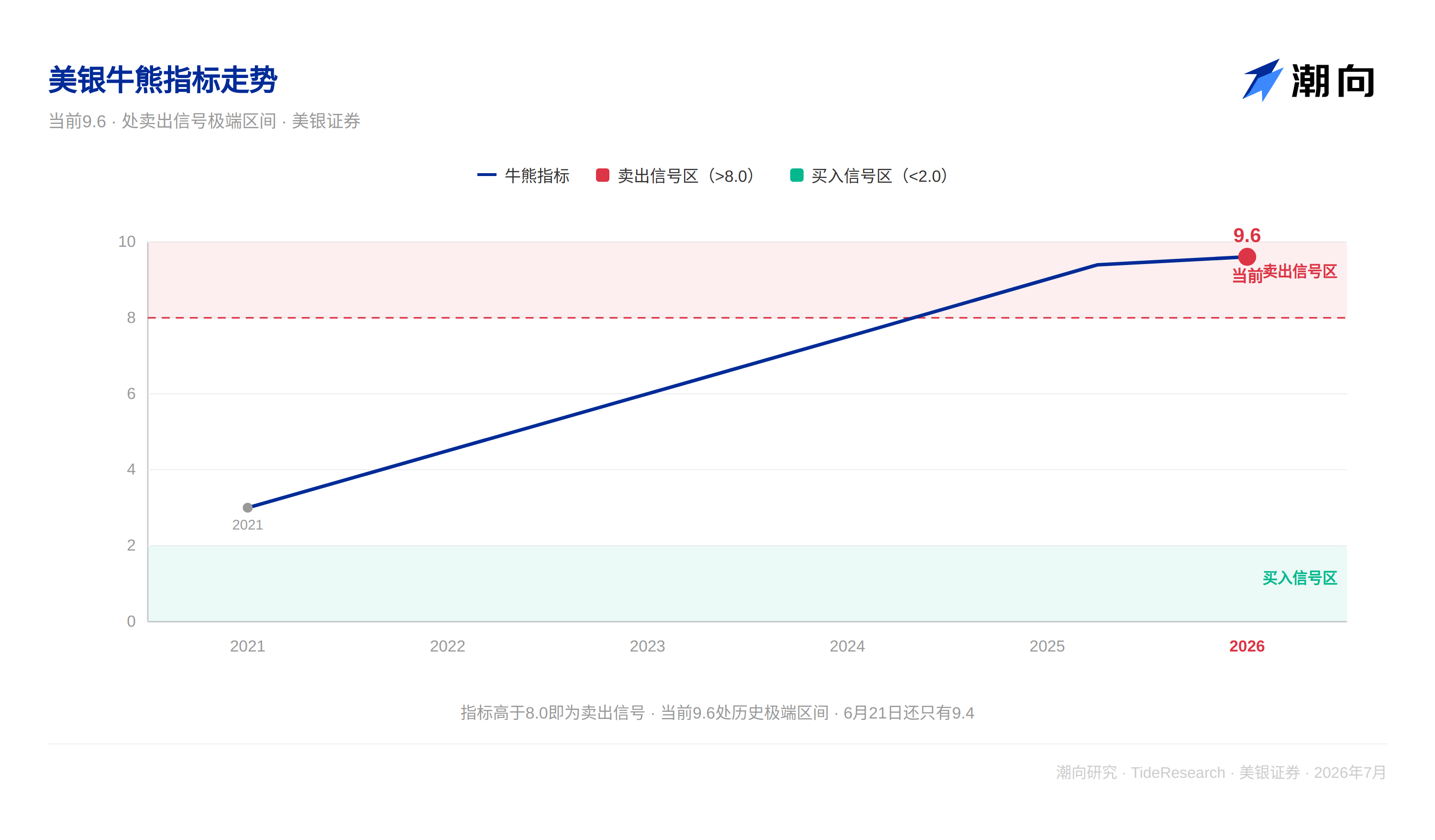
BofA's Bull & Bear Indicator has risen again, from 9.4 to 9.6, moving further into the extreme bullish zone. Historically, a reading above 8.0 on this indicator is a sell signal.
While the signal is flashing red, capital is still pouring in frenetically. Semiconductor ETFs have seen inflows of $46 billion this year, accounting for 31% of AUM; tech fund inflows over the past three weeks hit a record $48 billion. The problem is, the PHLX Semiconductor Sector Index has fallen about 20% from its June highs, yet capital is buying into a declining sector.
BofA's conclusion is straightforward: retreat or rotate; adding positions is not an option.
All Indicators of Extreme Bullishness Are Flashing
The Bull & Bear Indicator rose to 9.6, driven by three factors: institutional cash levels fell to 3.6% (July Global Fund Manager Survey), strong equity inflows, and improved global equity index breadth. This was partially offset by rising AT1 credit spreads, but the overall reading remains in the extreme zone.
BofA explicitly stated in the report that the current signal means the market is "topping out," recommending reducing equity exposure; retreating or rotating is a wiser strategy than adding positions.
This is not an isolated signal. BofA Private Client cash allocation dropped to a historic low of 9.6%, while equity allocation rose to 65.8%. Over the past four weeks, private clients have continuously bought municipal bonds and defensive sector ETFs (Consumer Staples, Healthcare, Utilities), while selling Materials, Low Volatility, and Energy ETFs. Capital is shifting towards defense, but the overall state remains extremely bullish.
Capital Is Buying Declining Semiconductors
The strangest scene is unfolding in the semiconductor sector. The SOX Index has fallen about 20% from its June highs, yet capital continues to pour into semiconductor ETFs. In the past week, the 8 largest semiconductor ETFs saw another $2.3 billion in inflows, totaling $46 billion year-to-date, equivalent to 31% of these ETFs' total AUM. Historically, such large inflows usually accompany sector gains; this situation during a decline is uncommon.
BofA describes this phenomenon as "prices falling sharply, but positions not declining." This is a typical "buying the dip" mindset, but against the backdrop of the Bull & Bear Indicator flashing red, the risk of buying the dip is rising.
Tech funds have seen cumulative inflows of $48 billion over the past three weeks, a historic record. BofA refers to this as "chasing" in the report, believing these inflows reflect more of a belief that "AI isn't over yet" rather than fundamental judgment.
Three "Won't Happen" Consensuses Are Loosening
The July Global Fund Manager Survey shows that investors' extreme optimism is built on three assumptions: the economy will not recession (54% believe in "no landing"), the Fed will not raise rates (83% believe no rate hike before the November mid-term elections), and hyperscalers will not cut AI capex (61% believe not before year-end).
BofA believes all three consensuses could be broken.
Inflation is not truly under control. Based on current trends, US CPI will remain around 3.9% by the end of 2026, with core inflation still running at a 0.3% month-over-month level. The Strait of Hormuz could close again, and US crude oil inventories have fallen to a 45-year low (43 days of supply); upside risks to oil prices could reappear at any time. If the Fed unexpectedly raises rates before November, the biggest beneficiary will be the USD.
Hyperscalers' AI capex is squeezing free cash flow. It is expected to turn negative in 2027, and credit markets are already reflecting pressure. Oracle CDS and IG tech bond spreads are returning to highs seen in September 2025, rising from 59 basis points to 87 basis points. BofA believes that if any hyperscaler announces a cut in AI capex, it will be a major turning point for the market.
What Is the Only "Buy Signal"
BofA provided a specific observation anchor in the report: MAGS (Mag 7 Index).
If MAGS falls below 65, it means the broader market is correcting, which will drag down long positions in cyclical sectors (banks, brokerages, industrial stocks). If MAGS breaks through 70, that is the reliable signal to re-enter.
Before then, BofA's advice is clear: the best strategy for summer is to retreat or rotate; adding positions is not under consideration. Directions include duration, defensive sectors, high dividends, and the USD.
TechFlow Perspective
The most valuable part of this BofA report is turning the vague judgment of "extreme sentiment" into a quantifiable system: a Bull & Bear Indicator of 9.6 equals a sell signal.
Extremes themselves are not predictions; they describe the current state. The 9.6 signal indicates the "degree of crowding"; it does not answer the question of "how much will it fall." But historically, when institutional cash falls below 4%, private client cash hits historic lows, and capital continues to pour in while prices fall, these combinations usually mean the market's risk-reward ratio is deteriorating.
For investors, the real anchor to watch is MAGS; its fluctuation between 62 and 70 will determine whether to retreat or enter. BofA did not give a directional conclusion but provided a clear observation framework: fall below 65, retreat; break through 70, enter.

Disclaimer
This article is a compilation and interpretation by TechFlow Research of a third-party broker research report (BofA Securities, July 17, 2026). The ratings, target prices, earnings forecasts, and related judgments cited in the text are the views of the broker's analysts, representing only their institution's stance, not representing the views of TechFlow Research, nor constituting any investment advice.
The market carries risks; decisions must be independent. This article should not be used as a basis for buying or selling any securities.
Join TechFlow official community to stay tuned
Telegram:https://t.me/TechFlowDaily
X (Twitter):https://x.com/TechFlowPost
X (Twitter) EN:https://x.com/BlockFlow_News
 @chaoxiangooo