








GPT-5.5 Is Here—But This Time, OpenAI Aims to Prove More Than Just “Smarter”
TechFlow Selected TechFlow Selected
GPT-5.5 Is Here—But This Time, OpenAI Aims to Prove More Than Just “Smarter”
Six weeks—and another generation. OpenAI’s release cadence is suffocating.
 Navigating Web3 tides with focused insights
Author: Hualin Wuwang
If someone had told you a few years ago, “You’ll be reviewing a new AI model, and before you finish your draft, the next generation will already be out,” you’d most likely have dismissed it as nonsense.
But now, it’s actually happening.
GPT-5.4 was released six weeks ago. Today, GPT-5.5 is already rolling out to paying users on ChatGPT.
This isn’t just an ordinary version update. OpenAI positions it as “a new intelligence tier”—delivering a significant leap in intelligence while maintaining inference latency comparable to GPT-5.4 in real-world service.
In one sentence: smarter—and faster.
Based on early user feedback, OpenAI may genuinely be staging a comeback!
01 “Faster” and “Stronger”: This Time, OpenAI Wants Both
To grasp the core logic behind GPT-5.5, you first need to understand a long-standing paradox in the AI industry.
The smarter the model, the slower and more expensive it tends to be. This has become an almost default industry rule. Deeper reasoning and more complex task handling come at the cost of higher latency and greater computational expense. Users and enterprise customers are often forced to choose between the two.
GPT-5.5 aims to break this trade-off.
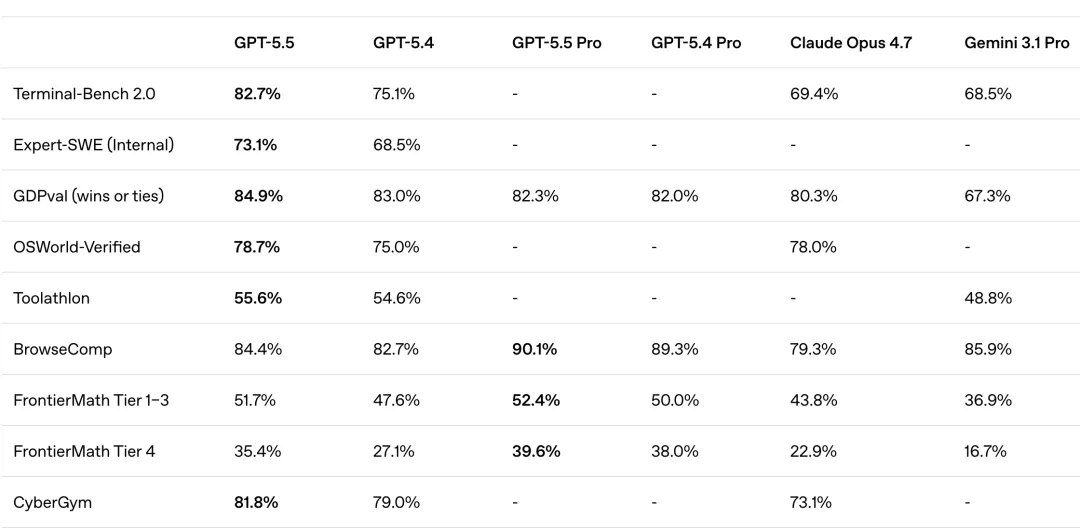
GPT-5.5’s performance stands out among peers. | Source: OpenAI
OpenAI claims that, in “real-world service,” the new model maintains per-token latency on par with GPT-5.4—yet its intelligence level already far surpasses it. VentureBeat’s benchmark testing shows GPT-5.5 achieves state-of-the-art results across 14 benchmarks—compared to Anthropic’s Claude Opus 4.7 (4 benchmarks) and Google Gemini 3.1 Pro (2 benchmarks).
In terms of capabilities, GPT-5.5 excels particularly at coding and debugging, online research, data analysis, document processing, and software operation—“agent-style” tasks.
Greg Brockman, OpenAI co-founder, calls it a “major step forward” toward “more agentic and intuitive computing.”
The most tangible example comes from Jackson Laboratory. Professor Derya Unutmaz of genomic medicine used GPT-5.5 Pro to analyze a dataset of 28,000 genes—generating a full report in minutes, a task his team would normally take months to complete.
This isn’t just time compression—it’s a paradigm shift in how work gets done.
02 A New Version Every Six Weeks: Product Cadence or Market Anxiety?
What’s even more telling is the signal embedded in OpenAI’s release cadence.
Six weeks. From GPT-5.4 to GPT-5.5—just six weeks.
Looking back over the past two months, OpenAI’s activity has been unusually dense. On April 21, ChatGPT Images 2.0 launched; Sam Altman stated live that the leap from gpt-image-1 to gpt-image-2 was “equivalent to jumping from GPT-3 to GPT-5.” That same day, OpenAI announced a partnership with consulting firms to roll out Codex to enterprises. Chief Revenue Officer Denise Dresser said this would help reach “enterprise customers they couldn’t access alone.”
Codex currently boasts over 4 million weekly active users—up from 3 million two weeks ago and 2 million last month. That growth rate speaks volumes.
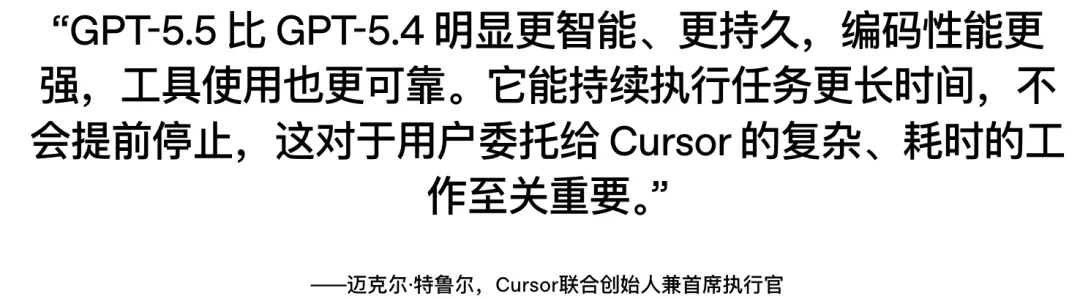
Cursor CEO sends congratulations. | Source: OpenAI
Meanwhile, over the past few weeks, OpenAI acquired Hiro—a personal finance startup—and TBPN, a new media company. The former signals a move beyond chatbots toward “something truly worth paying for”; the latter clearly aims to “better shape public perception—which has recently been less than ideal.”
Taken together, these moves convey a subtle sense of urgency.
The company has just closed a $122 billion funding round and generates $2 billion monthly in revenue. By any measure, it’s among the world’s wealthiest AI companies. Yet social media chatter about “OpenAI losing consumer appeal” and “falling behind Anthropic in enterprise customer acquisition” hasn’t subsided—even amid these numbers.
GPT-5.5’s launch, in a sense, is OpenAI’s public response to those criticisms.
03 Winning Benchmarks ≠ Winning Enterprise Trust
However, defining winners by benchmark scores can be misleading in the enterprise market.
Leigh-Ann Russell, CIO of a New York bank, put it bluntly: her top priority isn’t raw capability—it’s “response quality and impressive hallucination resistance.” “Banks require extremely high accuracy, which is critical for a heavily regulated institution.”
That statement reflects the real priorities of a broad swath of enterprise customers. They aren’t choosing “the smartest AI”—they’re choosing “the AI least likely to make mistakes.”
That’s why Anthropic continues gaining enterprise share: the Claude series has built strong brand recognition around “safety” and “predictability.” GPT-5.5’s sweeping benchmark lead must translate into demonstrable evidence of “trustworthiness” before it wins serious enterprise contracts.
One detail is telling: NVIDIA engineers internally reportedly described losing access to GPT-5.5 as “like having a limb severed.” This sentiment, circulating within the industry, suggests GPT-5.5 has already forged genuine dependency among some high-end users.
Yet there remains a long road from “some people love it” to “enterprises deploy it in mission-critical systems.”
04 When Speed Itself Becomes Competitive Advantage
From a broader perspective, GPT-5.5’s launch reveals a deeper industry trend.
Cutting-edge AI labs are shifting competition—from “whose model is stronger?” to “whose iteration cycle is faster?”
A major version every six weeks would have been unthinkable two years ago. And it’s not just incremental version-number updates—each iteration delivers tangible capability leaps. Brandon White, CEO of Axiom Bio, even predicted that if OpenAI sustains this pace, “the foundations of drug discovery will change before year-end.”
That may sound optimistic—but it captures a real sentiment: the pace of AI capability advancement is beginning to outstrip most people’s imagination of its application potential.
Mark Chen, OpenAI’s Chief Research Officer, characterized GPT-5.5’s capabilities in scientific and technical research as “meaningful progress,” noting it can “help expert scientists advance.” That phrasing is deliberate—not “replace” scientists, but “help experts advance.” It’s a way of showcasing capability while actively managing narrative.
GPT-5.5 is available to Plus, Pro, Business, and Enterprise subscribers, rolled out simultaneously across ChatGPT and Codex. This distribution strategy itself sends a commercial signal—to retain consumer-side user stickiness while accelerating enterprise penetration via Codex and consulting partners.
Two-pronged execution—and the pace is accelerating.
In six weeks, we’ll likely see GPT-5.6.
Join TechFlow official community to stay tuned
Telegram:https://t.me/TechFlowDaily
X (Twitter):https://x.com/TechFlowPost
X (Twitter) EN:https://x.com/BlockFlow_News
 极客公园
极客公园


