








The "Ultimate Forecast" from Silicon Valley's Brightest Minds: What Should We "All-In" On by 2026?
TechFlow Selected TechFlow Selected
The "Ultimate Forecast" from Silicon Valley's Brightest Minds: What Should We "All-In" On by 2026?
From Silicon Valley titan to "White House AI and Crypto Czar," here's a comprehensive assessment of business, politics, and technology in 2026.
 Navigating Web3 tides with focused insights
Author: Frank, MSX Research Institute
At the beginning of 2026, the world stands at an extremely divided crossroads.
On one side: inflation is cooling, AI adoption is accelerating, and capital markets are stirring with anticipation. On the other: geopolitical tensions are rising, institutional uncertainty is growing, and widespread skepticism persists about whether "the next wave of growth" is even real. Against this backdrop, the globally influential tech-business podcast All-In Podcast released its ultimate annual forecast.
Hosted by Silicon Valley’s renowned angel investor Jason Calacanis—early backer of Uber and Robinhood—and featuring heavyweight guests including “King of SPACs” Chamath Palihapitiya, “Scientific Sultan” David Friedberg, and David Sacks, widely regarded as the White House’s first “AI and Crypto Czar,” the discussion brought together a group of top-tier minds who command hundreds of billions in capital and deeply understand the mechanics of power and finance.
This elite brain trust engaged in a fiery debate on politics, technology, investment, and the global geopolitical landscape—ranging from California's wealth tax crisis to expectations of 6% GDP growth, from bullish takes on Huawei and prediction markets to the astonishing hypothesis that SpaceX might merge into Tesla.
MSX Research Institute has distilled the core insights from their intellectual clash for our readers.
The "11 Major Predictions" from 4 Titans
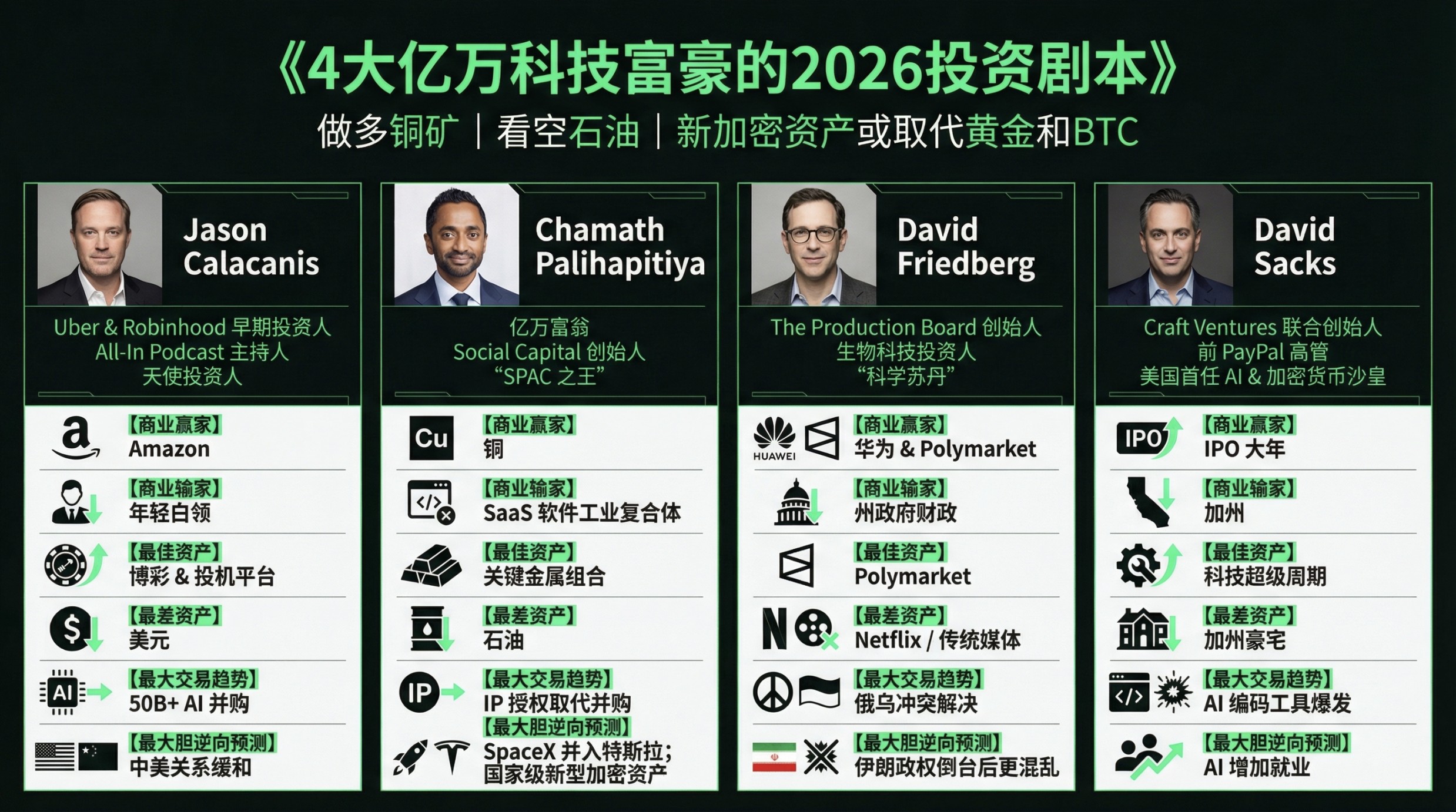
Source: AI-generated image
On California’s proposed wealth tax and capital outflow risks:
- Chamath Palihapitiya: A significant cohort has already clearly chosen to leave California, collectively holding thousands of billions in net worth—posing a material long-term threat to the state’s fiscal health;
- David Friedberg: The proposal is unlikely to pass, but it reveals structural fiscal pressures at the state level;
- David Sacks: The wealth tax was my direct reason for leaving California. Even if it doesn’t pass in 2026, people expect some version will return in 2028;
On the biggest commercial winners of 2026:
- Jason Calacanis: Amazon—he expects it to reach the “corporate singularity” first, becoming the first company where robots generate more profit than humans. Its automated warehouses and logistics network have built an exceptionally high moat;
- Chamath Palihapitiya: Copper—geopolitics and supply chain security will drive long-term supply-demand imbalance. At current rates, global copper supply could face a ~70% shortfall by 2040;
- David Friedberg: Huawei and prediction markets (PM). The former continues breaking through technologically; the latter is evolving from niche products into new infrastructure for information and price discovery, potentially exploding this year;
- David Sacks: 2026 will be a massive IPO year. “Trumpflation” will restart the capital market expansion cycle, leading to numerous successful listings and trillions in new market value. He agrees with Jason on Amazon, though for different reasons (not elaborated);
On the biggest commercial losers of 2026:
- Jason Calacanis: Young American white-collar workers—entry-level jobs will be prioritized for replacement by AI and automation;
- Chamath Palihapitiya: Enterprise SaaS companies reliant on “maintenance and migration” revenue models will see systemic compression under AI disruption;
- David Friedberg: State government finances—pension liabilities and solvency issues will come sharply into focus;
- David Sacks: California—regulatory and tax uncertainty will continue driving out capital and businesses;
On the most significant transaction forms of 2026:
- Jason Calacanis: A mega-AI acquisition exceeding $50 billion will occur;
- Chamath Palihapitiya: Traditional M&A will give way to large-scale IP licensing partnerships, which will become more common and mature in 2026;
- David Friedberg: Conflict resolution in geopolitics will be the “biggest deal”—the Russia-Ukraine war may be resolved this year;
- David Sacks: Explosive growth in coding assistants and tool-use AI applications;
On the boldest contrarian predictions for 2026:
- Jason Calacanis: U.S.-China relations will experience substantive easing, reaching a mutually beneficial working relationship;
- Chamath Palihapitiya: Two contrarian bets: First, SpaceX won’t go public—it may reverse-merge into Tesla instead. Second, central banks will build a new paradigm of sovereign cryptocurrencies (distinct from BTC);
- David Friedberg: If Iran’s unrest deepens, it could further destabilize the Middle East;
- David Sacks: AI will expand employment rather than destroy jobs—we’re likely to see net job growth;
On the best-performing assets of 2026:
- Jason Calacanis: Speculative platform-type assets—when the economy is poised for takeoff, interest rates may fall, and people have extra cash, they’ll bet more freely;
- Chamath Palihapitiya: Continue betting on a basket of critical metals, including copper;
- David Friedberg: Prediction markets—they’re replacing traditional media and market functions, with enormous potential;
- David Sacks: The tech expansion supercycle;
On the worst-performing assets of 2026:
- Jason Calacanis: The U.S. dollar will remain under pressure;
- Chamath Palihapitiya: Oil is entering a long-term downtrend, possibly falling toward $45 per barrel;
- David Friedberg: Bearish on Netflix and traditional media stocks;
- David Sacks: Bearish on high-end California real estate;
On the most anticipated trends of 2026:
- Jason Calacanis: The IPO market makes a triumphant return—at least two of the giants like SpaceX, Anthropic, or OpenAI will file for listing this year;
- Chamath Palihapitiya: The expansion of “Trumpism”—unilateralism, economic resilience—this is a major trend that will drive substantial GDP growth;
- David Friedberg: The reshaping of Middle East dynamics triggered by escalating tensions in Iran;
- David Sacks: Auditing government spending—needs to make “decentralized DOGE (Department of Government Efficiency)” permanent so the public can see where money is spent;
On the biggest political winners of 2026:
- Jason Calacanis: Young left-wing politicians;
- Chamath Palihapitiya: Anti-waste, anti-bureaucracy political forces;
- David Friedberg: Democratic Socialists of America (DSA)—they’re taking over the Democratic Party, and this trend will solidify in 2026;
- David Sacks: “Trumpflation”—he predicts a rate cut of 75 to 100 basis points by June;
On the biggest political losers of 2026:
- Jason Calacanis: Centrist Democrats;
- Chamath Palihapitiya: The Monroe Doctrine—because Trumpism has surpassed it;
- David Friedberg: The tech industry—becoming a shared target for populist movements on both left and right;
- David Sacks: Centrist Democrats;
Predictions for U.S. GDP growth in 2026:
- Chamath Palihapitiya: Between 5% and 6.2%;
- David Friedberg: 4.6%;
- David Sacks: 5%;
Final Thoughts
Today, China also released its 2025 national economic performance data: GDP reached 140.19 trillion yuan, up 5.0% year-on-year, achieving its target as planned.
If we zoom out to the global context and factor in exchange rate movements over the next one to two years, we observe a subtle yet striking trend: the gap between Chinese and U.S. GDP (in USD terms), which widened significantly in the previous two years, now appears to be narrowing once again at this juncture.
This contrast is thought-provoking: on one side, China seeks high-quality growth amid structural adjustments; on the other, the U.S., as described by the All-In Podcast, attempts to forcibly break free from an era of mediocre growth via “Trumpflation + AI Singularity.”
In essence, the world’s only two major economies have simultaneously entered a renewed phase of competition centered on productivity and structural efficiency. It is precisely within this context that Chamath Palihapitiya’s statement on the show sounds especially provocative: “Don’t short the U.S. economy—it’s ready to take off. 6% GDP growth isn’t fantasy.”
But there’s a prerequisite: in this year of accelerated reshuffling, you must stand on the side of productivity—not on the side being left behind.
Perhaps that is the most important question of this cycle.
A word to share, for mutual encouragement.
Join TechFlow official community to stay tuned
Telegram:https://t.me/TechFlowDaily
X (Twitter):https://x.com/TechFlowPost
X (Twitter) EN:https://x.com/BlockFlow_News


