Interview with Mark Yusko: Is the Crypto Winter Half Over? Will Bitcoin Become the Native Currency of the AI Era?
TechFlow Selected TechFlow Selected
Interview with Mark Yusko: Is the Crypto Winter Half Over? Will Bitcoin Become the Native Currency of the AI Era?
It would be wise to buy BTC between now and September.
 Navigating Web3 tides with focused insights
Compiled & Translated by TechFlow
Guest: Mark Yusko, Morgan Creek Capital Management
Host: Brandon Green, CEO of BTC Inc
Podcast Source: Bitcoin Magazine
Original Title: Mark Yusko: The Bitcoin Price is a Liar – Why to Watch Gold | Bitcoin Magazine Podcast
Release Date: March 4, 2026
Key Takeaways
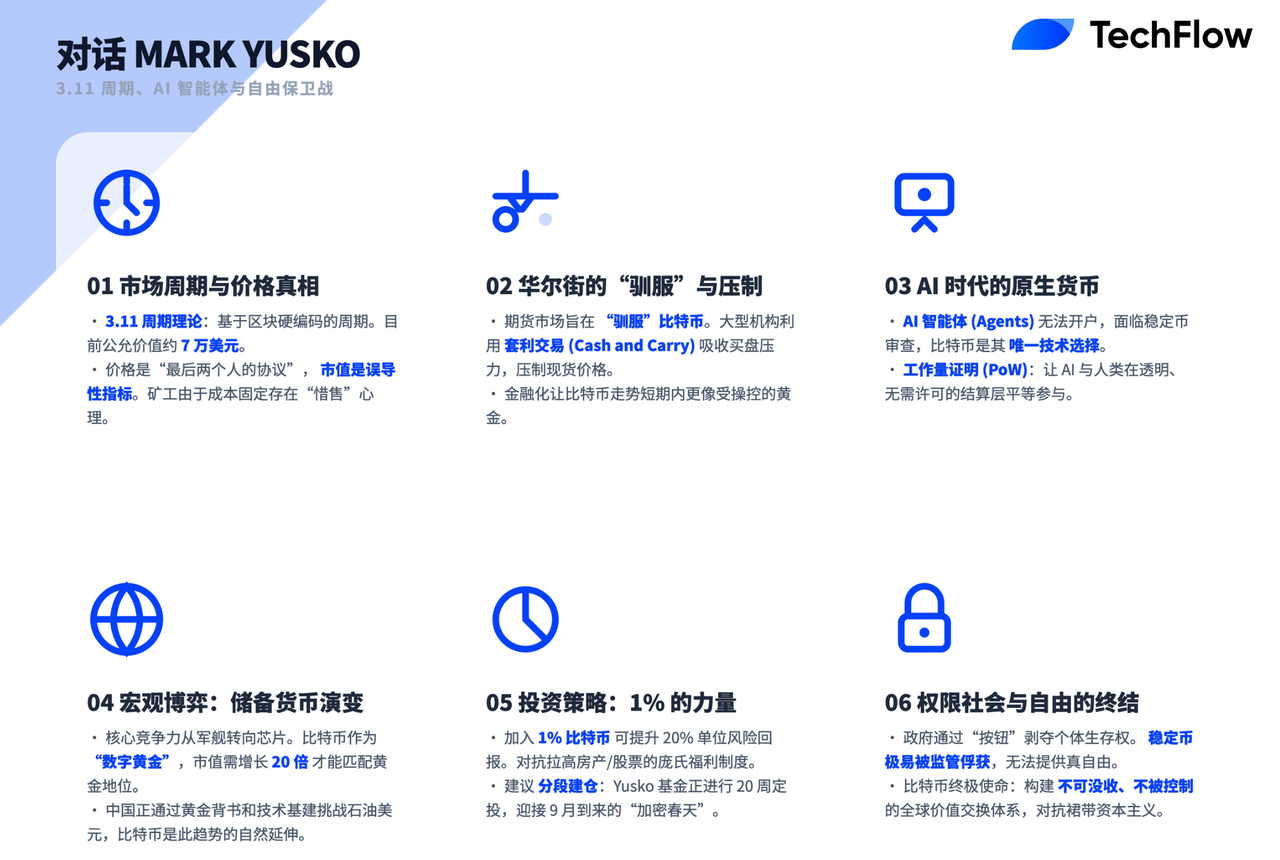
Mark Yusko of Morgan Creek Capital engages in an in-depth discussion with Brandon Green on the distinction between Bitcoin’s price and its intrinsic value—and why this distinction matters more than ever today. They analyze how futures markets influence Bitcoin’s spot price, unpack the regularity of Bitcoin’s four-year cycle, and explain why AI agents are increasingly selecting Bitcoin as their native currency.
Highlights of Key Insights
The Fundamental Difference Between “Price” and “Value”
- Price is a lie. The price of any asset is irrelevant—it bears no relationship to value. Price is merely the outcome of the last two people agreeing to trade a small quantity of that asset.
- Market capitalization is one of my least favorite metrics.
- Bitcoin’s total supply is capped at 21 million coins—but some have been permanently lost. Therefore, multiplying the current price by 21 million yields a misleading figure: it’s a fictional number.
The Hard-Coded Logic of the “Four-Year Cycle”
- I call it the “3.11 cycle,” based on block height—not calendar years.
- The four-year cycle is literally hard-coded into Bitcoin: every four years, Bitcoin’s code halves the block reward. If you halve the reward without adjusting difficulty or other parameters, roughly half the miners—whose costs remain fixed—may exit the market.
- Miners do not sell Bitcoin. Like oil producers, if the price drops, they won’t dump their inventory—they’ll hold until prices recover.
How Futures Markets Suppress Price
- They buy Bitcoin ETFs while simultaneously shorting Bitcoin futures—yet those short positions don’t need to be disclosed. So they’re effectively dollar-neutral, capturing only the futures basis spread.
- Buying BTC now through September would be prudent.
Why AI Agents Choose Bitcoin
- An agentic AI system needs to pay for services—but cannot open a bank account or use fiat. Stablecoins may seem viable, but AI agents aren’t part of the fiat system and can’t fully integrate into the infrastructure behind stablecoins—making Bitcoin their optimal choice.
- Bitcoin’s proof-of-work mechanism makes it the only system where AI agents and humans can participate on equal footing.
Risks of Cash and Portfolio Allocation
- Cash is actually the riskiest asset. Though seemingly safe, holding cash erodes wealth daily via inflation. Since 1913, fiat devaluation has steadily diminished our purchasing power—halving it roughly every 30 years.
- Allocating just 1% of your portfolio to Bitcoin can improve your risk-adjusted return by ~20%, and boost annualized compound returns by ~200 basis points.
A Warning About the “Permissioned Society”
- We’re gradually entering a “permissioned society,” where every action requires authorization.
- If your account is erroneously flagged as “high-risk,” governments could partner with stablecoin issuers to freeze your funds.
- This framing is deeply unsettling. If we called economic sanctions “starving women and children,” far fewer people might support them.
K-Shaped Economies and Welfare Systems
- The Baby Boomer generation controls the economy—holding both power and responsibility for creating what’s termed the “welfare state.” At its core, the welfare state is an unfunded promise—one borne by the next generation. Its mechanics resemble a Ponzi scheme: sustained by continually inflating the value of two assets owned predominantly by Boomers—equities and real estate.
Bitcoin’s Four-Year Cycle—and Why It Works So Well
Brandon Green: Welcome to the Bitcoin Magazine podcast. Today we’re joined by Mark Yusko. Mark, if you were to reflect on Bitcoin’s cycle over the past 24 months, how would you characterize its evolution? What surprised you—and what aligned precisely with your expectations?
Mark Yusko:
I love that you used the word “cycle.” Though many now declare “the cycle is dead,” I remain firmly convinced it persists.
There’s much debate in the industry today—but too often, participants talk past each other, failing to truly listen. Undeniably, Bitcoin—as a store of value—is subject to business cycles and liquidity cycles. That’s noncontroversial. Fundamentally, one ounce of gold is one ounce of gold; one Bitcoin is one Bitcoin. Its form may not be a round coin—but its supply is absolutely fixed.
What changes is fiat currency. Regardless of which fiat you use to price Bitcoin, shifts in the fiat environment—like interest rate changes—cause volatility. That’s normal. As for the central controversy—“Has the four-year cycle ended?”—the past 24 months’ price action actually confirms its existence.
Some argue institutional adoption and massive new capital flows will break historical patterns. My counter-theory is simple: The four-year cycle is hard-coded into Bitcoin’s underlying protocol. Every four years, Bitcoin’s block reward halves.
Why does this matter? Block rewards are payments to miners—their compensation for securing the network. Halving rewards—absent difficulty adjustments—could bankrupt miners whose production costs remain fixed. But miners behave like oil producers: if output prices crash, they won’t liquidate—they’ll accumulate and wait for recovery.
Looking back at the past 24 months, very little surprised me. The one thing that genuinely impressed me—perhaps even shocked me—was someone’s precise prediction that Bitcoin’s price would reverse on October 6. Yet if you examine the fundamentals, that precision is explainable: everyone defaults to the “four-year cycle,” but Bitcoin operates on block height—not the calendar. The actual cycle spans ~3 years and 11 months—so I call it the “3.11 cycle.”
Historical patterns bear this out: the 2017 peak occurred in December; 2021’s arrived in November; 2025 naturally points to October—all perfectly consistent. What struck me most, however, was the cycle’s heightened volatility—and how market participants fall into four categories: investors, traders, speculators, and hedgers. Investors buy below fair value—say, 70 cents for a $1 asset. As investors enter, price rises—ushering in the “crypto spring” and “crypto summer,” when people recognize assets are undervalued—but eventually, prices converge upward.
When price rises, traders enter—they need volatility to profit. Traders aren’t inherently good or bad—just different in behavior and methodology. Then come speculators—not villains, but counterparties to hedgers. Hedgers are actual producers who must sell to cover costs: oil, gold, copper miners—and Bitcoin miners. They hedge via futures markets; speculators take the opposite side.
When price exceeds fair value, buyers keep pouring in—pushing it even higher. Conversely, if you’re a hedger and the market price falls below your production cost, you typically won’t sell. That’s why Bitcoin hasn’t traded persistently below electricity cost in its 17-year history: logically—if I still pay for electricity, why sell Bitcoin below cost?
When price rises above fair value, hedgers begin selling—and speculators rush in. Speculation has surged because people no longer flock to Las Vegas or Macau as often; instead, they turn to online entertainment, betting, sports wagering—and now financial markets, with leverage.
Back to fundamentals: In 2017–2018, Bitcoin peaked at ~2× fair value. So what *is* fair value? We can estimate it using Metcalfe’s Law—a model measuring network value. Bitcoin *is* a network—and arguably the world’s strongest, most valuable one. By that metric, fair value then was ~$10, while the market hit ~$20.
In 2021, fair value hovered near $30; price soared to $69. This cycle, fair value sits near $80, with peaks reaching $120—meaning a ~50% premium over fair value, not the prior 100%. Thus, theoretically, this correction should be shallower: if price is double fair value, a 50% drop brings it back to fair value—but panic selling pushes it further, leading to historical drawdowns of 84%, 83%, and 74%. With only a 50% premium this time, a ~33% pullback would be expected—but the market fell 51%, breaching even that theoretical floor.
I’m not claiming the bottom is in. Historically, crypto winters last ~11.5 months—so this one may conclude around September this year.
Futures Markets, Arbitrage, and Price Suppression
Brandon Green: But the real pain isn’t the crash—it’s the prolonged sideways grind. That slow, tunnel-like stagnation is the most torturous phase.
Mark Yusko:
Markets move faster than ever—not just Bitcoin, but across all asset classes. Capital has become weaponized: apps like Robinhood enable instant 10× leveraged trading, accelerating volatility.
Yet this creates problems. In 2017, Leo Melamed—then-chairman of the Chicago Mercantile Exchange (CME)—declared, “We will tame Bitcoin.” That phrase is telling. He spoke to financial executives—including Jamie Dimon—who viewed Bitcoin as fraudulent and threatening to banking. Bitcoin delivers “truth,” not “trust”—potentially reallocating $7 trillion annually in global financial trust costs directly to users.
Gold is similar. Once $200/oz, it now trades near $5,000. This reflects fiat debasement—not gold changing. Yet gold’s price barely moved from 2021–2023—largely due to futures-market manipulation.
Futures contracts enable price control via virtual commodities. In traditional commodity trading, sellers must own the physical good. Futures let traders sell non-existent goods via synthetic contracts—akin to printing money, diluting value. The logic is identical: print another $1M against $1M, and value declines.
Gold’s price has long been “held down.” Look at its chart: it lingered near $200 for years—suppressed by futures—until breaking out, triggering short squeezes that propelled it to $400. Then it stalled again near $400—until breaking to $1,000. Similarly, gold traded sideways near $2,000 for two years before parabolic ascent. Silver’s even steeper: sharper rallies followed by brutal crashes.
So—what’s Bitcoin’s link? Recent 13F filings show firms like Millennium and Jane Street hold large “Bitcoin exposure.” But strictly speaking, they may not hold spot Bitcoin: they buy Bitcoin ETFs while shorting Bitcoin futures—and those shorts need not be disclosed in 13Fs. Result? They’re nearly “dollar-neutral,” purely capturing futures basis spreads.
Typically, futures trade at a premium to spot—because markets are naturally optimistic about the future. Hence the classic arbitrage: sell futures, buy back at expiry, pocketing the spread. This also explains why options expiries trigger heightened volatility and rebalancing.
This is arbitrage trading. Its logic promises desired outcomes—but unintended consequences abound. For example, many cheered when Bitcoin was first declared non-security—but becoming a commodity enabled futures markets, amplifying volatility.
Bitcoin futures launched on December 18, 2017—peaking the same day. Likewise, the second wave of futures innovation in 2021 coincided with Bitcoin’s peak two days later. Now CME plans new futures contracts on May 29, 2023—I worry this may spark a “volatile summer.”
Bitcoin’s fair value has declined—from ~$80,000 to ~$70,000—while price briefly dropped to $60,000 yesterday, rebounding to $67,000 within 24 hours. Such volatility is simply reality for market participants.
As venture capitalists, we allocate ~80% of raised funds to digital-age infrastructure—AI, blockchain, chips, data firms—and ~20% to protocols themselves. We don’t trade—we hold long-term.
In our first fund, we bought Bitcoin at $5,000 and sold at $100,000 ten years later—delivering strong returns. In our current fund, we plan to buy 5 BTC weekly for the next 20 weeks—since bottoms are unpredictable, but buying now through September is prudent.
Price Is a Lie: Why Market Cap Is Misleading
Brandon Green: Bitcoin’s cyclical nature is fascinating. While the 2024 halving was pivotal, the real catalyst may have been the ETF approvals at end-2023/start-2024—drawing massive institutional capital. Previously limited to futures or derivatives, institutions now access near-spot exposure via ETFs. Meanwhile, corporations—and nations and sovereign wealth funds—are dipping toes into Bitcoin.
Yet despite these positive signals, Bitcoin’s price hasn’t surged as expected. This begs inquiry: What’s stifling this boom? What’s causing stagnation? Are participants long-term investors, short-term traders, or hedgers? Are they buying for Bitcoin’s long-term value and world-changing potential—or exploiting arbitrage? Or do they see Bitcoin merely as a volatile tech asset for portfolio construction?
Current evidence suggests the latter dominates. To many investors, Bitcoin is just another portfolio line item—leveraged for volatility-driven gains, not conviction in its enduring value.
Bitcoin’s latent value remains immense—but market performance feels muted. This implies many newcomers aren’t “true Bitcoin believers.” They haven’t grasped Bitcoin’s essence. Their success metric isn’t accumulating BTC—but dollar-based derivative returns.
Mark Yusko:
This is a profound insight. Price is a lie. The price of any asset is irrelevant—it bears no relationship to value. Some claim price reflects future cash flows—but that’s false. Price is merely the result of the last two people agreeing to trade a tiny quantity of that asset. Microsoft stock may trade at $400/share—but if Bill Gates tried selling one million or one billion shares, he couldn’t get $400/share. Price has nothing to do with value—it’s just a transactional façade.
Market cap is one of my least favorite metrics. Consider Oklo—a fake nuclear energy company run by a couple who defrauded everyone. It had no product, never would—but its market cap hit billions. If people realized it was a scam, its market cap would vanish instantly.
Bitcoin faces similar issues. Total supply is 21 million—but some coins are irretrievably lost. Multiplying current price by 21 million yields an inaccurate figure—a fiction. Satoshi himself noted this: in an email, he wrote, “Yes, some bitcoins will be lost or stolen—consider it a contribution to the community.” As fiat converts to this superior monetary form, value concentrates across fewer intact bitcoins.
Of course, owning a full Bitcoin is ideal—but you can own fractions. My Twitter handle is “2.1 Quadrillion”—the total number of satoshis (Bitcoin’s smallest unit) in the entire supply. A big number.
Brandon Green: Returning to your point—the key is proportional ownership within the network. This reflects how you position yourself within a larger ecosystem where value is continuously transacted, stored, and recorded. That’s Bitcoin’s true value.
Mark Yusko:
Most crucially, it’s about owning a piece of the network. Participate—and share its value. So why hasn’t new demand significantly lifted spot prices? There *is* new demand.
For instance, Bitwise and others are evangelizing Bitcoin to traditional finance. Yet “alternative investments” is poor marketing—people prefer “traditional”: medicine, education, music—while viewing “alternative” with suspicion. Promoting Bitcoin as a novel asset class is tough.
Historically, investment paradigm shifts faced similar hurdles. Pre-1982, investing beyond bonds was seen as reckless—even violating fiduciary duty. In 1979, *Time* magazine ran a cover story titled “The Death of Equities,” advising trustees against stocks. Only after research showed equities’ superior long-term returns did attitudes shift.
Moreover, cash is actually the riskiest asset. Though seemingly safe, holding cash erodes wealth daily via inflation. Since 1913, fiat debasement has steadily sapped purchasing power—halving it every ~30 years. Bitcoin, as decentralized money, offers a solution.
This marketing resembles rebranding gambling as “prediction markets”—clever packaging, but gambling nonetheless. Regardless, we must confront cash’s flaws—and seek better alternatives.
Portfolio Allocation: Why 1% Bitcoin Changes Everything
Mark Yusko:
Facing cash erosion, we diversify into bonds—lowering portfolio risk. Though bonds are more volatile than cash, they’re uncorrelated—moving differently due to distinct drivers.
Adding bonds to cash lowers risk. Adding stocks further reduces risk—not increases it. Then adding alternatives—private equity, venture capital, hedge funds—boosts portfolio efficiency, Sharpe ratio, and risk-adjusted returns.
Then Bitcoin arrives. Allocating just 1% of your portfolio to Bitcoin improves your risk-adjusted return by ~20%, and lifts annualized compound returns by ~200 basis points.
I even excluded Bitcoin’s first four years (2009–2013)—when price was sub-cent and scale too small for meaningful capital deployment. But from late 2013 onward, real investment became possible—and results remain striking.
More people now accept this idea—allocating 0.5%, 1%, or 2% to Bitcoin as portfolio diversification. That’s a great start. We hope large institutions—Harvard, etc.—follow suit. That’s excellent news for Bitcoin.
So why hasn’t spot price reflected this stepwise demand growth? Historical data shows Bitcoin’s price is indeed forming higher highs and higher lows—a long-term accumulation pattern.
Regarding sovereign wealth funds and national Bitcoin reserves—we’ve yet to see mass adoption. Instead, we got the “Genius Act” and “Clarity Act.” Their impact falls short of expectations—especially the “Clarity Act,” whose current form is deeply flawed, akin to CBDCs. We must oppose this.
We also face powerful entrenched interests resisting Bitcoin’s rise. As the classic adage goes: “First they ignore you, then they laugh at you, then they fight you, then you win.” From 2009–2015, Bitcoin was ignored—most people didn’t know it existed, dismissing it as “internet magic money.” 2016–2021 marked the “laugh” phase—geeks profited, but mainstream saw it as nerds playing with internet cash. Now, 2022–2027/2028 is the “fight” phase—we’re squarely in the thick of it.
This fight includes regulatory intervention—ongoing measures we must vigilantly monitor and counter. Also market manipulation, financialization, and relentless FUD campaigns—all repeated to undermine Bitcoin’s influence.
I’m no technologist nor lifelong Bitcoin devotee—but as a financial services professional, after deep study, I concluded Bitcoin is a superior monetary form. Once you grasp that, you can’t ignore its potential—you’re excited by it.
Regulatory Capture and the FUD War
Brandon Green: You were the first firm to discuss Bitcoin allocation with pension funds—raising a key question: How do we convert these newcomers—from viewing Bitcoin as a trading tool—to truly understanding its value?
I wonder: Will hedge funds, financial institutions, sovereign wealth funds—or even governments—eventually hold Bitcoin long-term, breaking CME’s short dominance?
Mark Yusko:
Brilliant question—it hits Bitcoin’s core narrative. Bitcoin is fundamentally money for the future. Money is fascinating—it’s an asset with no liability. It’s typically gold, silver, or—less commonly—platinum and other rare assets. Money must be scarce, impossible to create ex nihilo, and debt-free.
As J.P. Morgan famously said: “Gold is money; everything else is credit.” What we call money—USD, JPY, EUR—is actually a derivative: debt-based, backed by government IOUs. Not evil—fractional-reserve banking is arguably humanity’s greatest invention; without it, we’d live in mud huts.
It fuels growth: idle money in a vault is useless. Yet many still reject Bitcoin as a monetary layer. Central banks and governments still rely on gold as crisis insurance—gold’s been perfect for 5,000 years as a store of value, but Bitcoin is better. A gold bar can’t be split and sent digitally—but Bitcoin can. With a few clicks, I send Bitcoin anywhere—near-instantly, nearly free.
Historically, government money was gold-backed—ideally stored in Fort Knox. From 1776–1913, stable money supply meant no inflation concept. But the Fed’s 1913 creation changed everything—fiat value began eroding.
Michael’s choice mirrors this trend: converting fiat to Bitcoin, not just for superior value storage—but for technical advantages. He built a full capital stack atop Bitcoin—a vision of things to come: Bitcoin as the monetary base layer.
Murray Stahl takes it further: Bitcoin isn’t just gold’s replacement—it upends Gresham’s Law. Gresham’s Law states “bad money drives out good”—e.g., Zimbabwe or Argentina. He posits the inverse: good money drives out bad—and Bitcoin could become a $100-trillion asset.
Gold and Bitcoin: Same Store of Value, Different Timelines
Brandon Green: Regarding recent gold price rises amid Bitcoin dips—some argue this undermines Bitcoin theory. But central banks are simply repeating 5,000 years of precedent. China, for instance, reduces U.S. Treasury holdings while boosting gold reserves—consistent with traditional monetary policy. This doesn’t invalidate Bitcoin’s value thesis—it just means Bitcoin-as-gold-substitute remains early-stage.
Mark Yusko:
Looking at the past three years, Bitcoin and gold returns are identical. Over five years, Bitcoin leads. Over seven or nine years, returns align again. Why? Because they’re fundamentally the same thing. What matters is exchange-rate volatility when buying them with fiat—but people say “gold rose, Bitcoin fell.” Yet from 2021–2023, Bitcoin rose while gold flatlined. That’s market manipulation: two years suppressing gold—then losing control. They manipulated silver for five years—capping it $20–$30—then it exploded. Reportedly, JPMorgan nearly collapsed shorting silver globally—twice their position—also shorted gold, prompting GLD’s launch.
They targeted gold for a reason: they don’t want gold rising—lest the public realize their wealth is being diluted. We must view this across longer time horizons. Second, short-term volatility between stores of value arises from futures markets—but long-term correlation remains high, per data.
The real issue is belief formation—humans often form beliefs incorrectly. We absorb beliefs from parents, mentors, media, religion, admired figures—then cherry-pick confirming data while rejecting disconfirming evidence. If FUD convinces you Bitcoin is evil, you’ll think gold outperforms—but check three- or five-year data: it doesn’t.
I was skeptical too—in 2013, Bitcoin intrigued me but seemed dubious. After deep study, I became a staunch believer. Almost everyone I respect—after studying Bitcoin—became believers. We believe what we believe—and reject contradictory evidence instead of examining it. Bitcoin is a technically superior store of value—better at preserving value *and* enabling efficient global value transfer. Data and facts confirm Bitcoin’s technology and network point to the future.
Bitcoin isn’t just the world’s most powerful computing network—it’s >1,500× stronger than CERN’s supercomputer. Owning part of this network is profoundly meaningful—but Bitcoin investment needn’t be all-at-once; gradual accumulation is wiser.
Volatility is Bitcoin’s feature—not a flaw. Volatility is wealth creation’s engine. Investing solely in low-volatility assets yields modest returns. Volatility reflects divergent market expectations of future outcomes. U.S. Treasuries have near-zero volatility—market consensus on near-zero default risk. Amazon and Bitcoin exhibit high volatility—Amazon saw double-digit drawdowns yearly for 30 years—but long-term holders reaped massive gains.
Divide investment capital into three buckets: First, daily spending money—for bills, requiring liquidity—still fiat-dominated. Second, high-risk capital—for high-reward experiments, high risk but high upside. Third, long-term preservation capital—for diversified portfolios including high-volatility, uncorrelated assets like Bitcoin.
Bitcoin fits perfectly as “preservation capital”—it’s minimally correlated with bonds and stocks, effectively diversifying long-term risk. Yes, correlations spike during crises—but long-term, Bitcoin remains uniquely positioned.
In investing, focus on long-term signals—not short-term noise—to achieve real wealth growth.
World Reserve Currency
Brandon Green: If I sum this up in one compelling moment: we’re here now. Gold’s market cap is $36 trillion—we can precisely identify all players, but the main driver is central banks diversifying from Treasuries into gold.
Mark Yusko:
This time, they chose gold—not Bitcoin. But if they choose Bitcoin once, its status as gold’s successor is cemented forever.
World reserve currency history spans centuries. In the 1500s–early 1600s, Portugal ruled—its currency was reserve. Spain conquered Portugal, inheriting reserve status—then the Dutch.
How did a country the size of Ohio defeat Spain’s fleet in the 1600s? Answer: the stock market. They invented it—and created the first central bank, printed vast money, invested in joint-stock companies, and fielded mercenary armies—defeating Spain.
Then came Napoleon—superior general, defeating the Dutch. Rothschilds fled to Britain, founding the Bank of England. Leveraging steamship tech, they seized reserve-currency dominance. Later, America linked to Rothschilds and central banking—then achieved global hegemony via nukes and subs.
I believe 15 years ago, China realized the next reserve-currency contest wouldn’t hinge on warships—but chips. A seismic shift. China explicitly aims for global dominance—in AI, 5G, and becoming reserve currency. It’s already in SDR—and plans massive gold purchases to re-anchor the yuan to gold, making it fully convertible. China dominates global trade—and challenges the petrodollar system head-on.
Yet some dismiss China’s plan—e.g., a recent *Washington Post* article claims global dominance requires military force, not infrastructure. But this ignores peaceful cooperation’s value. By providing resources to improve lives, China’s strategy is more sustainable. Such criticism ironically validates China’s plan—quality of opposition often measures idea quality.
Future competition centers on technology—and its natural extension is AI-driven open-source ecosystems transitioning to Bitcoin. Research shows AI agents now hold more Bitcoin than any other token. Why? Agentic AI systems need to pay—but can’t open bank accounts or use fiat. Stablecoins are an option—but AI agents aren’t part of the fiat system and can’t fully integrate into stablecoin infrastructures—making Bitcoin optimal.
AI Agents, Proof-of-Work, and the Future of Digital Currency
Mark Yusko:
A futurist described sitting in a self-driving car’s back seat, stopping automatically at fast-charging stations. This automated, tech-driven future aligns tightly with Bitcoin’s use cases—providing monetary infrastructure for such ecosystems.
Future automated payments may look like this: you sit in your car—it auto-pays charging fees, no card insertion needed. Entering a toll lane, it pays instantly—no license plate photos or mailed invoices. Even navigation could let you pay premiums for priority routes—while others are routed slower. Sounds dystopian—but it’s coming. And the payment asset? Likely Bitcoin.
Brandon Green: It *must* be Bitcoin—digital, independent of existing fiat systems; not stablecoins, whose supply and value are centrally determined. Bitcoin’s proof-of-work makes it the only system where AI agents and humans participate equally.
Satoshi Nakamoto designed Bitcoin 15 years ago foreseeing its role in future monetary systems—especially serving AI agents.
Mark Yusko:
Historically, barter—chickens for cows—was inconvenient and chaotic. Coins replaced barter—engraved with chickens/cows to signify value. But coins brought new problems: post-trade robbery led to bank deposits—and paper money emerged as the new medium.
Entering the electronic age, money digitized further. Stocks and assets shifted from paper to digital codes; bank balances became digital entries. Yet centralized electronic systems aren’t flawless. Banks hold your funds—and can deny transactions or withdrawals. If your balance reads zero, lacking paper statements makes proving existence difficult.
Though banks are usually reliable, exceptions exist. In Cyprus’s 2012 crisis, accounts were frozen or seized—two-thirds of deposits vanished. This exposed centralized finance’s fragility.
Brandon Green: We’re in transition: many transactions are digital—but still require centralized intermediaries. These intermediaries bear transaction responsibility—but introduce risk. When societies grow intolerant, minorities become targets—bank account freezes inflict deeper damage than street muggings.
Mark Yusko:
Current finance poses a worrying problem: if regulators can arbitrarily freeze personal assets—excluding people from the system—it’s dangerously dystopian. The BIS chief publicly stated regulators should fully control how people use their own money—a bleak, anti-utopian vision.
Imagine: you get paid Friday, celebrate with friends, drunkenly text something inappropriate about the president. Saturday morning—you can’t spend your salary.
Brandon Green: Sounds like sci-fi—but it’s happened: COVID-era restrictions and 2020–2022 censorship froze accounts, cutting off banking access.
Mark Yusko:
This circles back to why AI agents avoid stablecoins. Recent Tether events show even “stable” cryptos face centralized regulatory risks. The U.S. recently seized Iranian-linked accounts—and confiscated their Tether. If an AI agent transacts via those addresses—even a minor ID error—funds vanish, with zero explanation required.
Brandon Green: This exposes finance’s core flaw: AI agents lack real-world identities—existing systems may impose arbitrary ones deemed noncompliant. This heightens urgency for decentralized money.
Mark Yusko:
Coinbase CEO Brian Armstrong—labeled “Public Enemy #1” by *The Wall Street Journal* for opposing excessive crypto regulation—is fighting to shield users from government interference. Yet many tech firms have already capitulated—making crypto freedom especially precious.
Today, governments monitor nearly everything: Gmail, other email providers, phone calls. We’ve lost privacy—and voluntarily, by clicking “agree” for convenience.
More troubling: we’re entering a “permissioned society”—where all actions require permission. Similar risks exist with stablecoin accounts: if flagged “high-risk,” governments could partner with issuers to freeze funds. This permissioned society restricts action—and enables censorship and intervention.
Ultimately, it creates a “button”—press it, and “bad actors” vanish. Initially terrifying—erasing “bad guys.” But daily exposure to their acts may make pressing it feel justified. Yet the button itself is the problem—it can be abused. Who defines “bad”? This sparks philosophical debates: Why are Western values superior to Eastern? American over Chinese? Who defines “better”?
Take Canada’s protests: Why is supporting protesters “bad”? This framing is deeply unacceptable. As a friend noted: if we call economic sanctions “starving women and children,” far fewer would support them. Economic sanctions pressure people into compliance with our will.
Should we allow one nation to weaponize finance—or build a global value-exchange system immune to seizure, control, or weaponization? I choose the latter.
Brandon Green:
During the Biden administration—especially Russia-Ukraine conflict in 2022—the U.S. froze oligarch-linked assets globally. These assets belonged to the “Western financial system”—yet vanished overnight. Many may later view this as the final straw for the dollar’s reserve-currency status.
This raises: in a permissioned society, the “button” works only once—press it twice, and nothing happens.
Mark Yusko:
Exactly. First press must target precisely—if you clear most “bad actors” but leave allies, they’ll retaliate. Also, “bad actor” definitions are subjective. One person’s “bad actor” is another’s “freedom fighter.” This relativity demands reflection: who decides “good” vs. “bad”?
Hyperbitcoinization, Bear Market Outlook, and Final Thoughts
Brandon Green: On current market conditions: we’re in a familiar phase—the tail end of a bear market. Bears lack bull excitement—but often birth new opportunities.
This cycle shows early signs of hyperbitcoinization. Those who swore they’d never touch Bitcoin now explore its potential—entering a sandbox, testing cautiously. Once inside, they “build sandcastles”—creating new use cases and value.
Bitcoin adoption isn’t complete—but no rush. Time favors us: more people will recognize its value and join the movement. Like gold—currently ~$36 trillion market cap. Though we can’t predict if China’s central bank keeps buying gold, those who gained 10× wealth via gold—what will they do when Bitcoin surges? If central banks halt massive gold purchases and gold stalls—how many will sell gold for Bitcoin? After all, Bitcoin is “the fastest horse.”
Bitcoin’s impact replacing gold varies with gold’s market value. If gold’s $10 trillion, substitution differs from $36 trillion. Bitcoin’s ceiling is pushed higher—making me optimistic about future cycles. As Metcalfe’s Law suggests, this cycle lacked extreme “bubble tops”—hinting at less extreme “bottoms.”
Mark Yusko:
Human behavior is reflexive—peaks and troughs stem from excessive leverage and speculation. But leverage is far lower this cycle—most cleared, remnants minimal. So I’m comfortable with current conditions. Wherever the bottom lands, excessive leverage has been purged. “Crypto winter” is halfway over—spring is coming.
Bitcoin is often compared to gold—as a store of value. Note: only part of gold’s value is monetary—e.g., central bank reserves (bars/bullion). The rest is jewelry/industrial. Historically, gold’s monetary value comprised ~50% of total value—recently maybe 60%.
Using gold’s monetary value as baseline—say $10 trillion—versus Bitcoin’s ~$1 trillion market cap—means Bitcoin needs 20× growth to match gold’s monetary value. Huge—but possible. Bitcoin’s growth doesn’t mean harder to carry—it means more fiat needed to buy one BTC.
Bitcoin’s decentralization makes it unique—especially in economically unstable nations. In Venezuela and Turkey, dictators enrich elites via currency debasement while impoverishing masses. Here, Bitcoin shines—protecting people from extreme economic manipulation and crony capitalism.
If you live in a dysfunctional nation like Venezuela, you may already experience hyperbitcoinization—realizing you need “escape capital” or “independent capital” to shield yourself from extreme economic control and cronyism. This isn’t anti-capitalism—it’s anti-crony capitalism and anti-dictatorship. Crony capitalism and dictatorship playbooks may repeat elsewhere—but globally, powerful families have controlled wealth for generations. They hold most wealth—and refuse to share—causing K-shaped economies: elites thrive, while the bottom decays.
Bottom-tier struggles include record vehicle scrappage rates, soaring apartment rents, unaffordable food. Rarely reported—because elites control media narratives. Their lives thrive—and markets surge. Yet 49% of Americans hold no stocks—no retirement plans, no Robinhood accounts—unmoved by market performance.
The Baby Boomer generation controls the economy—holding power and crafting the “welfare state.” The welfare state is an unfunded promise—paid by the next generation. Its mechanics mirror a Ponzi scheme: sustained by inflating Boomers’ two key assets—stocks and real estate. That’s exactly what we see today.
Shocking: Venezuela’s stock market performed best globally over five years. Would you buy Venezuelan stocks? Only if you lived there, used bolivars, and sat atop power. Same in Zimbabwe—I have a 100-trillion-Zimbabwe-dollar note on my desk—worth less than a loaf of bread. These nations tried solving problems via hyper-printing—but printing money doesn’t create wealth.
Wealth creation doesn’t come from printing—it comes from human creativity. Creativity is society’s most powerful engine. Yet tech advances—especially AI—spook many, fearing mass unemployment. But AI is just a tool—and tools exist to enhance humanity. Every tool—cars, planes, biotech, Bitcoin—has improved life. Tools eliminate old jobs—but create more new ones. Today, Earth hosts more jobs than ever in human history. Tools empower humans—not replace them.
AI is like a hammer—excellent at driving nails. But rapid nail-driving doesn’t build houses. Many AI advocates believe enough compute + energy will spontaneously yield consciousness and creativity—but that’s not how AI works. Human brains converse using ~20 watts—not nuclear reactors or 24/7 high-power grids—showing cognition isn’t brute-force. We don’t fully understand brain function—let alone replicate it.
Join TechFlow official community to stay tuned
Telegram:https://t.me/TechFlowDaily
X (Twitter):https://x.com/TechFlowPost
X (Twitter) EN:https://x.com/BlockFlow_News
 深潮TechFlow