The U.S. will not reject stablecoins
TechFlow Selected TechFlow Selected
The U.S. will not reject stablecoins
Stablecoin Outlook for 2026
 Navigating Web3 tides with focused insights
Author: Zuoye
Coinbase's last-minute reversal caused the subsequent Clarity Act to stall in Congress, making the "passive yield" mechanism of stablecoins a focal point.
The banking sector argues that up to $6 trillion in deposits could flow into stablecoins, especially USDC—where Coinbase takes a 50% revenue share—which would drain deposits from small regional and community banks, further worsening financing difficulties for small businesses and ordinary people.
Coinbase counters that earning yield is merely an operational and incentive tool. As long as stablecoins maintain sufficient asset reserves, systemic risks will not arise. Instead, more people can escape the exploitation of near-zero 0.01% interest rates offered by traditional banks.
After three cycles of yield-bearing stablecoins on-chain, the yield mechanism remains a hot topic that traditional finance has yet to catch up with. We live in a world of vast disparity—crypto moves fast, while TradFi holds scale.
Yield Capitalism
The reduction in U.S. Treasury holdings coincides with increased gold purchases. With Treasuries needing new buyers, Tether and Circle have stepped up.
Facing Coinbase’s USDC offering an annualized yield of up to 3.35%, the banking industry offers two defenses. First, the U.S. banking sector holds $18 trillion in deposits. If demand deposit rates rise too high, banks may raise lending rates, ultimately increasing corporate and personal credit costs.
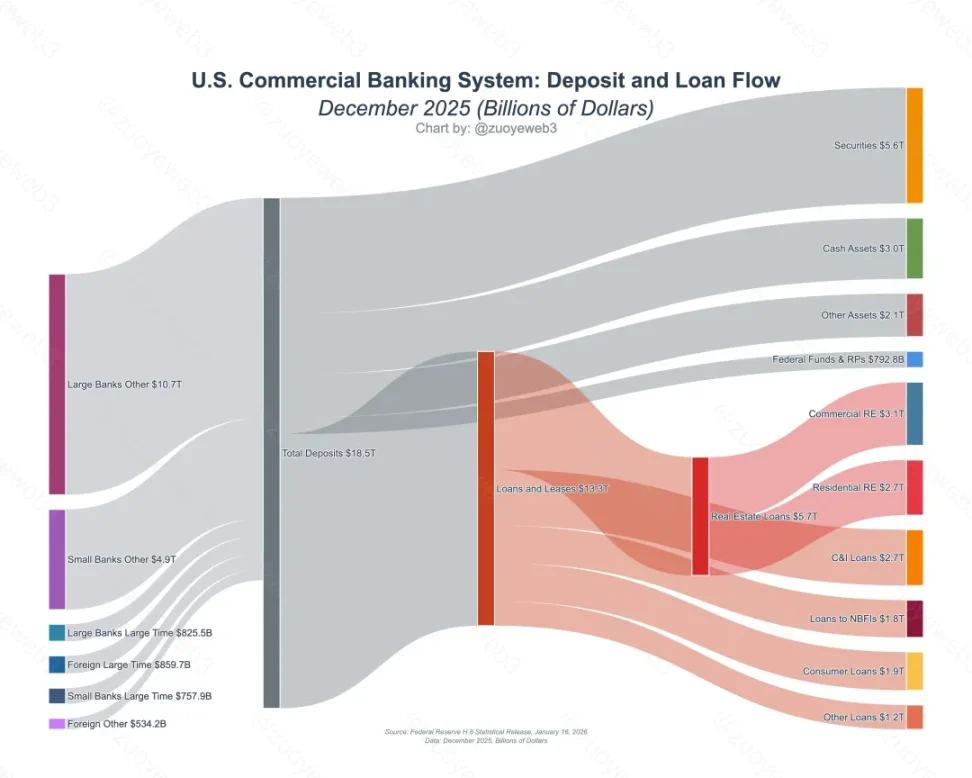
Image caption: Flow of deposits and loans in U.S. commercial banks, Source: @NewYorkFed
Second, stablecoin issuers are increasingly buying U.S. Treasuries, undermining banks’ role in dollar circulation. Additionally, on-chain stablecoins participating in DeFi could potentially trigger systemic financial crises.
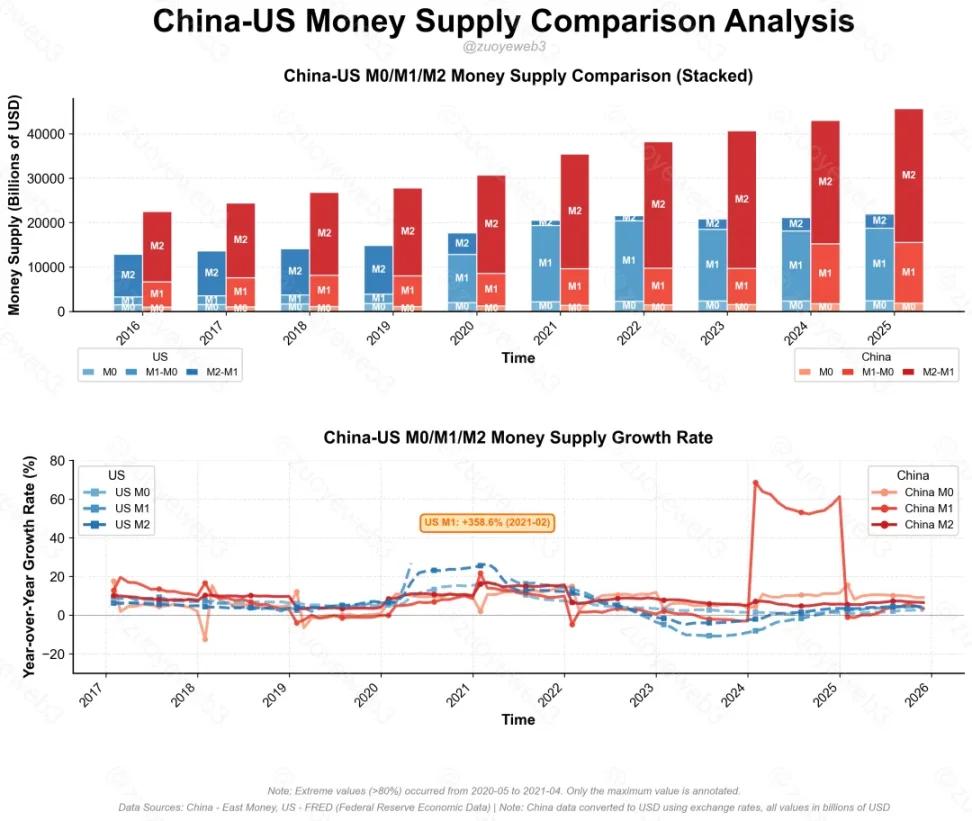
Image caption: Comparison of M0/M1/M2 between China and the U.S., Source: @zuoyeweb3
In response to these concerns, current figures show USDC issuance at $75 billion with $40 billion in Treasuries held, and Tether issuing $180 billion while holding $130 billion in Treasuries. Stablecoins backed by Treasuries amount to $170 billion, representing 3%, 0.8%, and 0.7% of U.S. M0/M1/M2 respectively.
However, according to Ark Invest, the share of the top three foreign buyers of U.S. Treasuries has dropped from 23% in 2011 to just 6% in 2024. Amid escalating tariff wars spreading to Europe, the U.S. needs more external buyers to sustain the global status of its debt. Fundamentally, the U.S. has no reason to reject stablecoins.
Just as the Genius Act bans paying interest to attract customers, Paxos bypasses this restriction by partnering with Kraken to issue GUSD and with PayPal to launch PYUSD—either through third parties like Paxos acting as operators or custodians like Anchorage offering yield to institutional clients.
In fact, within the crypto space—including peers like Ripple and a16z—there is strong support for quickly passing such legislation. Most agree that rejecting passive yield allows room for active yield models, leaving only Coinbase resisting.
At the core is scaling. Currently, total stablecoin issuance stands at $300 billion, with strictly defined on-chain yield-bearing stablecoins around $30 billion. Compared to the two major real-world obstacles, the actual impact feared by banks remains distant.
Within crypto, since the collapse of UST in 2022, the only bright spot has been Ethena’s USDe and sUSDe, which now represent the dominant model for on-chain yield-bearing stablecoins. Yet after sparking a frenzy in 2025, it rapidly cycled through three phases:
- July 29, 2025: The loop-lending arbitrage initiated by USDe in collaboration with Aave collapsed during the October 11 mass liquidation, causing its size to plummet from $10 billion to $6.5 billion. It abandoned building its own chain and effectively transformed into a white-label platform;
- November 3: The xUSD depegging incident triggered FUD among numerous Morpho/Euler vault managers, halting both issuance growth and market expansion that had continued since July;
- And not until December did anyone recall Plasma’s deposit campaign—projects like Tempo (backed by Paradigm and Stripe), Stable, and Plsama (supported by Tether)—all failed to gain momentum, unable to break through in P2P payments or enterprise off-chain adoption.
Outside crypto, despite the banking sector’s strict resistance to yield-bearing stablecoins, the tokenization of payments is unstoppable—though curiously disconnected from DeFi. First, none of the three crises dampened payment players’ enthusiasm for stablecoins; second, yield mechanisms genuinely enhance overall economic efficiency.
Payments Meet On-Chain Vaults
It's not capital that creates yield—it's yield that generates capital.
Ethena may be winding down, but it has at least left behind another chance for stablecoins to be reborn—a true case of “when a whale falls, ecosystems thrive”:
- Yield mechanisms have become generalized, spreading beyond stablecoins to all assets, including products like Perp DEX and Binance’s RWUSD;
- Vault structures have matured, exemplified by Generic, a white-label yield stablecoin platform built on yields from Morpho managers like Stakehouse.
If we examine today’s stablecoin operations, they differ significantly from traditional USDT, especially with embedded yield products.
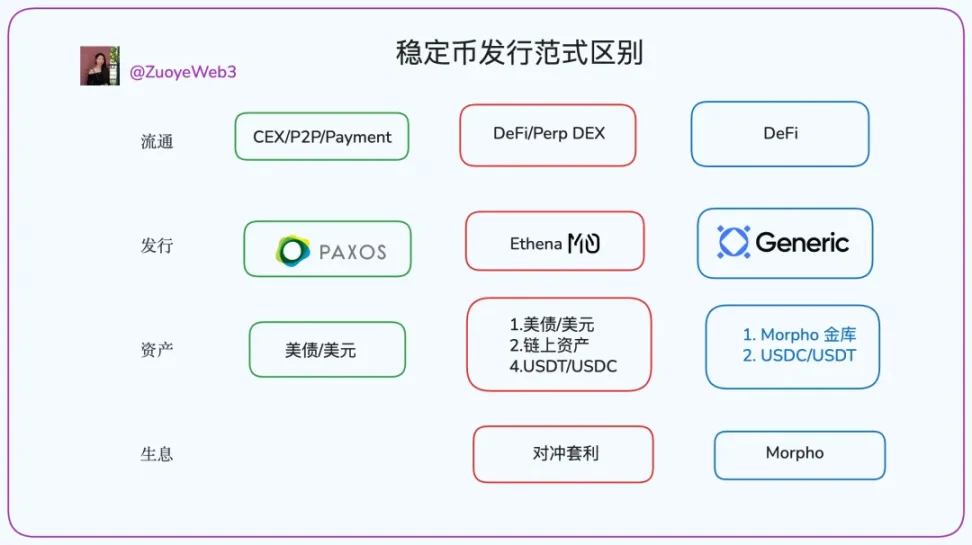
Image caption: Stablecoin issuance paradigms, Source: @zuoyeweb3
U.S. Treasury-backed USDC/USDT not only serve as foundational collateral for stablecoins like Ethena, but also provide the underlying yield source when deposited into lending pools—this is the true state of stablecoin adoption on-chain today.
Except for TRC-20 USDT on Tron, most stablecoins end up in DeFi. This disproves both banks’ fears that yield-bearing stablecoins threaten financial stability and Coinbase’s insistence on the sanctity of “passive yield.” The Morpho yield vaults accessed by Coinbase are themselves operated by products like Stakehouse.
Coinbase plays a dual extraction role: capturing profits from USDC issuance and skimming operational gains from Morpho—a middleman more aggressive than Meituan or Didi.
Beyond Coinbase, on-chain stablecoins can already avoid excessive fees extracted by issuers and intermediaries. However, bridging the gap between yield, stablecoins, and payments still requires innovative mechanisms.
In other words, if yield-bearing stablecoins merely redirect funds from banking into DeFi vaults, turning into non-productive speculative bubbles, they risk fulfilling their own prophecy—$6 trillion in stablecoins would indeed trigger systemic crisis.
To grow stablecoin scale, expand real-world utility, and preserve yield mechanisms, the only solution is to make yield a universal standard across the payments industry.
Take Airwallex’s Yield product as an example: it offers higher annual returns than Coinbase’s USDC deposits and supports multi-currency yield solutions for merchants, underpinned by money market funds.
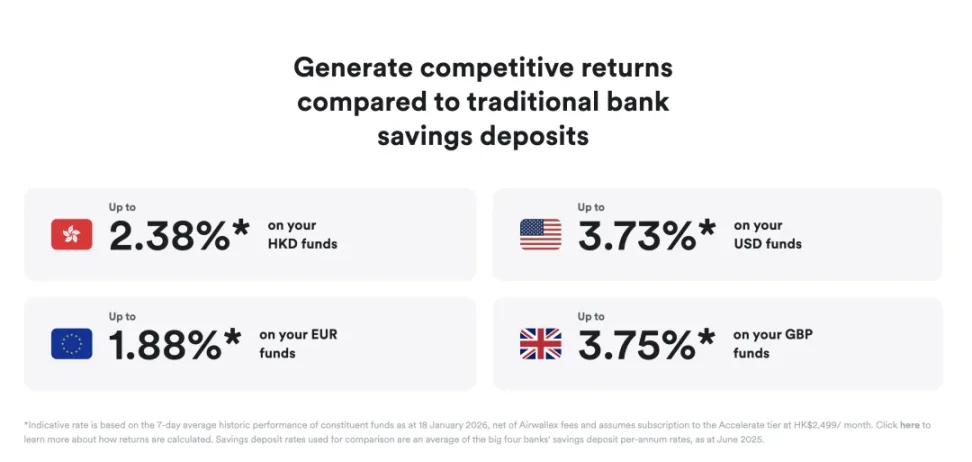
Image caption: Airwallex Yield Product, Source: @airwallex
Compared to Stakehouse’s on-chain vaults, the key difference lies in Airwallex’s real commercial use cases and efficient utilization of corporate idle cash. But if combined with on-chain vault structures, yields could be even higher—and yield-bearing stablecoins could remain fully usable.
Unlike USDC’s passive holding yield or Airwallex’s idle fund yield, “yield-while-using” stablecoins embed yield throughout pre-, mid-, and post-transaction flows—even integrating point systems post-consumption.
Compared to the difficult C-end customer acquisition faced by U-card platforms, payment channels need financial innovation from stablecoins more urgently. Ctrip’s international version accepts U deposits via Singapore-licensed gateway Triple-A. For Ctrip, it’s simply adding another third-party payment option; for Triple-A, choosing which stablecoin to use is merely a code-level decision.
After the disputes involving Morpho, Aave, and Sonic, no one truly believes in “Code is Law” anymore—the idea of decentralization has suffered a setback. Yet “Money is Code” grows ever clearer. From a regulatory standpoint, many yield-bearing stablecoins are actually more compliant than USDT.
Thus, users get yield, merchants gain customers, and channels enjoy benefits—this integrated approach represents the most viable path forward for commercial applications.
Conclusion
Funds becoming deposits, deposits generating yield.
The crypto industry has reached a turning point. Selling assets to outsiders is increasingly unsustainable. Altcoins and meme coins cannot carry the burden. Stablecoins' path to mainstream adoption remains distant from retail users, primarily because retail investors cannot profit from real-world stablecoin usage.
Six months ago, stablecoins were seen as an asset issuance method. Today, they must contain hidden appreciation potential.
After leveraged models like USDe and xUSD faded, expanding stablecoin utility and user base—enabling retail users to act as LPs and organize on-chain vault liquidity—is currently the most feasible route.
But problem follows problem. This introduces new risks—vault mismanagement. Previously confined to crypto circles, impacts were manageable. Once real commerce and everyday users are affected, stablecoins could face widespread backlash. How to control vaults requires new solutions—this will be the subject of the next piece: Everyone Can Be a Manager—Demystifying Manager Vaults.
Join TechFlow official community to stay tuned
Telegram:https://t.me/TechFlowDaily
X (Twitter):https://x.com/TechFlowPost
X (Twitter) EN:https://x.com/BlockFlow_News
 @zuoyeweb3