Discussion on Several Issues Regarding Stablecoin Payments Since the Passage of the GENIUS Act
TechFlow Selected TechFlow Selected
Discussion on Several Issues Regarding Stablecoin Payments Since the Passage of the GENIUS Act
Revenue prospects remain uncertain, while payments are booming.
 Navigating Web3 tides with focused insights
By: Zuoye
Uncertain Returns, Flourishing Payments
Since the Genius Act was passed in July 2025, yield-bearing stablecoins have faced comprehensive resistance from the banking industry, while payment stablecoins have surged in popularity.
Legacy payment infrastructure has become a new hotspot; Agents and stablecoins exemplify the complex relationship between Fintech and Crypto.
Yield is the past, payments are the present, and AI is the future—a dangerous and quickly outdated taxonomy, yet one that provides a convenient diachronic framework for understanding.
Meta has re-embraced stablecoins; Google co-founded the AP2 Alliance with over 60 enterprises; Stripe explicitly positions stablecoins and Agents as central to its future. Yet PayPal—which launched $PYUSD—and Coinbase—which proposed the x402 protocol—have both seen their stock prices decline.
We urgently need to address two questions: first, what drives the new payment battleground—whose actions are stoking market sentiment? Second, are Agents and stablecoins truly the next “boarding pass”?
This article focuses on the former; the interplay among AI, blockchain, and stablecoins will be explored in a follow-up piece, while forward-looking analysis of yield-bearing stablecoins awaits clarity from finalized regulations.
Losers Get the Dust: Fintech Is More Anxious Than Crypto
Crypto holds promise; individuals do not.
U.S. equities and Treasuries are increasingly tokenized on-chain; BlackRock and WisdomTree frequently embrace DeFi; tokenomics inevitably heads toward obsolescence. No one still believes in blockchain’s wealth-generation effect—even if public blockchains and vaults achieve real-world adoption, that does not guarantee price appreciation for $ETH or $Aave.
This view isn’t entirely wrong—but it exaggerates Crypto’s challenges, because Fintech now faces life-or-death stakes.
Yes—you can make this counterintuitive judgment after Stripe’s valuation surpassed $159B.
Following Peter Thiel’s capital flows—selling Wise shares while holding onto NeoBroker projects like Trade Republic—or examining the elite investor lineup behind Europe’s most valuable neobank, Revolut ($75B)—reveals how Fintech’s valuation logic has shifted.
After more than two decades of effort, Fintech’s attempt to build independent payment rails outside traditional banking has failed. Only businesses capable of retaining or converting user funds hold real value. Wise’s cross-border transfers and Stripe’s merchant acquiring lack genuine long-term futures.
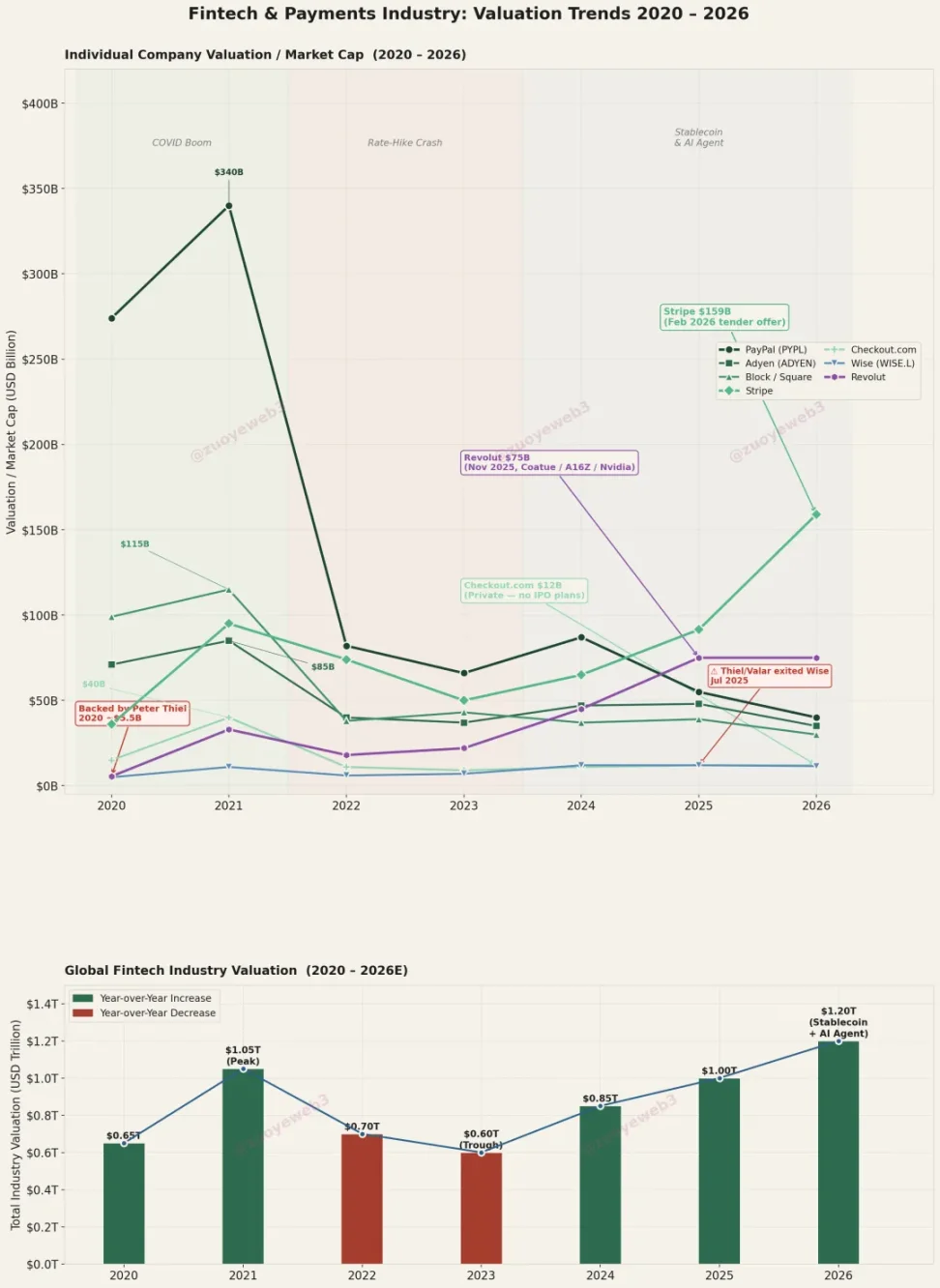
Caption: Evolution of Fintech & Payment Value. Source: @zuoyeweb3
One reason is their inability to fully bypass banks for fund settlement; another is that blockchain can deliver the same services at lower cost.
This isn’t merely a company-level issue—the entire Fintech sector peaked during the pandemic. Today, PayPal—rumored to be up for sale—was valued at $340B in 2021; by 2026, the entire Fintech sector must desperately prove its superiority over stablecoins and Agents.
Stripe’s valuation is five times Adyen’s market cap ($35B) and roughly 13 times Checkout.com’s valuation ($12B), yet Stripe’s transaction volume is not five times Adyen’s. This valuation premium stems entirely from investor imagination around stablecoins and Agents.
Fintech’s anxiety far exceeds Crypto’s—after all, “public chain + stablecoin” forms a self-contained system, and DeFi remains a killer application. What we’re witnessing as the “new payment war” is merely Fintech inflating valuations to fan the flames.
Fintech possesses only legacy advantages; the future belongs to Crypto.
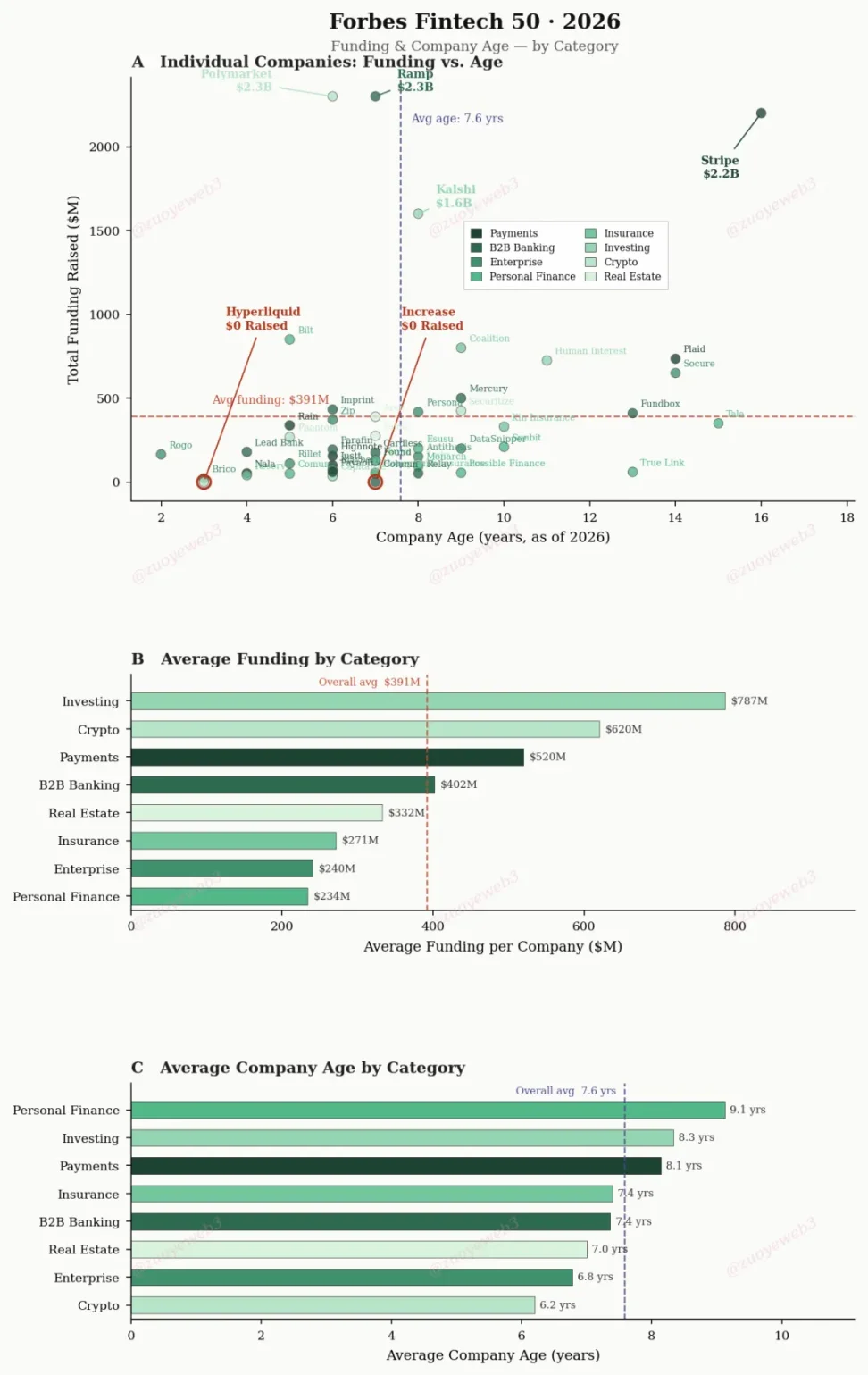
Caption: Forbes Fintech 50 List. Data source: @ForbesCrypto
According to Forbes data, payment-focused Fintech companies average 8.1 years before making the list—while Crypto firms take just 6.2 years.
Or consider the commercial reality directly: long-running players like Stripe must deliver answers—or even exit rationales—to capital markets. Capital allocation demands either newer or larger future opportunities.
- Larger: Agents could exponentially increase payment frequency. Stripe founders John and Patrick Collison envision needing blockchains capable of 1 billion TPS;
- Newer: Leveraging stablecoins to completely overhaul the existing payments tech stack—this would represent the largest technological shift since the API-first era.
Yet realizing this rosy future requires Fintech not only to prove itself superior to Crypto-native firms but also to withstand resistance from both banks and internet super-platforms. With so many participants, the landscape has descended into utter chaos.
Compared to unicorns like Stripe, super-platforms such as Meta and Google are vastly larger—trillion-dollar market caps and billions of users are par for the course. They primarily act as distribution channels, seeking revenue share. You might say they see opportunity in launching their own stablecoins or payment protocols—or you might say they simply intend to charge higher tolls by leveraging existing advantages.
Under Vitalik Buterin’s benevolent leadership, Crypto voluntarily ceded the hardware layer to the internet, becoming AWS’s tenant. Still, blockchain technology—as new infrastructure enabling monetary flow—has achieved consensus across banking, internet platforms, Fintech, and regulators.
Where consensus remains elusive is whether blockchain should fully replace banks—and how payment stablecoins can expand beyond their current C2C/B2B dichotomy to encompass B2C use cases.
Mutual Recognition Among Peers: Tether and Circle’s Dual Encirclement
USDT has faded into obscurity, expanding into the Global South to encircle the U.S. and Europe; USDC aggressively pushes on-chain adoption, with regulatory compliance serving merely as camouflage for bank displacement.
Blockchain doesn’t just bypass banking-centric finance—it achieves independent existence via informal economies (“the theoretical minimum viable threshold”) and, over Ethereum’s decade-long evolution, has demonstrated overwhelming capital efficiency advantages over TradFi.
Most intriguingly, this advantage isn’t about scale: $ETH’s $236B market cap, $300B in stablecoins, and $1.32T in $BTC collectively fall short of JPMorgan Chase’s $2.5T deposit base.
The edge lies in banking’s ability to lock out Fintech and PSPs (Payment Service Providers, or third-party payment processors) through alliances—because you simply cannot independently process digitized USD flows without banks. Blockchain can. Even the hardest nut to crack—the stablecoin industry’s access points into and out of the banking system—has been breached: first by Silicon Valley Bank, now by Lead Bank.
Capitalists can sell their own noose; banking’s “traitors” cannot be absorbed internally—Wall Street lacks regulatory authority.
Regulatory priorities remain deeply conflicted: post-2008, “too big to fail” banks are unpopular, yet Crypto may pose a greater threat to financial order than Wall Street itself.
“Besiege three sides, leave one open”—an ancient political maxim—is repeatedly and skillfully applied by bureaucratic systems.
Reviewing regulatory actions following the Genius Act, the Fed, OCC, CFTC, and SEC have opened wide doors for payment stablecoins—but at the cost of dismantling the foundations of yield-bearing stablecoins, responding to banks’ “deposit flight” crisis while steering stablecoins back into the existing system.
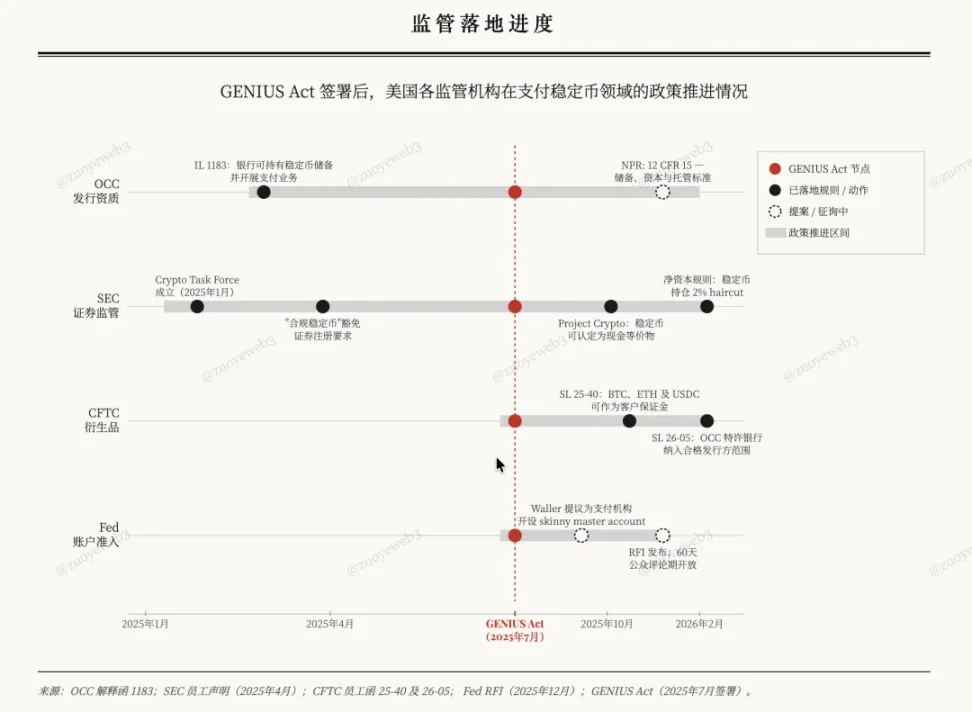
Caption: Regulatory Implementation Timeline. Source: @zuoyeweb3
Since Merrill Lynch invented the Cash Management Account (CMA) money market fund (MMF) in the 1970s, banks have accused MMFs of draining deposits from small and community banks—but the die was cast. CMAs enabled flexible deposits and withdrawals while offering interest rates exceeding those of bank accounts.
Ultimately, banks were gradually permitted to engage in diversified operations and offer MMF-like products, halting deposit outflows. Ironically, large banks leveraged their scale to capture deposits from smaller ones.
Heresy is more terrifying than apostasy.
Stablecoin yields aren’t even a real problem—banks want to issue yields themselves, avoiding obsolescence. Another example: when Alipay and WeChat Pay surged in 2013, U.S. banks again waved the banner of protecting small banks.
Unsurprisingly, U.S. domestic Fintech firms like PayPal bore the brunt—and the false narrative took root that third-party payment providers would disrupt banks by relying on them.
But Crypto is different. Truly different.
Facing fierce pushback from banks and regulators, Circle appears more American, more compliant; Tether is an outsider, underground, a scrappy underdog. Yet for a long time and across vast regions, $USDC and $USDT have not been competitors.
Simply put: USDC follows a “DeFi + B2B + stablecoin” logic, whereas USDT adopts a “CEX + P2P + stablecoin” narrative.
It sounds odd—but indeed, USDC enjoys broader DeFi adoption, widely used as quote assets and dominating DEXes and lending protocols far beyond USDT. Outside Coinbase, however, most CEX liquidity is priced in USDT.
In institutional finance, USDC has become the standard stablecoin; Circle’s CCTP and related stacks serve as gateways for institutions entering on-chain ecosystems.
Yet USDT proves remarkably resilient: $80B in USDT on Tron supports global peer-to-peer transfers; in Argentina and Nigeria, dollarization is effectively USDT-ization.
Per joint research by Artemis and McKinsey, the $35T in global stablecoin transaction volume is largely illusory—only ~$39B (~1%) represents genuine stablecoin payments, constituting just 0.02% of total global payments (>$2T).
- B2B Payments: $22.6B (dominant use case, 60% of total, up 733% YoY), representing just 0.01% of the ~$1.6T global B2B payment market.
- Global Payroll & Cross-Border Remittances: $9B (<1% of global share).
- Clearing & Settlement: $0.8B (<0.01% of global share).
- U-Cards: $4.5B.
This data feels more authentic in daily experience. Perhaps adoption trends matter more: Fintech firms actively integrate with banks, while banks simultaneously resist yield-bearing stablecoins yet support wider stablecoin usage.
Examining Tether’s recent moves, partnering with Lyn Lutnick and launching USAT are mere fig leaves; its $200M investment in Whop reveals deeper intent—effectively paying $200M for access to 18M users, using remittance flows from the Global South to encircle the developed world.
Thus, cross-border remittance firms operating between Latin America ↔ U.S., South Asia ↔ Middle East, and Africa ↔ Europe commonly support USDT, whereas Stripe and Huma default to USDC.
Crypto’s essence is P2P; Circle deliberately pursues enterprise and bank partnerships. Today’s widespread coverage of B2B use cases—and framing them as the future trend—misreads the fundamental direction of payments.
As noted earlier, pure transfer, clearing, and aggregation channels hold limited value: transaction volumes are finite numbers, lacking the “dream valuation” foundation required for exponential growth. Everyone needs GPUs for gaming—maximum sales of 7B GeForce RTX 5090s pales beside AI’s status as the Fourth Industrial Revolution.
“Payments aren’t a SaaS product or feature—they’re AI-powered payment infrastructure, akin to Cloudflare: a distribution network whose value isn’t quantified by volume.”
This is Crypto’s story to tell the world: transforming stablecoins into something transcending payments, enabling end-to-end monetary retention on-chain.
On-Chain Settlement and Accumulation
Everyone discusses the demise of SaaS and the aging of channel distributors—as if decades of Fintech progress could vanish overnight.
Reality won’t shift that fast—especially given USDC’s institutional B2B adoption still requires time, and Tether’s aggressive push of USDT into legacy channels doesn’t guarantee future success.
If identifying a meaningful observation point for Crypto’s payment narrative, the only relevant question is how to reconcile payments and yield. The answer is now clear:
- To capture yield effects, stay on-chain in DeFi—like MetaMask’s U-card collaborating with Aave to enter the U.S. market indirectly, unable to penetrate broader consumer ecosystems;
- To scale payments, obtain an OCC bank charter to issue compliant, non-yielding stablecoins—entering the expansive derivatives markets governed by the CFTC and SEC;
- Meanwhile, BitGo’s Asia-focused institutional dollar stablecoin $FYUSD and Circle’s euro stablecoin $EURC deliberately confine themselves to niche domains.
B2B is fundamentally about pipes; C2C is about scale; B2C is about plug-ins.
Tracing the evolution of payment stablecoins, the hope for replacing card networks lies with public chains/L2s—but relative to Fintech’s “bank replacement” advantage, the solution must be a new product combining MMF+ payment functionality, surpassing banks in capital efficiency.
Peter Thiel backs neobanks and neobrokers; Vitalik champions ETH-based yield-bearing stablecoins.
On this point, Vitalik sees more clearly: without ETH-based yield-bearing stablecoins to diversify holding risk—or at minimum, RWA-backed stablecoins to diversify yield sources—the path remains perilous.
In short: payment functionality without on-chain yield cannot escape the dominance of dollar-denominated assets—and ultimately, will be tamed by the OCC into becoming part of the banking system. Those who trade freedom for security end up with neither.
Here’s a second risky assertion: existing B2B use cases built on USDC—and cross-border remittance projects integrating USDT transfers—cannot propel payment stablecoins across the threshold into global adoption. They hold only transitional significance and will not emerge as primary players in the next era.
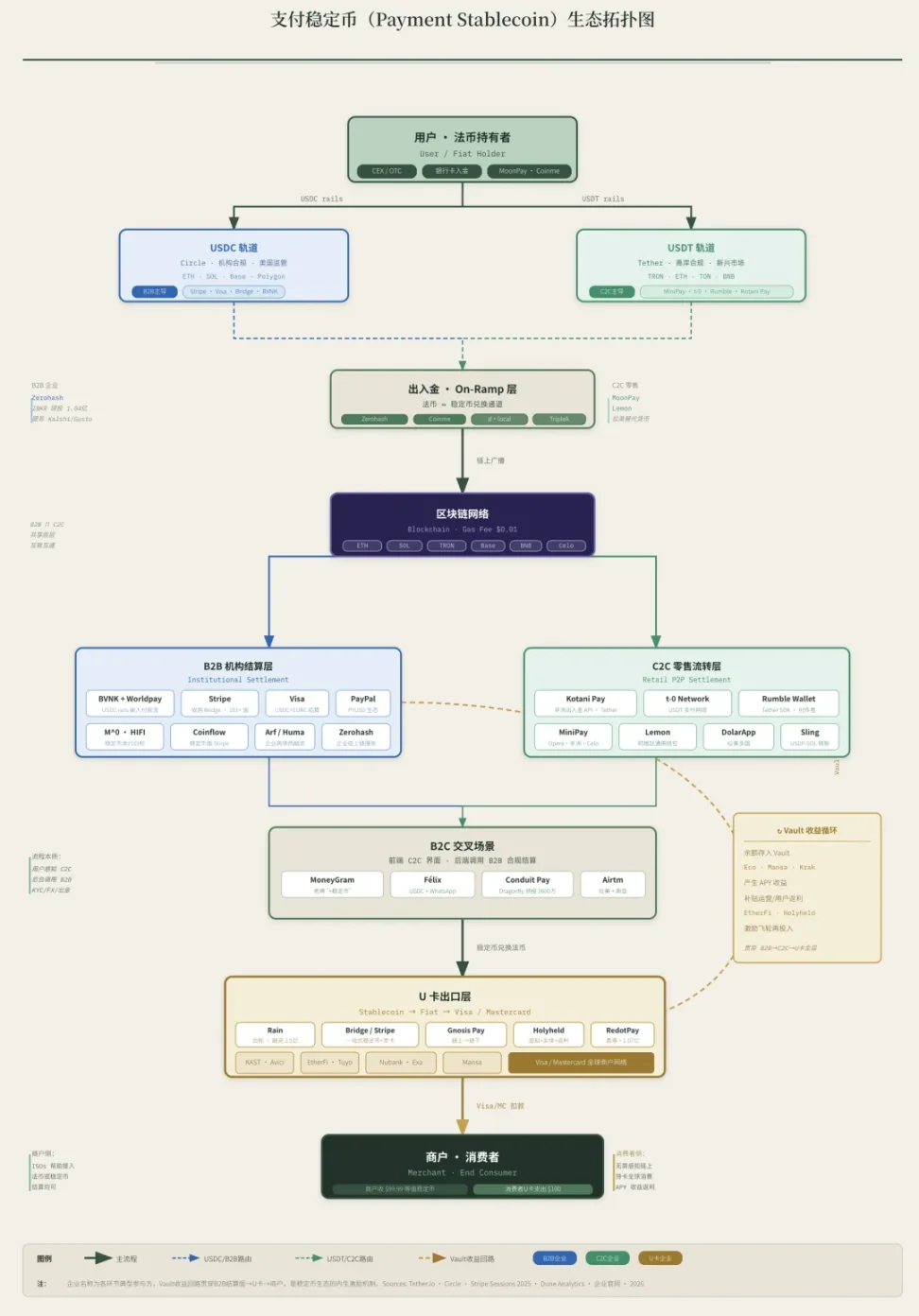
Caption: Payment Stablecoin Flow. Source: @zuoyeweb3
The phase where yield serves as a customer acquisition tool has ended. Banking resistance has impacted both off-chain and on-chain realms: after $USDe and $xUSD, on-chain yield initiatives have also stalled. It’s time to rigorously study real-world payment adoption.
But caution: focusing solely on payments while ignoring yield characteristics means missing 50% of this wave’s most valuable component. USDT/USDC, funded by Treasury yields, have been co-opted—banking has won its third assault, continuing to wield the cheapest demand deposits as instruments of power.
Conclusion
Following Fintech’s footsteps, we hope Crypto charts a distinct future.
Four drivers fuel the new payment battleground: Stripe and peers embracing new narratives frantically ahead of IPOs; Meta/Google recognizing their bargaining power as distribution channels; banks aiming to retain fee income and cheap assets; and Tether’s aggressive investments in payment firms, hoping to encircle Circle.
Two new narratives are bundled into future visions: stablecoins are taken for granted as Agent payment tools—yet no one asks whether Agents are truly necessary.
That question remains for the next article.
Join TechFlow official community to stay tuned
Telegram:https://t.me/TechFlowDaily
X (Twitter):https://x.com/TechFlowPost
X (Twitter) EN:https://x.com/BlockFlow_News
 @zuoyeweb3