Industry Divergence Amid AI Impact: Intuit Plunges 50% to Top S&P 500’s Worst Performers, while Victoria’s Secret Surges 47% in a Single Day
TechFlow Selected TechFlow Selected
Industry Divergence Amid AI Impact: Intuit Plunges 50% to Top S&P 500’s Worst Performers, while Victoria’s Secret Surges 47% in a Single Day
In June, as the S&P 500 continued to hit new highs and AI narratives dominated the market, the inverse performance between the software sector and Victoria’s Secret served as a diagnostic mirror.
 Navigating Web3 tides with focused insights
Author: Ada, TechFlow
On the previous trading day, Forbes labeled Intuit the worst-performing S&P 500 constituent year-to-date, while Goldman Sachs simultaneously downgraded the stock. Meanwhile, Victoria’s Secret surged 47% in a single day following a Q1 earnings report that doubled analyst expectations. This is not merely a simple contrast between two individual stocks—it reflects two facets of an underlying fissure within today’s U.S. equity market.
Narratives are reshaping market valuations, revealing the classic sectoral divergence in U.S. equities amid the AI shock: traditional retail can be reborn through product and experience, but the software sector is taking a direct hit.
Forbes “Crown” of Worst Performer: Intuit Down 50%, Goldman Downgrades Same Day
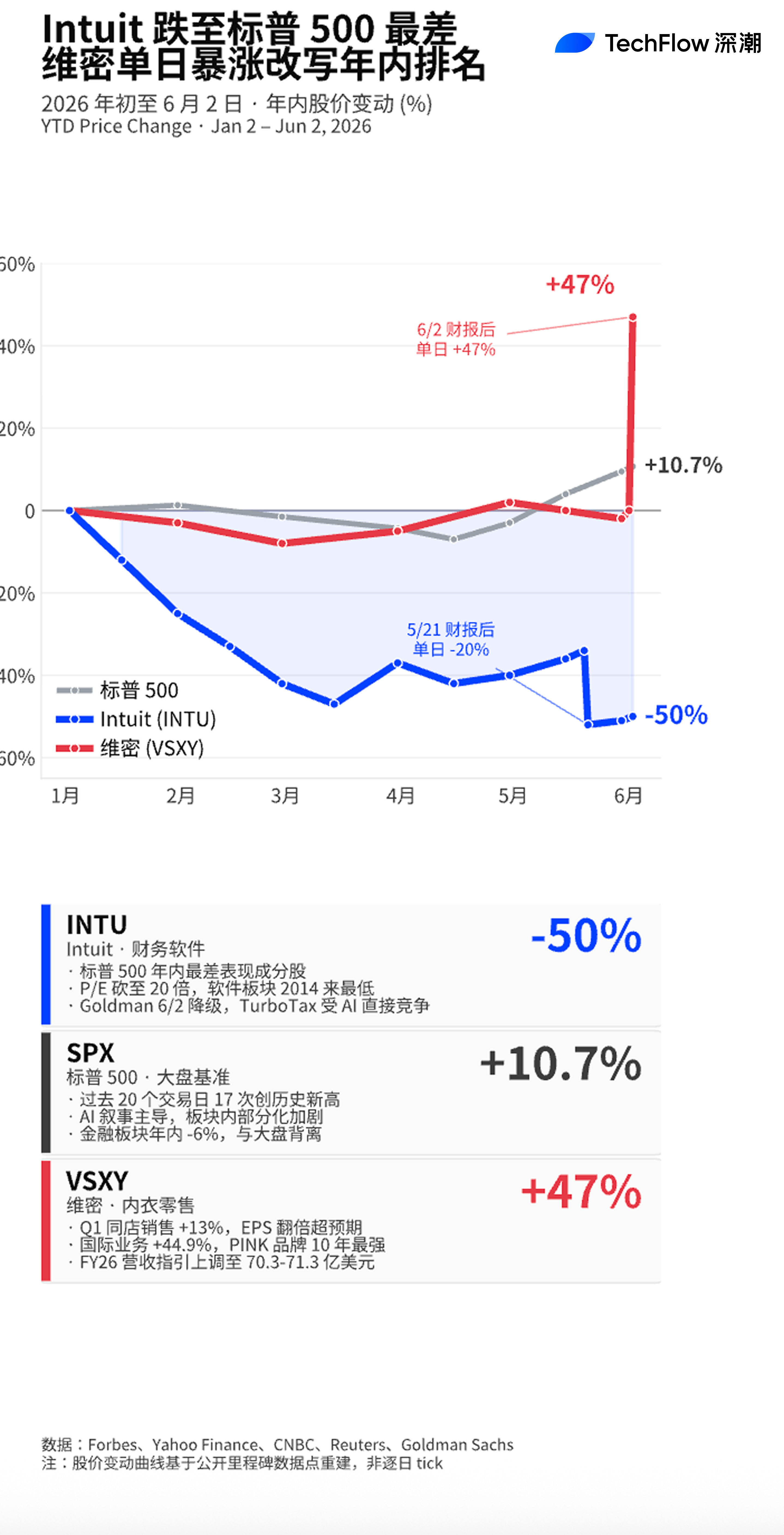
According to a June 2 report by Forbes, Intuit has become the worst-performing S&P 500 constituent year-to-date. Data from Yahoo Finance and The Motley Fool show that as of early June, INTU had fallen roughly 50% year-to-date and over 55% over the past 12 months, with its market capitalization shrinking to approximately $106 billion. On the same day, Goldman Sachs analysts led by Gabriela Borges downgraded the stock, noting in their report that INTU’s share price is likely to remain range-bound over the coming quarters and advising investors to lower earnings expectations to reflect a more challenging competitive landscape.
Ironically, the company’s fundamentals have not meaningfully deteriorated. Intuit reported $8.6 billion in third-fiscal-quarter revenue, up 10% year-on-year; EPS for each of the past four quarters has exceeded consensus estimates; and management raised its fiscal 2026 earnings guidance in May. Yet on May 21—immediately after reporting those results—the stock plunged 20% in a single day, becoming the decisive event that shattered investor confidence. The Motley Fool noted the unusual nature of this decline: it occurred right after the company delivered multiple investor-friendly catalysts—including earnings above guidance, an upward revision to full-year forecasts, an expanded buyback program, and a higher dividend.
Goldman Sachs’ core concern centers on TurboTax—the company’s flagship product, which accounts for roughly one-quarter of Intuit’s revenue and operating profit—but which now faces direct competition from generative-AI–driven tax tools. Bank of America similarly cut its price target on May 27, stating that AI’s “substantive erosion” of Intuit’s “moat around its business model” warrants a fundamental repricing.
SaaS Sector Faces Systemic Discounting: P/E Ratio Slashes from 35x to 20x
Intuit is far from alone. In its Q1 2026 investor letter, Auxier Asset Management wrote: “The SaaS (Software-as-a-Service) industry was among the hardest-hit sectors in Q1. Investor uncertainty about AI’s potential for disruption continues to rise, driven by concerns that AI could commoditize the entire industry and compress margins.”
Data corroborate this view. As previously reported by Forbes, the software sector’s forward P/E ratio fell from ~35x at end-2025 to 20x in Q1 2026—the lowest level since 2014. The iShares Expanded Tech–Software Sector ETF (IGV), which tracks the software sector, posted a Q1 2026 loss of over 24%, marking its worst quarterly performance since Q4 2008. Even after bottoming near $74 in April and rebounding partially to ~$92, IGV’s year-to-date relative performance versus the S&P 500 registered a historic negative excess return.
Jim Cramer of CNBC offered a more granular description on his February 2 program: Among the S&P 500’s worst performers in January, the second-, fourth-, seventh-, ninth-, and tenth-worst were all software companies—“same business model, crushed by the same thing: AI’s compression of P/E multiples.” Intuit ranked second-worst in the S&P 500 for January, falling nearly 25% in a single month.
This valuation compression unfolded almost entirely independent of fundamentals. Forbes cited Auxier’s statistics showing that Intuit, Adobe, Salesforce, and FICO all saw share prices fall 30%–37% in Q1—even though each reported strong financial results. Investors’ central concern is that AI agents can replace most of the work currently performed by these software companies—at a fraction of their current cost.
Intuit’s Pivot: Partnership with Anthropic — “If You Can’t Beat It, Join It”
Intuit’s management was not unprepared for the AI threat. CEO Sasan Goodarzi declared AI a core corporate strategy well before mainstream software firms embraced it broadly, repeatedly framing AI as a tool—not a threat—to the business. On February 24, Intuit announced a multi-year partnership with Anthropic.
The bidirectional structure of the collaboration carries symbolic weight. Intuit will integrate its core products—including TurboTax, Credit Karma, QuickBooks, and Mailchimp—into Anthropic’s Claude.ai, Claude for Enterprise, and Cowork platforms via the Model Context Protocol (MCP). Conversely, Anthropic’s AI models will power customized agents on Intuit’s own platform. Trading Tips summarized the move succinctly: “If you can’t beat the robot, hire it.”
The irony is palpable: Anthropic is precisely one of the forces widely feared to disrupt TurboTax. While Intuit’s pre-market share price briefly rebounded on the announcement, medium- to long-term valuation pressure remains unresolved. Goldman Sachs’ June 2 downgrade report reiterated that TurboTax faces direct competition from AI-driven tax tools—a category representing ~25% of Intuit’s revenue and operating profit—and thus anchors the company’s overall valuation.
A deeper layer of irony is that Intuit has become an early example of the “vendorization” trend in the AI ecosystem. Within the AI narrative, application-layer software firms are expected to bifurcate into two paths: one moving upstream toward foundational models (e.g., Intuit + Anthropic integration), the other being displaced outright by native AI products. Markets currently assign no materially higher valuation to the former than to the latter.
Victoria’s Secret as Counter-Evidence: Markets Don’t Reward Narratives—They Reward Visible Profits
On that same June 2, Victoria’s Secret (NYSE: VSXY, formerly VSCO, ticker switched in May) surged 47% in a single day, hitting an intraday all-time high of $81.28. Over the past 12 months, its share price has nearly tripled.
The catalyst was a hard, beat-and-raise earnings report: Q1 revenue of $1.56 billion (+15% YoY, vs. $1.52 billion expected); adjusted EPS of $0.60 ($0.30 expected—nearly double); same-store sales growth of 13% (vs. 11.4% expected). Operationally, operating profit jumped from $20 million to $76 million year-on-year; the company repurchased 2.2 million shares for $100 million year-to-date.
Benzinga data shows North American store sales rose 11.3% to $802.8 million; direct-channel sales increased 8.4% to $469.4 million; and international sales surged 44.9% to $287.4 million—driven primarily by China. The PINK brand recorded its strongest growth in a decade; Beauty posted double-digit growth; and all three core brands—Victoria’s Secret, PINK, and Beauty—achieved double-digit sales growth.
CEO Hillary Super told CNBC: “We’ve had an exceptionally strong start to 2026—exceeding both revenue and earnings guidance—and building on the momentum established in the second half of last year.” She attributed growth to focused product execution, reduced discounting, and renewed brand heat—including the revived lingerie show and Valentine’s Day marketing campaigns. Axios previously quoted her describing the essence of the lingerie business as “fun and pleasure”—not a serious enterprise.
CFO Scott Sekella noted that part of Q1 sales benefited from tax-refund spending, but that proportion remained within normal range. Even as the tax-refund tailwind fades in Q2, demand remains stable. The company raised its FY2026 revenue guidance to $7.03–$7.13 billion (from $6.85–$6.95 billion) and adjusted operating profit guidance to $550–$580 million (from $430–$460 million)—an increase of over $100 million just in operating profit guidance alone.
Even more intriguing is a structural market detail: According to Ortex data, ~19% of VSXY’s freely tradable shares were shorted—an unusually high short interest that some analysts believe may have provided additional fuel for the rally via short-covering.
A Diagnostic Mirror with Two Faces
In June—a month when the S&P 500 keeps hitting new highs and AI narratives dominate markets—the inverse price action between software stocks and Victoria’s Secret forms a diagnostic mirror. Intuit’s 50% decline is not an isolated event, but rather the market’s front-loaded discounting of “future risk”: When the AI-disruption narrative reaches its extreme, even fundamentally robust SaaS leaders—whose EPS has consistently beaten expectations—get repriced at the lowest P/E ratio since 2014.
Victoria’s Secret’s counter-trend move provides the other half of the evidence: In a market where narratives suppress valuations, visible profitability itself has become scarce. A turnaround in same-store sales—from negative growth three years ago to +13% today; the execution delivered by Hillary Super’s team over the past year; and explosive international growth of +44.9%—these were rewarded directly by the market with a 47% single-day surge.
In other words, the market in 2026 isn’t betting on “what AI can disrupt,” but rather on “what, besides the AI narrative, is actually generating profits.” The answers to these two questions will determine the most critical sector allocation decisions for the second half of the year.
Join TechFlow official community to stay tuned
Telegram:https://t.me/TechFlowDaily
X (Twitter):https://x.com/TechFlowPost
X (Twitter) EN:https://x.com/BlockFlow_News
 深潮TechFlow