Global stock markets are moving towards 7x24-hour trading, but who will retain the life-saving pause button?
TechFlow Selected TechFlow Selected
Global stock markets are moving towards 7x24-hour trading, but who will retain the life-saving pause button?
Morgan Stanley was able to survive in 2008 precisely because the market closes on weekends.
 Navigating Web3 tides with focused insights
Author: Byron Gilliam
Compiled by: TechFlow
TechFlow Editor's Note: As global exchanges rush towards 7x24 non-stop trading, we may have forgotten a fact: Morgan Stanley survived in 2008 precisely because markets close on weekends. Nights and weekends are like the financial system's "emergency brakes," giving a panic-stricken market a breathing window — but tokenized stocks and blockchain are dismantling this guardrail.
Before the 2008 Columbus Day long weekend, Morgan Stanley looked like it would become the next domino to fall in the financial crisis.
The bank started that week with $130 billion in cash on its books, which management believed was enough to weather the storm.
But the hedge funds that had once finished off Bear Stearns, Lehman Brothers, and Merrill Lynch were now also withdrawing capital from Morgan Stanley — pulling out $65 billion in a single day.
This was a bank run, and the only way to stop it seemed to be for a large investor to inject equity capital.
"If we didn't make this deal, it was all over," CEO John Mack later said, "We couldn't continue operating."
Fortunately, Mack had already negotiated a deal.
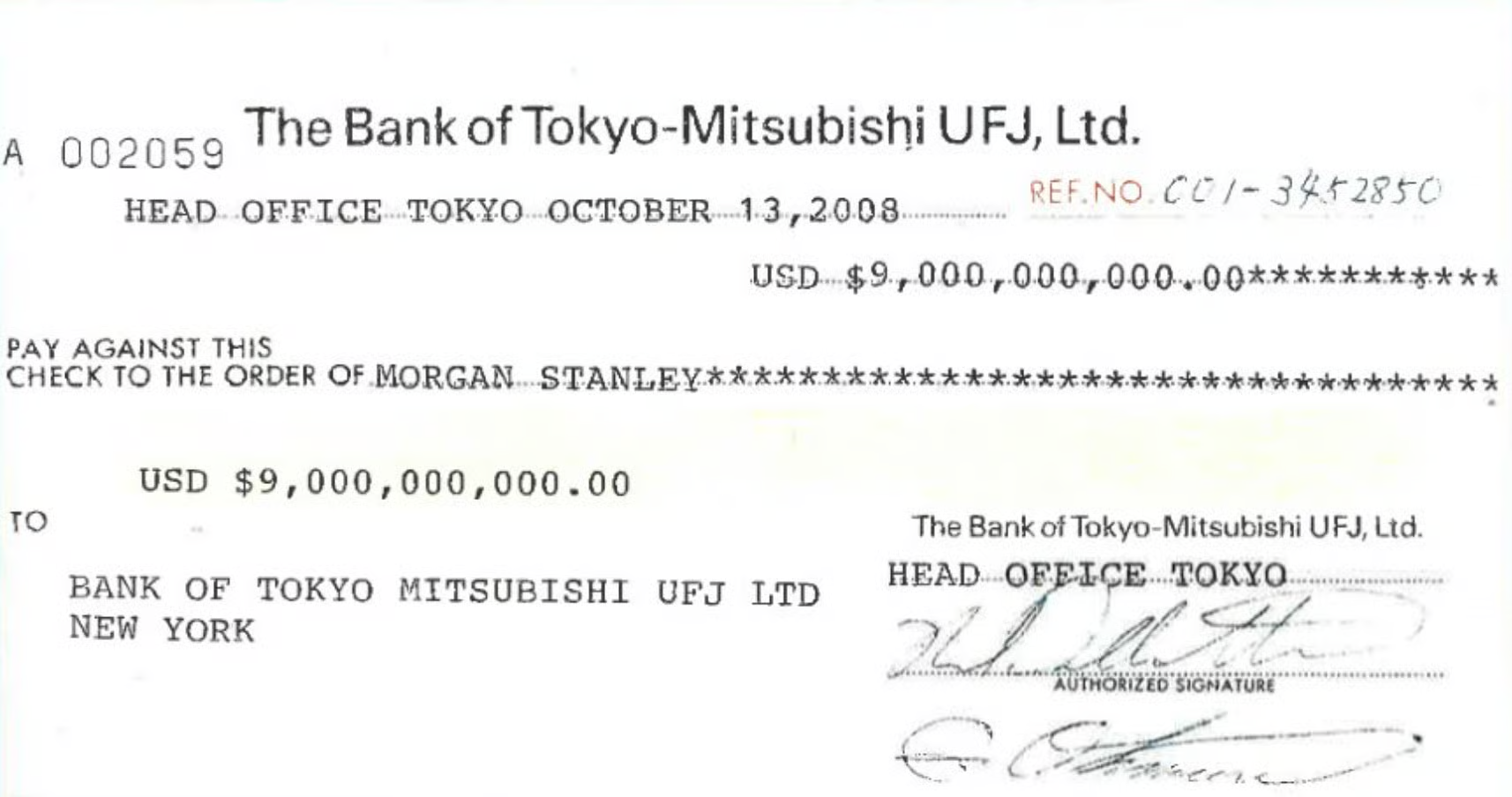
Two weeks earlier, Japan's Mitsubishi UFJ Financial Group (MUFG) — the world's second-largest bank, with $1 trillion in customer deposits — had agreed to acquire a 21% stake in Morgan Stanley for $9 billion.
Unfortunately, the deal had not yet been completed.
The market was increasingly skeptical that it would ever be completed. The deal valued Morgan Stanley at $25.25 per share, but investors seemed unconvinced: the closing price on the day of the announcement was only $14.22.
Nine days later, it fell below $10.
This was a big problem.
The more the stock price fell, the less likely the deal was to be completed. The less likely it was to be completed, the more the stock price fell.
Worse still: the more the stock price fell, the more capital customers withdrew. The more... you know, a death spiral.
Morgan Stanley was at the mercy of the stock price, which fell day after day.
"We just needed to hold on until the weekend," Charles Smith, Morgan Stanley's head of business development, later said.
The Weekend is a Circuit Breaker
The weekend was a circuit breaker — a two-day window that allowed Morgan Stanley to complete the transaction with MUFG without worrying about the stock price.
On Saturday, MUFG said it remained committed to investing but needed to renegotiate. By Sunday, a new deal was reached, with MUFG primarily receiving preferred stock instead of common stock.
Only the payment issue remained.
Announcing the renegotiated deal would not stop the death spiral that would surely restart as soon as trading resumed on Monday morning. To restore confidence in Morgan Stanley, the deal had to be completed.
"We knew that if this money could not be delivered," MUFG Chairman Nobuyuki Hirano recalled, "the market would sell off Morgan Stanley stock, possibly down to zero."
MUFG was ready to pay, but there was a problem: the Federal Reserve was closed for the Columbus Day holiday, but the stock market was not.
Morgan Stanley needed to receive the money before trading resumed on Monday morning, but the Fedwire payment system, which handles such large transfers, would not reopen until Tuesday.
In market panic mode, Tuesday might be too late, and $9 billion would not help. Morgan Stanley might have lost multiples of that amount in withdrawals by then.
So there was only one way: MUFG had to write a check.
Morgan Stanley Vice Chairman Rob Kindler proposed this suggestion on Sunday, and MUFG agreed. At 7:30 Monday morning, Kindler waited in a conference room at the Wachtell Lipton law firm to receive a physical check.
"He looked terrible," Aaron Sorkin wrote in Too Big to Fail, "He hadn't slept in at least a day."
Kindler thought the check would be delivered by a messenger, so he didn't bother shaving, nor did he change out of the khakis and flip-flops he was wearing when he canceled his vacation in Cape Cod.
As it turned out, the check was delivered by a team of suit-clad MUFG executives. And a film crew.
Kindler hastily borrowed a suit jacket from a lawyer, but the lawyer's shoulders were not as broad as Kindler's. The back of the jacket tore.
"I assure you, I am the Vice Chairman of Morgan Stanley," the exhausted-looking Kindler said to his Japanese saviors.
Despite his appearance, MUFG handed over the check — with enough time for Morgan Stanley to announce it to the world before stock trading resumed.
The stock price rose as much as 70% that day.
The run on the bank was over, thanks to the weekend circuit breaker — which may soon cease to exist.
The Life-Saving Pause Button
If the S&P 500 falls 7%, trading pauses for at least 15 minutes. If it falls 20%, it pauses until the next day.
These market-wide circuit breakers were established after the 1987 Black Monday crash, aimed at interrupting panic selling before it becomes self-reinforcing.
Exchanges also have the discretion to halt trading in individual stocks, for major news awaiting release or simply order imbalances — anything investors might need extra time to think about.
Companies announce earnings before or after hours for the same reason. Berkshire Hathaway even releases them on Friday nights, so investors have the entire weekend to digest them.
This is also the time regulators most often attempt to stop bank runs. Continental Illinois, Barings Bank, and Bear Stearns were all rescued over the weekend.
The Federal Deposit Insurance Corporation almost always closes failing banks after Friday closing, so there is enough time to reorganize under new ownership without affecting depositors withdrawing money.
Nights and weekends are the natural circuit breakers of the entire financial system.
But perhaps not for much longer.
Yesterday, the London Stock Exchange became the latest major exchange to announce plans to shift to 24-hour trading five days a week. The NYSE, Nasdaq, and CBOE are also planning the same.
Is 7x24-hour trading far behind?
Exchanges are expanding trading hours to defend against the competitive threat from tokenized stocks, which trade on blockchains that never close.
Nasdaq says this will also "expand investor access, broaden wealth accumulation opportunities, and redefine how markets operate."
I'm sure this is true. But at what cost?
Morgan Stanley is now a $340 billion bank — employing 83,000 people — because the market paused long enough for someone to save it.
MUFG still holds a 24% stake to this day.
Join TechFlow official community to stay tuned
Telegram:https://t.me/TechFlowDaily
X (Twitter):https://x.com/TechFlowPost
X (Twitter) EN:https://x.com/BlockFlow_News
 Blockworks