Can Mesh Security Revitalize the Osmosis Ecosystem?
TechFlow Selected TechFlow Selected
Can Mesh Security Revitalize the Osmosis Ecosystem?
This article will explore the reasons why Osmosis is worth paying attention to and its independent path of innovation in the DeFi space.
 Navigating Web3 tides with focused insights
Author: Bing Ventures
With the advancement of blockchain technologies such as IBC, appchains—as sovereign technical solutions—have drawn increasing attention. Appchains allow developers to control and customize every layer of a blockchain to meet specific needs and achieve optimal integration. This article by Bing Ventures focuses on a compelling appchain project—Osmosis—and explores why it stands out and how it is forging an independent path of innovation in the DeFi space.
As discussed in our previous articles, appchains grant developers technological sovereignty, enabling them to unleash their creativity. By experimenting with different consensus models, custom node requirements, state machines, and other innovative features, developers can explore and test the most suitable technical frameworks for their applications. This sovereignty allows apps to prioritize their own chain's value and make decisions based on the most meaningful trade-offs. Ultimately, this empowers communities to take full control of their destinies.
However, we have also argued that appchains are not a perfect solution for every project—they represent a subjective set of trade-offs. Critics point to issues with synchronous composability and liquidity fragmentation under the appchain model. Yet, just as liquidity on general-purpose L1s tends to concentrate around a few dominant applications, the same will occur within the appchain ecosystem: DeFi functionalities will coalesce around core products on a select number of high-liquidity appchains, effectively mitigating concerns about fragmented liquidity. This trend is already being validated through Osmosis’ development.
The Advantage of Concentrated Liquidity
DeFi projects face numerous user experience challenges, including complex workflows, high fees, network congestion, and low liquidity. As a decentralized exchange (DEX) and emerging liquidity hub within the Cosmos ecosystem, Osmosis aims to leverage the advantages of appchains to solve these problems. Osmosis enables users to create liquidity pools with unique and customizable parameters, experiment with various bonding curves, multi-weighted asset pools, and more. Additionally, it introduces innovative features such as superfluid staking, which incentivizes users to participate in network security using $OSMO-backed LP tokens, thereby returning greater value to the community.
We’ve previously articulated a key idea across multiple articles: In Cosmos, liquidity determines security. Osmosis launched during the early days of IBC, when overall ecosystem liquidity was extremely limited. To address this, Osmosis introduced Balancer-style automated market makers and used incentive programs to attract significant liquidity into the Cosmos ecosystem. However, because funds were spread across many pools, much of this liquidity remained underutilized.
This led to the emergence of concentrated liquidity—a model allowing liquidity providers to allocate capital within specific price ranges. This means LPs can be more strategic in deploying their capital. At the same time, Osmosis can handle the same trading volume with significantly less liquidity, improving capital efficiency by approximately 100x.
Osmosis is set to introduce Supercharged Pools, a new incentive mechanism that further optimizes pool utilization and liquidity distribution. This model allows users to claim rewards at any time without waiting for fixed vesting periods. Moreover, there is no requirement to bond LP tokens when joining a Supercharged Pool. However, participation in superfluid staking still requires token bonding.
The Emergence of Mesh Security
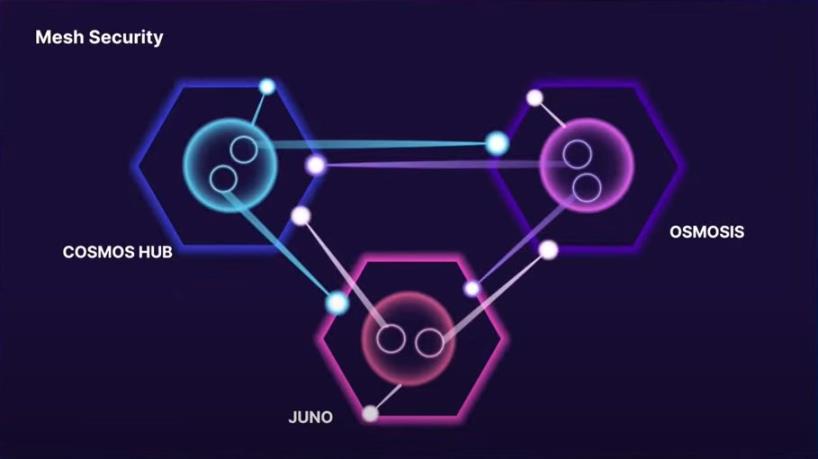
Another major innovation from Osmosis—one that complements concentrated liquidity—is Mesh Security. Mesh Security is an innovative cross-chain security model designed to strengthen the overall security of the Cosmos ecosystem. Its core concept involves combining staked assets across chains to enhance security, addressing vulnerabilities in traditional cross-chain models such as validator collateral takeover risks.
In traditional cross-chain security models, security flows unidirectionally: one chain’s validator set fully validates another. While efficient, this approach compromises the sovereignty of the dependent chain. An alternative model allows subsets of validators to optionally validate other chains, improving scalability but still falling short in governance utilization and chain autonomy. In contrast, Osmosis’ Mesh Security enables bidirectional security flow. Each chain maintains its own validator set and sovereignty while mutually reinforcing each other’s security.
Under the Mesh Security model, staked tokens on one chain can be re-staked to validators on partner chains, enabling Cosmos chains to pool their staked capital and better resist security attacks—thereby enhancing the individual security of each Cosmos chain. In short, Mesh Security benefits from both ATOM stakers’ protection and enhanced security via OSMO staking, creating a stronger, shared defense mechanism.
We expect the Mesh Security model to bring long-term benefits to the Osmosis ecosystem. One of its key functions is preventing malicious validator behavior and slashing incidents, thus safeguarding transaction integrity. Furthermore, this security framework helps defend against MEV-related attacks, ensuring fairness in transaction ordering. Combined with concentrated liquidity—which boosts transaction efficiency—Mesh Security can provide users and ecosystem participants with a more reliable and secure trading environment, fostering sustainable growth across Cosmos.
Osmosis and the Innovation Path of DeFi Appchains
Osmosis is striving to deliver a centralized-exchange-grade user experience by integrating leveraged trading and lending directly into its core product suite. Through collaboration with Mars Protocol, Osmosis aims to embed lending functionality natively into its trading engine. Additionally, Osmosis is exploring several innovative approaches to mitigate MEV on its DEX, including threshold encryption, fee differentiation, Flashbots-like mechanisms, and protocol-level arbitrageurs that operate at the beginning of each block.
As a pioneer among DeFi appchains, Osmosis leverages the robust developer tools and asynchronous composability infrastructure of the Cosmos ecosystem, positioning itself to exert a profound influence on the broader DeFi landscape.
Despite its many benefits, the Mesh Security model also presents challenges and risks, including potential centralization patterns and the complexity of cross-chain coordination and governance. Future development must carefully address these issues to preserve decentralization and balance stakeholder interests.
In tackling MEV, Osmosis has already demonstrated strong innovation and competitive advantages, particularly in threshold encryption. This provides a promising defense against MEV attacks and gives Osmosis a distinct edge over Ethereum within the Cosmos ecosystem.
Liquid staking is also poised for rapid growth on Osmosis. With Cosmos offering relatively high staking yields and moderate unbonding periods, users gain greater flexibility in liquidity management. Further innovations could transform Osmosis into a platform offering checking-account-like yield generation and leveraged yield farming, boosting both asset efficiency and staking rates.
Finally, we are optimistic about innovations in stablecoins, which may become the most important direction for Osmosis’ future growth. By introducing more diverse and innovative stablecoin options, Osmosis will solidify its position as the primary DeFi liquidity hub on Cosmos and drive further development of the liquidity market. This will open up new trading and investment opportunities, catering to a wider range of user needs.
Join TechFlow official community to stay tuned
Telegram:https://t.me/TechFlowDaily
X (Twitter):https://x.com/TechFlowPost
X (Twitter) EN:https://x.com/BlockFlow_News
 Bing Ventures