








Liquidity Wars 3.0: Bribes Become the Market
TechFlow Selected TechFlow Selected
Liquidity Wars 3.0: Bribes Become the Market
If you can determine the direction of liquidity, you can influence who survives in the next market cycle.
 Navigating Web3 tides with focused insights
Author: arndxt, Crypto KOL
Translation: Felix, PANews
A battle for yields may be about to unfold again. If you've been in DeFi long enough, you understand that Total Value Locked (TVL) is merely a vanity metric. In the modular world of fiercely competitive AMMs, perpetual contracts, and lending protocols, what truly matters is not who owns the protocol or even who offers the highest rewards—but who controls the flow of liquidity. It's about convincing liquidity providers (LPs) to deposit capital and ensuring TVL stability. This is precisely where the bribe economy originates.
What once began as informal vote-buying (Curve Wars, Convex, etc.) has now professionalized into a mature liquidity coordination market complete with order books, dashboards, incentive routing layers, and even gamified participation mechanisms in some cases.
Today, this is becoming one of the most strategically significant layers across the entire DeFi stack.
Shift: From Issuance to Meta-Incentives
Between 2021 and 2022, protocols bootstrapped liquidity in a traditional way:
-
Deploy a pool
-
Issue tokens
-
Hope greedy LPs stick around after yields drop
But this model has a fundamental flaw: it’s passive. Every new protocol competes against an invisible cost—the opportunity cost of existing capital flows.
I. Origins of Yield Wars: Curve and the Rise of Vote Markets
The concept of yield wars originated during the Curve Wars of 2021 and gradually solidified.
The unique design of Curve Finance
Curve introduced vote-escrowed (ve) tokenomics, where users lock CRV (Curve’s native token) for up to four years in exchange for veCRV, which grants holders:
-
Boosted rewards on Curve pools
-
Governance voting power (determining which pools receive emissions)
This created a meta-game centered around yield:
Protocols want liquidity on Curve
The only way to obtain it is by attracting votes to their pool
So they begin bribing veCRV holders to vote for them
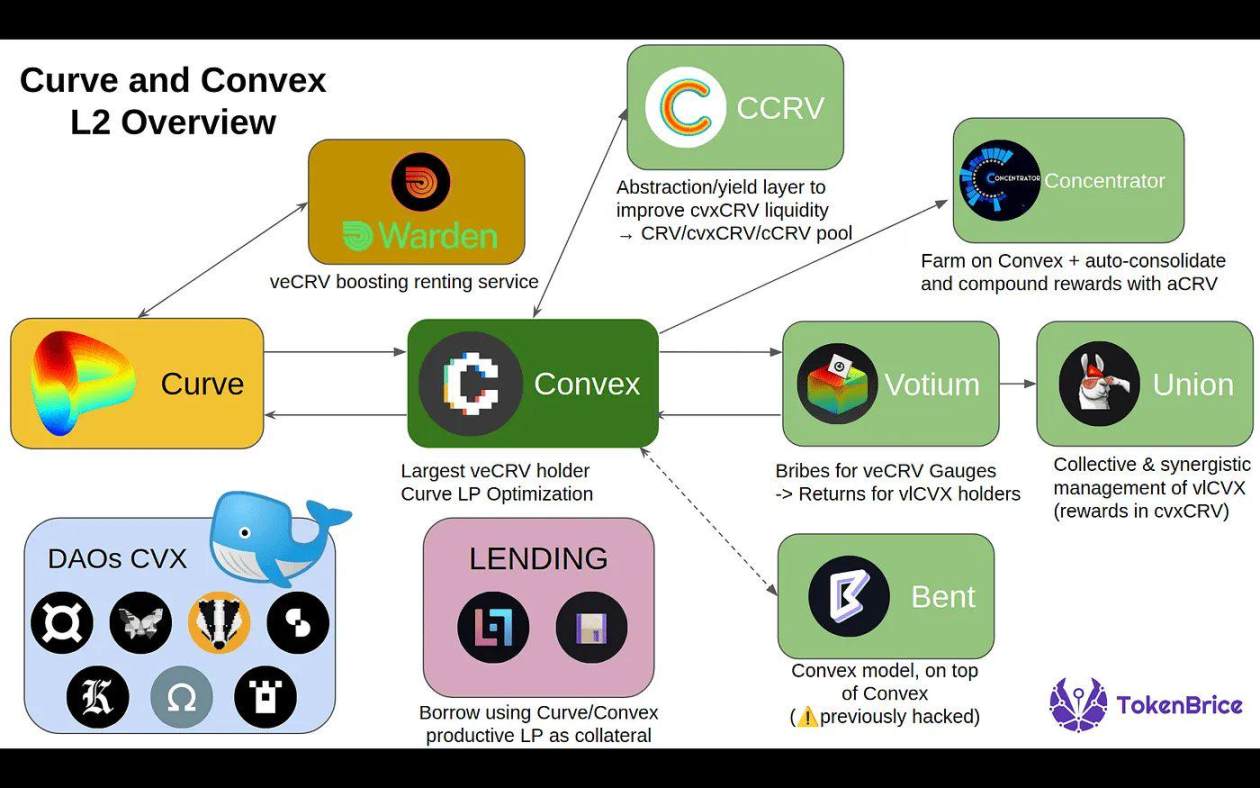
Thus, Convex Finance emerged (a platform focused on maximizing Curve protocol yields):
Lesson 1: Whoever controls voting power controls liquidity.
II. Meta-Incentives and Bribery Markets
The First Bribery Economy
Initially just manual efforts to influence emissions, this evolved into a mature market where:
-
Votium became an OTC bribery platform for CRV emissions.
-
Redacted Cartel, Warden, and Hidden Hand extended this model to other protocols like Balancer and Frax.
-
Protocols no longer simply pay issuance costs but strategically allocate incentives to optimize capital efficiency.
Expansion Beyond Curve
-
Balancer adopted vote-escrow mechanics via veBAL
-
Frax, Tokemak, and others integrated similar systems
-
Incentive routing platforms like Aura Finance and Llama Airforce added further complexity, turning emissions into a capital coordination game
Lesson 2: Yields are no longer about Annual Percentage Yield (APY), but programmable meta-incentives.
III. How Yield Wars Unfold
Here’s how protocols compete in this game:
-
Liquidity aggregation: Use wrappers like Convex (e.g., Aura Finance for Balancer) to consolidate influence
-
Bribery campaigns: Reserve budgets for ongoing vote-buying to attract emissions when needed
-
Game theory and tokenomics: Lock tokens to establish long-term alignment (e.g., ve models)
-
Community incentives: Gamify voting through NFTs, lotteries, or reward airdrops
Today, protocols like Turtle Club and Royco are orchestrating this liquidity: instead of blindly emitting tokens, they auction incentives to LPs based on demand signals.
In essence: “You bring liquidity, and we’ll route incentives to where they’re needed most.”
This unlocks a second-order effect: protocols no longer need to forcibly capture liquidity—they coordinate it.
Turtle Club
Turtle Club has quietly become one of the most effective bribery markets, yet remains rarely discussed. Their pools are often embedded within partnerships, with Total Value Locked (TVL) exceeding $580 million, featuring dual-token emissions, weighted bribes, and an unexpectedly sticky LP base.
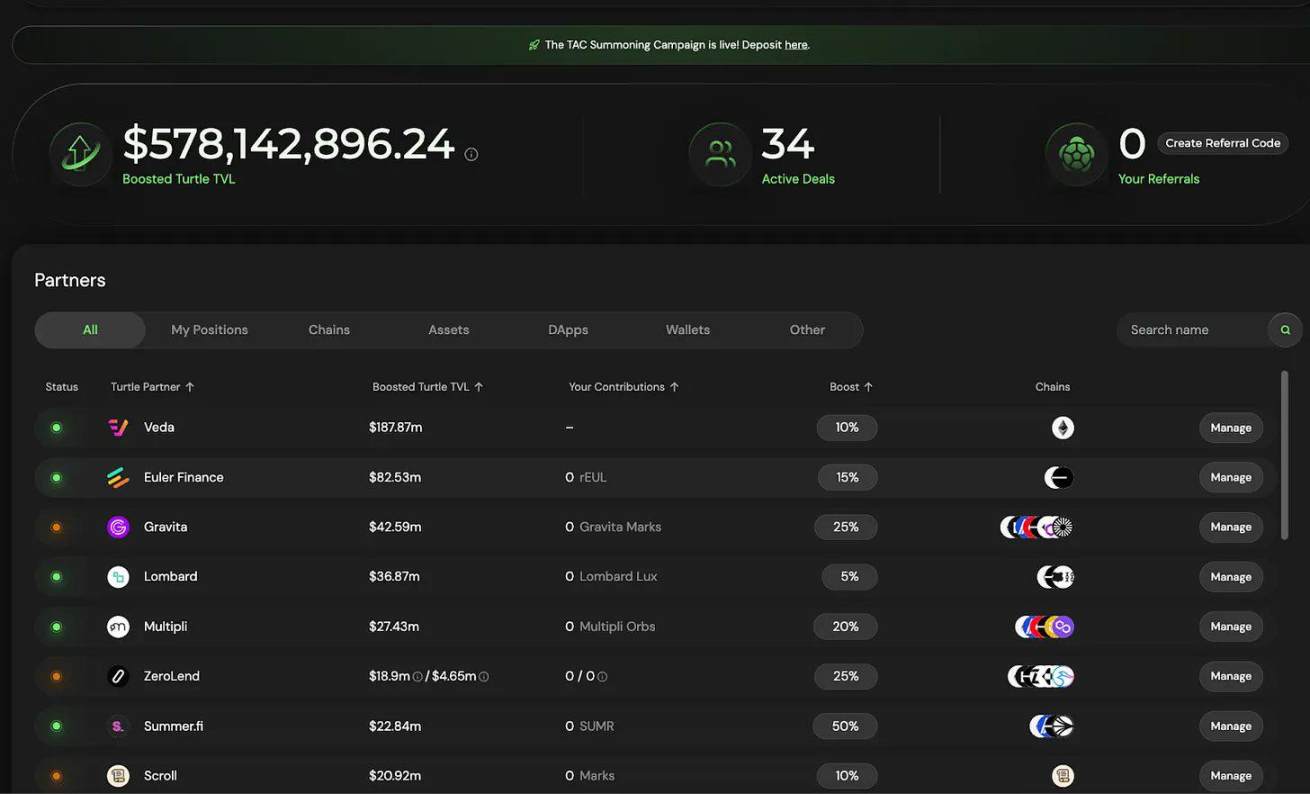
Their model emphasizes fair value redistribution, meaning reward distribution is determined by voting and real-time capital velocity.
This creates a smarter flywheel: LPs earn rewards tied to their capital’s efficiency, not just size. This time, efficiency is incentivized.
Royco
Royco’s monthly Total Value Locked (TVL) surged past $2.6 billion, a month-on-month increase of 267,000%.
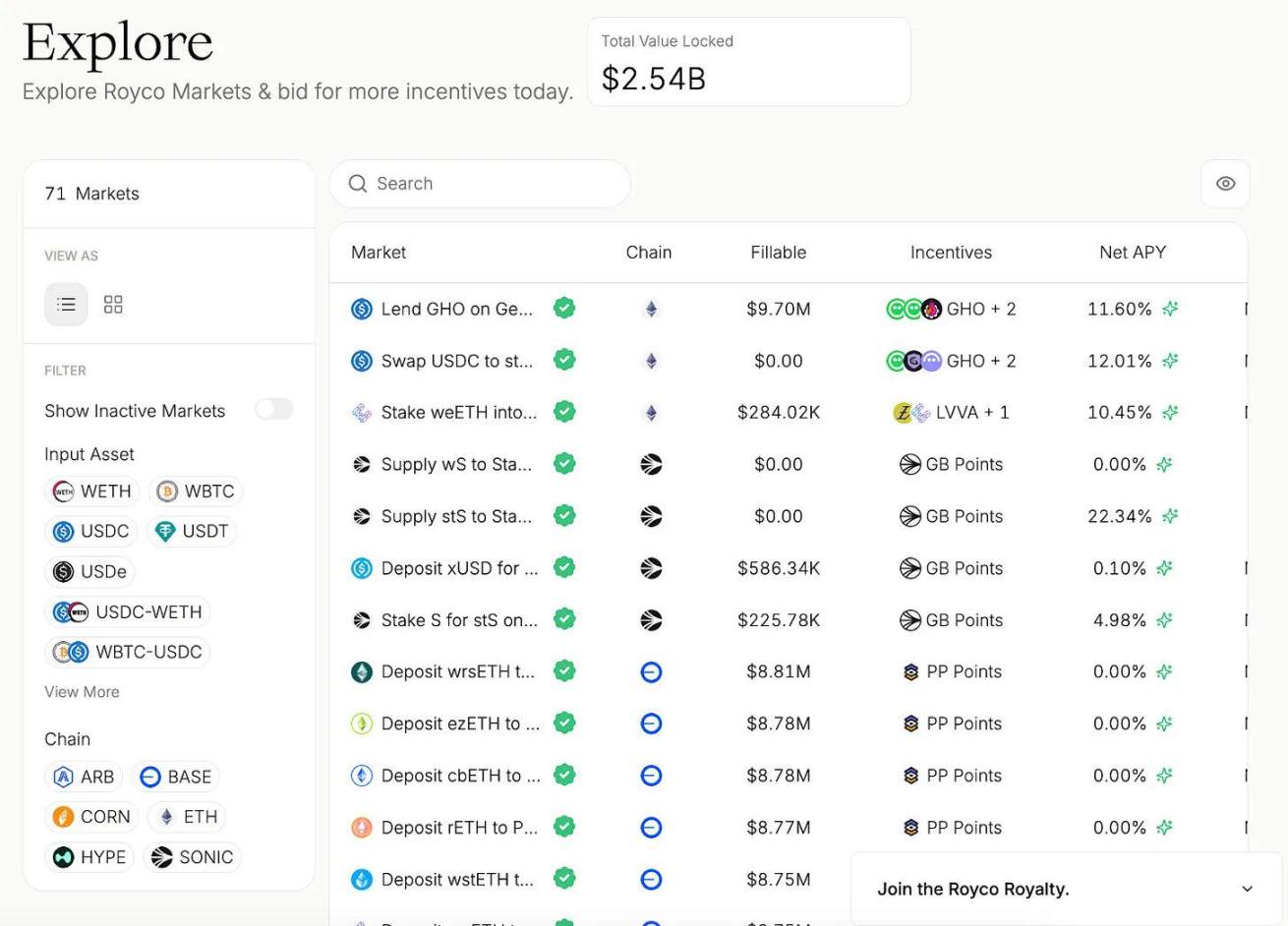
While part of this inflow was points-driven, the infrastructure behind it is critical:
-
Royco is an order book for liquidity preferences.
-
Protocols can’t just emit rewards and hope capital flows in. They post requests, and LPs decide whether to commit capital—this coordination forms a market.
Here’s why this narrative goes beyond just a yield game:
-
These markets are becoming the meta-governance layer of DeFi.
-
Hidden Hand has facilitated over $35 million in bribes across major protocols like Velodrome and Balancer.
-
Royco and Turtle Club are shaping effective emission strategies.
Mechanics of Liquidity Coordination Markets
1. Bribes as Market Signals
Projects like Turtle Club enable LPs to see where incentives are flowing, make decisions based on real-time metrics, and earn rewards based on capital efficiency rather than just capital size.
2. Requests for Liquidity (RfL) as Order Books
Platforms like Royco allow protocols to list liquidity demands—just like posting orders on a market—which LPs then execute based on expected returns.
This transforms the process into a two-way coordination game, not one-sided bribery.
If you can determine the direction of liquidity, you can influence which protocols survive the next market cycle.
Join TechFlow official community to stay tuned
Telegram:https://t.me/TechFlowDaily
X (Twitter):https://x.com/TechFlowPost
X (Twitter) EN:https://x.com/BlockFlow_News
 @arndxt_xo






