Understanding the Matr1x Economic Model: A Path to Sustainable Growth for Web3 Gaming
TechFlow Selected TechFlow Selected
Understanding the Matr1x Economic Model: A Path to Sustainable Growth for Web3 Gaming
The core positioning of FIRE is to serve as the central circulation mechanism for the MATR1X FIRE product and function as a key asset that drives players' sense of purpose and pursuit.
 Navigating Web3 tides with focused insights
Authors: Loki, ABCDE
1. Three-Token Asset System
Matr1x's economic system follows a typical three-token model: the first is an equity token (carrying ownership value), the second is a utility token (carrying usage rights value), and the third is NFTs (carrying data, product, and service value).
(1) Governance Token MAX
Based on currently available public information, Matr1x’s governance token MAX will primarily be used for incentives and staking. Staking MAX grants access to treasury distributions, partial pricing rights for in-game items (corresponding to revenue rights), as well as voting rights for operational decisions, community events, and esports competitions. Clearly, MAX carries the ownership value of the entire Matr1x ecosystem. With treasury distributions in place, the value anchor for MAX will be Matr1x’s protocol revenue, treasury payouts, and governance significance.
Currently, the MAX token has not yet been issued. According to the whitepaper, MAX distribution will occur after the game launch. Players can earn MAX tokens by leveling up in the game, ranking in competitive modes, or holding top-tier NFTs. In terms of allocation, 8% will go to Matr1x FIRE, and another 12% is reserved for other games. MAX will be the highest barrier-to-entry and longest production cycle asset.
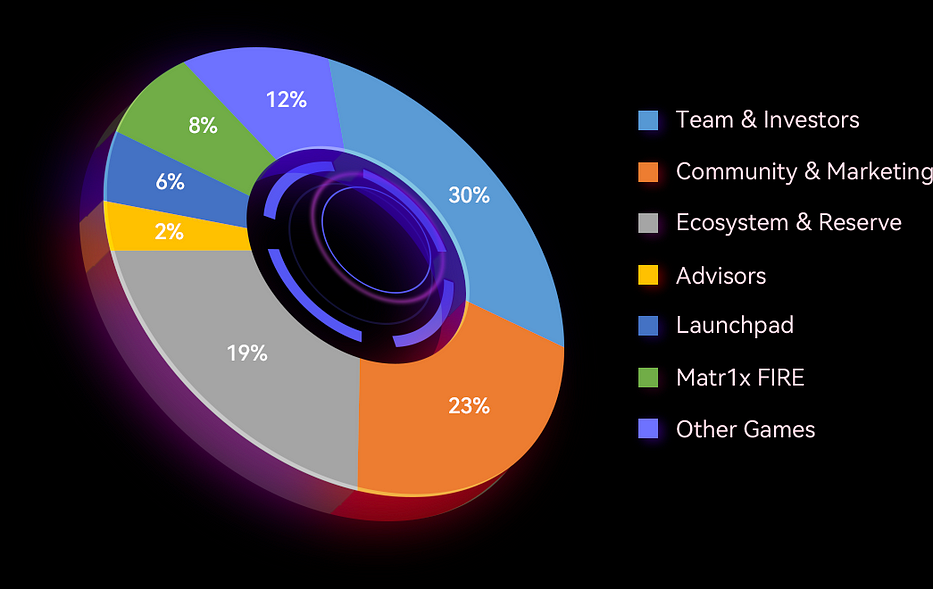
Figure: MAX Token Allocation
(2) Utility Token FIRE
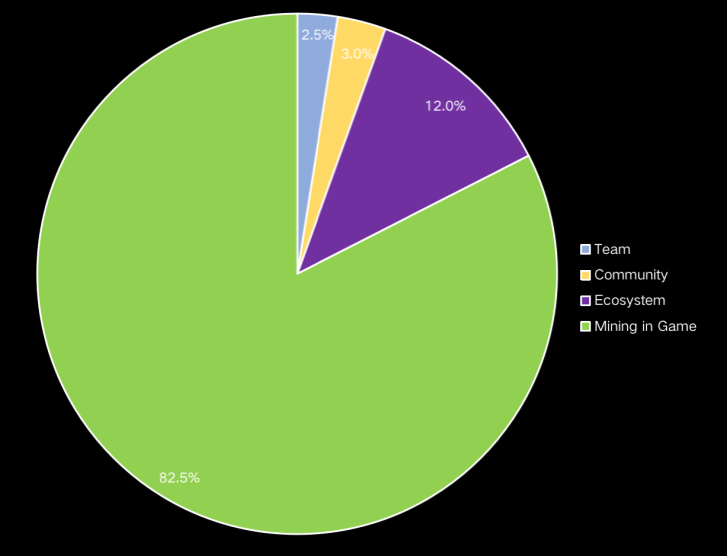
FIRE is positioned as the core circulating token within the MATR1X FIRE ecosystem and serves as a key aspirational asset for players. The distribution of FIRE is relatively straightforward: the team, community, and ecosystem collectively receive 17.5% of the tokens, while the remaining 72.5% are generated through gameplay activities such as playing the game, opening crates, and participating in tournaments. FIRE is used for character development, crate openings, esports tipping, purchasing privileges, and certain consumption actions like asset upgrades and crate openings result in the burning of FIRE.
(3) Assets and Items as NFTs
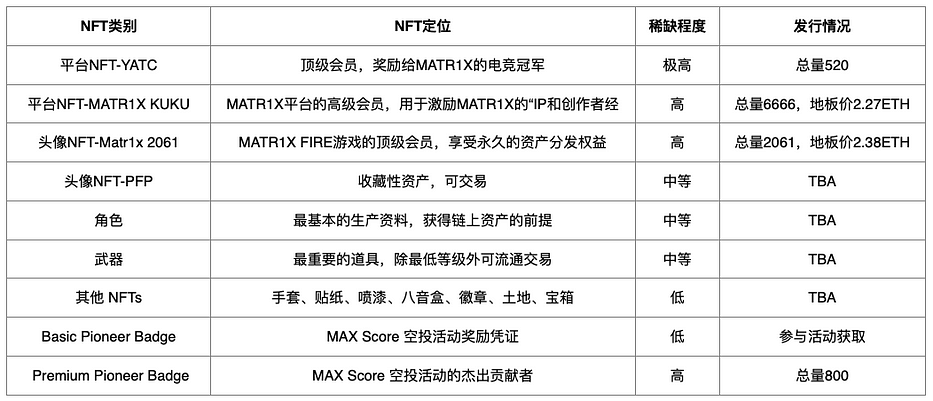
MATR1X has designed a "triangular strategy" encompassing gaming, esports, IP, and co-creators, based on which it has developed a series of NFTs:
2. In-Game Economy: Integration of Web2 and Web3 Business Models
Matr1x provides players with a series of system-generated assets, including characters, equipment, materials, and consumables. These elements are not isolated but are closely interrelated in terms of resource synthesis and exchange.
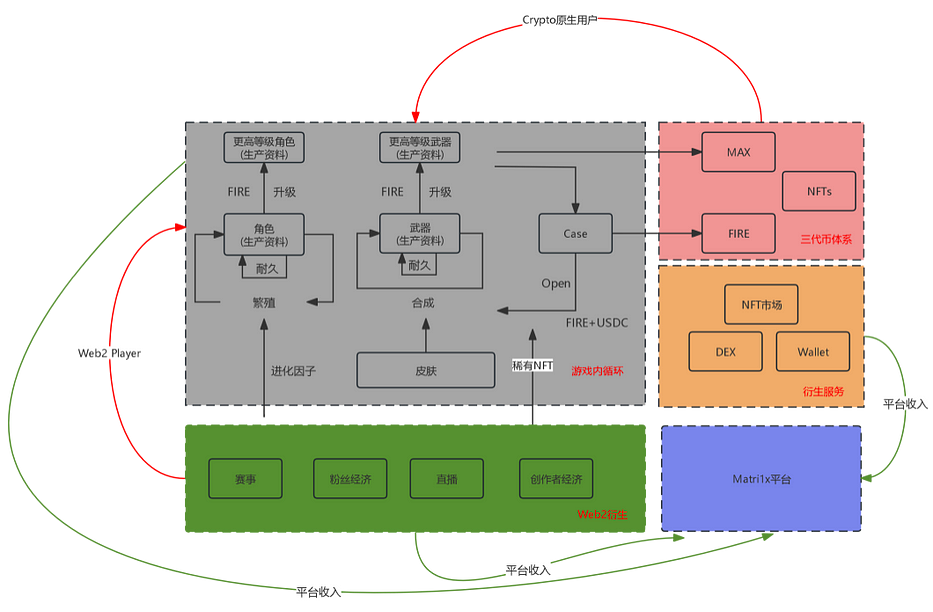
From the output perspective, these resources come from two main sources. The first is primary market issuance and subsequent mapping, such as the already-released NFT-MATR1X KUKU and NFT-Matr1x 2061.
The second source is in-game generation. Unlike most Web3 games, MATR1X FIRE primarily distributes game rewards in the form of crates, which can yield weapons (with a small chance of obtaining golden items) and various weapon skins.
On the consumption side, FIRE is the primary medium of the in-game economy. Character leveling and breeding, weapon synthesis and upgrading, and crate openings all require FIRE, with some scenarios also requiring USDC.
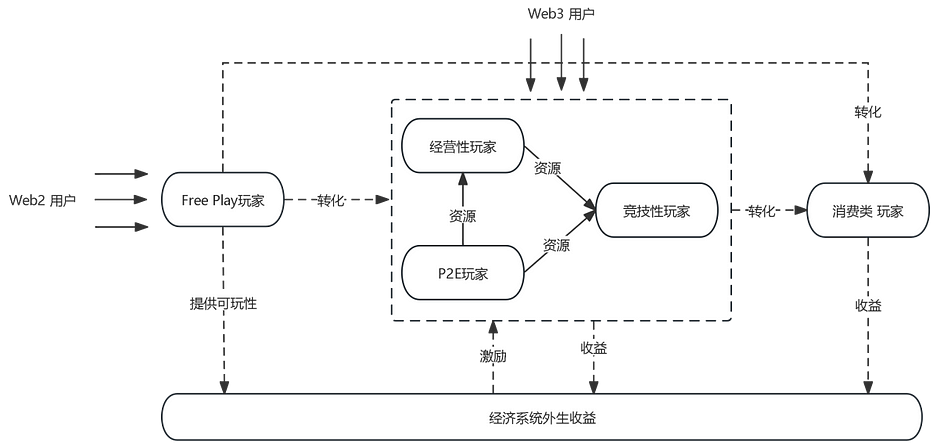
Based on this in-game economy, several types of participants emerge:
(1) P2E Players
Players who earn crates and tokens through gameplay. These players typically focus on maximizing returns and efficiency, acting as both demanders and suppliers of in-game assets.
(2) Competitive Players
Players aiming for higher rankings and tournament placements to obtain high-value rewards. They prioritize skill and performance and represent the primary consumers and demanders of in-game assets.
(3) Entrepreneurial Players
Players who buy, produce, and resell in-game assets for profit, serving as the primary suppliers of in-game assets.
(4) Free-to-Play / Casual Players
MATR1X FIRE offers free gameplay, but users without an Avatar NFT cannot receive any on-chain assets.
3. How to Avoid a Death Spiral?
When discussing P2E, many people naturally associate it with Ponzi schemes and death spirals. This unfair Web3 narrative has repeated itself multiple times over the past few years: poorly made games attract users virally, continuously drawing in new participants through asset cycles and wealth effects—until the entire structure collapses.
Therefore, we begin with a fundamental premise: a good Web3 game must first be a good game; otherwise, discussions about economic models or avoiding death spirals are meaningless. As we pointed out in “Why Are We Investing in Matr1x?”, Matr1x Fire stands out competitively even within the Web2 landscape in terms of visuals, gameplay, and overall quality, capable of attracting a significant player base in the shooter genre. A survey by Folius Ventures also shows that over half of users believe Matr1x Fire offers better gameplay than mobile competitors such as CrossFire, PUBG, and CoD.
Under this premise, the economic model helps Matr1x attract a broader market and build a sustainable economic loop.
(1) A Large Asset Sink
Lack of asset diversity and excessive focus on productive assets have been persistent issues in many X2E models. In pure gold-farming models, all assets experience continuous inflation, making “holding” an ineffective strategy. Users are forced to constantly maximize capital efficiency.
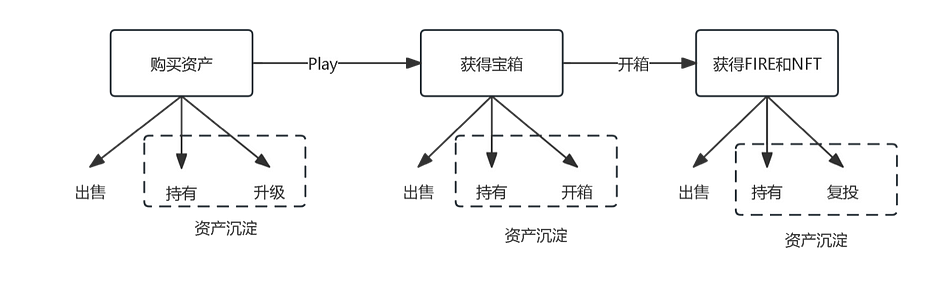
Matr1x introduces a wide variety of NFT assets with different functionalities, and earning is not linearly tied to productive assets. From a user’s perspective: after acquiring basic productive assets through some means, they play the game and earn crates, which must then be opened to obtain FIRE and NFTs.
At each stage, participants face three options. Due to the scarcity of certain assets, these choices are genuinely meaningful, leading to player differentiation and retention. These assets act as a sink, allowing Matr1x to benefit from growth driven by incentives without converting all economic output into sell pressure.
(2) Balancing Speculation and Real Demand
From the in-game economy perspective, Matr1x Fire exhibits significantly lower speculative characteristics compared to other Web3 games. On one hand, certain Matr1x Fire assets are non-productive—such as weapon skins, which function more like collectibles. It is foreseeable that the diversification among gold farmers, competitive players, entrepreneurs, and collectors will prevent Matr1x from being purely speculation-driven from the outset. Backed by strong gameplay, esports integration, and fan economy strategies, real player spending and protocol revenue will steadily increase, achieving long-term balance and sustainability.
On the other hand, the in-game economy primarily consumes FIRE and USDC, while participation in the governance token MAX is minimal. This design ensures that player count and activity scale affect FIRE, but pure “self-exploitation” or “player-versus-player draining” does not drive value capture for MAX. Additionally, the team and investors hold minimal shares in FIRE, meaning they do not benefit from Ponzi-like growth. This incentivizes the team to faithfully execute the roadmap and ultimately benefit from genuine long-term growth.
(3) Expandable Boundaries
Even if, in the long term, Web2 breakout success and growing protocol revenue are likely, the project may still face decline before reaching critical inflection points. The solution lies in offering sustainable expectations.
Matr1x’s plans in this regard include several key aspects:
(1) The complexity of Matr1x Fire’s gameplay and assets enables longer-lasting, sustainable engagement
(2) An NFT marketplace, DEX, and wallet provide additional value capture mechanisms
(3) Development of future games
Join TechFlow official community to stay tuned
Telegram:https://t.me/TechFlowDaily
X (Twitter):https://x.com/TechFlowPost
X (Twitter) EN:https://x.com/BlockFlow_News
 ABCDE
ABCDE