Firsthand Account: What Pitfalls Has the Web3 Content Publishing Platform Mirror Encountered Over the Past Two Years?
TechFlow Selected TechFlow Selected
Firsthand Account: What Pitfalls Has the Web3 Content Publishing Platform Mirror Encountered Over the Past Two Years?
Despite its ups and downs, Mirror remains the strongest contender in the content publishing platform space—thanks entirely to its peers.
 Navigating Web3 tides with focused insights
Over the past two years, the content publishing platform Mirror has constantly wavered in its strategic direction: debates over curation models, product vs. protocol, and missteps pursuing mass adoption.
With co-founder Graeme Boy exiting in November 2022 and Rafa (DAO leader) officially departing in January 2023, internal conflicts within Mirror's core team regarding product direction have come to an end.
In the first half of 2022, numerous big tech companies and startup teams reached out to me wanting to build competitors to Mirror. Unfortunately, not a single one succeeded. Despite Mirror’s turbulent journey, it remains the strongest player in this niche space—largely thanks to the lack of competition.
Recently, I discussed various pitfalls Mirror has encountered during a workshop at the Lensfans hackathon. Many friends showed interest and DM’d me afterward. So here’s a compiled reflection based on my firsthand experience participating in Mirror.
1. The Curation Model Debate
Earlier internal research at Mirror evaluated several potential directions:
-
Recommendation algorithms;
-
Professional curation teams;
-
Mirror DAO-led curation;
-
Open Web3-wide voting for curation by all users.
At launch in early 2021, Mirror adopted $WRITE Race as its initial curation mechanism—essentially option 4 (open Web3 voting). In August 2021, participants in the voting were airdropped $WRITE tokens. By October, however, the $WRITE Race voting was terminated.
The main reasons for ending $WRITE Race were:
-
Serious issues with vote-buying and Sybil attacks;
-
Due to U.S. compliance concerns, the Mirror team consistently avoided engaging with the tokenomics of $WRITE. Yet incentivizing participation in voting inherently required leveraging $WRITE.
By the end of 2021, Mirror shifted to option 3—curation led by Mirror DAO—with strong support from co-founder Graeme Boy, while Rafa founded Mirror DAO to lead the effort. After a six-month trial, results were underwhelming. The hundreds of prominent members within Mirror DAO simply didn’t have time to participate in voting. Ultimately, curation reverted back to a small circle of insiders—effectively regressing into option 2 (professional curation teams).
In 2022, co-founders Graeme Boy and Denis Nazarov developed clear disagreements over the curation strategy.
For example, on the day writing NFTs were officially launched, Denis Nazarov tweeted an introduction. I replied, suggesting that “with writing NFTs, we could finally restart voting-based curation on Twitter.” Denis liked my reply, but Graeme Boy objected. Both engaged in multiple exchanges beneath the tweet, later deleting their comments.
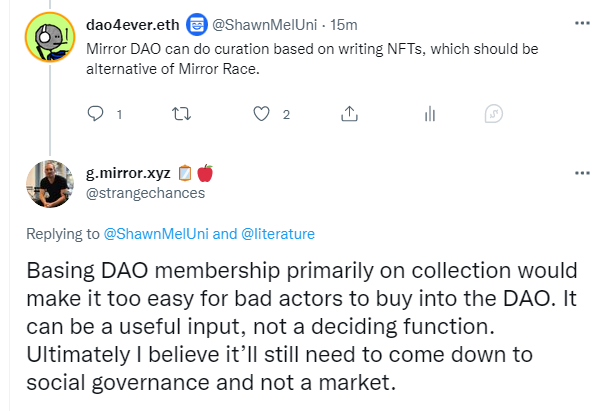
Following Graeme Boy’s departure, Denis Nazarov continued pushing writing NFTs forward, establishing them as Mirror’s primary curation method.
2. Product or Protocol?
Under Graeme Boy’s leadership, Mirror’s development team insisted on building only a protocol—not a product—and ideally leaving the frontend to third-party ecosystem developers. The Mirror frontend became notoriously poor: basic features were missing or riddled with obvious bugs, yet the team often took months to fix them. While users complained about the user experience, the dev team—among the earliest supporters of OP Layer2—enthusiastically launched various experimental NFT side projects, which eventually evolved into today’s writing NFTs.
Patrick, a key developer at Mirror, wrote an article titled “Thoughts on DAO Tooling,” arguing that successful DAO tools ultimately become protocols—a piece that sparked considerable debate. After the controversy, Patrick also left Mirror.
Building a protocol requires a thriving ecosystem. However, developers contributing to the Mirror ecosystem received no compensation—many even self-funded server costs—while Mirror collected a 2.5% on-chain fee. The Mirror DAO treasury accumulated nearly a million dollars (from the 2.5% revenue generated by Mirror’s product), originally intended in part to subsidize ecosystem developers. Yet, no payments were ever made. When I asked Rafa if this was due to U.S. compliance concerns (since the funds counted as revenue for a U.S. company), he did not deny it.
Today, under Denis Nazarov’s leadership, Mirror appears to be shifting focus back toward product development.
3. The Mass Adoption Pitfall
At the end of 2021, Mirror hired Veronica Saron, former Marketing Leader at Pokémon (Pokémon Go), to build a team aimed at helping Mirror break into the mainstream and pursue mass adoption.
Veronica Saron eventually left quietly. I was involved in this initiative and can attest—it was a bloody mess. Mirror neither solved high barriers like wallet onboarding, nor offered financial incentives competitive with Substack or Medium, and its editor and UX remained deeply unintuitive. Beyond native Web3 users, who would actually use this?
Crucially, throughout 2022, Mirror failed to allocate resources to address these fundamental issues. Mass adoption cannot be achieved through marketing spend alone.
4. The Core Team’s Persistent Avoidance of Tokenomics
The Mirror core team has been extremely cautious about U.S. compliance issues. There has been extensive discussion and conflict around this topic, which I won’t go into detail here.
On April 3, 2022, I published an article titled “Thoughts on Mirror DAO,” outlining the above challenges along with proposed solutions, and shared it with Rafa. At the time, the Mirror core team had gathered from around the world for a closed-door meeting in New York—Rafa even traveled from Germany despite pandemic risks. That same day, Rafa approached me and asked whether I’d be willing to present this article at the private team meeting, as these were exactly the issues they were debating.
As someone who has run multiple startups, I deeply understand how difficult entrepreneurship is—especially in Web3, where idealism constantly clashes with reality. Regarding Mirror’s strategic choices, I personally support Denis Nazarov. At the same time, I respect the departed Graeme Boy and Rafa—they are both pure idealists.
Join TechFlow official community to stay tuned
Telegram:https://t.me/TechFlowDaily
X (Twitter):https://x.com/TechFlowPost
X (Twitter) EN:https://x.com/BlockFlow_News
 @ShawnMelUni