Breaking the Walls: A Transformative Moment for Web3 Developers
TechFlow Selected TechFlow Selected
Breaking the Walls: A Transformative Moment for Web3 Developers
Save Your Margin!
 Navigating Web3 tides with focused insights
On February 28, 2023 at ETHDenver, a giant inflatable bubble labeled "Save Your Margin!" drew significant attention. Filled with stacks of U.S. dollars and surrounded by symbolic graffiti, the installation delivered a powerful visual impact to developers on site. This exhibit was designed by Mirror World, an all-in-one development platform, with support from developer communities including Gitcoin, Lens Protocol, and RSS3—demonstrating their shared vision of reclaiming fair revenue for developers and returning rightful earnings back to those who create value.
In fact, the issue of disappearing income refers directly to the heavy platform fees imposed on developers’ in-app revenues. The revenue-sharing model within walled gardens has persisted for over a decade. While platforms like the App Store have slightly adjusted their commission rates, one must question whether these ratios remain fair in today’s ecosystem—where third-party developers are now the primary creators of app content. Moreover, as Blockchain technology introduces new paradigms, user awareness of asset ownership grows stronger, and purchasing behaviors evolve, can existing platforms truly accommodate such innovation? These questions demand urgent reevaluation.

With the maturation of Blockchain technology and the emergence of more platforms that lower Web3 development barriers and improve user onboarding—such as Mirror World’s Smart Platform—mass adoption of Blockchain is becoming increasingly feasible. More importantly, integrating Blockchain with mobile applications can further accelerate this transformation. Mobile devices enjoy unparalleled advantages globally in terms of penetration, commercialization, and content distribution maturity compared to other application platforms. Users can easily download and experience mobile apps instantly. However, it must be acknowledged that Blockchain still faces major challenges in mobile adoption, primarily due to app distribution gatekeepers—Apple Store and Google Play—that control release rules and take substantial cuts from developers’ in-app revenues.
Take Apple as an example: it charges a 30% commission on all digital goods and services sold through the App Store and mandates the use of its in-app payment system, leaving developers no way to avoid these fees.
Consider this data: when the App Store launched in 2008, it offered around 500 apps for iPhone and iPod Touch. By 2021, the number of apps had grown to nearly 2 million—with approximately 99.99% developed by third parties. As the App Store ecosystem matured, Apple ceased being the main content provider; instead, third-party developers became the backbone of both content creation and revenue generation.
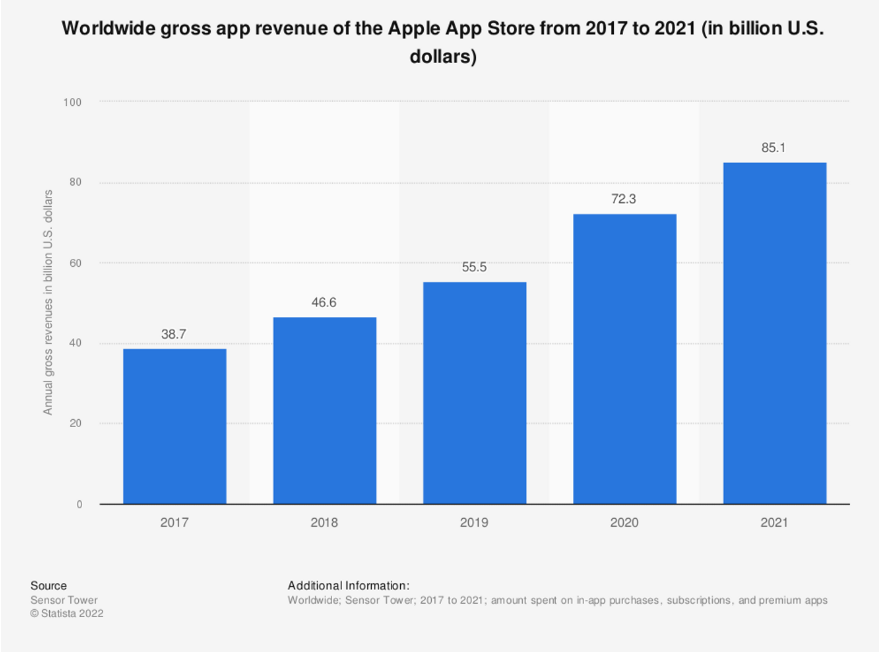
Furthermore, even the revenue developers receive must be heavily reinvested into advertising and marketing to acquire users and drive conversions—much of which flows right back into Apple’s own ecosystem. Thus, despite creating the core value and enabling millions to enjoy high-quality games, social experiences, music, and more, developers see most of their profits siphoned off by the platform.
It must be noted that even large companies like Epic are forced to pay massive commissions to Apple. According to a Washington Post report, between January 2017 and October 2020, Epic paid Apple $237 million in commissions for Fortnite alone. While giants like Epic can fight back legally against unfair policies, smaller studios often have no choice but to comply—even if they disagree—due to their lack of leverage.
The rise of cryptocurrency has begun loosening the bricks in this seemingly solid wall. Globally, most crypto users can now seamlessly purchase virtual assets across borders without intermediaries, using consensus-based value—and, in a meaningful sense, truly own those assets. Due to Blockchain’s inherent resistance to censorship, its protocol-level transaction capabilities allow it to bypass Apple’s commissions entirely. Sensing this disruption, Apple has responded by introducing new policies restricting NFT transactions: third-party payment tools are banned, and only Apple’s in-app purchase system is permitted—otherwise apps face removal or account suspension.
Through these actions, Apple seems to constantly declare itself as the true ruler of the internet era—controlling the gateway to app distribution and unilaterally dictating the direction of innovation. But protecting its own interests in this way ultimately suffocates real innovation, crushing the very applications that could thrive in a freer environment.
Mirror World’s Smart Platform aims to help all developers defend against this imbalance, empowering them to better utilize and integrate Blockchain technology to accelerate application innovation. With Mirror World’s Smart Platform, developers can rapidly build cross-platform (Mobile & PC) Blockchain applications. By assigning value to digital assets and leveraging Blockchain’s interoperability and liquidity, developers can reclaim their rightful revenue, reinvest in their core communities, and continue challenging dominant platforms on this long journey forward.
Gathered around the bubble are idealistic developers—warriors determined to break through the walls, true disruptors. Looking up at this translucent dome, it becomes clear that it’s not as solid as it appears. All attempts to suppress innovation will eventually fade into history as illusions. All that remains is for the disruptors to deliver their decisive blow.
Reference
Join TechFlow official community to stay tuned
Telegram:https://t.me/TechFlowDaily
X (Twitter):https://x.com/TechFlowPost
X (Twitter) EN:https://x.com/BlockFlow_News
 @joinmirrorworld