Overview of Autonomous Worlds: Are Bitcoin and Ethereum AW?
TechFlow Selected TechFlow Selected
Overview of Autonomous Worlds: Are Bitcoin and Ethereum AW?
The debate between broad and narrow definitions.
 Navigating Web3 tides with focused insights
Written by: syora
Translated by: MetaCat
I attended token2049 and participated in a roundtable discussion. To my surprise, even top-tier builders lacked a clear definition of Autonomous Worlds (AW). Yet, those within the core circle—including myself—seem to share a common vision. What is this shared dream? Let's reflect deeply, starting with the concept of Autonomous Worlds introduced by 0xPARC:
"An autonomous world has strict narrative boundaries, formal onboarding rules, and does not require privileged individuals to sustain its vitality."
In reality, this describes its essence rather than defining it—and now it seems to have evolved into something else.
Let me be clear from the outset: this article does not provide a definition of Autonomous Worlds. The purpose here is to offer talking points when considering what an Autonomous World truly is. Specifically, I explore personal perspectives on "Autonomous Worlds," conduct a recognition survey on related projects, and discuss what AW means from its fundamental nature.
Through this piece, I hope to clarify diverse viewpoints, spark discussion, and offer both current and aspiring builders an opportunity to deepen their understanding of Autonomous Worlds. If that happens, the author’s goal will have been achieved.
The structure of this article is as follows:
-
First, I will explain the research methodology and present the results.
-
Next, I will review findings regarding the definition of Fully On-Chain Games (FOCG), since AW originated from FOCG.
-
Then, I will discuss the research findings on the definition of AW—the main topic—which surprisingly reveals significant disagreement.
-
Following that, I will list potential characteristics that could serve as foundations for discussion and examine the definition of AW through these lenses.
-
Finally, I will summarize and discuss future directions.
Research Methodology
My literature review incorporated key blog posts such as those from 0xPARC and guiltygyoza. Ultimately, I summarized referenced articles. While I aimed to include perspectives from all reviewed blogs, some interpretations may remain subjective. In this sense, any criticism of this article is welcome.
For insights from the core community, I conducted a survey within a closed Telegram group composed exclusively of core AW builders. Within this group, I asked not only for definitions of AW but also whether specific projects should be considered AW and why. This helped gauge builders’ perceptions of AW.
In total, I synthesized input from over 20 individuals to complete this article.
Results
First, let’s examine the survey results. I polled builders, and while the number of respondents was only 11, they were all deeply engaged in AW development, so the sample should suffice to capture general trends.
To the question, “Do you think there are currently representative AW projects?” the responses were as follows:
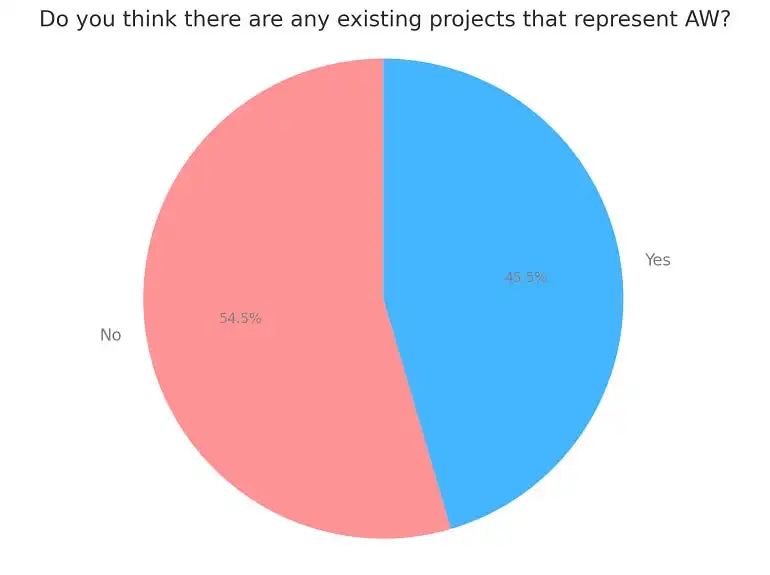
Approximately 45% of respondents believe representative AW projects already exist.
Next, I asked respondents whether they considered several major projects to be AWs:
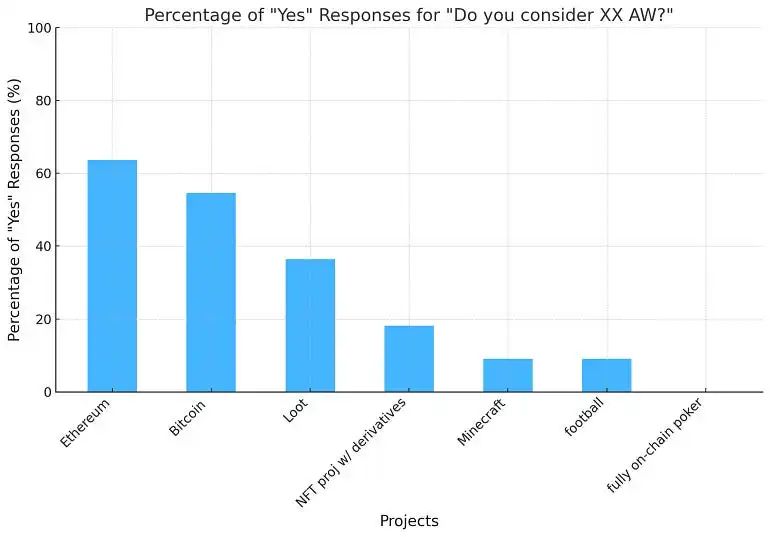
As shown in the chart, Ethereum is seen as closest to an AW. Interestingly, Fully On-Chain Poker—a project widely recognized as a FOCG—is considered an AW by the smallest proportion. Moreover, although about 45% answered “yes” to the first question, over 60% consider Ethereum to be an AW.
These results are indeed intriguing. Why such discrepancies? I believe two reasons: first, the definition of AW varies significantly among individuals; second, there may be no self-evident, fully realized AW yet.
To delve deeper into these issues, I’d like to first revisit the definition of FOCG.
Definition of FOCG
The definition of FOCG? That’s easy! It’s a game where everything runs on-chain, right? You might think so, but that’s not entirely accurate. In fact, at minimum, the frontend doesn’t need to run on-chain.
The commonly agreed-upon basics are:
- Logic/rules are on-chain
- State is on-chain
Points open to debate include:
- Must logic run on-chain, or is on-chain verifiability sufficient?
- Should concepts like “autonomous world” be included?
The first point clearly requires discussion, but the second needs clarification. When asked about the definition of FOCG, some mentioned the following requirements:
- It must persist/update and maintain security without developer maintenance
- Blockchain ensures data reliability and persistence without reliance on clients
- It aims for permissionless composability and interoperability, enabling full ownership, etc.
You can find these ideas discussed in articles such as “The Strongest Crypto Game Paper,” guiltygyoza’s “Game 2.0,” and “Infinite Game.” All these discussions center on “games,” not “worlds,” making it crucial whether these criteria are considered part of the FOCG definition.
Specifically, the following question clarifies your stance:
Should a simple fully on-chain poker game be considered a FOCG?
If yes, then you only require that logic and state reside on-chain. If not, you hold a higher bar—requiring the game to be crypto-native.
Defining AW: Are Bitcoin and Ethereum AWs?
Some argue FOCG and AW are identical concepts.
As noted above, if FOCG is required to be fully crypto-native, it closely approaches the concept of AW. But even then, it’s not quite the same.
I recognize a key distinction between FOCG and AW: whether it constitutes a “world”.
Due to the connotations of the term, FOCG remains a game, whereas AW implies a broader “world.” Additionally, whether it is session-based appears to be a strong criterion many use to distinguish FOCG from AW.
Moreover, most respondents emphasized “scalability” and “composability” as next-level elements. These may relate more to desirable attributes than strict definitions, but many see them as intrinsic values of AW.
To clarify your view on “whether this is an AW and its scalability/composability,” consider the following:
Is Bitcoin an AW?
Bitcoin is certainly crypto-native, but whether it qualifies as a “world” is debatable. Furthermore, due to its design prioritizing simplicity, it lags in scalability and composability compared to other projects. Those who consider these features essential to AW may not classify Bitcoin as one.
Another useful starting point for discussion:
Is Ethereum an AW?
Unlike Bitcoin, Ethereum offers strong scalability and composability. However, some argue it lacks a coherent “world” concept. Others say its world boundaries are blurred, while some cite the lack of a sustainable funding model for its scalability. Among surveyed projects, Ethereum comes closest to being an AW. Hence, discussions based on this premise should be encouraged.
Considering AW Through Its Characteristics
While thinking in terms of projects is helpful, discussing characteristics is equally valuable. Based on the survey, the key characteristics attributed to AW fall into three layers:
Inherent properties enabled by blockchain:
- Censorship resistance
- Decentralization
- Immutability
- Perpetuity
- Verifiability
- Ownership
- Transparency
Features actively enabled by blockchain technology:
- Autonomy
- Composability
- Interoperability
- Permissionlessness
Unique attributes of Autonomous Worlds:
- Worldness
Although not explicitly listed, one might also consider “world boundaries” as a feature. However, as discussed by BlockScience (https://medium.com/block-science/disambiguating-autonomy-ca84ac87a0bf), this can also be interpreted as part of autonomy and worldness.
Broad vs. Narrow AW
One reason discussions around AW are complex is that different people expect different things from AW.
Some emphasize certain features and label something as AW if those are met. Others insist all features must be satisfied for it to qualify as AW.
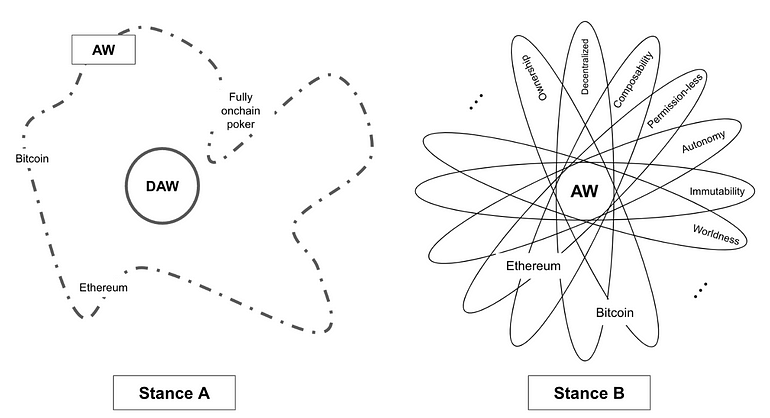
Furthermore, some acknowledge both positions, distinguishing between broad and narrow definitions of AW. We need to align our understanding here.
-
Position A: This view holds a broad scope for AW. In many cases, Ethereum would qualify as an AW. This stance faces two challenges. First, with such a wide scope, reaching consensus on core AW features becomes difficult. One solution might be to treat AW as a philosophical concept without strict boundaries. Second, a narrow definition of AW would require a distinct name. Inspired by DAOs and believing true decentralization aligns with narrow AW criteria, I propose the term “Decentralized Autonomous World (DAW).”
-
Position B: This position recognizes only the narrow definition as AW. Just as there's no debate over whether Bitcoin is a blockchain, under this view, only universally accepted AWs count—implying AW may not yet exist. In this case, “DAW” becomes redundant, yet it becomes curious how freely people claim their projects are AWs.
I welcome both positions.
However, given frequent misalignments in discussions about “autonomous worlds,” I hope we can move toward greater consensus.
Future Work
To reiterate, this article does not aim to define AW but to organize discussion points.
Also, I intentionally avoided deep dives into each characteristic mentioned. Discussing each in depth might take ten articles, and determining whether a feature is fulfilled often involves gray areas. For example, while decentralization is critical, I haven’t seen sequencer-level discussions in the context of AW. Discussions on decentralized operations seem lacking. Moreover, debates on “autonomy” and “worldness” will be especially important.
Another area for future work is exploring how to reconcile seemingly conflicting features—especially immutability and permissionless composability. The concept of immutability, in particular, may pose various challenges.
Additionally, considering the narrow definition of AW (for convenience, called DAW), examining technical pathways to fulfill all requirements would be beneficial.
Why don’t DAWs exist today? Is it due to technological limitations? If so, what are they? Could speed or latency become barriers to satisfying all the above traits? Indeed, it’s often more productive to consider technical constraints after clearly defining the goal.
Conclusion
In this article, through literature review and surveys, I investigated perceptions and definitions related to FOCG/AW. Surprisingly, even the definition of FOCG is ambiguous, and it’s evident that AW has two interpretations: broad and narrow. Whether we call the broad version AW and the narrow version DAW, or reserve AW only for the narrow definition, I hope consensus can form soon.
Join TechFlow official community to stay tuned
Telegram:https://t.me/TechFlowDaily
X (Twitter):https://x.com/TechFlowPost
X (Twitter) EN:https://x.com/BlockFlow_News
 @0xsyora