








China's Crackdown on Cryptocurrency Enables International Miners to Profit Handsomely
TechFlow Selected TechFlow Selected
China's Crackdown on Cryptocurrency Enables International Miners to Profit Handsomely
"Currently, the profitability of Bitcoin mining is extremely high—so high that even using the oldest, least efficient machines can still generate profits."
 Navigating Web3 tides with focused insights
By Eva Szalay, Financial Times
Translation: TechFlow
China's de facto ban on energy-intensive bitcoin mining has benefited international "miners," who are reaping increasingly high profits by filling the vacuum left by former Chinese competitors in the creation of digital tokens.
In June, crackdowns began in several major bitcoin-producing provinces in China, targeting computer operations used for cryptocurrency mining—a move that forms part of Beijing’s broader efforts to reduce carbon emissions and curb private cryptocurrencies while it develops its own official digital currency.
China had long been the world’s largest producer of bitcoin, accounting for about half of global output. Miners elsewhere say the cooling of bitcoin activity in China has opened up market opportunities for other competitors.
"If you think of daily global bitcoin production as a pie, with the size of the pie remaining constant, every existing miner now gets a bigger slice," said Shane Downey, chief financial officer at Hut 8 Mining, a Toronto-based publicly traded company.
Bitcoin miners create new coins by using powerful computers to solve complex mathematical problems. Since the number of coins that can be produced each day is fixed, minting new coins becomes easier and cheaper when there are fewer competitors.
Improved economic conditions have prompted entrepreneurs around the world to launch new mining operations.
According to data website Blockchain.com, the total computing power globally dedicated to bitcoin mining initially halved after China’s ban but has since recovered to about 30% below May levels.
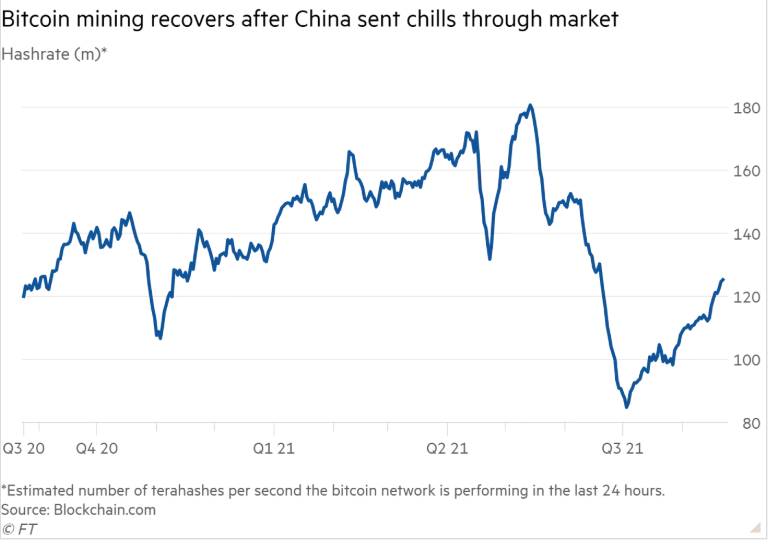
A bitcoin miner’s profitability depends on multiple factors, including the current market price of the coin, server operating costs, electricity prices, and mining speed per unit.
On Monday, bitcoin rebounded from a summer low of around $30,000 to $50,000—a shift that could further incentivize miners to ramp up operations.
Fiorenzo Manganiello, founder of Lian Group, a private equity firm that owns one of Europe’s largest renewable-powered bitcoin mining farms, said: “It’s as if our machine count has doubled.”
Hut 8 Mining has also benefited significantly. The company’s mining revenue in the second quarter surged 241% year-on-year, reaching 31.4 million Canadian dollars ($24.8 million).
The company’s CEO noted that the absence of Chinese miners in June and July proved highly lucrative, with mining profits reaching 19.3 million Canadian dollars—up sharply from 697,000 Canadian dollars during the same period last year.
“After China imposed its domestic mining ban, global output dropped by approximately 40% to 50%. Our mining output at Hut 8 then rose—we mined 40% to 50% more bitcoin without a direct increase in costs,” said Hut 8’s Downey.
UK-based mining company Argo Blockchain also reported an 180% increase in revenue during the first half of 2021, thanks to shifts in the global mining landscape that allowed it to produce more bitcoin without increasing machine usage. Its pre-tax profit during the period soared to 10.7 million pounds, compared to 523,074 pounds in the first half of 2020.
Sam Doctor, head of strategy at U.S. digital asset firm BitOoda, estimates it will take about 18 months for capacity to return to pre-ban levels. Replacing lost infrastructure requires time due to upgrades needed for power grids and facilities.
Chinese miners have attempted to relocate to neighboring countries such as Mongolia and Kazakhstan, but many have struggled to transport equipment across borders. Others remain concerned about local governments’ stances toward bitcoin mining.
Bitcoin mining carries significant environmental impacts. According to the Cambridge Bitcoin Electricity Consumption Index, bitcoin mining consumes 0.4% of the world’s electricity—more annually than Finland or Belgium. Chinese miners, who relied heavily on coal-powered energy, contributed disproportionately to this impact.
"Under current conditions, we believe cryptocurrencies still have a long way to go before meeting ESG criteria," said analysts at Candriam, a French asset management firm. ESG criteria refer to investment standards related to environmental, social, and governance issues.
Outside China, mining activities are gradually shifting toward regions rich in renewable energy, such as Norway and Canada. But with explosive demand growth, professional site operators find it difficult to build facilities quickly enough.
"Recovery of mining capacity will take about a year or longer," said Kjetil Hove Pettersen, CEO of Norwegian miner and data center operator Kryptovault. "Many new mining machines are now being shipped to the U.S. and Canada instead of China, but data center capacity remains a bottleneck."
In the U.S., Texas has become a major beneficiary of new mining ventures, while specialized mining farms in Norway and other European countries have suffered setbacks due to insufficient demand.
"People are calling us, begging us to take their machines. Some are even willing to pay us 50% of their future profits if we provide space for them in our data centers," said one operator.
Mining machines have also declined in both price and scarcity. Before China’s ban, miners had to spend heavily to acquire mining rigs for greater efficiency. Now, with idle machines piling up in China, prices have plummeted, eliminating what was once a high-cost barrier to entry.
"Bitcoin mining profitability is currently so high that even the oldest, least efficient machines can turn a profit," said Kryptovault’s Hove Pettersen.
Join TechFlow official community to stay tuned
Telegram:https://t.me/TechFlowDaily
X (Twitter):https://x.com/TechFlowPost
X (Twitter) EN:https://x.com/BlockFlow_News






